
The name "Asia Minor" is a kind of colonial flattening of an extraordinarily rich place.
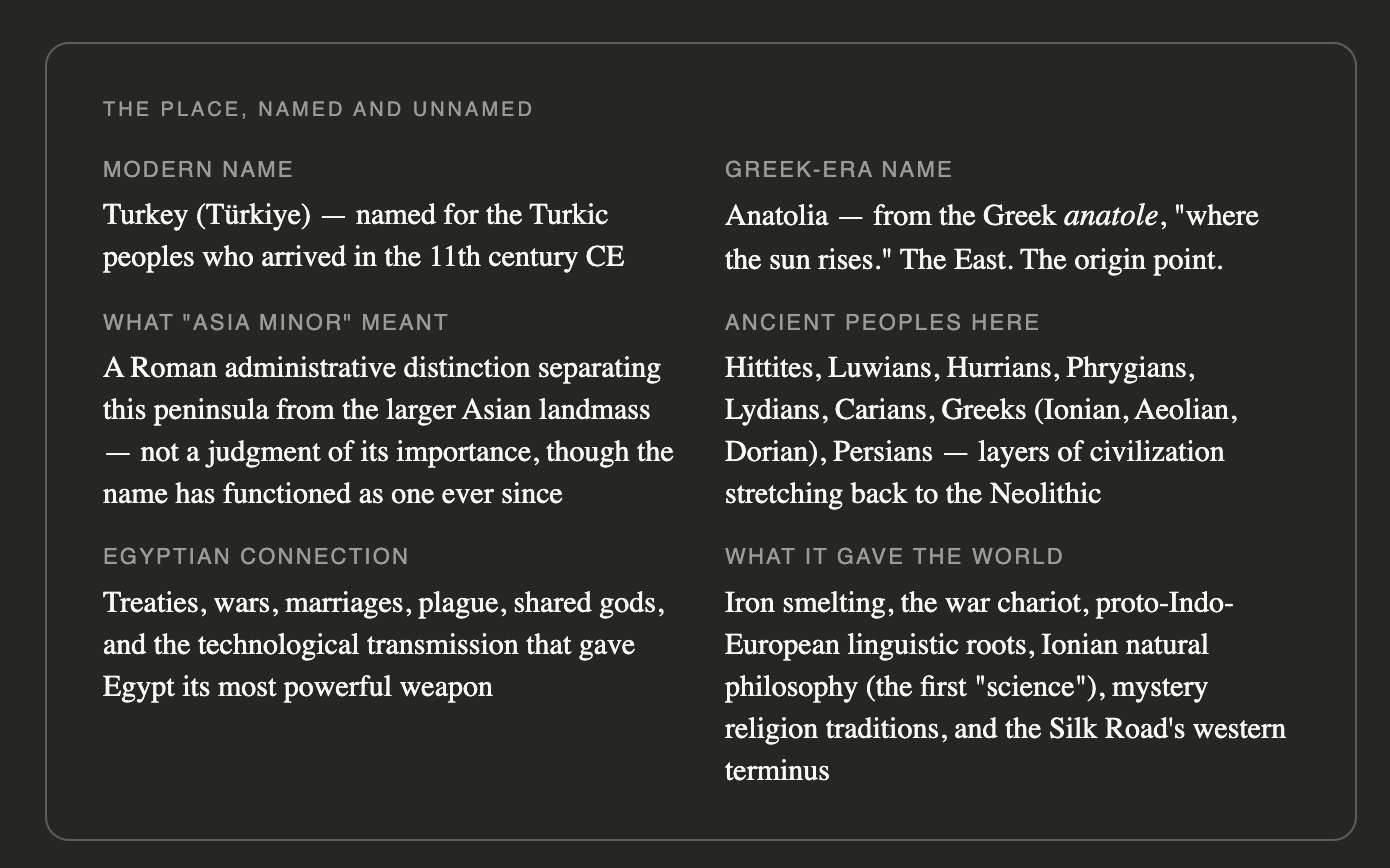
Asia Minor
The bridge that built the ancient world — and the chariot that crossed it
They called it "Minor." As in small. As in less than. Asia Minor — the little Asia, the lesser peninsula. That name tells you everything about who was doing the naming, and nothing at all about the place. What they were calling minor was the origin point of half of what the ancient world ran on: its war technology, its mathematical tradition, its goddess theology, its diplomatic framework, and the vehicle — the chariot — that changed the shape of every empire that ever tried to hold these lands.
The name "Turkey" postdates the place by several thousand years of recorded civilization. The Turkic peoples — Central Asian nomads who swept in during the Seljuk migrations of the 11th century CE — arrived to a peninsula that had already been, in sequence: the heartland of the Hittite Empire, the intellectual engine of early Greek philosophy, the Roman province of Asia, a Byzantine Christian stronghold, and a battleground between every major power in the ancient world. Calling it Turkey is like calling Rome "Italy" and leaving it at that.
The Greeks who settled its western coast in the Ionian city-states — Miletus, Ephesus, Halicarnassus — were not refugees from mainland Greece seeking empty land. They were colonizers of an already ancient civilization, building their theaters and agoras on top of Hittite and Luwian sacred sites. And it was in those Ionian cities that the first philosophers emerged: Thales, Anaximander, Anaximenes, Heraclitus — all from Anatolia, not Athens. The tradition we call Greek philosophy began on the western coast of what is now Turkey. The math, the astronomy, the speculation about what the world is made of — it did not come from Athens. Athens inherited it from the east.
"The tradition we call Greek philosophy began on the western coast of what is now Turkey. The math, the astronomy, the speculation about what the world is made of — Athens did not originate it. Athens inherited it from the east."
What this place was actually called, and what those names mean
Before the Romans flattened it into an administrative label, this peninsula went by names that described what it actually was. Anatolia — rising sun, the place of emergence. The Hittites called their empire Hatti, after the pre-Hittite Hattic people they absorbed when they arrived. Their capital, Hattusa, means something close to "the place of Hatti" — the city named for the people the conquerors consumed, a pattern that would repeat itself across every subsequent civilization in this region.
The Luwians — the people who spoke the language most closely related to proto-Indo-European, possibly the linguistic ancestors of half the world's language families — called the western coastal region Arzawa. The Egyptians wrote to the Arzawan kings in the Amarna letters as diplomatic equals. This was not a backwater. This was a correspondent.
Anatolia — where the sun risesHatti — land of the absorbedArzawa — the Luwian westAsia Minor — the Roman diminutiveTürkiye — arrived 11th century CE
The chariot was not a weapon first. It was a throne.
Before the chariot carried soldiers, it carried gods. This is not a metaphor. The oldest wheeled vehicles in the archaeological record — heavy, solid-wheeled wagons pulled by oxen in Mesopotamian Sumer, around 3000 BCE — were designed to transport divine statues during religious festivals. Specifically, during the Akitu New Year festival, the statue of Inanna was processed through the city on a cart. The city was performing the goddess's movement. The wheel was sacred before it was tactical.
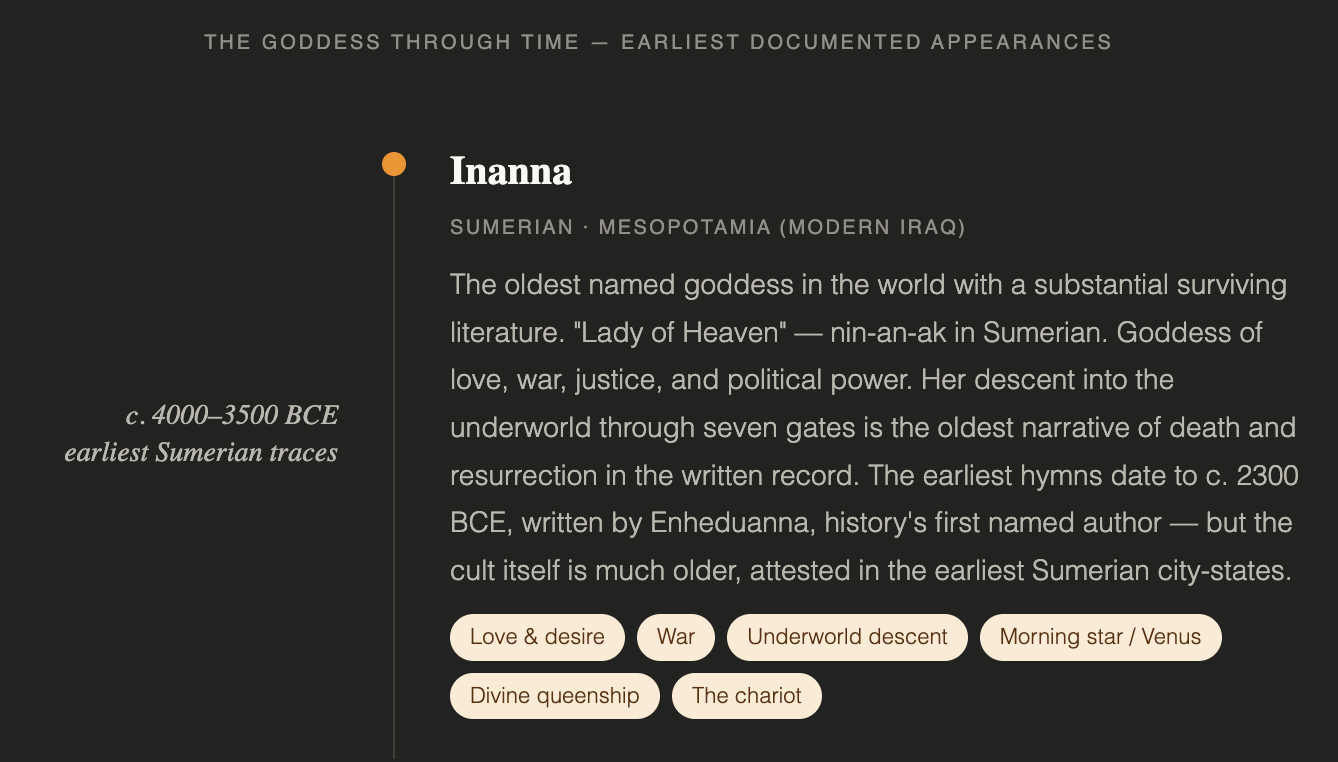
Inanna — Lady of Heaven, Queen of the Great Above and the Great Below — was a war goddess and a love goddess simultaneously, which in the ancient world was understood as the same thing. In the Sumerian hymns, she harnesses the Seven Storms to her chariot. The vehicle was hers conceptually before it was anyone else's militarily. When you track where the chariot goes next, you are also tracking where her worship travels.
The leap from heavy religious wagon to light military chariot happened somewhere in the arc between Mesopotamia and Anatolia, during the second millennium BCE. The innovation that made the difference was the spoked wheel — a radical weight reduction that turned the ox-wagon into something a horse could pull at speed. The Hurrians, who ruled the kingdom of Mitanni in what is now northern Syria and southeastern Turkey, are credited with perfecting this technology and with developing the specialized art of chariot horsemanship. A Mitanni text called the Kikkuli horse-training manual — considered one of the oldest systematic training documents in human history — was found in the Hittite archives at Hattusa.
The chariot transmission chain
𒀭 Sumer Heavy ox-wagon carries Inanna's statue in festival procession
→ ⚒ Anatolia / Mitanni Spoked wheel perfected; Hurrians develop horse-training science
→ ✦ Levant / Hyksos Semitic peoples carry the chariot and the goddess (Astarte) south
→ 𓂀 Egypt Hyksos invasion delivers chariot, horse, and Astarte to the Nile
The Hittites: lords of iron and masters of the three-man chariot
When the Hittites entered this story — arriving in Anatolia around 2000 BCE and building their empire at Hattusa in the central plateau — they inherited the chariot tradition and improved it in a way that changed the entire logic of ancient warfare. The Egyptian chariot was light, fast, and carried two men: a driver and an archer. It was designed to harass from a distance, release arrows, and retreat. A cavalry of mosquitoes.
The Hittite chariot was heavier, wider, and carried three men: driver, fighter, and shield-bearer. That third person — the shield-bearer — transformed the vehicle from a mobile archery platform into something closer to a tank. Protected on all sides, the Hittite chariot could crash directly into infantry formations and shatter them, rather than circling and stinging. The philosophical difference between these two chariots — the Egyptian preference for speed and distance versus the Hittite preference for mass and impact — reflects something deeper about how the two civilizations understood power.
The Hittites also held a monopoly that may have been even more important than the chariot: iron. While every other empire in the Bronze Age was arming its soldiers with swords that bent and dulled, Hittite elites carried iron weapons that could shatter bronze shields. They guarded the smelting technology as a state secret. The Iron Age, when it finally spread across the world, spread from this peninsula. Anatolia handed the ancient world both its most sophisticated wheeled weapon and the metal that made all weapons obsolete.
At Kadesh, 1274 BCE: Ramses II marched his army into one of history's most studied ambushes. The Hittite king Muwatalli II hid thousands of chariots behind the walls of the city. Ramses, fed false intelligence by Hittite double agents, advanced with his forces split. The Hittites erupted from concealment and nearly destroyed the Egyptian army. Ramses returned home and carved "victory" on every temple wall he could find. The Hittites kept the city. The peace treaty that followed — the Treaty of Kadesh, around 1259 BCE — is considered the oldest surviving international peace agreement. A copy of it hangs in the United Nations headquarters in New York. It was written, both sides, in Akkadian cuneiform — the shared diplomatic language of the ancient world, maintained through centuries of exchange between Anatolia and Egypt.
The Hyksos: the delivery system, and the goddess they brought
Egypt did not invent the chariot. Egypt did not even adopt it voluntarily. The chariot arrived in Egypt around 1650 BCE in the hands of the Hyksos — Western Semitic peoples, likely Canaanite or Amorite in origin, who took over northern Egypt and ruled it as the 15th Dynasty for about a century. The Egyptians called them Heka Khasut: "rulers of foreign lands." Before the Hyksos, Egypt had no horses. Before the Hyksos, Egypt had no chariots. Before the Hyksos, Egypt had no Astarte.
Place Spotlight · Sound-Led Research Series
Asia Minor
The bridge that built the ancient world — and the chariot that crossed it
They called it "Minor." As in small. As in less than. Asia Minor — the little Asia, the lesser peninsula. That name tells you everything about who was doing the naming, and nothing at all about the place. What they were calling minor was the origin point of half of what the ancient world ran on: its war technology, its mathematical tradition, its goddess theology, its diplomatic framework, and the vehicle — the chariot — that changed the shape of every empire that ever tried to hold these lands.
The place, named and unnamed
Modern name: Turkey (Türkiye) — named for the Turkic peoples who arrived in the 11th century CE
Greek-era name: Anatolia — from the Greek anatole, "where the sun rises." The East. The origin point.
What "Asia Minor" meant: A Roman administrative distinction separating this peninsula from the larger Asian landmass — not a judgment of its importance, though the name has functioned as one ever since
Ancient peoples here: Hittites, Luwians, Hurrians, Phrygians, Lydians, Carians, Greeks (Ionian, Aeolian, Dorian), Persians — layers of civilization stretching back to the Neolithic
Egyptian connection: Treaties, wars, marriages, plague, shared gods, and the technological transmission that gave Egypt its most powerful weapon
What it gave the world
Iron smelting, the war chariot, proto-Indo-European linguistic roots, Ionian natural philosophy (the first "science"), mystery religion traditions, and the Silk Road's western terminus
The name "Turkey" postdates the place by several thousand years of recorded civilization. The Turkic peoples — Central Asian nomads who swept in during the Seljuk migrations of the 11th century CE — arrived to a peninsula that had already been, in sequence: the heartland of the Hittite Empire, the intellectual engine of early Greek philosophy, the Roman province of Asia, a Byzantine Christian stronghold, and a battleground between every major power in the ancient world. Calling it Turkey is like calling Rome "Italy" and leaving it at that.
The Greeks who settled its western coast in the Ionian city-states — Miletus, Ephesus, Halicarnassus — were not refugees from mainland Greece seeking empty land. They were colonizers of an already ancient civilization, building their theaters and agoras on top of Hittite and Luwian sacred sites. And it was in those Ionian cities that the first philosophers emerged: Thales, Anaximander, Anaximenes, Heraclitus — all from Anatolia, not Athens. The tradition we call Greek philosophy began on the western coast of what is now Turkey. The math, the astronomy, the speculation about what the world is made of — it did not come from Athens. Athens inherited it from the east.
"The tradition we call Greek philosophy began on the western coast of what is now Turkey. The math, the astronomy, the speculation about what the world is made of — Athens did not originate it. Athens inherited it from the east."
What this place was actually called, and what those names mean
Before the Romans flattened it into an administrative label, this peninsula went by names that described what it actually was. Anatolia — rising sun, the place of emergence. The Hittites called their empire Hatti, after the pre-Hittite Hattic people they absorbed when they arrived. Their capital, Hattusa, means something close to "the place of Hatti" — the city named for the people the conquerors consumed, a pattern that would repeat itself across every subsequent civilization in this region.
The Luwians — the people who spoke the language most closely related to proto-Indo-European, possibly the linguistic ancestors of half the world's language families — called the western coastal region Arzawa. The Egyptians wrote to the Arzawan kings in the Amarna letters as diplomatic equals. This was not a backwater. This was a correspondent.
Anatolia — where the sun risesHatti — land of the absorbedArzawa — the Luwian westAsia Minor — the Roman diminutiveTürkiye — arrived 11th century CE
The chariot was not a weapon first. It was a throne.
Before the chariot carried soldiers, it carried gods. This is not a metaphor. The oldest wheeled vehicles in the archaeological record — heavy, solid-wheeled wagons pulled by oxen in Mesopotamian Sumer, around 3000 BCE — were designed to transport divine statues during religious festivals. Specifically, during the Akitu New Year festival, the statue of Inanna was processed through the city on a cart. The city was performing the goddess's movement. The wheel was sacred before it was tactical.
Inanna — Lady of Heaven, Queen of the Great Above and the Great Below — was a war goddess and a love goddess simultaneously, which in the ancient world was understood as the same thing. In the Sumerian hymns, she harnesses the Seven Storms to her chariot. The vehicle was hers conceptually before it was anyone else's militarily. When you track where the chariot goes next, you are also tracking where her worship travels.
The leap from heavy religious wagon to light military chariot happened somewhere in the arc between Mesopotamia and Anatolia, during the second millennium BCE. The innovation that made the difference was the spoked wheel — a radical weight reduction that turned the ox-wagon into something a horse could pull at speed. The Hurrians, who ruled the kingdom of Mitanni in what is now northern Syria and southeastern Turkey, are credited with perfecting this technology and with developing the specialized art of chariot horsemanship. A Mitanni text called the Kikkuli horse-training manual — considered one of the oldest systematic training documents in human history — was found in the Hittite archives at Hattusa.
The chariot transmission chain
𒀭 Sumer Heavy ox-wagon carries Inanna's statue in festival procession →
⚒ Anatolia / Mitanni Spoked wheel perfected; Hurrians develop horse-training science →
✦ Levant / Hyksos Semitic peoples carry the chariot and the goddess (Astarte) south →
𓂀 Egypt Hyksos invasion delivers chariot, horse, and Astarte to the Nile
The Hittites: lords of iron and masters of the three-man chariot
When the Hittites entered this story — arriving in Anatolia around 2000 BCE and building their empire at Hattusa in the central plateau — they inherited the chariot tradition and improved it in a way that changed the entire logic of ancient warfare. The Egyptian chariot was light, fast, and carried two men: a driver and an archer. It was designed to harass from a distance, release arrows, and retreat. A cavalry of mosquitoes.
The Hittite chariot was heavier, wider, and carried three men: driver, fighter, and shield-bearer. That third person — the shield-bearer — transformed the vehicle from a mobile archery platform into something closer to a tank. Protected on all sides, the Hittite chariot could crash directly into infantry formations and shatter them, rather than circling and stinging. The philosophical difference between these two chariots — the Egyptian preference for speed and distance versus the Hittite preference for mass and impact — reflects something deeper about how the two civilizations understood power.
The Hittites also held a monopoly that may have been even more important than the chariot: iron. While every other empire in the Bronze Age was arming its soldiers with swords that bent and dulled, Hittite elites carried iron weapons that could shatter bronze shields. They guarded the smelting technology as a state secret. The Iron Age, when it finally spread across the world, spread from this peninsula. Anatolia handed the ancient world both its most sophisticated wheeled weapon and the metal that made all weapons obsolete.
At Kadesh, 1274 BCE: Ramses II marched his army into one of history's most studied ambushes. The Hittite king Muwatalli II hid thousands of chariots behind the walls of the city. Ramses, fed false intelligence by Hittite double agents, advanced with his forces split. The Hittites erupted from concealment and nearly destroyed the Egyptian army. Ramses returned home and carved "victory" on every temple wall he could find. The Hittites kept the city. The peace treaty that followed — the Treaty of Kadesh, around 1259 BCE — is considered the oldest surviving international peace agreement. A copy of it hangs in the United Nations headquarters in New York. It was written, both sides, in Akkadian cuneiform — the shared diplomatic language of the ancient world, maintained through centuries of exchange between Anatolia and Egypt.
The Hyksos: the delivery system, and the goddess they brought
Egypt did not invent the chariot. Egypt did not even adopt it voluntarily. The chariot arrived in Egypt around 1650 BCE in the hands of the Hyksos — Western Semitic peoples, likely Canaanite or Amorite in origin, who took over northern Egypt and ruled it as the 15th Dynasty for about a century. The Egyptians called them Heka Khasut: "rulers of foreign lands." Before the Hyksos, Egypt had no horses. Before the Hyksos, Egypt had no chariots. Before the Hyksos, Egypt had no Astarte.
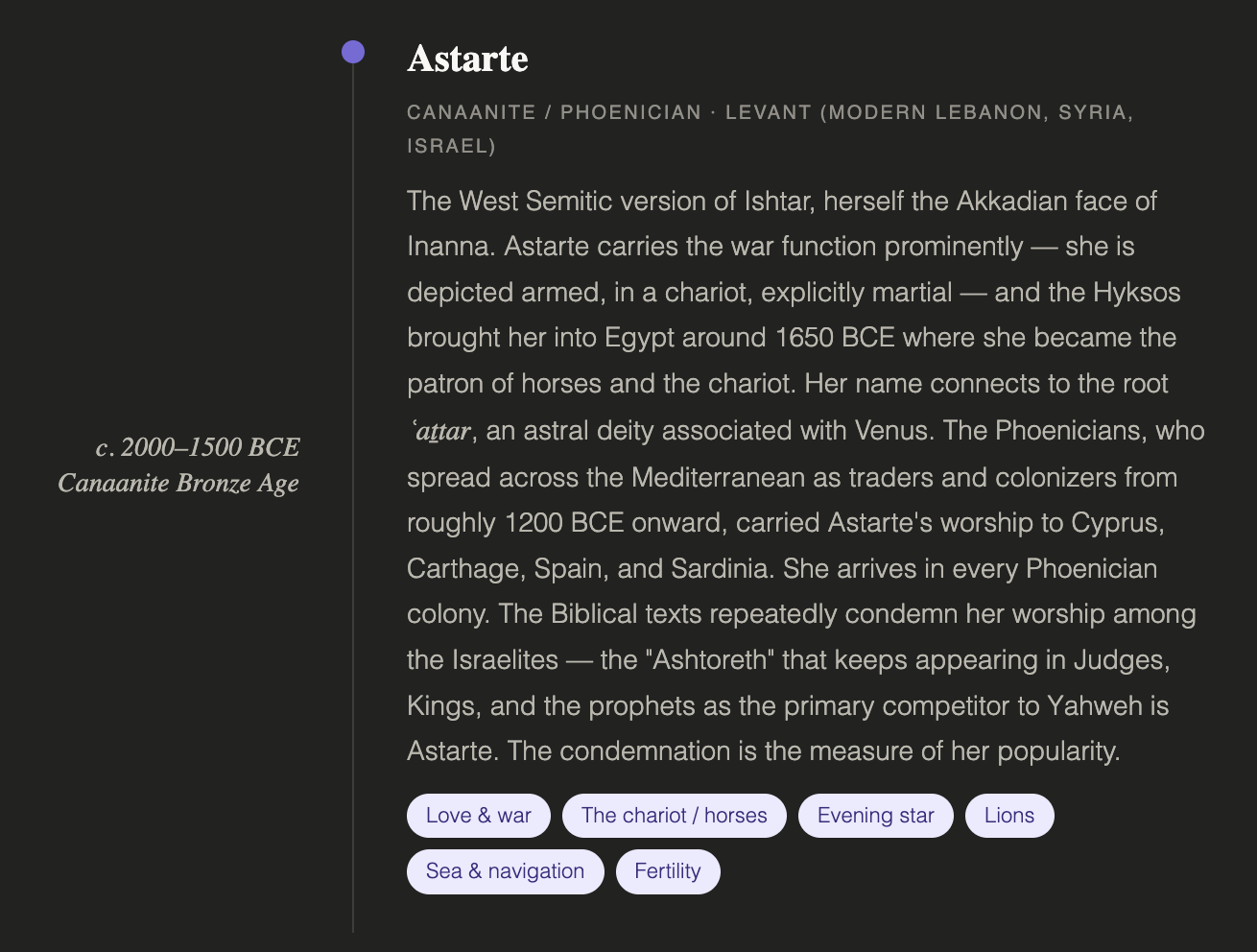
That last item is the one that tends to get dropped from the military history summaries. The Hyksos brought their goddess with them. Astarte — the Canaanite face of Inanna/Ishtar, the Semitic version of the same figure who had been riding her storm-chariot through Sumerian hymns for a thousand years — was introduced to the Egyptian pantheon during this period. In Egypt, she became explicitly the patron goddess of horses and the chariot. She is depicted in Egyptian art driving a chariot herself, armed, in full battle posture. The Egyptians received the vehicle and its divine owner together, as a package.
The word the Egyptians used for chariot — wrrt — is a loanword from a Semitic language. They bought the car and borrowed its name. This is not a small footnote. It is a record of a moment when a civilization received a technology so foreign to its existing vocabulary that it had to import the word alongside the object. Egypt had no native term for "chariot" because Egypt had no chariot until Anatolia, via the Levant, sent it one.
"Egypt had no native term for chariot because Egypt had no chariot until Anatolia sent it one. The word wrrt is a loanword — they bought the vehicle and borrowed its name in the same transaction."
Inanna becomes Ishtar becomes Astarte becomes Aphrodite becomes Venus
The goddess does not stay in one place. She travels with the technology. This is one of the clearest threads in the entire ancient world's religious history — the love-and-war goddess follows the trade routes, picks up new names, loses some attributes and gains others, and arrives in each new culture recognizable but transformed. Tracking her journey is essentially the same as tracking the chariot's journey, because for thousands of years they moved together.
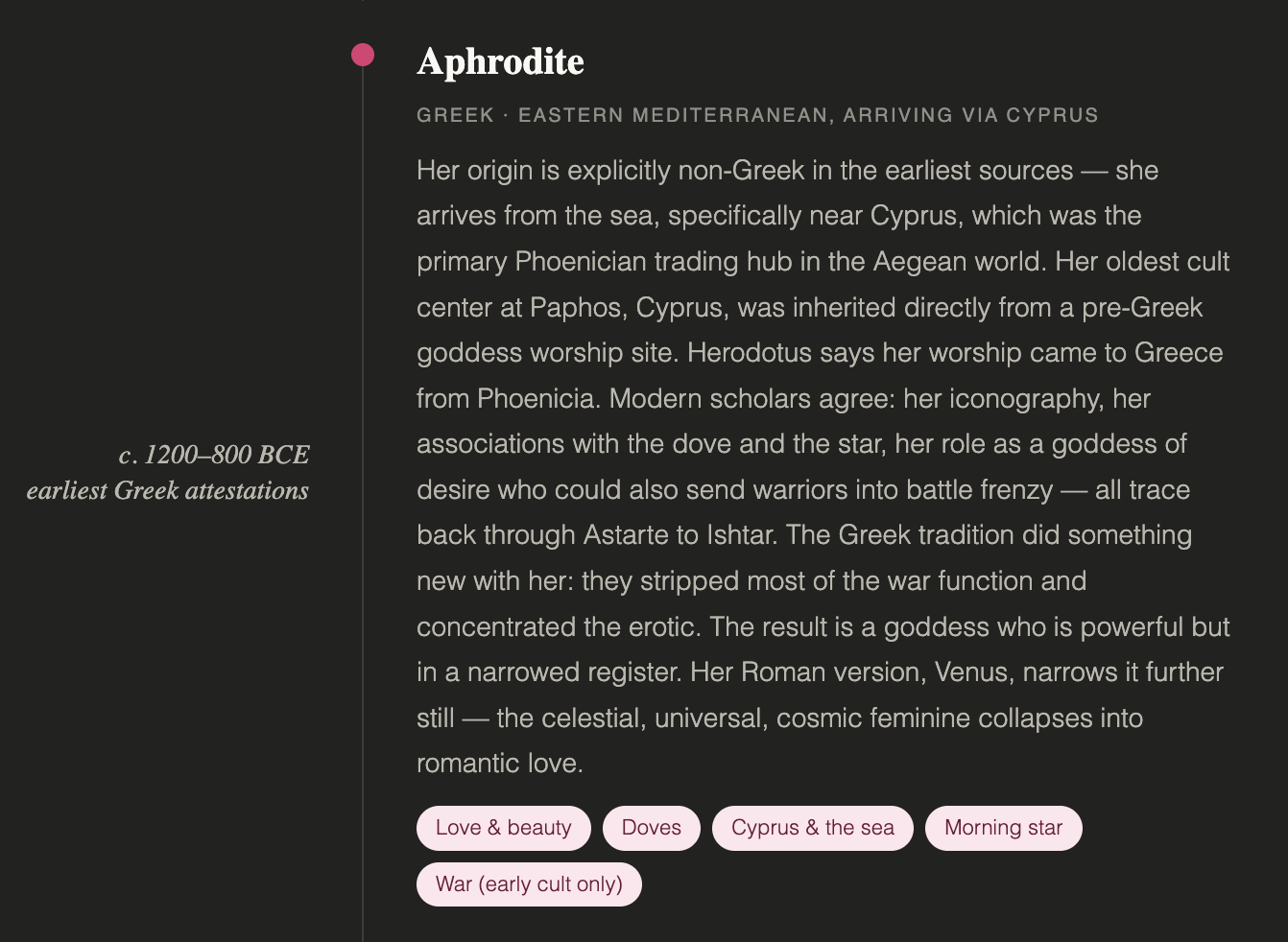
Inanna is Sumerian. Ishtar is Akkadian — the same figure, absorbed during Sargon the Great's empire-building in the 24th century BCE, her Sumerian poetry merged with Akkadian martial ferocity by the first known author in world history, Enheduanna, Sargon's daughter and high priestess. Astarte is the Canaanite-Phoenician version who traveled west with Levantine traders and colonizers. Aphrodite arrives in the Greek world carrying unmistakable traces of her eastern origins — born from the sea, arriving from Cyprus, associated with the morning star, the goddess of both love and warfare in her oldest Cyprian cult. Venus is the Roman adoption, by which point the war function has been mostly stripped away and she has been tidied into a deity of romantic love alone. That stripping is itself a story — the progressive domestication of the goddess as she moves west and north, away from the cultures that kept both her faces.
Anatolia is the fulcrum of this journey. The Hurrians of Mitanni had their own version of the goddess, Shaushka, explicitly identified with Ishtar and explicitly worshipped as a war divinity. The Hittites absorbed Shaushka into their thousand-god pantheon and carved her image at Yazılıkaya. When the Hyksos carried this tradition into Egypt, they carried a version of the goddess that had already passed through Anatolian hands — already hybrid, already carrying the chariot as her defining symbol.
Sound note: The progression Inanna → Ishtar → Astarte → Aphrodite tracks not just a religious tradition but a phonetic drift. The ASH/AST/APH root moving westward, softening as it travels. The IS- in Inanna and Ishtar connects to the same root I flagged in the Laodicea piece — a sacred syllable that keeps appearing in the names of places and figures associated with divine feminine power across the entire ancient Mediterranean world.
The "minor" place that tutored the world
The Ionian Greeks of the Anatolian coast — the ones who gave us the first natural philosophers, the first historians (Herodotus was from Halicarnassus, now Bodrum), the first systematic geography — were operating in a region already saturated with knowledge accumulated by the Hittites, the Hurrians, the Luwians, and the Phrygians before them. Thales of Miletus, who predicted a solar eclipse in 585 BCE and is often called the first scientist, had direct access to Babylonian astronomical records. The Babylonian tradition was itself heir to the Sumerian. The chain runs directly back through Anatolia.
Pythagoras — associated primarily with his theorem — was born on Samos, an island off the Anatolian coast. He later traveled to Egypt and spent years studying in its temples. The "Greek" mathematical tradition was in significant part an Anatolian-Egyptian synthesis, transmitted through people who moved between these worlds because the worlds were connected. The ancient Mediterranean was not a collection of isolated civilizations accidentally influencing each other. It was a network, and Anatolia was one of its most important nodes.
What the name "Asia Minor" erases is the directionality. The Roman administrators who coined the term needed to distinguish this peninsula from the larger Asian landmass. That is a logistical distinction. But the word "minor" carries a weight that logistics doesn't require. It implies secondary, derived, lesser. The archaeological and textual record suggests something closer to the opposite: a place so strategically, technologically, and theologically rich that every major power in the ancient world spent centuries trying to control it, marry into it, plague it into submission, and build their religious monuments on top of its older ones.
It is, perhaps, not an accident that the modern country named for a group of people who arrived here in the 11th century CE has one of the most devalued currencies in the world today. That devaluation is not a reflection of the place's poverty. It is a reflection of centuries of precisely what you'd expect for a region that has been fought over, colonized, converted, and renamed so many times that its own continuity of wealth and knowledge has been repeatedly interrupted.
The economic/geopolitical thread on why ancient knowledge centers become modern economic victims is actually a coherent historical argument.
So what happens to a place after it has been fought over long enough?
The mechanism: why the richest crossroads become the most economically precarious
The Turkish lira is, as of this writing, among the most depreciated major currencies in the world. A currency that traded near parity with the US dollar in the early 2000s now trades at many multiples of its former value in the other direction. Inflation has eroded savings, purchasing power, and institutional stability across multiple generations. This is not because Turkey is a poor country in any geological or agricultural sense — it sits on some of the most fertile land in the world, controls the Bosphorus strait, which is one of the most strategically significant waterways on the planet, and has a population of 85 million people. It is poor in the specific way that places get poor when they are perpetually targeted.
The pattern runs like this: a region of extreme strategic value — one that controls trade routes, holds rare resources, sits at the junction of continents — becomes a site of repeated conquest. Each conquest interrupts the accumulation of institutional wealth. The Hittite archives were burned when Hattusa fell, around 1180 BCE, during the general Bronze Age collapse that destroyed nearly every major civilization in the eastern Mediterranean simultaneously. The Ionian Greek cities were conquered by Persia, then liberated by Alexander, then absorbed into the Roman Empire, then inherited by Byzantium, then taken by the Seljuks, then reorganized under the Ottomans. Each transition represented not just a change of rulers but a disruption of whatever knowledge infrastructure, trade relationship, or economic system had been building.
The Ottoman Empire's final century is particularly instructive. By the 19th century, the empire was hemorrhaging territory on every frontier while simultaneously taking on enormous debt from European creditors — primarily British and French banks — to finance wars it was losing. The terms of those loans included structural conditions that constrained Ottoman economic policy in ways that benefited the creditors. This is the same mechanism that has been applied to post-colonial economies across Africa, Asia, and Latin America throughout the 20th century — debt as a tool of continued extraction from formally independent states. Turkey entered the 20th century already in a debt trap that predated its existence as a republic.
Then came the partition. After World War I, the Treaty of Sèvres in 1920 attempted to divide Anatolia between Greece, Armenia, France, Italy, and a residual Turkish state confined to a small interior region. The Greek invasion and the subsequent Turkish War of Independence — ending with the Treaty of Lausanne in 1923 — stabilized Turkey's borders but at the cost of the catastrophic population exchanges that uprooted over a million Greeks from Anatolia and hundreds of thousands of Muslims from Greece. Communities that had lived in the same towns for centuries, many of them maintaining the artisan and merchant traditions that connected back to the Byzantine and even earlier periods, were dispersed within a generation.
What gets lost in these ruptures is not just people. It is accumulated relational capital — the traders who knew the routes, the craftspeople who held the techniques, the families whose social networks spanned the old commercial geography. You cannot rebuild a 3,000-year-old trading network in one generation. You cannot replace the institutional memory of a library that took centuries to fill. Each time Anatolia has been broken and reassembled under new management, something of that deep accumulation has had to start over.
The currency is a symptom. What it measures, underneath the inflation rates and interest decisions and political miscalculations of the present day, is the compound interest on centuries of interrupted continuity. The place that gave the world the chariot, iron smelting, the first philosophy, and the oldest peace treaty is now primarily known in Western news cycles for its currency crises. That inversion is not accidental. It is the predictable result of being, for a very long time, the most valuable piece of land in the world, and therefore the most fought over.
"What the currency measures, underneath the inflation rates and political miscalculations, is the compound interest on centuries of interrupted continuity."
This is a rich expansion — two distinct threads that deserve real space. Let me build them out properly.
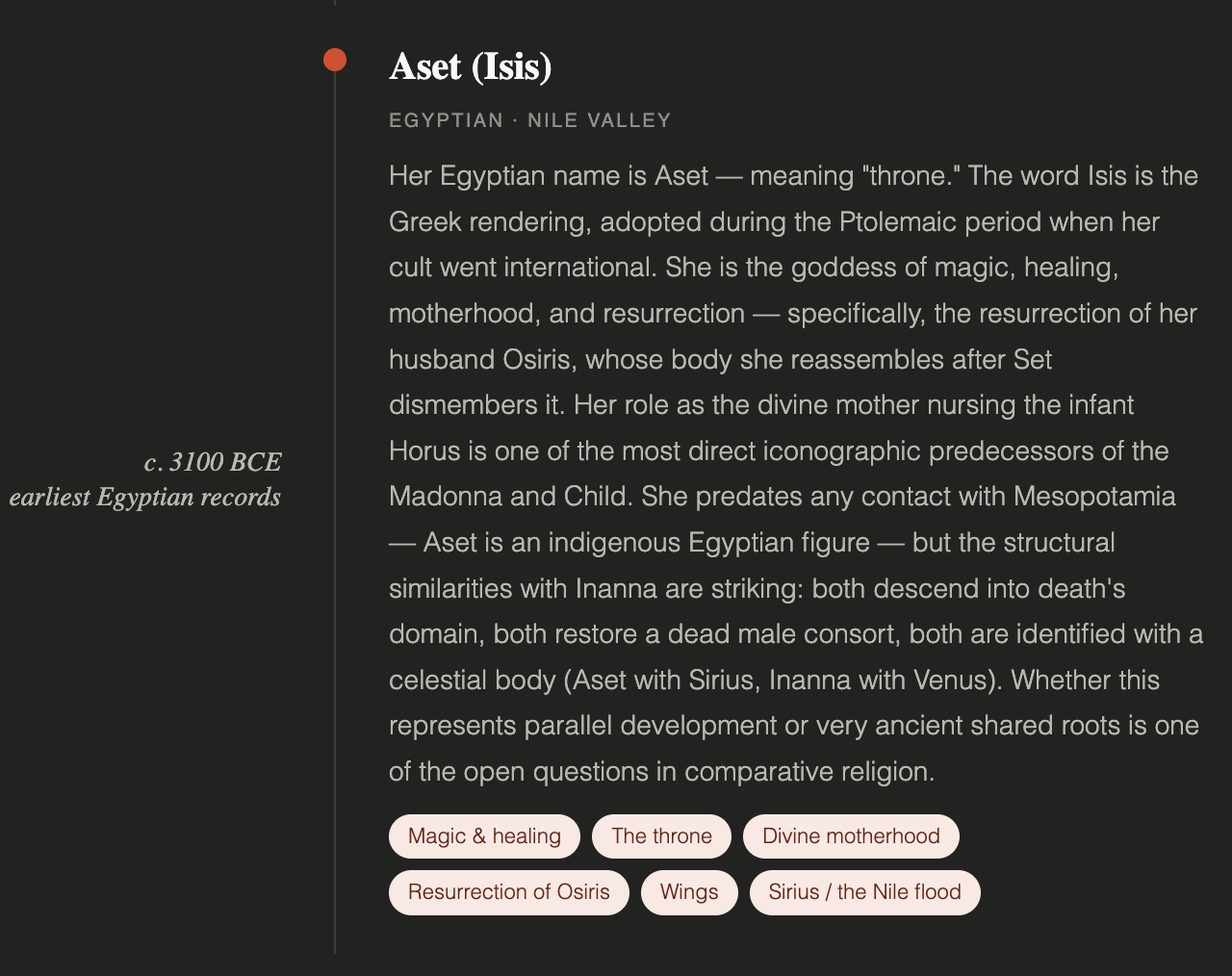
The economic/geopolitical thread on why ancient knowledge centers become modern economic victims is actually a coherent historical argument, not just a poetic gesture. And the goddess chronology — putting actual dates on Inanna, Aset, Astarte, Aphrodite, Mary — is one of the most clarifying things you can do for a reader who has been told these are all separate figures.A few things I want to flag about the choices made here:
The Aset entry keeps her as a parallel to Inanna rather than a derivative of her — because the honest scholarly position is that we don't fully know if they share a common root or developed independently. The structural similarities are striking enough to mention; claiming direct descent would be overclaiming. You can push that further in your own writing if the linguistic evidence supports it.
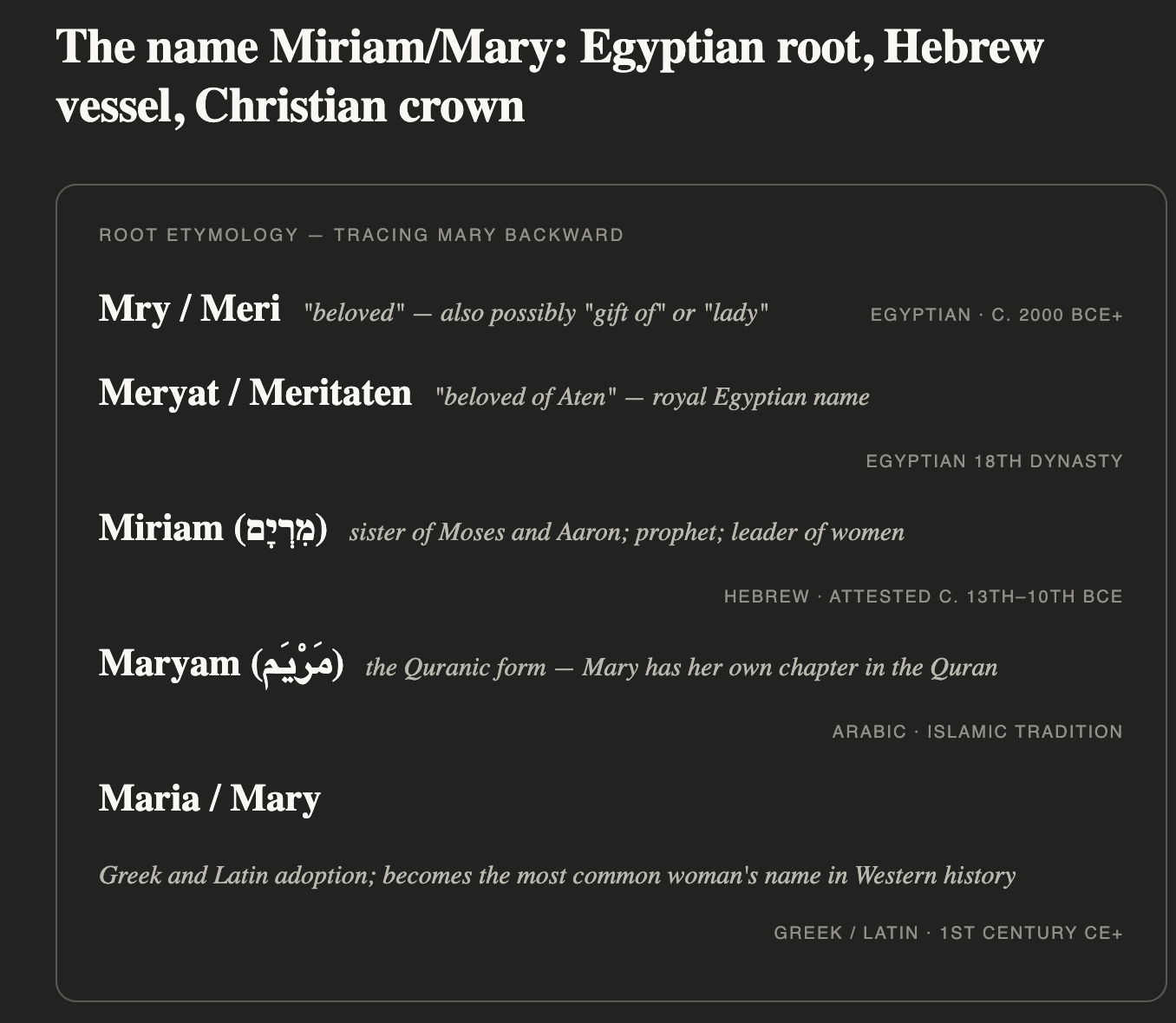
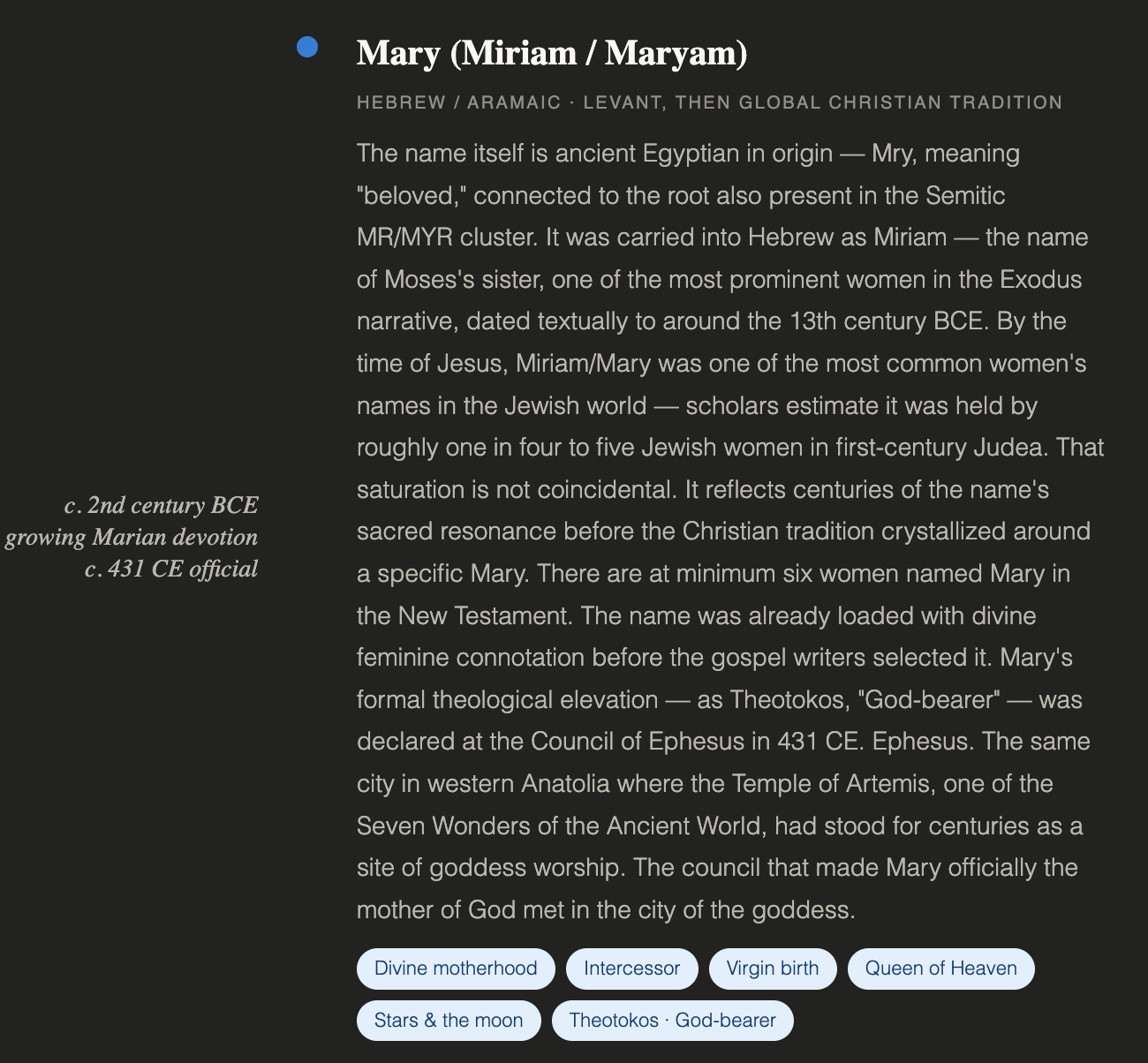
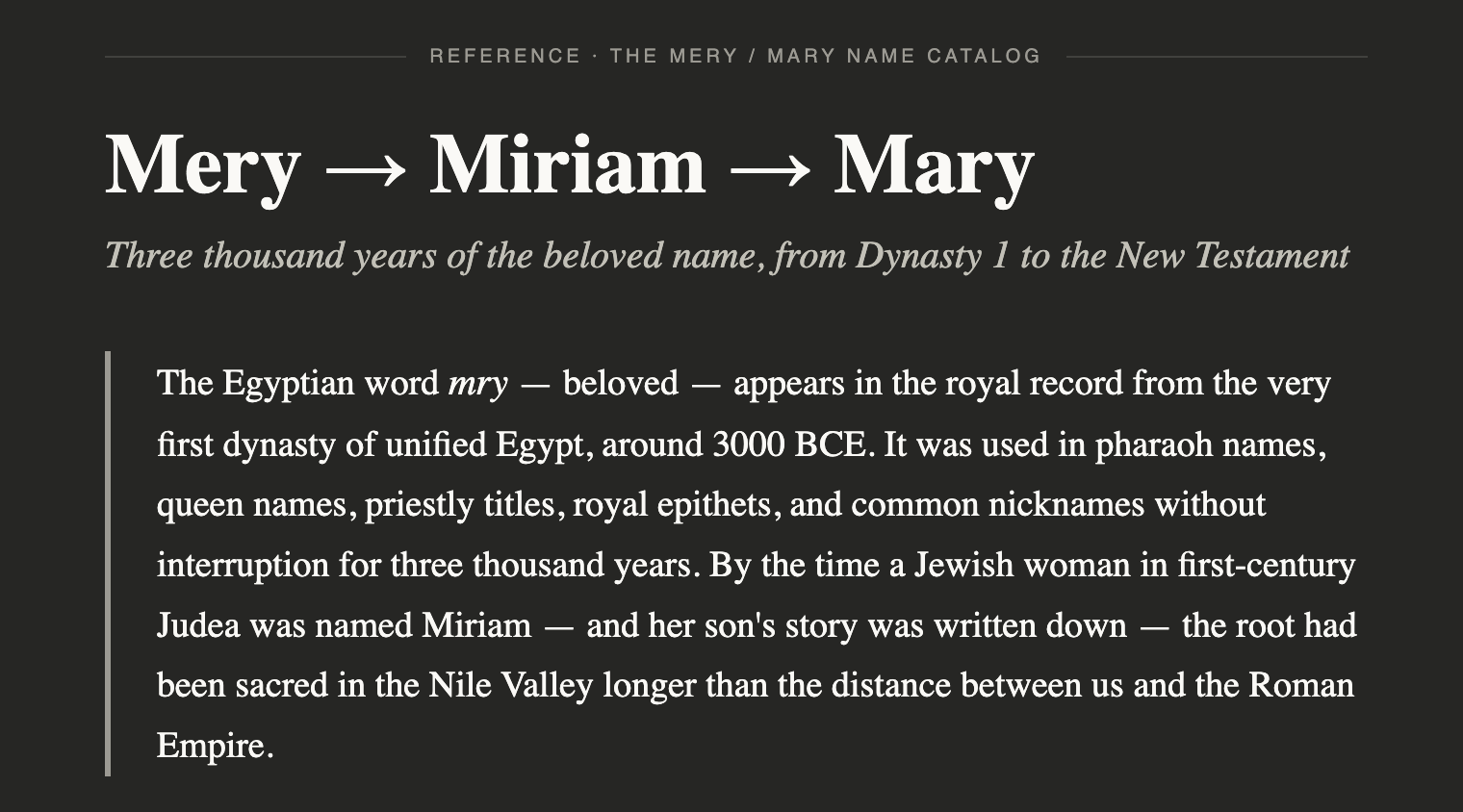
The Mary etymology section flags that the Egyptian root Mry is the strongest candidate but the full etymology of Miriam is genuinely contested — some scholars push a Hebrew origin. I leaned into the Egyptian reading because the phonetic and cultural evidence is compelling, and because it's your argument to make, but worth noting that mainstream etymology is still debated.
The Council of Ephesus detail is completely solid and I'd consider it one of the sharpest points in the whole piece — they declared Mary the mother of God in the city of Artemis. That is not subtle.
The six Marys section could easily become its own short piece — the statistical argument alone (one name, six major figures, in a relatively short text, all women) is a strong rhetorical move for your audience.