
Deep Dive, on the Mothers
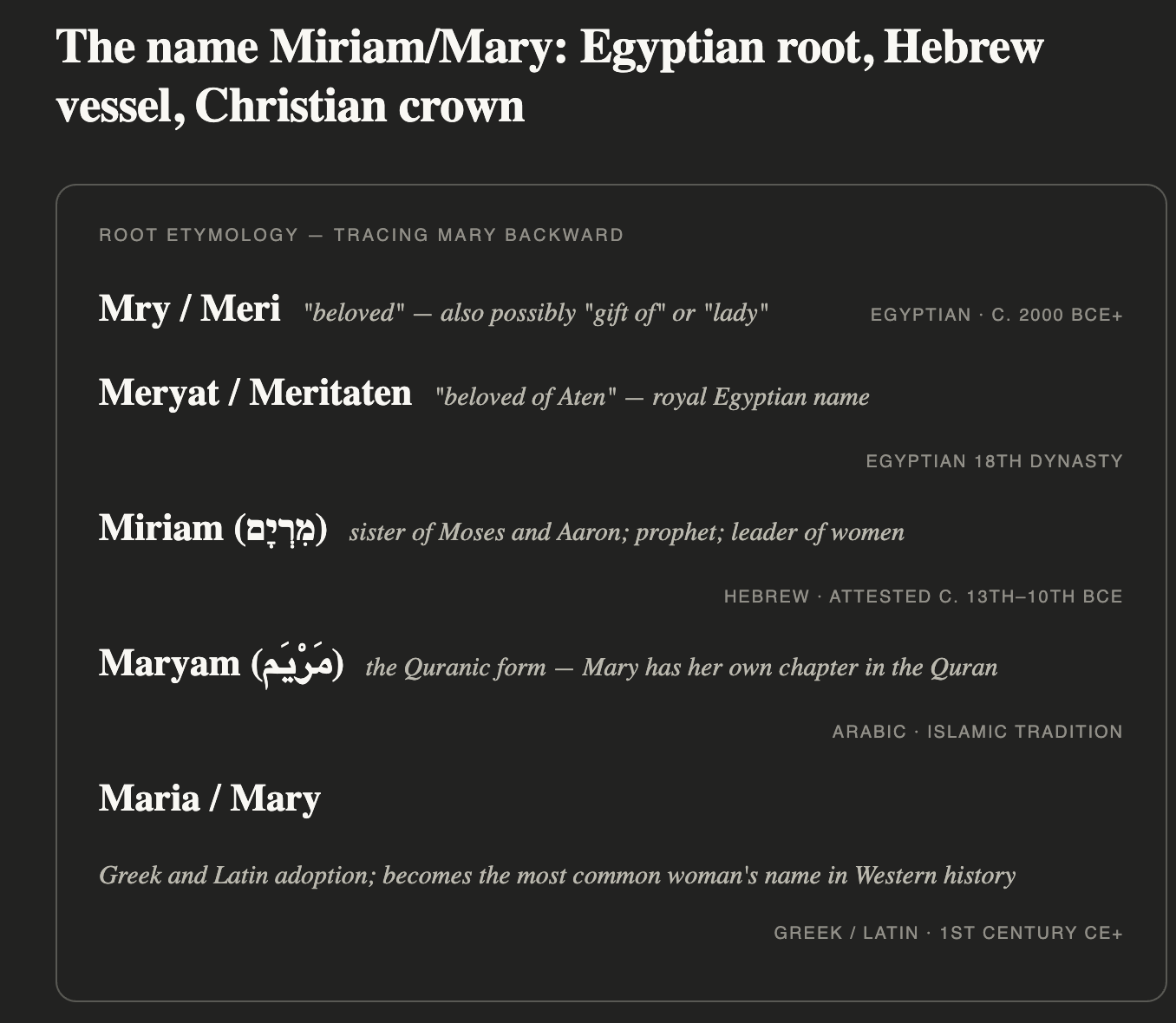
More about the ages of innana vs aset vs astarte, how we find the earliest roots of all these women turned into the same things. add mary in there too for fun, showing the dates of when she started being significant, though the roots of her name, and popularity of it, came well before jesus' mom's time. hence, why she was named it and so many marys in the bible- egyptian root name popular then and still today.
A word on a woman whose name predates the religion she is most associated with by several thousand years.
The goddess who never stopped traveling: a chronology
She is not multiple women. She is one figure who acquired different names as she moved through different cultures, each name reflecting the language and the specific attributes the new culture chose to emphasize. The war function gets softened. The sexuality gets sanitized. The cosmic scope gets narrowed. But the core — the divine feminine who governs love, death, birth, the cycles of nature, and the fate of kings — remains recognizable across five thousand years of renaming.
By Date:
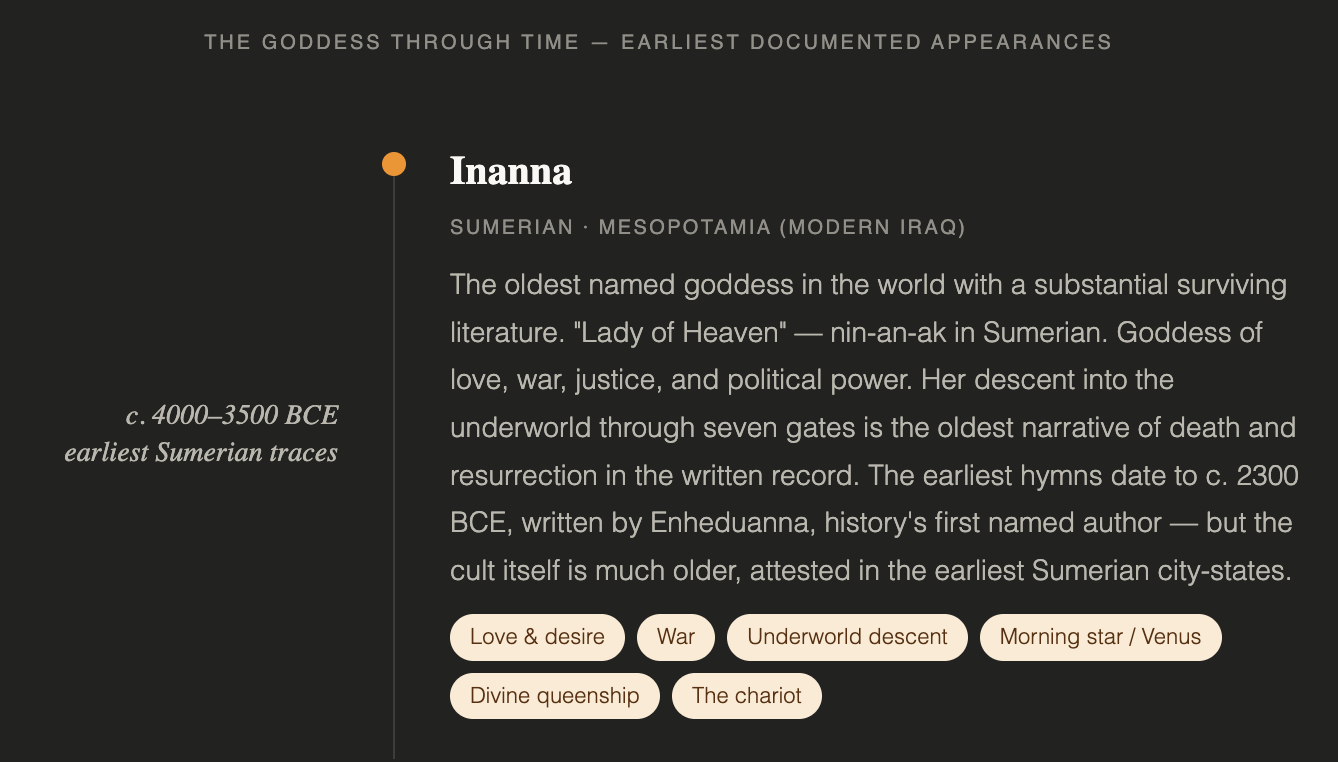
c. 4000–3500 BC, earliest Sumerian traces, Inanna
Sumerian · Mesopotamia (modern Iraq)
The oldest named goddess in the world with a substantial surviving literature. "Lady of Heaven" — nin-an-ak in Sumerian. Goddess of love, war, justice, and political power. Her descent into the underworld through seven gates is the oldest narrative of death and resurrection in the written record. The earliest hymns date to c. 2300 BCE, written by Enheduanna, history's first named author — but the cult itself is much older, attested in the earliest Sumerian city-states.
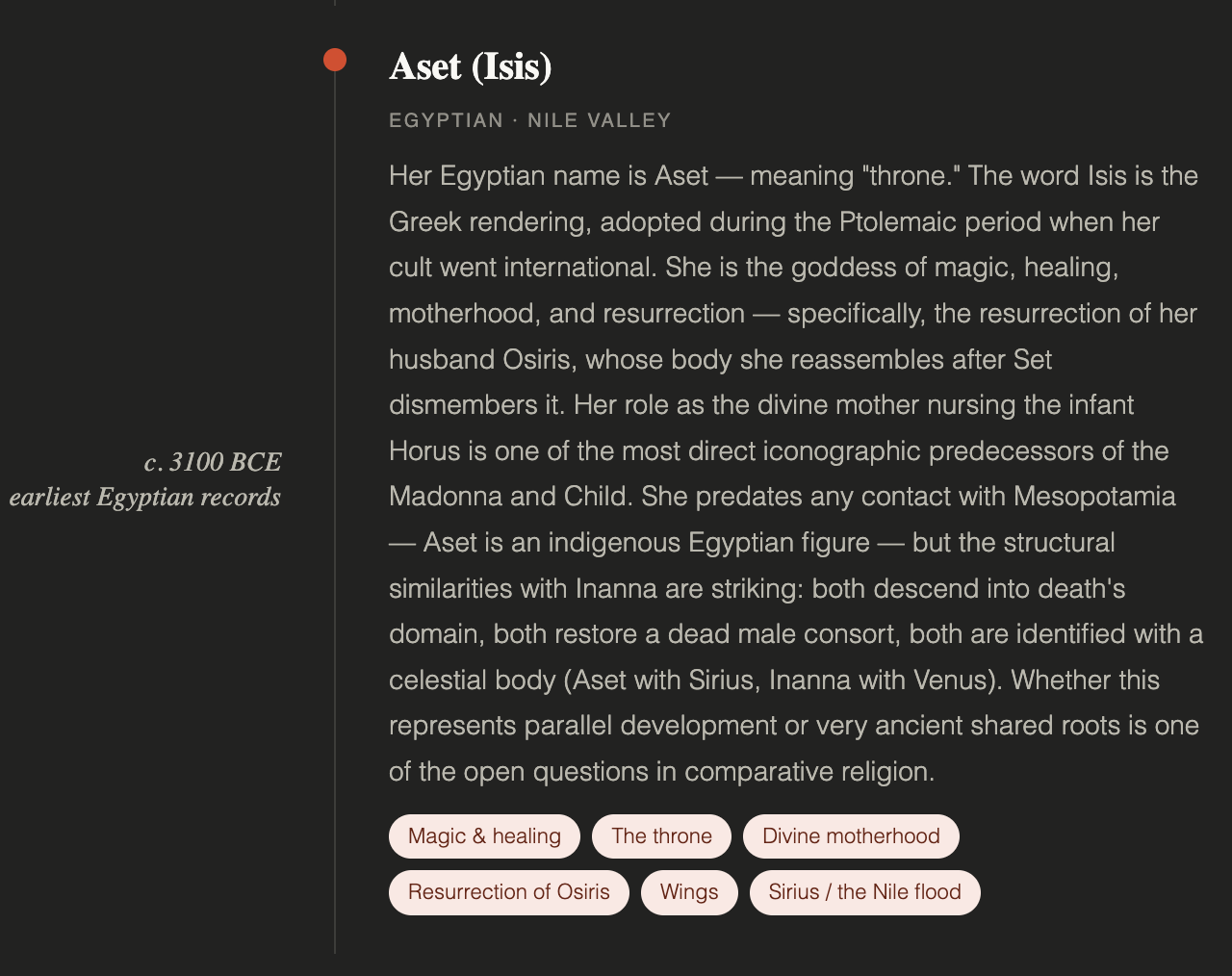
c. 3100 BC, earliest Egyptian records, Aset (Isis)
Egyptian · Nile Valley
Her Egyptian name is Aset — meaning "throne." The word Isis is the Greek rendering, adopted during the Ptolemaic period when her cult went international. She is the goddess of magic, healing, motherhood, and resurrection — specifically, the resurrection of her husband Osiris, whose body she reassembles after Set dismembers it. Her role as the divine mother nursing the infant Horus is one of the most direct iconographic predecessors of the Madonna and Child. She predates any contact with Mesopotamia — Aset is an indigenous Egyptian figure — but the structural similarities with Inanna are striking: both descend into death's domain, both restore a dead male consort, both are identified with a celestial body (Aset with Sirius, Inanna with Venus). Whether this represents parallel development or very ancient shared roots is one of the open questions in comparative religion.
Aset is a goddess whose name means "throne," who began as a relatively minor figure and grew, over three thousand years, into the most widely worshipped divine feminine presence the ancient world ever produced — appearing in temples from Afghanistan to England, from Egypt to Poland.
c. 2950 BC: Merneith
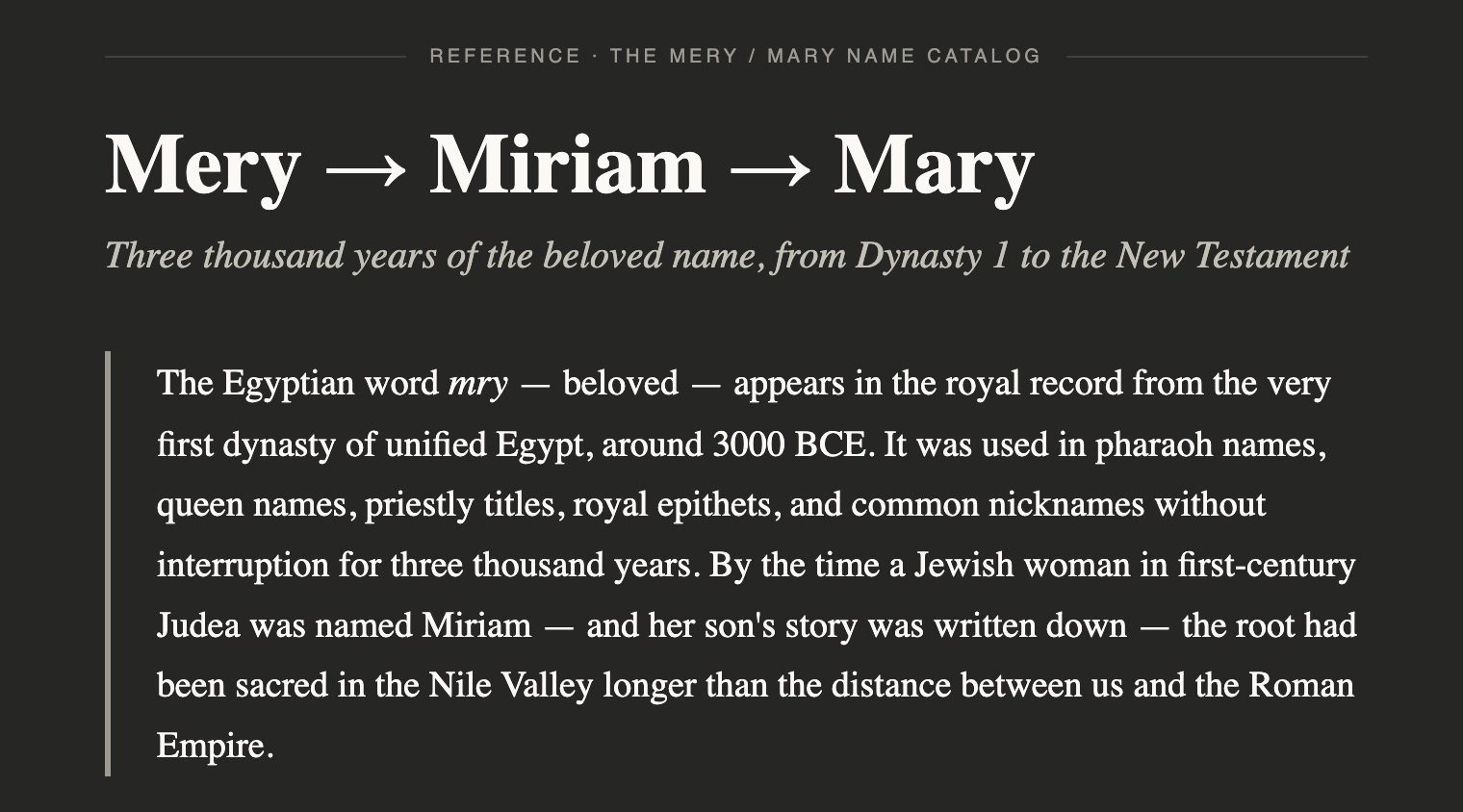
A pharaoh whose name carries the root mery — beloved — from the very first dynasty of Egypt, who ruled around 2,950 BCE and was then systematically removed from the king lists that came after.
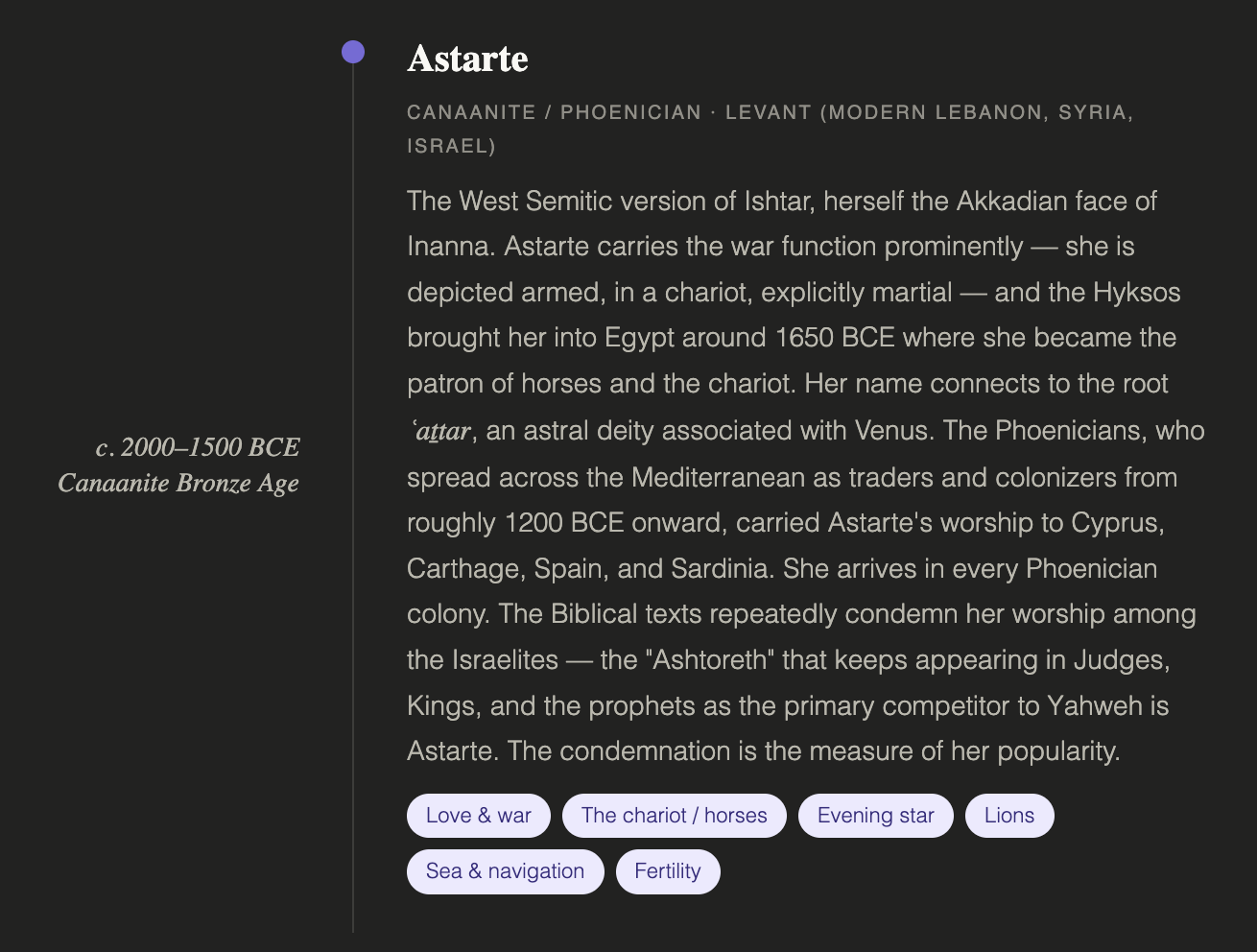
c. 2000–1500 BC, Canaanite Bronze Age, Astarte
Canaanite / Phoenician · Levant (modern Lebanon, Syria, Israel)
The West Semitic version of Ishtar, herself the Akkadian face of Inanna. Astarte carries the war function prominently — she is depicted armed, in a chariot, explicitly martial — and the Hyksos brought her into Egypt around 1650 BCE where she became the patron of horses and the chariot. Her name connects to the root ʿaṯtar, an astral deity associated with Venus. The Phoenicians, who spread across the Mediterranean as traders and colonizers from roughly 1200 BCE onward, carried Astarte's worship to Cyprus, Carthage, Spain, and Sardinia. She arrives in every Phoenician colony. The Biblical texts repeatedly condemn her worship among the Israelites — the "Ashtoreth" that keeps appearing in Judges, Kings, and the prophets as the primary competitor to Yahweh is Astarte. The condemnation is the measure of her popularity.
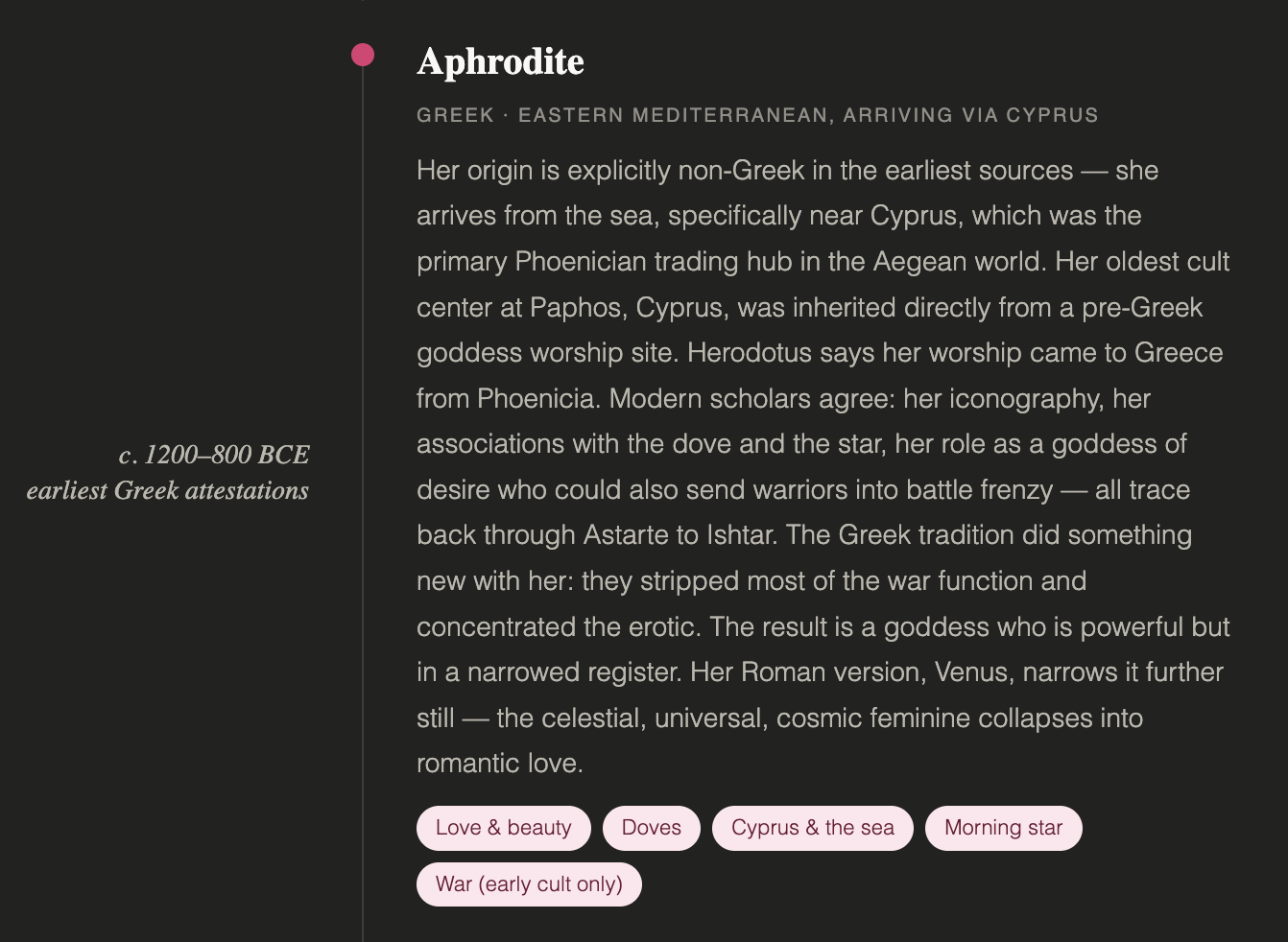
c. 1200–800 BC, earliest Greek attestations, Aphrodite
Greek · Eastern Mediterranean, arriving via Cyprus
Her origin is explicitly non-Greek in the earliest sources — she arrives from the sea, specifically near Cyprus, which was the primary Phoenician trading hub in the Aegean world. Her oldest cult center at Paphos, Cyprus, was inherited directly from a pre-Greek goddess worship site. Herodotus says her worship came to Greece from Phoenicia. Modern scholars agree: her iconography, her associations with the dove and the star, her role as a goddess of desire who could also send warriors into battle frenzy — all trace back through Astarte to Ishtar. The Greek tradition did something new with her: they stripped most of the war function and concentrated the erotic. The result is a goddess who is powerful but in a narrowed register. Her Roman version, Venus, narrows it further still — the celestial, universal, cosmic feminine collapses into romantic love.
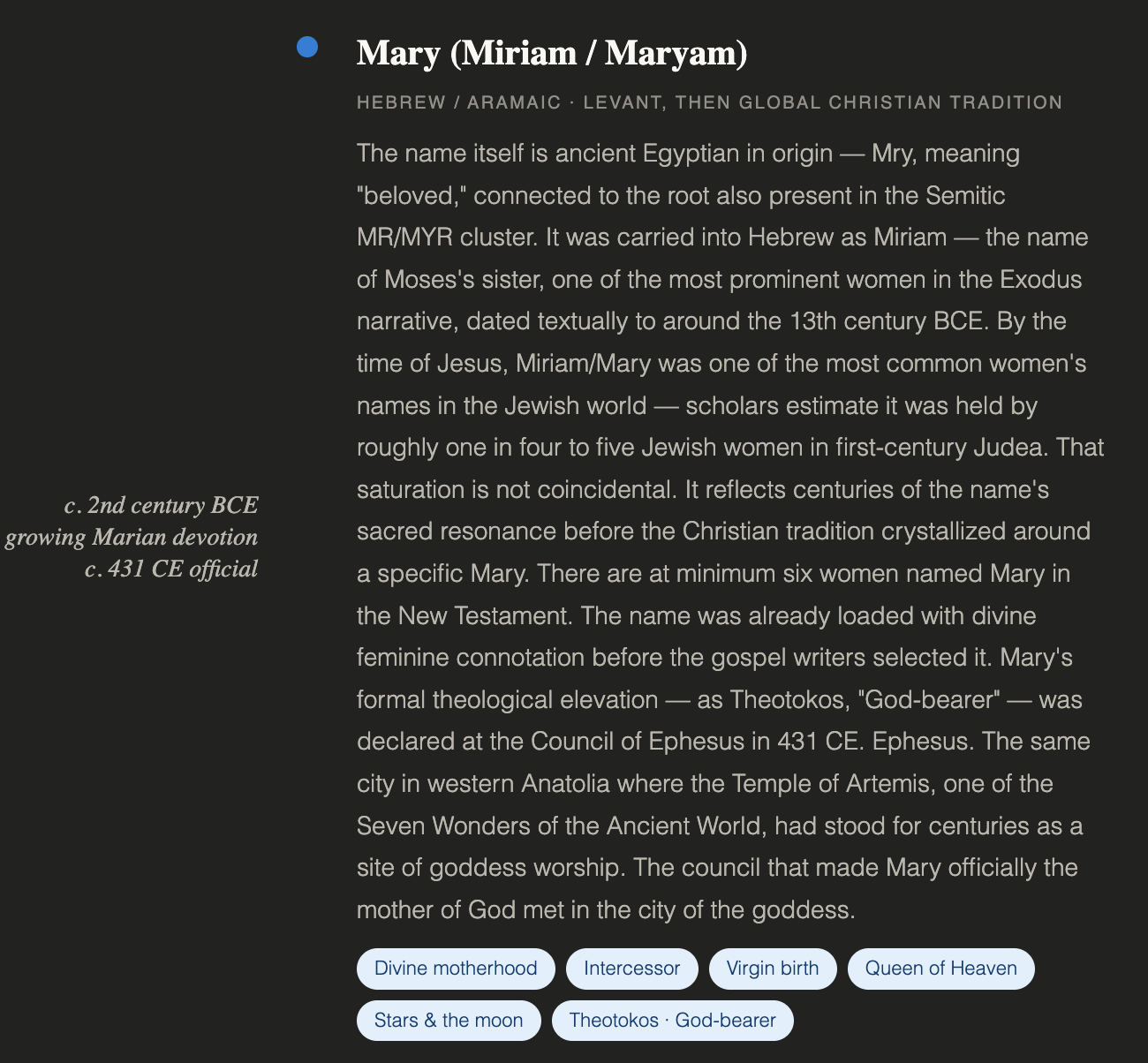
c. 2nd century BC, growing Marian devotion, c. 431 CE official, Mary (Miriam / Maryam)
Hebrew / Aramaic · Levant, then global Christian tradition
The name itself is ancient Egyptian in origin — Mry, meaning "beloved," connected to the root also present in the Semitic MR/MYR cluster. It was carried into Hebrew as Miriam — the name of Moses's sister, one of the most prominent women in the Exodus narrative, dated textually to around the 13th century BCE. By the time of Jesus, Miriam/Mary was one of the most common women's names in the Jewish world — scholars estimate it was held by roughly one in four to five Jewish women in first-century Judea. That saturation is not coincidental. It reflects centuries of the name's sacred resonance before the Christian tradition crystallized around a specific Mary. There are at minimum six women named Mary in the New Testament. The name was already loaded with divine feminine connotation before the gospel writers selected it. Mary's formal theological elevation — as Theotokos, "God-bearer" — was declared at the Council of Ephesus in 431 CE. Ephesus. The same city in western Anatolia where the Temple of Artemis, one of the Seven Wonders of the Ancient World, had stood for centuries as a site of goddess worship. The council that made Mary officially the mother of God met in the city of the goddess.
When the gospel writers chose the name of Jesus's mother, they were not choosing an obscure or arbitrary name. They were choosing the most resonant female name in their cultural world — a name that carried Moses's sister, that carried centuries of Egyptian-Semitic sacred naming practice, that carried the entire weight of divine feminine lineage in a single word. If you were constructing a new religious movement in first-century Judea and you wanted the mother of your divine figure to carry immediate spiritual authority in her very name, you would name her what she was named.
The "Queen of Heaven" title given to Mary in Catholic devotion — appearing in papal documents, in Marian hymns, in the Litany of Loreto — is the direct translation of the title held by Inanna for three thousand years before the Council of Ephesus convened. Nin-an-ak. Lady of Heaven. The oldest written religious title in the world, assigned to the Sumerian goddess of love and war around 4000 BCE, arrives in the Catholic Church attached to a Jewish woman from Nazareth, declared official theology at a meeting held in a city where the goddess had been worshipped without interruption for centuries.
None of this diminishes Mary. It contextualizes her within the longest and most continuous tradition of divine feminine veneration in human history. She did not replace that tradition. She completed it — or rather, she was the form that tradition took when it moved through the specific theological and political filter of early Christianity. The attributes are the same: the miraculous birth, the divine son, the grief at his death, the intercessory role between humans and the divine, the identification with celestial light (Inanna with Venus, Aset with Sirius, Mary with stars and moon). The Church did not invent the mother of God. It inherited her.
"The 'Queen of Heaven' title given to Mary is the direct translation of the title held by Inanna for three thousand years. Nin-an-ak. The oldest written religious title in the world, arriving in the Catholic Church via Ephesus — the city of the goddess."
The Aset / Isis → Mary iconographic transfer: The image of Isis nursing the infant Horus — seated, crowned, child at breast — appears in Egyptian religious art from approximately 1350 BCE onward. When Christianity spread through Egypt in the first and second centuries CE, the Isis-nursing-Horus image was common throughout the country. Art historians have documented dozens of cases where early Coptic Christian Madonna-and-Child iconography is nearly identical in pose, composition, and symbolic elements to the Isis-Horus prototype. The throne that Aset wears as her crown becomes, in Marian imagery, the throne on which Mary sits. The meaning of the name Aset — throne — is present in the visual tradition even after the name itself was replaced.
On the six Marys in the New Testament: Mary the mother of Jesus. Mary Magdalene. Mary of Bethany (sister of Martha and Lazarus). Mary the mother of James and Joseph. Mary the wife of Clopas. Mary the mother of John Mark. Six named individuals, in a text of moderate length, share a single name. This is a statistical reflection of genuine naming practice — but it also means that the most intimate female figures in the foundational Christian narrative all carry an Egyptian-rooted name that had been sacred in the Levantine world for over a thousand years before any of them were born.
These are expansions of the Asia Minor & Chariot article in the Sound-Led Research Series. The goddess chronology is designed to sit alongside that piece as reference material — dates, attributes, and naming lineage that the main article gestures toward but doesn't fully develop. Both pieces feed the larger book project on the sacred year and the suppression of the feminine divine.
Aset is shown here as parallel, and separate from, Inanna rather, than a derivative of her. The most accepted scholarly position today is that we don't fully know if they share a common root or developed independently. The structural similarities are striking enough to mention, and lay out plainly here to show it would be absurd to cast aside a connection as trivial.
Mary etymology is highly contested, and scholars have agreed to stop somewhere in the Hebrew realm. But hebrew doesn’t exist without Egyptian influence, and the name continued before and after Hebrew started as a thing. Continuous use, same name, same places, same time, continuously.
The Council of Ephesus literally declared Mary the mother of God in the city of Artemis. That is not subtle.
The six Marys section could easily become its own short piece — the statistical argument alone (one name, six major figures, in a relatively short text, all women) is a strong rhetorical move that is worth coming back to.