
Place spotlight: Laodicea. These are places that i noticed by sound alone, in finding female centered places that have Egyptian core values.
Laodicea
Where Egypt's gods went when the empire moved north
This is a place I found by sound. The name carried something — a deep feminine root wrapped in layers of conquest, medicine, and wool dye. Following that sound into the historical record revealed a city that was, in every sense, a node where Egyptian sacred culture embedded itself into the body of what we now call Asia Minor- a strange name, like a “mini Asia”. What is this place? We call it Turkey today, after the more “modern” (as compared to Egyptian type eras) Turks. It was what was once part of the Greek world, where all the inventions and math stuff was happening. And it was DEEPLY tied to Egypt.
Laodicea sits in the Lycus Valley of what is now southwestern Turkey — a warm, mineral-rich corridor running between the hot springs of Hierapolis (modern Pamukkale) and the dark volcanic plateau of Colossae. It is one of the cities addressed in the Book of Revelation, scolded famously for being "neither hot nor cold." For centuries, that epithet has been the thing most people remember about it.
But that reading misses the entire physical geography of the place. The city was located between the hot springs to the north and the cold springs to the south. Its own water arrived lukewarm through aqueduct — a literal engineering fact. When Revelation called it lukewarm and "wretched," it was talking about water, yes, but also invoking something deeper: a city that had absorbed so many religious traditions, so many conquering cultures, that it had become a site of spiritual ambiguity. Egypt was one of the primary architects of that ambiguity.
How Egypt Got Here: The Marriage that Named the City
The city does not merely have Egyptian influence. Its very founding is the direct result of an Egyptian political crisis. In 250 BCE, Seleucid King Antiochus II sealed a peace treaty with Egypt's Ptolemy II by marrying his daughter Berenice — and formally exiling his first wife, Laodice, for whom this city was already being built.
When Ptolemy II died, Antiochus returned to Laodice. The historical record darkens from there. Ancient sources suggest she poisoned Antiochus, then had Berenice and her infant son killed, securing the Seleucid throne for her own bloodline. The city named for her was thus born directly out of an Egyptian-Seleucid entanglement — intrigue, poisoning, dynastic murder, and an Egyptian bride's blood. This is not a footnote. It is the founding story.
"The city does not merely have Egyptian influence. Its founding is the direct consequence of an Egyptian political crisis — a marriage treaty, a poisoning, and an exiled queen whose name the city still carries."
The Goddess Hiding in Plain Sight: Isis in the Lycus Valley
Isis was not a peripheral cult figure in this region. She was a dominant religious presence, and her hold on the Lycus Valley was specifically tied to her function as a universal goddess — one who transcended ethnic and political boundaries. That universalism is exactly what made her a direct competitor to early Christianity, which was marketing the same thing.
Excavations at Laodicea have produced a statue torso of Isis. The nearby Hierapolis — with its thermal pools, oracle sites, and the famous "Gate to Hell" — has its own deep Egyptian resonance. The "Antique Pool" there is still called Cleopatra's Pool, drawing on a tradition that Egypt's last queen visited this valley for its therapeutic waters. Whether historically true, the persistence of that legend tells us something real: Egypt was understood to be cosmologically present here.
Isis as she was worshipped in the Hellenistic world had evolved significantly from her earliest Egyptian form. She was by this period the goddess of fate, magic, healing, and the sea — worshipped across the Mediterranean with a dedicated mystery cult and an explicit theology of personal salvation. In this, she anticipates the Christian structure almost point for point: a suffering god, a devoted divine mother, resurrection, and the promise of eternal life for the initiate. The two faiths were not merely in proximity in Laodicea. They were structurally competing for the same devotional territory.
Sound note: The IS- in Isis (also spelled Aset, meaning "throne") recurs as a sacred syllable across the region: IS-RA-EL, IS-tar, and ultimately in the root claim to divine feminine power. Following this sound through place names is what first flagged this region as worth investigating. Laodicea sits inside a web of sites where that root is phonetically and theologically active.
The Textile Economy and Egyptian Chemical Knowledge
Laodicea's famous black wool — the industry that made it wealthy — was not simply a product of local sheep. It was a product of dyeing technology. Deep, stable, market-premium color requires mordants: chemical fixatives that bind pigment to fiber. The most sophisticated mordant knowledge in the ancient world came from Egypt, and the trade networks of the Lycus Valley were directly plugged into it.
"Egyptian Blue" — the first synthetic pigment in recorded history, a calcium copper silicate manufactured at high temperature — has been identified in the regional trade networks and in nearby Ephesus. This was not a decorative pigment alone. It was a technological demonstration: proof that color could be engineered rather than merely gathered. The textile guilds of Laodicea, who produced garments that were "designer status" across the Roman Empire, were working within a technical tradition whose roots ran south to the Nile.
The medical school at Laodicea — renowned particularly for its eye salve, referenced directly in Revelation 3 — also sits within this Egyptian knowledge corridor. The obsession with eye medicine in this region connects both to practical ophthalmology and to the much older Egyptian theological significance of the eye: the Eye of Horus, the Eye of Ra, the healing and protective eye that appears across thousands of years of Egyptian sacred art. In this valley, the eye was not only a body part to be treated. It was a symbol to be held.
The Physical Overwrite: Christianity Building on Egyptian Ground
Perhaps nowhere is the Egyptian-to-Christian transfer more visible than in the neighboring city of Pergamum, part of the same Seven Churches circuit that includes Laodicea. There, a massive temple complex originally built for the Egyptian gods Serapis and Isis was physically converted into a Christian basilica — still visible today as the Red Hall (Kızıl Avlu). The walls stayed. The orientation stayed. The divine address changed.
At Hierapolis, the pattern is even more operatic. The Martyrion of Saint Philip — built in the 5th century as an octagonal structure on the hilltop — was placed directly above the Ploutonion, the ancient "Gate to Hell," a volcanic fissure that emitted toxic gases and was understood as a literal door to the underworld. The symbolic communication was deliberate: the Christian saint who conquered death was placed architecturally above the place death was thought to live.
The Acts of Philip describe the city as a center of serpent worship, and Philip is credited with killing a great serpent through prayer — after which mass conversions followed. Sculptures in the region still show Philip standing on a dragon. The parallel to Saint Patrick "driving out the snakes" of Ireland (a land that never had them) is exact: these are narratives of spiritual replacement, not historical wildlife reports. The serpent was a central figure in Phrygian and Egyptian-influenced nature religion. Killing it, symbolically, was the whole point.
"The Christians built their own healing center at Philip's tomb, where pilgrims practiced incubation rites — sleeping near the grave hoping the saint would appear in their dreams. They were directly mimicking the older healing rituals of the Temple of Men Karou down the road."
Deep Time: The Hittites, the Plague, and the Oldest Diplomacy
The Egyptian connection to this region does not begin with the Ptolemies. It begins, in the written record, around 1323 BCE — nearly a thousand years earlier — with one of the most astonishing documents in all of ancient history.
A widowed Egyptian queen, identified in Hittite records as Dahamunzu (almost certainly Ankhesenamun, widow of Tutankhamun), wrote to the Hittite king Suppiluliuma I — who ruled from his capital in central Turkey — and asked him to send one of his sons to marry her and become Pharaoh of Egypt. Her stated reason was devastating in its directness: she did not want to marry "a servant." The Hittite king, suspicious, sent an envoy to verify her sincerity. He was eventually convinced. He sent his son, Prince Zannanza, south toward Egypt.
Zannanza was murdered before he arrived. The Hittite records accuse "the people of Egypt" — most historians believe the order came from the vizier Ay or the general Horemheb. Ankhesenamun was then forced to marry the elderly Ay and disappeared from history entirely.
The Hittite king went to war. His soldiers captured Egyptian prisoners who carried a plague back into Anatolia. That plague devastated the Hittite empire for twenty years — killing the king, then his son and heir. The surviving son, Mursili II, wrote what are known as the Hittite Plague Prayers: anguished, remarkably honest documents in which he essentially performs a spiritual audit of his father's actions, concludes that the plague is divine punishment for breaking a treaty with Egypt, and begs the Storm God: "It is true, the father sins — but does the son have to pay?"
Scholars note that Mursili ends these prayers with the Hittite and Akkadian equivalent of "let it be so" — the same structural formula, and possibly the same root sound, as the "Amen" that Jesus would use in his letters to these same cities thirteen centuries later.
The scapegoat rituals the Hittites performed to try to end the plague — dressing an animal or a woman in royal clothes and driving them toward the Egyptian border, shouting "Take this plague back to your land!" — are considered by scholars to be the direct cultural predecessors of the biblical scapegoat concept. This entire region of Phrygia inherited a Hittite framework of purity and pollution that the medical school at Laodicea, with its eye salves and its cleansing traditions, was still operating within.
What the Sound Opened
The name Laodicea contains within it the Greek laos (people) and dike (justice, fate, the casting of lots). The city of the people's fate. The city where divine judgment was administered. That reading is not strained — this was a city famous for banking, for legal institutions, for a medical trade that itself operated as a kind of bodily judgment (the eye salve that lets you see, the wool dye that signals status, the thermal waters that either heal or harm depending on their temperature).
What the sound-led method found here is a place that sits at the intersection of every major ancient transfer I have been mapping: Egypt into Turkey, the goddess tradition into early Christianity, the Hittite treaty system into biblical covenant theology, the scapegoat into Levitical law, the eye of Horus into the eye salve of Revelation. It is not a coincidence that this specific city received the most theologically dense of all the letters in Revelation — the one about being neither hot nor cold, about being spiritually blind and needing salve, about purchasing refined gold. The writer of Revelation knew exactly what this city's symbolic economy was. It had been Egyptian for a very long time.
This piece is part of the Sound-Led Research Series — an ongoing investigation into female-centered sacred sites identified first by phonetic pattern and confirmed through historical record. The method holds that certain sounds carry memory, and that following them into the archive reveals connections that category-based research tends to organize away. Laodicea was found by its name. Everything else was already there, waiting.
The Egyptian thread runs unbroken from the founding story (the Berenice poisoning) through Isis worship, through the dye and medical knowledge economy, through the physical architectural overwrites, and all the way back to the 1323 BCE plague that connects the Hittite capital in Turkey to the Egyptian throne. It's one continuous current, not a list of random Egyptian facts.
The Amen connection is in there — Mursili II's plague prayers and their structural echo in the letters to these same cities thirteen centuries later.
The Details:
The city of Laodicea has been an important one in my collection of facts and stories from the past.
Laodicea on the Lycus (pronounced: Ladoshea on the Lisus)
It was in this city, in modern day Turkey, where a Jesus supposedly addressed a group of locals, not in a good way, lashing at them with words for doing their own thing.
The town he was addressing was located strategically along a major water route that allowed for bountiful trade. It was a rich city, one with its own gods, own story, no reason to subdue, at least not quite yet.
And Jesus says something interesting, trying to appeal to them, “I am the Amen”, aka, the source of creation, etc. And a bunch of other stuff. THE amen. Not Amen at the end of the prayer, but he is associating himself with what seems to be a local god of the town. A pronoun. A person, a deity.
In Revelation 3:14, Jesus dictates a letter to the church in this city, opening with: "These things says THE Amen, the Faithful and True Witness, the Beginning of the creation of God."
Notice the text uses the Hebrew word Amen (meaning "Truth," "Verily," or "So be it") as a personal title.
Remember, vowels are fluid. Consonants are the hard stops of sound, of language. Egyptians and Hebrews did not even write the vowels. The vowels can be considered the music of breath, speaking, because they provide the resonants between stops. Like in music, the magic lives between the notes, how you bring the sound alive.
Anyways, amen and amun have lots in common that we talk about elsewhere. It becomes clear when you see them both as the root _M_N_ where any vowels can be placed in between. For thousands of years. THE _M_N_ means something, not just a stop of a prayer. Amun was a major god, starting in Africa, spread across the Greek and Roman lands that were once rulers of this land now called Turkey. The ancient Turks (Anatolians) and Egytpians had even the first known peace treaty between Empires, long before, hundreds of years before Romans were rogue warriors on a hill pretending they could live without women. The Anatolian and Egyptians were marrying their children to one another to create alliances. These were places with known contact, known riches, and everything the later Roman Christian Empire would be frothing at the mouth to adopt.
Religions have long tried to associate themselves with local gods to appear the latest transformation of the same. Regardless, this location always seemed interesting to me, its history, and I finally had a stolen moment to look deeper. What were its eldest names for the city? What are nearby cities and rivers? Any with that Is- feminine lilt that we keep finding elsewhere in places with treasures, wealth, and matrilineal bent that comes with a hard won identity that does not want to give in?
And bingo. I found it. The cool thing about sounds are their habit of sticking around, even if spelled differently. Close your eyes and say this out loud: Lycus River. ISIS is not hard to find, the mother.
The modern city name: Laodicea (-isea) hides it a little, but not once you see the elder variations in the name, it no longer feels just like a coincidence. It was an embedded sound pattern.
Laodicea (…-isi-a)
Lycus River (L-Isis)
Laodicea was strategically built on a plateau surrounded by three significant waterways, which is why it was often called Laodicea ad Lycum (Laodicea on the Lycus) to distinguish it from other cities.
River names that come together here:
The Lycus River: Known today as the Çürüksu Çayı, it flows to the northeast and was the primary river of the valley.
The Caprus River: Now called the Başlıçay, it flows along the southeast side of the city.
(bas has to do with king)
The Asopus River: Now known as the Gümüşçay (or Goncalı Deresi), it borders the northwest.
(aso in asopus, us in gumuscay, RESI in deresi)
The Maeander River: The Lycus is a major tributary of the Büyük Menderes (the ancient Maeander), which is famous for its winding path that gave us the word "meander".
menes, men, even the word semen, all have to do with the source of creation, found with the “mn” root in Egyptian, same as found in Amun/Amen (_M_N_).
Turkish linguistic evolution of the site’s names:
Eskihisar: The current name for the ruins ("Old Castle") contains the "ish" sound prominently (though this could have come later with the regal-ness of things like castle, etc)
Çürüksu: The modern name for the Lycus River (Choo-rook-soo) contains a soft "sh" or "ch" sound that is common in the local phonetic patterns of theDenizli Province.
Denizli: Denizli has abundant water sources. There are many beautiful ponds. Because of the similarities of water to sea water this province was named the Denizli. Evliya Çelebi in his book of travels stated that ‘Kesir-i tülenha olmağula Denizli’. Meaning that it was called Denizli because of its abundant water supply. This a true expression. From other expressions the petition of Turkoman nomadics to converted Denizli into a Turkish city. Within the length of time Tonguzlu was called Dengiz and later Denizli. Former names were Laodikeia and Tonguzlu. Germiyanoğulları called it Tonguzluk.
Eşeler Mount: In the east of Acıpayam plain.
Honaz Mount: It’s altitude is 2571 m. It’s located in southeast of Denizli. The slopes are steep. Honaz Mount is the highest mount in the province. It’s under governmental protection as a National Park.
Acı Lake (Çardak Lake): (sound: asi) It’s a tectonicly formed lake.
Karagöl: (Ra) The total area is 0.20 km2 and 1250 m. high. A crater lake, which feeds by creeks.
Işıklı Lake: (Isis sound) This lake is feed by Çivril town’s Işıklı creeks and Küfi River.
Lâdik : While it ends in a 'k', the transition from the soft 'ci' in Laodicea to the Turkish 'dik' or 'dik' often involves a localized softening of consonants in regional dialects.
(L- sound did not exist in egyptian, it is synonymous with -r, so here we get RAdik.
Then there is the Denizli Province (IZI sound again)
There seem to be so many things to explore here, can be hard to know where to start. But let’s just say there is a pattern.
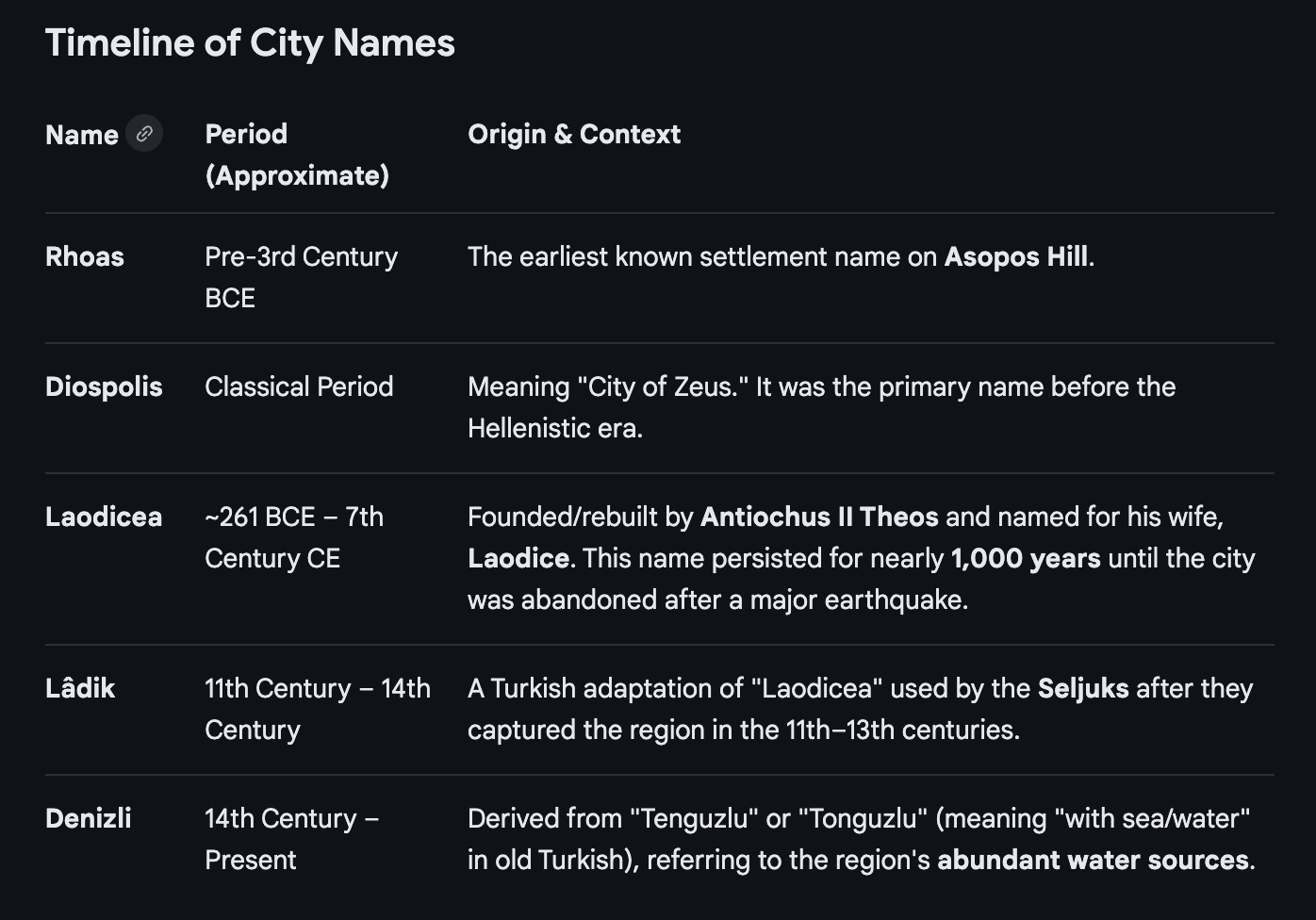
Before it was named Laodicea in the 3rd century BC (let’s say 250 BC), the city went through several identity changes. Its history is deeply tied to the fertile valley and the multiple rivers that surround it.
According to Pliny the Elder and archaeological records, the city was known by these names before it became Laodicea: Rhoas, The earliest known name for the settlement. (Just as I said about Ladik, the Rho- sound comes back).
Ra has to do with the sun god, the child of isis and horus. Ra and Isis are often found together, like Mary and Jesus. Let’s keep going.
The city had also been named Diospolis: Meaning "City of Zeus," this name reflects the area's long history as a center for the worship of the Greek god. It kept the religion of the city of Rhoas alive, but changed it to one of their gods’ names. It came back around however to the R/L pattern quickly.
Rhoas > Diospolis > Laodicia > Ladik > Denizli (plus Eskihisar, the site of ruins)
Eskihisar: This is the modern name of the village and site where the ancient ruins of Laodicea are located.
Denizli: The modern city center was established roughly 6 km south of the ancient site in the13th century(Kaleiçi district) because it had better access to water after the ancient city's aqueducts were destroyed.
Often, where things were destroyed or layed over on top of- means something important to find!
Nobody knows just how old the city of Rhoas was.
Laodicea was a wealthy banking and textile center in the Roman province.
Were these the words of Jesus? Not really, they were words from a vision of a different guy. No less, they made it into the bible as if Jesus said it. The "Lecture": This was not a physical speech given by Jesus during his earthly ministry (he never traveled to Turkey/Asia Minor in the Gospels). Instead, it is a vision received by the Apostle John on the island of Patmos, dictating a specific message to the people of Laodicea.
Recent excavations led by Pamukkale University have unearthed remarkable structures at the site, many of which are now visible to visitors.
The "Church of Laodicea": Discovered in 2010, this 4th-century church (300 AD) is one of the oldest known churches in Christianity. It features intact mosaic floors and a baptismal font.
The "Syria Street": A massive colonnaded main street running through the city, now partially restored with its original columns re-erected.
Temple A: A large temple complex with a glass floor installed above the excavation, allowing you to walk over the underground vaults and substructures.
The Sacred Agora: One of the largest agoras (public squares) in the ancient world, covering a massive area with surrounding porticoes.
Zeus Statue: In 2019, a 3-meter tall statue of the Emperor Trajan was found, along with a head of Zeus, highlighting the city's connection to its old name, Diospolis.
Celal Şimşek’s Scorpions: Look for the relief carvings of scorpions on the stones of the monumental fountain; they were likely an ancient apotropaic symbol (to ward off evil) or a zodiac reference.
The Deep History of "Rhoas"
The history of the settlement before it became the Greek city of Laodicea is ancient and somewhat shadowy, but archaeology has clarified much of it.
How Old is it? Excavations have proven that settlement at this specific location (Asopos Hill) goes back to the Chalcolithic Period (Copper Age), around 5,500 BC. This means the site has been inhabited for over 7,500 years.
Who Owned it Before the Greeks? Before the arrival of the Hellenistic Greeks (who renamed it Laodicea), the people here were likely Luwians or indigenous Phrygians.
Luwians: Western Anatolia was the heartland of the Luwian civilization (cousins to the Hittites) during the Bronze Age (c. 2,000–1,200 BC). They spoke an Indo-European language and are often identified with the "Arzawa" lands mentioned in Hittite texts.
Phrygians: By the Iron Age (c. 1,200–700 BC), the Phrygians dominated this region. The name "Rhoas" likely emerged from this local Phrygian or Luwian context BEFORE being Hellenized.
Hellen itself is a term meaning Greek-Egyptian, times of Alexander the Great, a Greek in Egypt, adopting their customs and fanfare.
LU <> RU, not a far leap
Origin of the Name "Rhoas"
Date of Use: "Rhoas" was the name used for the indigenous village on the hill before the city was refounded as "Diospolis" and then "Laodicea" in the 3rd century BCE. It was likely the name used for centuries by the local villagers.
Meaning: The etymology is obscure. Some scholars link it to the river name or a local deity, but it is distinct from Greek roots. It served as the identity of the settlement for potentially over a thousand years before the Seleucid kings arrived.
Cultural Continuity
Continuity: The culture here was remarkably continuous. Even when the Greeks "refounded" the city, the local population (Phrygians/Luwians) remained the labor force and the weavers of the famous black wool. The "Luwian" linguistic and cultural substrate survived in this region well into the Roman period, influencing local religion and names.
Peace & Treaties: This region was a "crossroads" often managed by treaties. The Hittites and Luwians had famous treaties (like the Kadesh Treaty with Egypt, similar diplomacy existed here). The Pax Romana later enforced a similar peace that allowed the banking and textile industries to explode in wealth
Black Wool
Let’s explore how the "black wool" industry specifically connected the ancient indigenous shepherds (from the Rhoas era) to the incredible wealth of the Roman bankers.
The black wool of Laodicea (ancient Rhoas/Diospolis) was the cornerstone of its staggering wealth, effectively turning a rugged shepherd culture into a global fashion and banking empire.
The "Raven-Black" Sheep
Unlike other regions that had to dye their wool, the Lycus Valley was famous for a unique breed of sheep that produced naturally glossy, raven-black wool. This wool was prized for being exceptionally soft and having a "shiny" or "glossy" quality that made it look like a luxury material.
Historians believe this was the result of a highly sophisticated, centuries-old cross-breeding program managed by the local Phrygian and Luwian shepherds long before the Greeks arrived.
These specific sheep were so central to the city's identity that they were featured on local coins. While black sheep exist today, the specific "glossy" breed of Laodicea is considered extinct, having vanished by the 19th century (1800’s).
From Shepherds to "Designer Brands"
The transition from the ancient village of Rhoas to the wealthy Laodicea happened when the local wool was commercialized for the Roman elite.
Laodicea became a massive manufacturing hub for a specific type of seamless tunic called the Trimita. (that RI- sound again, and don’t forget, weaving and sewing was a royal custom controlled by women, connected to temples and dressing the “gods” ie pharohs as living gods, and statues of gods, and for parades).
These black garments became the "designer label" of the Roman Empire. While Roman citizens typically wore white togas for formal events, owning a "Laodicean" black cloak or tunic was a mark of extreme wealth and sophisticated taste.
The textiles were loaded onto galleons and shipped down the Maeander River to the Aegean Sea, reaching as far as Rome, Egypt, and beyond.
The textile industry was so profitable that it necessitated the creation of one of the ancient world's most powerful banking centers.
The city was so rich from wool and banking that when a devastating earthquake hit in 60 AD, the citizens refused financial aid from the Roman Senate, famously declaring they were wealthy enough to rebuild on their own.
This also meant, the people were not so interested in converting right away, doing what these outisder christians wanted them to, thus, the lashing vision from “Jesus”.
The gold exchange in Laodicea was built directly on the profits of the "black gold" (wool).
The Biblical Connection (Revelation 3:18)
The wool industry explains why the "lecture" mentioned in Revelation uses specific imagery. Jesus tells the people—who were proud of their expensive black clothing—to buy "white raiment" from Him. This was a direct, pointed cultural jab at their primary source of pride and wealth.
Phrygian Powder
An eye medication was another of the city's other famous (and very expensive) export.
The Phrygian Powder was a world-famous medicinal export from Laodicea, primarily used as an eye salve (collyrium) to treat various ocular ailments.
Source and Production
The "Phrygian Stone": The powder was made by grinding a specific local mineral known as the Phrygian Stone (lapis Phrygius). Ancient writers like Pliny the Elder described it as a porous, pumice-like mass.
Preparation: To activate its healing properties, the stone was saturated with wine, heated until red-hot with bellows, and then quenched in sweet wine—a process repeated three times.
Form: It was often sold in small, dried cakes or "loaves" (Greek: kolloura), which could be ground back into a fine powder and mixed with oil or water when needed for application.
Egyptian Connections and Roots
While the powder itself was a local Phrygian product, its usage reflects deep ties to ancient medical traditions:
Chemical Overlap: Researchers found that similar ancient Mediterranean eye medications contained high levels of zinc oxide. This mirrors ancient Egyptian eye paints (kohl), which used lead-based compounds and minerals like galena and malachite to fight bacterial infections and block sun glare.
The School of Herophilos: The medical school at Laodicea followed the teachings of Herophilos, an influential Greek physician who practiced in Egypt (Alexandria, specifically). His principle was that "compound diseases require compound medicines," leading to the sophisticated mineral mixtures found in the Phrygian Powder.
Shared Ritual: Like the Egyptians, the people of the Lycus Valley viewed eye health as both a physical and spiritual matter. This cultural backdrop gave weight to the biblical warning in Revelation 3:18, where the "blind" Laodiceans are told to seek spiritual eye salve from God.
Archaeological Evidence
Excavations at the Eskihisar site have confirmed the city's medical prominence. A coin found at the site depictsZeuxis, a famous physician who founded the medical academy near the city around 9 BCE.
The Era: 9 BC is technically Early Roman Imperial (not pre-Roman), but it is pre-Christian. This was about a generation before the ministry of Jesus and roughly 60–90 years before the "Catholic" (universal) church was addressed in the Book of Revelation.
The fact that a doctor was put on a coin (usually reserved for gods or emperors) proves that medicine was integral to the city's religion before Christianity arrived.
The medical school in Laodicea was a "branch campus" of the intellectual tradition started by Herophilus in Alexandria, Egypt (c. 330–250 BC).
In Egypt, Herophilus was the first to systematically dissect human cadavers (a practice taboo in Greece and Rome). Laodicean doctors were trained in this superior Egyptian understanding of anatomy. (Bias in modern scholarship downplays the “Egyptian-ness” of Alexandria, on Egyptian soil, however, this is one example what they were doing was not sourced from Greek practice, it was EGYPTIAN.
Pharmacology: The "compound medicines" (like the Phrygian Powder) were an Egyptian concept. Herophilus taught that complex diseases needed complex chemical mixtures, a method perfected in Egypt and exported to Laodicea.
The curriculum used by Zeuxis (9 BC) in Lad came directly from Egyptian research.
Jesus (or some guy using a vision of Jesus here) used the city's medical fame to contrast physical healing with spiritual truth.
The Council of Laodicea (held much later in 364 AD) eventually established the "Catholic" canon of the Bible in this very same city.
Council of Laodicia, now a Christian Center
By the time the Council of Laodicea met in 364 AD, the city’s identity had shifted from a pagan medical hub to a heavyweight center of the early "Catholic" (universal) Church. This council is famous because it used the city's established prestige and "banking" mindset to bring order to the chaos of early Christianity.
Laodicea was the place where you went to verify the purity of gold, the Council of Laodicea was where the Church sought to verify the purity of Scripture.
I’m curious how this major city was ever overtaken by Christianity at all, when and how.
Christianity "took over" Laodicea not through a sudden conquest, but through a slow infiltration of the city's elite social and economic networks. Instead of overthrowing the wealth, the early church successfully converted the people who owned it.
The Church in Laodicea didn't just inherit the city's ruins; it inherited its high-class culture. The bishops of Laodicea weren't humble shepherds; they were often from the same wealthy families that ran the banking and textile guilds.
Outcomes of the Council: This council produced Canon 60, which provided one of the first official lists of books to be read in church. It essentially "audited" the various religious texts floating around and decided which ones were "legal tender" for the faith.
The Omission: Interestingly, they left the Book of Revelation off the list at that time—possibly because its harsh "lecture" to their own city (calling them "lukewarm" and "naked") was still a bit of a sore spot for the local leaders!
The Council famously passed Canon 29, which forbade Christians from "Judaizing" by resting on the Sabbath (Saturday). Instead, they were told to work on Saturday and honor the "Lord’s Day" (Sunday). This was a move to align the Church with the Roman work week and the urban, professional rhythm of a wealthy trade city.
We see deliberate, consistent shifts in laws to turn them away from their roots.
The ruins at Eskihisar show that when the Christians built their Great Church (the one discovered in 2010), they didn't hold back: They used expensive marble, intricate mosaics, and even glass-tesserae in their decorations—the 4th-century equivalent of "designer branding."
The Baptismal Font: It is one of the largest and most ornate ever found, designed to process large numbers of wealthy converts who were trading their "Phrygian Powder" and "Black Wool" for the new "Universal" faith.
By 364 AD, the Council officially shifted to a Church Hierarchy. They established strict rules for how clergy should behave, ensuring that the Church in Laodicea remained as organized and prestigious as the Roman banks that preceded it.
The faith spread primarily through high-society networks. Wealthy residents converted and turned their massive villas into "house churches".
It is believed that Philemon (of the biblical Book of Philemon) was a wealthy Laodicean who hosted a church in his home. Epaphras, a disciple of Paul, is credited with planting the church by leveraging his local connections in the Lycus Valley. Excavations have uncovered a 2,000-square-meter Roman house (nearly half an acre) that was later converted into a church, complete with 20 columns and a courtyard.
Laodicea had a massive, prosperous Jewish population—estimated at up to 10,000 people. Many of the first Christians here were first Jewish - later converts who already held high status in the banking and textile guilds.
Visual Evidence: Archaeologists found a column in the city's central square featuring a menorah with a cross growing out of it, symbolizing the faith’s direct emergence from the city's established Jewish community.
Because the city's wealth depended on trade guilds, Christian merchants faced a dilemma: join the "Imperial Cult" (worshiping the Emperor) to stay in business, or face poverty.
Many Laodicean Christians chose to "blend in" to keep their status, which is exactly why the Book of Revelation calls them "lukewarm". They weren't necessarily losing their faith; they were just refusing to lose their money. They converted (at least publicly) to keep their wealth.
Built in the 300’s AD, The Church of Laodicea took up an entire city block and was covered in marble and expensive mosaics, effectively replacing the pagan temples as the new center of prestige.
How many pagan temples were there before christianity? Was it more Pagan or more Jewish?
Before Christianity arrived, Laodicea was overwhelmingly Pagan in appearance and administration, but it also had one of the largest and wealthiest Jewish populations in the entire Roman diaspora (ie, when Romans kicked Jews out of their homeland and renamed it to Palestine to erase them from the land).
Archaeologists have identified at least five major temple complexes that would have dominated the skyline, along with numerous smaller shrines. The city was a "supermarket" of deities.
We see temples to Zeus, but also other massive temples labeled things like “Temple A”, possibly because the Deity was so “completely” removed, attempted to be erased by the Christian Romans?
Temple A (The Imperial Religion) : A massive temple on the main Syria Street dedicated to the worship of the Roman Emperors, along with Apollo, Artemis, and Aphrodite. This was the center of political loyalty.
Temple of Athena: Located in the sacred northern district.
Temple of Men Karou: Located just outside the city (near the medical school), this temple honored a local Phrygian moon/healing god. It was the spiritual center of the "Phrygian Powder" industry. (That MN root again!)
Temple of Asklepios: The Greek god of medicine was heavily worshipped here due to the famous medical school.
Shrines to Isis & Tyche: Smaller sanctuaries and statues (like in the Nymphaeums) honored the Egyptian goddess Isis and the goddess of fortune, Tyche.
If you walked the streets, you would see statues of emperors, attend pagan theater festivals, and use coins stamped with pagan gods. The calendar and law were Roman.
Demographically: Shockingly Jewish.
While still a minority compared to the total pagan population, the Jewish community in Laodicea was exceptionally large and integrated—far more so than in most other cities.
The Numbers: Roman records (from a famous trial where Cicero defended a governor who seized Jewish gold) reveal that Laodicea sent 20 pounds of gold annually to the
Temple in Jerusalem
. Based on the tax rate, this indicates a population of roughly 7,500 adult Jewish men.
Total Estimate: With women and children, the Jewish population was likely between 30,000 and 40,000 people.
The "Vibe": Unlike in other cities where Jews often lived in poorer, separated quarters, the Jews of Laodicea were citizens, bankers, and guild members. They were fully integrated into the economy, wearing the same "black wool" and living in the same villas as the Pagans.
The Result: A "Lukewarm" Melting Pot
This specific mix—a Pagan city where the Jewish population was too comfortable and wealthy to be "counter-cultural"—created the exact environment for the "lukewarm" Christianity mentioned in Revelation. The Christians likely emerged from this Jewish group that was already expert at compromising with Roman society to maintain their wealth.
Temple of Men Karou
The "Temple of Men Karou" specifically operated as a "hospital-temple" that competed directly with the Christian healing ministry.
It was more than a place of worship; it was the "Mayo Clinic" of the ancient world. Located about 13 miles northwest of Laodicea (near modern Karahayıt), it was a massive hospital-temple complex that served as the primary medical, social, and economic engine of the entire Lycus Valley.
Before modern hospitals, healing was tied to the divine. The Temple of Men Karou operated as a centralized medical facility:
The God:
Men Karou
was an indigenous Phrygian moon god. Unlike the Greek moon goddess Selene, Men was a powerful male deity associated with time, fate, and physical healing.
The Medical School: The temple was the original home of the Laodicean Medical School. Its physicians practiced the "compound medicine" of Herophilus, which treated complex diseases with complex mineral mixtures, including the famous Phrygian Powder eye salve.
Infrastructure: The site likely utilized the red thermal springs of the region (similar to the famous pools at Pamukkale), which were believed to have therapeutic properties for skin and eye conditions.
When Christianity arrived, it presented a direct threat to the temple’s "monopoly" on healing.
Spiritual vs. Scientific Healing: The temple offered expensive, secret mineral formulas and elaborate rituals. In contrast, the early Christians offered "healing by the Name"—simple prayers and anointing with oil that were free and accessible to all.
The "Amen" vs. The Moon God: Jesus identifying Himself as the "Amen" (the absolute Truth) was a direct challenge to the authority of the moon god Men, who was worshipped as the "father and king" of the valley's destiny.
The "Eye Salve" Taunt: In Revelation 3:18, Jesus tells the Laodiceans to buy "eye salve to anoint your eyes" from Him. This was a biting cultural critique: He was telling them that despite their world-famous "Phrygian Powder" from the Temple of Men Karou, they were still spiritually blind.
The Eventual Takeover
By the 2nd century CE, the medical school became so large that it physically moved from the rural temple site into the city of Laodicea itself to be closer to its wealthy banking clients. Once Christianity became the state religion, the Church essentially "absorbed" the medical prestige of the city. Temple A in Laodicea, once used for pagan worship, was eventually repurposed as an archive and center for the Church.
The Healing Springs
The ancient thermal springs of Hierapolis (modern Pamukkale) were more than just a natural wonder; they were a spiritual epicenter linked deeply to female power, the underworld, and healing deities.
1. The Original "Goddess" of the Springs
Before the Greeks arrived, the springs were likely dedicated to the indigenous Anatolian Mother Goddess, Cybele.
Cybele was the "Mother of the Gods" and ruler of the wild nature of the mountains. The thermal caves, which emitted deadly gases (carbon dioxide), were seen as her direct gateway to the underworld.
The Eunuch Priests: Her priests (the Galli) were famous for being the only ones who could enter these toxic caves without dying (likely by holding their breath or finding oxygen pockets), a "miracle" that proved her power over life and death.
2. The Egyptian Connection: Isis & Cleopatra
Egyptian ties are surprisingly strong here:
Cleopatra’s Pool: The most famous swimming spot in Hierapolis is still called Cleopatra’s Pool (or the Antique Pool). Legend claims Marc Antony gifted these springs to Cleopatra so she could use the mineral-rich water for her beauty regimen. While it's debated if she actually visited in person, the brand of her beauty was definitely used to market the site.
Worship of Isis: As the Roman world embraced Egyptian religions, the goddess Isis became a major figure in Hierapolis and Laodicea. She was often blended with Hygieia (goddess of health).
3. Ancient Names & Female Associations
Hierapolis: Means "Holy City," but some historians believe it was originally named for Hiera, the wife of Telephus (the legendary founder of Pergamum). She was a warrior queen of the Mysians, linking the city’s very name to a powerful female figure.
The "Bride" of the Underworld: The toxic cave (Ploutonion) was dedicated to Pluto (Hades) and his wife Kore (Persephone). The springs were seen as a wedding gift or a connection between the living world of the bride and the dead world of the husband.
Leto: The mother of Apollo and Artemis was also worshipped here. The city held a festival called the Letoia, involving "orgiastic rites" that celebrated fertility and the feminine divine.
4. How the "Holy" Water Became "Lukewarm" Vomit
This context makes the biblical insult even sharper.
The Journey: The water started at Hierapolis as hot, healing, "divine" water (linked to Cybele/Isis).
The Cooling: By the time it traveled 6 miles through the aqueduct to Laodicea, it had cooled down to a tepid, nauseating temperature.
The Insult: Jesus wasn't just talking about temperature; He was saying the Laodicean church had become like their own water supply—no longer "hot" and healing (like the pagan springs of Hierapolis) and not "cold" and refreshing (like the mountain water of Colossae), but a useless, sick mixture that He wanted to "spit out."
The "Gate to Hell" (Ploutonion) thread is hard not to follow.
It was recently rediscovered and found to still kill birds that fly too close to it. The gate is built directly over a deep fissure that emits volcanic carbon dioxide (CO₂), known as The "Breath of Death". The Deadly Lake: Because CO₂ is heavier than air, it settles into a dense, invisible "lake" on the arena floor.
Modern Deaths: During the 2013 excavations, archaeologists watched helplessly as birds and other small animals dropped dead instantly after flying too close to the opening.
Lethal Levels: Modern sensors have measured CO₂ concentrations as high as 91% inside the cave and 35% at ground level—more than enough to kill a human in minutes.
In ancient times, the Galli (eunuch priests of Cybele) would lead massive bulls into the gate. The bulls, with their noses close to the ground, would suffocate and die, while the priests remained standing.
The Trick: Priests knew that the gas was most concentrated near the floor. By standing tall or even stepping on stones, they kept their heads in the oxygen-rich air above the "lake of death".
Hallucinations: While they didn't die, the priests often inhaled enough gas to become "high" or hallucinate, which they interpreted as a divine connection to Pluto.
The temple was a major source of income for the city. Like a dark version of a modern gift shop, priests would sell small birds to tourists. Visitors would throw the birds into the misty arena to watch them "breathe their last," proving the lethal power of the god of the underworld. For a fee, visitors could also consult the Oracle of Pluto, seeking answers from the world of the dead.
Ploutonion / Plutonium: Meaning "Place of Pluto." There is also the Sewer of Charon: Pliny the Elder called it this, referring to the mythical ferryman who rowed souls across the River Styx. As well as The Breath of Cerberus: The toxic gas was believed to be the literal breath of the three-headed dog that guarded the underworld. Dogs (like anubis) were part of the realm of the dogs in Egypt).
the Christians didn't just preach against these sites; they engaged in a literal, physical "cover-up" operation to erase the pagan power of the region.
When the "Gate to Hell" (Ploutonion) was excavated in 2013, archaeologists discovered evidence of a deliberate effort to bury the site and silence its "demons" forever.
1. They literally "Stoned" the Gate to Hell
In the 6th century AD, Christians didn't just abandon the Ploutonion; they attacked it.
The Cap: Excavators found that the entrance to the deadly cave had been intentionally blocked with a massive layer of stones and rubble.
The Purpose: This wasn't just demolition; it was a "sealing" ritual. By physically burying the fissure, they prevented the toxic gas from killing birds and bulls. In doing so, they "hid" the supernatural evidence of the Underworld God. If the gas couldn't kill, the pagan priests lost their primary "miracle," effectively disproving the power of Pluto.
2. The "Vandalized" Statues of Hell
When archaeologists cleared the rubble, they found the statues of the pagan gods toppled and buried face-down, hidden from view for 1,500 years.
Hades and Cerberus: A magnificent marble statue of
(Pluto) and his three-headed dog
Cerberus
was found buried in the debris. Christians had knocked it from its pedestal and buried it to "imprison" the pagan gods in their own pit.
The message: By burying the statue of the "Ruler of the Dead" inside the dead zone, they were declaring that Jesus had conquered death and that Pluto was now the prisoner.
3. The "Overwrite" of Saint Philip
To hide the pagan pilgrimage route, they built a massive Christian "theme park" directly on top of it.
The Martyrion: The Apostle
was martyred in Hierapolis (crucified upside down). In the 5th century, a massive octagonal
Martyrion
(shrine) was built directly uphill from the pagan temple.
Visual Dominance: The church was positioned so that it physically looked down on the pagan site. To get to the new Christian shrine, pilgrims had to walk past the ruined, buried Ploutonion, effectively stomping on the old gods to reach the new one.
4. Hiding the City Name (Regional Context)
This "hiding" practice was common in the region. Just a few miles away, the city of
Aphrodisias (named after the goddess of sex and love, Aphrodite) was so offensive to the Christians that they literally "deleted" its name from the map.
The Rename: They renamed it Stauropolis , meaning "City of the Cross." They chiseled the name "Aphrodite" off of inscriptions, literally hiding her name from history to purify the region.
In 60 AD, a massive earthquake leveled the cities of the Lycus Valley. While neighboring cities like Hierapolis and Colossae begged Rome for financial aid, Laodicea did something that shocked the Empire.
1. The Ultimate Act of Pride
The city was so wealthy from its banking and black wool trade that the citizens famously refused the "bailout" from Emperor Nero. The Roman historian Tacitus recorded:
"Laodicea, one of the famous cities of Asia, having been laid low by an earthquake, rose again, and by her own resources, without any help from us."
The people were so proud that they rebuilt their temples, theaters, and markets using their own gold. This "self-made" attitude became the city's defining characteristic.
2. The Spiritual "Audit"
When the "lecture" in Revelation was written (roughly 30 years later), it directly addressed this specific event.
The Claim: The people were saying, "I am rich; I have acquired wealth and do not need a thing." (Revelation 3:17).
The Reality Check: The message countered that despite their rebuilt marble walls, they were "wretched, pitiful, poor, blind, and naked."
3. "Behold, I Stand at the Door"
The most famous line from this "lecture"—"Behold, I stand at the door and knock"—is often used today as a gentle invitation, but to a Laodicean, it was a legal threat.
The Closed Door: In a banking city, a closed door meant the business was "shut" or bankrupt.
The Inspection: If a high-ranking official or a "true witness" knocked on your door in Laodicea, it was usually for an audit.
The Irony: They had rebuilt their city's literal doors and gates with their own money, feeling secure behind them. The "lecture" was warning them that while they had successfully "shut the door" on Roman help, they had accidentally shut the door on the very "Amen" (the Truth) they claimed to follow.
4. The "Gold" Refinement
Because they were a banking hub, the message told them to buy "gold refined in the fire" from God. This was a direct jab at their local mint. Their local gold was "dirty" because it was tied to the pagan trade guilds; the "refined" gold was a metaphor for a faith that could survive a shaking even worse than the earthquake of 60 AD.
Today, when you visit the ruins at Eskihisar, you can still see the massive cracks in the stone and the fallen columns from the many earthquakes that eventually—by the 7th century—broke the city's pride for good, leading the people to abandon the site and move to what is now Denizli.
The Ancient "Banking District" (
Laodicea Agora
)
In ancient times, "banking" wasn't done in a private glass tower; it was public, loud, and tied to the
Central Agora
(marketplace).
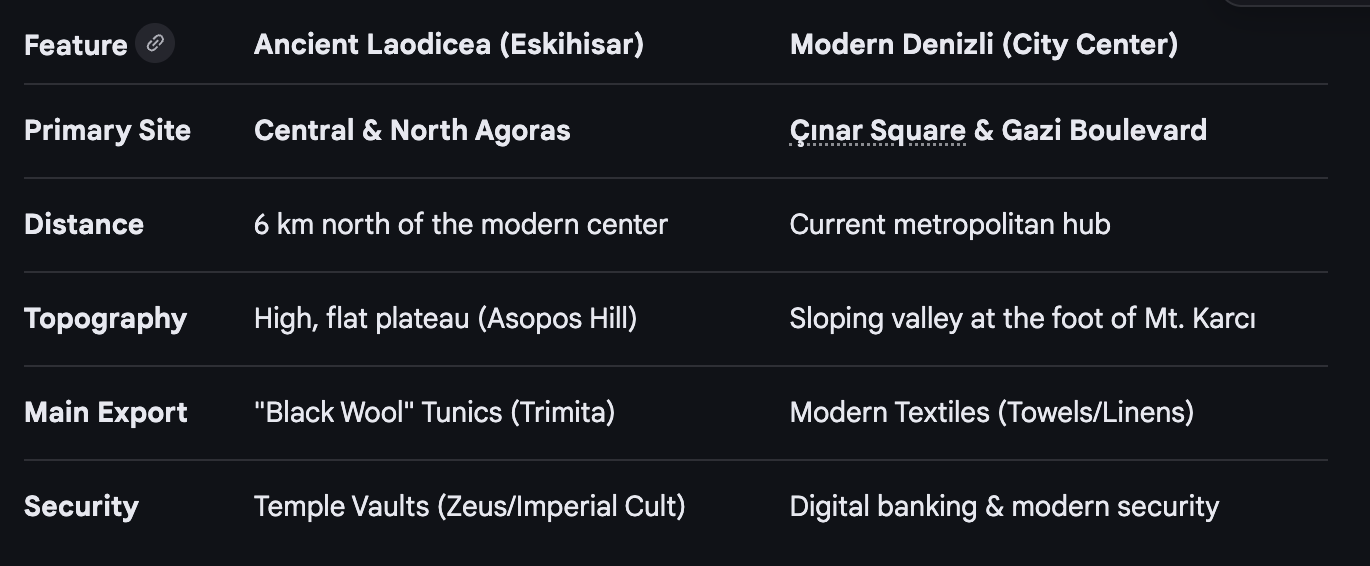
Location: The ruins are located at Eskihisar, about 6 km north of modern Denizli.
The Hub: The
Central Agora
and the
Sacred (North) Agora
served as the financial heart. This is where money changers, tax collectors, and representatives of the textile guilds operated under the shade of massive colonnaded porticos.
The Vibe: Imagine a massive open-air square (the
North Agora
alone is nearly 9 acres) surrounded by shops. Bankers sat at tables (trapeza) near the
Syria Street
entrance, exchanging Roman denarii for local currency and financing the massive "black wool" exports.
The "ATM" of 60 AD: The city's wealth was kept in secure vaults beneath the temples, essentially using the "fear of the gods" as a security system for the city's gold.
2. The Modern Financial Center (Denizli)
After the earthquakes of the 7th century, the "banking" shifted 6 km south to where the water was more reliable.
Location: The modern financial and administrative heart of Denizli centers around
(Delikliçınar Meydanı) and the surrounding Merkezefendi district.
The Hub: While the ancient bankers stood in the Agora, modern banking happens along
Gazi Mustafa Kemal Boulevard
and near the Denizli Municipality buildings. This area is packed with national banks (Ziraat, İş Bank, etc.) and the offices of the modern textile magnates who still drive the city's economy.
The Successor: Modern Denizli is still a global leader in textiles (especially towels and bathrobes), proving that the "business DNA" of ancient Laodicea never actually left the valley.
Egyptian Connections
The connections between Egypt and the Laodicea-Denizli region go past medicine and wool dying techniques- the area was part of a vast network where Egyptian culture, religion, and politics were deeply embedded.
The Amun has more than enough reason to be here as a main god that even Jesus would want to tie himself to.
The Royal Egyptian Alliance (250 BCE)
Laodicea's very foundation was tied to a power struggle with Egypt.
The Marriage Treaty: In 250 BCE, King Antiochus II (the founder of Laodicea) made a treaty with Ptolemy II of Egypt. To seal the peace, Antiochus married Ptolemy’s daughter,
Berenice, and exiled his first wife, Laodice (for whom the city is named).
The Scandal: After Ptolemy died, Antiochus returned to Laodice. Rumors persist that
Laodice eventually poisoned him and Berenice to secure the throne for her children, making the city's early history a direct result of Egyptian-Seleucid conflict.
The Universal Religion of Isis
While the city was officially Greek and then Roman, the Egyptian Goddess Isis had a massive following in the Lycus Valley.
Archaeological Finds: Excavations at Laodicea have uncovered the torso of a statue of Isis. In nearby Hierapolis (Pamukkale), the "Antique Pool" is traditionally called
Cleopatra's Pool, reflecting the legend that the Egyptian queen favored the area's thermal waters for her beauty.
Religious Fusion: Isis was worshipped here as a "universal" goddess of fate and protection. This made her a direct competitor to early Christianity, which also claimed to offer a "universal" savior.
3. The "Egyptian Blue" Trade
The world-famous textile industry of Laodicea likely relied on Egyptian chemical knowledge.
Synthetic Pigments: Egyptian Blue, the first synthetic pigment in history, has been identified in regional trade networks and nearby cities like Ephesus.
The Blue & Black Link: While Laodicea was famous for its natural black wool, its high-end textile guilds were masters of dyeing. They likely imported Egyptian "mordants" (chemical fixatives) and minerals to create the deep, stable colors that made their garments "designer" status across the Roman Empire.
UNESCO World Heritage Centre +3
4. Architectural Overwrites
The region contains "Egyptianized" buildings that were later claimed by the Church.
Red Hall Basilica: Bergama/İzmir, Türkiye (IZ! sound)
In the nearby city of Pergamum (part of the same "Seven Churches" circuit), a massive temple originally built for Egyptian gods (likely Serapis and Isis) was later converted into a Christian church. This shows a broader regional pattern of Christianity physically "building over" Egyptian religious sites.
The Martyrion of Saint Philip in Hierapolis stands as one of the most aggressive physical "overwrites" of paganism in early Christian history. Built in the 5th century, this monumental complex was designed to visually and spiritually conquer the terrifying "Gate to Hell" (Ploutonion) located just downhill.
The Octagonal Shield against "Hell"
The shrine was built as a massive octagon, a shape early Christians used to symbolize "the eighth day" or eternal life.
Ertunga Ecir
The Position: It was placed high on a hill overlooking the entire city, making it the most visible landmark.
The Symbolism: By placing the shrine of a man who supposedly conquered death directly above the "portal to the underworld," the Church was physically demonstrating that the "Gate to Hell" had been defeated by the Resurrection.
Replacing "Serpent Worship"
According to the Acts of Philip, the city was a center for snake and dragon worship. Legend says Philip killed a giant serpent or dragon in a local temple through prayer, which led to mass conversions. You can still see ancient depictions and statues in the region showing Saint Philip stepping on a dragon or suppressing a serpent, representing the replacement of indigenous Phrygian and Egyptian-style nature cults with Christianity. (Just like Saint Patrick drove the “snakes” out of Ireland, a land that never had snakes).
The Rediscovery of the "Real" Tomb (2011)
For centuries, pilgrims believed Philip was buried inside the hilltop octagonal Martyrium. However, in 2011, archaeologist Francesco D'Andria made a shocking discovery:
The Tomb Church: Philip's actual 1st-century Roman tomb was found about 40 yards away in a separate, smaller church.
Pilgrim Graffiti: The tomb was covered in crosses and inscriptions from ancient travelers, proving that this specific spot was a "holy magnet" that drew people away from the pagan theaters and temples below.
Cleansing the Water Rituals
Just as the Pagans used the thermal springs for "miraculous" healing, the Christians built ritual baths right next to Philip's tomb.
Memphis Tours
The Competitor: They created their own healing center where pilgrims would practice "incubation rites"—sleeping near the tomb in hopes that Saint Philip would appear in their dreams to heal them, directly mimicking (and replacing) the older medical rituals of the Temple of Men Karou.
But there were much older marriage contracts between people living in what is now called Turkey and Egypt- well before the Ptolemies.
known to historians as the Zannanza Affair (or the Dahamunzu Affair). It is one of the most dramatic diplomatic "what-ifs" in ancient history, occurring during the late 18th Dynasty of Egypt (roughly 1323 BCE), nearly 1,000 years before the Ptolemies.
"Give me one of your sons". Please.
After the death of a Pharaoh—most likely Tutankhamun—his widow, Queen Ankhesenamun (referred to in Hittite texts as Dahamunzu), found herself in a desperate position. Surrounded by powerful officials like the Vizier Ay and the General Horemheb, she did not want to marry a "servant" to keep the throne.
She wrote a shocking letter to the Hittite King Suppiluliuma I, who ruled from his capital in central Turkey:
"My husband has died and I have no son. They say about you that you have many sons. You might give me one of your sons to become my husband... To me he will be husband, but to Egypt he will be king."
The Betrayal: The Death of Prince Zannanza
The Hittite king was initially suspicious, wondering if it was a trap. After sending an envoy to verify the Queen's sincerity, he eventually agreed and sent his son, Prince Zannanza, to Egypt to be crowned Pharaoh.
Zannanza never reached the Egyptian capital. He was murdered en route, likely near the border.
Hittite records explicitly accused "the people of Egypt" for the slaying. Most historians believe the hit was ordered by Ay or Horemheb to prevent a foreigner from taking the Egyptian throne.
Following the murder, Ankhesenamun was forced to marry the elderly Ay, who then became Pharaoh. She disappeared from history shortly after.
Impact on the Region
This event triggered a brutal war between the Hittites (Turkey) and the Egyptians.
During the conflict, Hittite soldiers captured Egyptian prisoners who were carrying a deadly plague.
This plague devastated the Hittite capital and eventually killed King Suppiluliuma I himself, the very man who had sent his son to Egypt.
While this happened centuries before the city was named Laodicea, the "marriage contracts" and treaties between the Anatolian kings (Hittites/Luwians) and the Egyptian Pharaohs established the long history of diplomacy and betrayal that defined this region of Turkey.
The Amarna letters in general share how important this pre-Turkish kingdom was. We hardly have to explain that Egypt had power and wealth, but the fact the people here requred a truce means they were a true power. In a place where today, has the last value to its currency in all the world. This is not due to anything their fault, it is due to the enormous value of the place and people attempting to conquer it time and time again.
The Amarna Letters are a collection of roughly 382 clay tablets found in the ruins of Akhetaten (modern Tell el-Amarna), Egypt, dating back to the 14th century BCE. They represent the oldest surviving archive of international diplomacy and offer a rare look at the "Great Powers" of the Bronze Age—including the Hittites in modern Turkey and the Egyptian Pharaohs.
Most were discovered in 1887 in a building identified as the "Place of the Correspondence of Pharaoh". They cover roughly a 30-year period during the reigns of Amenhotep III, Akhenaten, and the early years of Tutankhamun.
Language of Diplomacy: Although found in Egypt, the letters are not written in Egyptian hieroglyphs. Instead, they use Akkadian cuneiform, which was the "lingua franca" (international language) of the ancient world.
"Brotherly" Correspondence: Rulers of major powers like the Hittites addressed the Pharaoh as "my brother," discussing equal exchanges of gold, lapis lazuli, and royal marriages.
Distribution: Today, these tablets are scattered in major museums, with the largest collections held at the Vorderasiatisches Museum in Berlin, the British Museum in London, and the Egyptian Museum in Cairo.
The Metropolitan Museum of Art +5
The "Zannanza Affair" Tablet
While the Amarna Letters cover the period just before the Zannanza incident, the specific records of that betrayal are found in a related set of Hittite tablets called The Deeds of Suppiluliuma.
The widow queen in those texts is called Dakhamunzu (an Egyptian title, not a name), though most historians agree she was Ankhesenamun, the widow of Tutankhamun.
This specific tablet, currently housed in the Istanbul Archaeological Museum in Turkey, describes the request for a son and is considered the catalyst for centuries of hostility between the two empires.
Modern Resources
If you want to read the full text of these ancient "complaint letters" and diplomatic deals, several scholarly translations are available:
The Amarna Letters edited by William L. Moran is the standard authoritative English translation.
Detailed linguistic studies like Language of Amarna - Language of Diplomacy explore how scribes from different cultures communicated across these tablets.
The Hittite Plague Prayers are some of the most haunting and honest documents from the ancient world. They were written by King Mursili II (the son of Suppiluliuma I) about 20 years after the murder of Prince Zannanza.
The plague that the Hittite soldiers brought back from the Egyptian war devastated the kingdom for twenty years, wiping out the population and killing the King’s father and brother.
1. The "Confession" of a Son
Mursili II didn't blame the gods; he blamed his own father. In the tablets, he holds a "spiritual audit" to find out why the plague won't stop:
The Broken Treaty: He concludes the plague is a punishment because his father, Suppiluliuma, broke a sacred treaty with Egypt (the Kuruštama Treaty) when he attacked them following Zannanza's murder.
The Plea: Mursili cries out to the Storm God: "It is true, the father sins, but does the son have to pay? Because I have confessed my father's sin, let the plague depart!"
2. The Egyptian "Biological Weapon"
While the Hittites saw it as divine wrath, historians see it as one of the first recorded instances of war-driven pandemic.
The Source: The Hittite texts explicitly state the plague came from Egyptian prisoners of war.
The Disease: Scholars believe it was likely tularemia (carried by animals/ticks) or a form of the bubonic plague. Because the Hittites were a "land power" in Turkey and the Egyptians were a "river power," their immune systems were defenseless against each other's local germs.
3. The Rituals of "Hiding" and Cleansing
To stop the plague, the Hittites used "Scapegoat rituals" that share striking similarities with later biblical and regional traditions:
The Scapegoat: They would take a ram or a woman, deck them in jewels and "kingly" clothes, and drive them toward the border of the enemy (Egypt), shouting, "Take this plague back to your own land!"
The Connection to Laodicea: This region of Turkey (Phrygia) inherited these Hittite concepts of "purity" and "pollution." This deep cultural memory eventually evolved into the medical school at Laodicea and the obsession with "eye salves" and "cleansing" that we discussed earlier.
4. Where the Tablets are Now
The original clay tablets of these prayers were found in the Hittite capital, Hattusa (modern Boğazkale, Turkey).
Museums: They are primarily housed in the Museum of Anatolian Civilizations in Ankara and the Istanbul Archaeological Museum.
The "Amen" Link: In these prayers, Mursili often ends his pleas with the Akkadian/Hittite equivalents of "Let it be so," the same structural root as the "Amen" used by Jesus in His lecture to the same region 1,300 years later.
Then there is the Hittite capital of Hattusa, where the original letters from the Egyptian Queen were found.
The city is famous for its Royal Archives, which contained over 30,000 cuneiform tablets. high ridge served as the royal residence and administrative acropolis. The specific letter from the Egyptian Queen (Ankhesenamun) was part of the "Deeds of Suppiluliuma," found within these palace archives.
The World's First Library: Archaeologists consider Hattusa to be home to one of the world's first organized libraries. The tablets were stored on wooden shelves, often with clay "labels" identifying their contents—much like a modern filing system.
Hattusa was a masterpiece of urban planning, surrounded by over 6 km (almost 4 miles) of massive stone walls. Several iconic gateways that still stand today (with noted synchrony with Egypt):
The Lion Gate: Guarded by two fierce stone lions intended to ward off evil spirits.
The Sphinx Gate: Located at the highest point of the city, featuring sphinxes with human faces and lion bodies.
The King's Gate: Adorned with a high-relief carving of a warrior god or king.
Yerkapı (The Earth Gate): A unique 70-meter-long stone tunnel (postern) running under the Sphinx Gate, used as a sally port for soldiers to surprise enemies
A whole language family is named after the Hittites.
The Great Temple: Located in the Lower City, this massive complex was dedicated to the Storm God Teshub and the Sun Goddess Arinna. (that inna anna sound, i associate with the word ANNUAL).
Just 2 km from the city walls lies Yazılıkaya (AZI sound!!) , an open-air rock sanctuary where the Hittites carved over 60 gods into the natural cliff faces. This site served as a religious center for royal ceremonies and reflected the "thousand gods of Hatti". This rock monument means “inscribed rock” can be seen as a political tool to unify a fractured empire.
In it, 90 gods are carved in a procession. The Hittites called themselves the "Land of a Thousand Gods." Instead of forcing conquered nations to worship Hittite gods, they stole (aka absorbed) the gods of the people they conquered and added them to the rock walls at Yazılıkaya.
If you were a soldier from a conquered tribe (like the Luwians or Hurrians), you didn't feel like you were fighting for a foreign king; you saw your god marching in the Hittite procession. This created a fanatically loyal, multi-ethnic army that didn't rebel—a weakness that often plagued Egypt.
Recent research suggests Yazılıkaya was also a giant lunisolar calendar (something learned from Egypt). The arrangement of the gods allowed priests to track days, months, and years. Controlling "Time" gave the King absolute authority over the planting and harvest, proving he was the master of the cosmos.
Today, the ruins of Hattusa are a UNESCO World Heritage Site, and many of the original tablets and statues are housed in the Museum of Anatolian Civilizations in Ankara and the local Boğazköy Museum.
Battle of Kadesh (1,274 BC, How one could ever stand up to Egypt, leading to a stalemate and peace treaty!)
Hittites gained power with military technology (the first "tanks" and iron weapons) and a genius psychological strategy (weaponizing religion).
Chariot differences:
Egypt's Chariot: Light, fast, and made of wood/leather. It carried two men (driver + archer). It was designed to shoot arrows from a distance and run away. (may have been from hittite/mesopotamian invention to carry around the stature of inann, brought into Egypt by the Hyksos people, semetic speaking people possibly from Turkey learning from the Middle East in 1,650 BC).
Hittite Chariot: Heavy, wide, and reinforced. It carried three men (driver + fighter + shield bearer). This third man was the game-changer. He protected the other two, allowing the chariot to crash directly into infantry lines like a tank, smashing formations rather than just harassing them.
Note here on the history of the chariot, which may have Hittite connections, in how it came to Egypt at all. the ancestor of the war chariot was likely a religious vehicle before it was a military one.
The "God's Car": Long before the light, fast war chariot was invented (c. 1800 BCE), the Sumerians in Mesopotamia (modern Iraq) used heavy, solid-wheeled wagons to transport statues of their gods during festivals (like the Akitu New Year festival).
Inanna (later Ishtar) was the primary goddess of war and sexual love. In Mesopotamian texts, she is famously described as harnessing the "Seven Storms" like a chariot.
It is believed that the prestige of "driving the god's statue" helped develop the skills and technology (spoked wheels, lighter frames) that were later adapted for kings to ride in battle.
2. The "Turkey" (Anatolian) & Chariot Connection
While the Hyksos were primarily Semitic speakers (from the Levant/Syria), the specific chariot technology they brought likely came from the non-Semitic peoples of the north (modern Turkey/Syria border).
The Hurrians & Hittites: The "high-tech" chariot (light, spoked wheels, horse-drawn) was perfected by the Hurrians (kingdom of Mitanni) and the Hittites (in Anatolia/Turkey).
The "Learning" Phase: The Semitic tribes (Hyksos) living in Northern Syria would have "learned" this technology from their northern neighbors (Hurrians/Hittites) or served as mercenaries for them. When the Hyksos migrated south into Egypt, they brought this northern "super-weapon" with them.
3. The Hyksos Vector (The Delivery System)
The Hyksos (known as Heka Khasut or "Rulers of Foreign Lands") were the bridge.
Who they were: They were likely Western Semitic peoples (Canaanites/Amorites).
What they brought: When they took over Northern Egypt (c. 1650 BCE), they introduced the horse and the chariot—neither of which existed in Egypt before.
The Goddess Connection: Crucially, the Hyksos introduced the worship of Astarte (the Canaanite version of Inanna/Ishtar) to Egypt. In Egypt, Astartebecame the patron goddess of the chariot and horses, often depicted driving a chariot herself.
Summary of the Chain
Mesopotamia: Heavy wagons carry statues of Inanna.
Turkey/Syria (Hurrian/Hittite): Wagons evolve into light, fast war chariots.
Levant (Hyksos): Semitic people adopt the chariot and the goddess (Astarte/Inanna).
Egypt: Hyksos invade, bringing the chariot and the "Chariot Goddess" (Astarte) to the Nile, forever changing Egyptian history.
The Egyptian word for chariot (wrrt) is even a loan word from the Semitic language, proving they "bought the car and the name" from these foreign visitors.
———————————————
The Hittites were the Lords of Iron. While Egyptian soldiers were still using softer bronze swords that could bend or dull, Hittite elites wielded iron weapons that could shatter bronze shields. They guarded the secret of iron smelting as a state monopoly
In the Battle, Hittites hid thousands of chariots behind the city of Kadesh, completely tricking Egyptian Pharoah Ramses II. Both sides claimed victory, but history tells the truth: The Hittites kept the city. Ramses went home and carved "victory" on his walls, but he never captured Kadesh.
Just Like Mary and Isis (Aset) merged, so did Ishtar and Inanna
How did the names Inanna and Ishtar connect?
The names Inanna and Ishtar became connected through a process of historical syncretism, where two originally independent goddesses from different cultures were merged into a single identity.
Two Names, Two Languages
The primary distinction between the two names is linguistic and cultural:
Inanna is the Sumerian name, likely deriving from nin-an-ak, meaning "Lady of Heaven".
Ishtar is the Akkadian (Semitic) name. It is etymologically related to the West Semitic god Attar, an astral deity also associated with the planet Venus.
The Political Merger
The formal "joining" of these two goddesses occurred over 4,000 years ago during the rise of the Akkadian Empire under Sargon the Great (c. 2,334–2,154 BC).
Enheduanna's Influence: Sargon’s daughter, the high priestess and poet Enheduanna, played a crucial role in this connection. She wrote famous hymns that identified the Sumerian Inanna of Uruk with the Akkadian Ishtar of Agade to help unify the newly conquered Sumerian city-states with the Akkadian north.
Evolution of Traits: While both were goddesses of love and war, their merger combined Inanna's more "poetic and intimate" nature with Ishtar's "fierce and lustful" aspects.
Shared Identity
By the Old Babylonian period, they were effectively interchangeable.
Celestial Aspect: Both were identified with the planet Venus as the morning and evening star.
Universal Title: Inanna's title, "Queen of Heaven," became the standard way to refer to Ishtar throughout later Mesopotamian history.
Global Legacy: This connected identity eventually spread westward, influencing the Canaanite Astarte, the Greek Aphrodite, and the Roman Venus.
Exploring the myths of Inanna's descent into the underworld help us see how her personality differed in the earlier Sumerian versions compared to later Akkadian ones.
While the core story of a goddess descending through seven gates is shared, the Sumerian Inanna and Akkadian Ishtar versions differ significantly in their tone, motivations, and the consequences of their journey.
Inanna (Sumerian): She is a cunning strategist. She uses the funeral of her sister Ereshkigal’s husband, the Bull of Heaven, as a polite pretext for her visit. She meticulously prepares by giving her servant, Ninshubur, specific instructions on which gods to visit if she doesn't return.
Ishtar (Akkadian): She is much more aggressive and impulsive. She arrives at the gate and threatens to"smash the door-posts"and bring up the dead to eat the living if she isn't let in immediately. She doesn't even offer a reason for her visit; her behavior itself signals her intent to dominate.
The Face-Off with Ereshkigal
Inanna (Sumerian): When she finally reaches the throne room, she manages—possibly through cleverness—to make Ereshkigal rise and sits on the throne herself. This direct challenge to her sister's power leads the seven judges of the underworld, the Anunna, to strike her dead.
Ishtar (Akkadian): There is no clever maneuvering. Ishtar simply throws herself at Ereshkigal in a rage as soon as they meet. Ereshkigal, angered by her presence, orders her servant Namtar to unleash sixty diseases upon Ishtar's body, disfiguring her.
Cosmic Consequences
Inanna (Sumerian): The focus is on agricultural balance. Her descent reflects the natural cycle where her husband, Dumuzi, must eventually take her place for half the year, representing the death and rebirth of vegetation.
Ishtar (Akkadian): The stakes are more immediate and dire for the entire planet. While
Ishtar is in the underworld, all procreation on earth stops. Neither humans nor animals mate, and no plants grow. This emphasizes Ishtar's indispensable role as the goddess of sexual desire and reproduction.
The Replacement (Dumuzi vs. Tammuz)
Inanna (Sumerian): After her resurrection, Inanna returns to find Dumuzi feasting on a throne instead of mourning her. Enraged by his indifference, she looks at him with the "eye of death" and chooses him as her substitute.
Ishtar (Akkadian): In this version, Ereshkigal actually shares some responsibility for the replacement. She orchestrates a setup by ordering her demons to care for Tammuz and introduce him to "joy girls," ensuring Ishtar will find him in a cheerful state rather than a mourning one, thus provoking her wrath.