
The removal of the feminine was never only about women.
That is the argument that took me the longest to see clearly, and the one I believe matters most. When a culture systematically pushes out the feminine principle — not just women as people, but the entire cluster of values, practices, relationships, and ways of knowing that the feminine represents — the damage spreads in every direction simultaneously. You cannot remove one thread from a living web without the whole structure changing shape.
Here is what was removed, and when, and what we lost when it went:
The Jews — the people of the book, the keepers of the oldest layer. The demonization of Jewish people by Christian Europe was not incidental to the story of Western religious history. It was structural. The people who carried the oldest surviving written tradition — who preserved the Hebrew Bible, the Talmud, the mystical Kabbalah, the memory of Asherah and the Queen of Heaven — were systematically blamed, expelled, restricted, tortured, and murdered. Pogroms. Inquisition. Ghetto walls. Forced conversion. Holocaust. And with each wave of persecution, more of the living transmission of what came before was severed. To know Christianity you must know Judaism. To know Judaism you must know Egypt. That chain of knowing was one of the things anti-Semitism was designed, consciously or not, to break.
Indigenous and African peoples — the living libraries of the oldest wisdom. When European colonial powers encountered peoples who had maintained unbroken relationships with the land, with plants, with ancestors, with cyclical time, with communal ritual, with the sacred embedded in daily life — they did not see wisdom. They saw primitive. They saw heathen. They saw obstacle. The Doctrine of Discovery, issued by papal decree in the fifteenth century, declared that any peoples unwilling to convert to Christianity could be treated as subhuman, their land taken, their bodies enslaved. This was not a rogue policy. It was official theology. And what it destroyed — the botanical knowledge of healers across the Americas, the astronomical wisdom of African civilizations, the matrilineal governance structures of dozens of nations, the living oral traditions that carried ten thousand years of ecological knowledge — cannot be fully calculated. We are still living in the impoverishment of that destruction. When we wonder why we feel disconnected from the land, from the seasons, from the food we eat, from the rhythms of our own bodies — part of the answer is that the people who knew how to maintain those connections were systematically killed or silenced or assimilated into forgetting.
Plant medicines and healers — the women who knew. Before the word herbalist, before the word healer, before the word midwife became a legal category — there were women who knew the plants. Who knew which root brought on a fever and which broke one. Who knew how to ease a birth and how to prevent a pregnancy and how to ease the dying. This knowledge was accumulated across thousands of years of careful, embodied, intergenerational observation. It was not superstition. It was pharmacology before pharmacology had a name. And it was systematically destroyed. The European witch trials — running roughly from the fourteenth through the seventeenth centuries, killing an estimated 40,000 to 60,000 people, the overwhelming majority of them women — were not primarily about witches. They were about eliminating the independent authority of women who held knowledge the institution could not control. The plants did not disappear. The knowledge of how to use them safely, ceremonially, and medicinally was driven underground, burned with the women who carried it, or survived only in fragments that we are still trying to reconstruct today.
Psychedelics and altered states — the direct line to the divine. Every major religious tradition on earth has, in some form, a practice of altered consciousness: fasting, rhythmic movement, drumming, chanting, breathwork, vision quests, plant medicines. These practices exist because they work — because the human nervous system is capable of states of perception that feel sacred, connective, and transformative, and because cultures that did not find ways to access those states tended to feel the absence. The institutional church's campaign against ecstatic religious experience was not a coincidence. It was a campaign against direct access to the divine — against the possibility that any person, without the mediation of a priest, without the authority of the institution, could encounter something real and come back changed. Peyote ceremonies were outlawed. Ayahuasca traditions were suppressed. The mushroom traditions of Mesoamerica were buried so thoroughly that they were only rediscovered in the 1950s. Scientists were prohibited from studying psychedelics for twenty years in the twentieth century. The campaign was not about safety. It was about who gets to stand between a human being and God.
Sacred music and dance — the body's way of praying. I have written elsewhere in this book about the suppression of the frame drum, the silencing of women's voices in church, the castrati, the Council of Laodicea, the outlawing of the tambourine. But the suppression of sacred music and dance was also a suppression of African tradition — of the ring shout, of drumming, of embodied worship, of the understanding that when a body moves in rhythm with other bodies, something happens that is not separate from the sacred but is the sacred. What the enslaved people of the African diaspora preserved through their music — what became gospel, blues, jazz, rock and roll, the entire emotional grammar of modern popular music — they preserved despite laws against drums, despite the banning of African languages and rituals, despite every institutional force arrayed against them. They turned the floor into a drum when the drum was taken. That survival is one of the most extraordinary acts of cultural resistance in human history. And it happened in the body, in the breath, in the beat — the three places the institution could never fully reach.
The removal of men from family life. The harm of patriarchy is not only to women. Men were removed from the domestic world — from birth, from early childhood, from the daily rhythms of family — so that they would be available to the labor force, the military, the imperial project. A man who is fully present to the birth of his child, who is embedded in the daily life of his family, who watches children grow and elders age and meals be prepared and illness move through a household — that man is harder to send to war. He has something too specific to lose. The culture that built the empire needed men who were unmoored enough to go. And so fatherhood was systematically diminished: reduced to provision, to authority, to the occasional presence, to the paycheck. The joy of it — the particular, irreplaceable joy of being needed by something small and learning to be in the world — was treated as optional, feminine, secondary. The fathers who missed it paid a cost no one counted. The children who grew up without fathers fully present paid a cost everyone is still counting.
The isolation of women and the starvation of the next generation. A woman who is isolated, malnourished, overworked, disrespected, and denied access to the natural world does not disappear. She makes bodies. She grows and feeds the next generation of humans with her own tissue. If she is depleted — nutritionally, socially, emotionally, spiritually — the children she makes are built from that depletion. This is not metaphor. It is epigenetics, it is developmental biology, it is the grandmother hypothesis, it is the documented relationship between maternal stress and infant cortisol levels and lifelong health outcomes. The woman who was given the worst cut of meat, who was expected to eat last, who was denied education and mobility and community and the sacred authority of her own body — that woman's depletion was transferred directly into the next generation's body. We built civilizations on the biology of depleted women, and we are still paying the health costs of that inheritance. Favoring the labor force over the creation of life is not an abstract policy choice. It is a decision about what kind of humans the next generation will be. And we made the wrong choice, for a very long time.
Connection to land and animals as sacred. Before the doctrine that the earth was given to man for his use and dominion — before the idea that nature was a resource to be extracted rather than a community to be maintained — there were cultures that understood themselves as part of the living world rather than above it. That understanding was not romantic primitivism. It was sophisticated ecological knowledge expressed in the language available: story, ritual, ceremony, taboo, seasonal practice, relationship with specific plants and animals and places. When that understanding was destroyed — when the sacred groves were cut, when the animals were stripped of their spiritual significance and reduced to livestock, when the land became property rather than relative — the knowledge embedded in those relationships went with it. We have spent the last two hundred years trying to reconstruct with science what those cultures carried as lived wisdom. We are not finished reconstructing it. We may not be able to fully.
These losses are not separate from each other. They are the same loss, experienced from different angles. The woman who could not sing in church, the healer whose plants were burned with her, the African drummer whose drum was confiscated, the Jewish scholar whose library was destroyed, the Indigenous elder whose grandchildren were taken to boarding schools, the father who was told his job was to provide and not to be present, the boy whose body was altered so the Church could have a high voice without a woman — they are all chapters in the same story.
The story of what happens when a culture decides that the sacred must be controlled, the body must be conquered, the feminine must be managed, and the natural world must be subdued.
We are living in the aftermath of that story.
The question is whether we are willing to see it clearly enough to tell a different one.
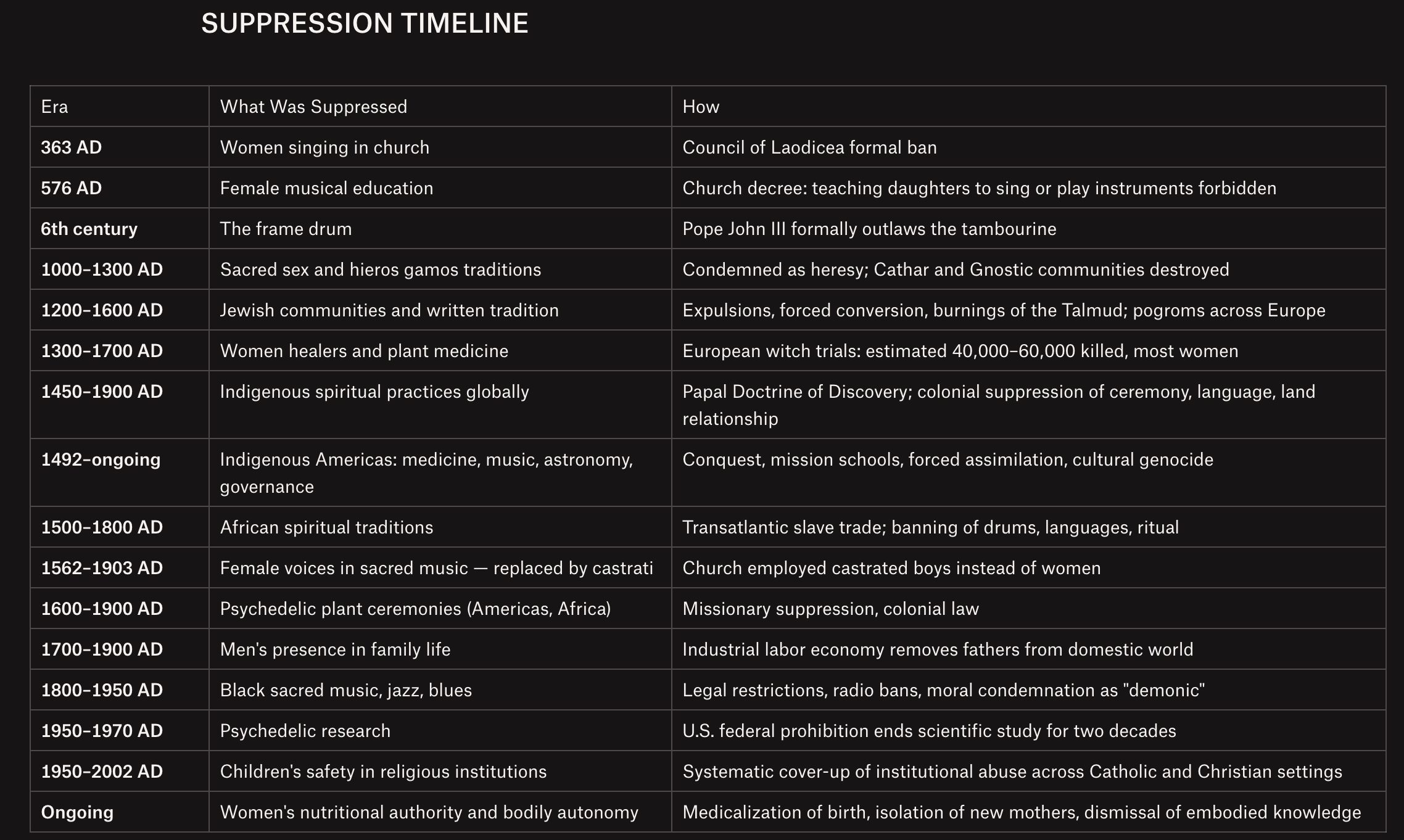
SUPPRESSION TIMELINE
Era, What Was Suppressed, & How
363 AD: Women singing in church, Council of Laodicea formal ban
576 AD: Female musical education, Church decree: teaching daughters to sing or play instruments forbidden
6th century: The frame drum, Pope John III formally outlaws the tambourine
1000–1300 AD: Sacred sex and hieros gamos traditions, Condemned as heresy; Cathar and Gnostic communities destroyed
1200–1600 AD: Jewish communities and written tradition, Expulsions, forced conversion, burnings of the Talmud; pogroms across Europe
1300–1700 AD: Women healers and plant medicine, European witch trials: estimated 40,000–60,000 killed, most women
1450–1900 AD: Indigenous spiritual practices globally, Papal Doctrine of Discovery; colonial suppression of ceremony, language, land relationship
1492–ongoing: Indigenous Americas: medicine, music, astronomy, governance, through Conquest, mission schools, forced assimilation, cultural genocide
1500–1800 AD: African spiritual traditions, through the Transatlantic slave trade; banning of drums, languages, ritual
1562–1903 AD: Female voices in sacred music — replaced by castrati, Church employed castrated boys instead of women
1600–1900 AD: Psychedelic plant ceremonies (Americas, Africa), through Missionary suppression, colonial law
1700–1900 AD: Men's presence in family life, Industrial labor economy and war needs removes fathers from domestic world
1800–1950 AD: Black sacred music, jazz, blues through Legal restrictions, radio bans, moral condemnation as "demonic"
1950–1970 AD: Psychedelic research, through U.S. federal prohibition ends scientific study for two decades
1950–2002 AD: Children's safety in religious institutions through Systematic cover-up of institutional abuse across Catholic and Christian settings
Ongoing: Women's nutritional authority and bodily autonomy through Medicalization of birth, isolation of new mothers, dismissal of embodied knowledge