Appendix III · The End of the Line
August 24, 394 CE
The last hieroglyph, the seven failed bans, and the art that couldn't tell the difference
A few things I want to surface explicitly:
The consul with the axe. With workmen refusing to demolish the altars, the consul Lucius Aemilius Paulus had to personally put his hands to the axe Archäologie Online — the most powerful magistrate in Rome doing manual demolition work because the workers wouldn't. That image tells you everything about the social dynamics of these bans.
Tiberius's priests. Tiberius had the priests of the goddess executed and the cult statue thrown into the Tiber. Wikipedia Then within twenty years Caligula reinstated the cult. The priests were killed for nothing. The goddess was back within a generation.
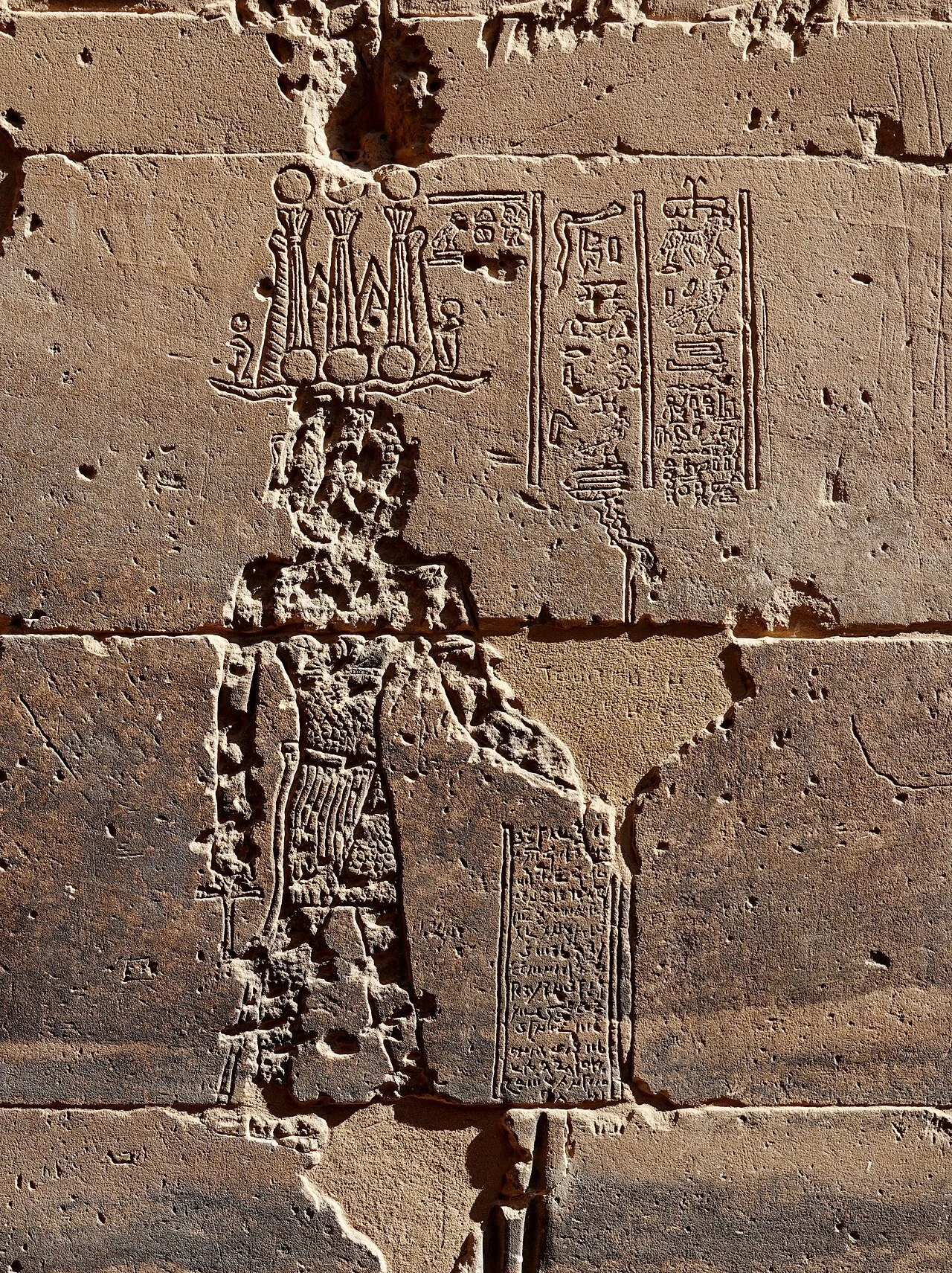
The inscription itself. Nesmeterakhem belonged to a family of priests who staffed the temple. Due to the Christianization of Egypt, it is possible that belief in the old Egyptian gods by Nesmeterakhem's time did not extend far beyond his own immediate family. Shortly after the 394 inscription was made, it is likely that there was no longer anyone alive who could read the hieroglyphs. Wikipedia He knew this. He wrote it anyway.
The last words. He asked for it to last "for all time and eternity" — and it did. The image beside his inscription was deliberately damaged by Christians at some point after. But the words are still there. On an island in Lake Nasser, Nesmeterakhem's last hieroglyph is still readable, if you know how.
The 452 CE demotic inscription is the detail I'd most want you to carry into the book — another generation of the same family, fifty-eight years later, still calling themselves Priests of Isis, still carving. The last known demotic inscription carved at Philae in 452 CE reads: "Esmeyt senior, son of Pakhom, the first prophet of Isis, his mother's name Tshenesmet, the daughter of a chief priest of Isis; Esmet junior the second prophet of Isis, son of Haretyotf." Roger Pearse They would not stop. They had to be stopped.
A man named Nesmeterakhem picked up his chisel on the birthday of Osiris and carved into the stone wall of a temple on an island in the Nile. His father had been the Second Priest of Isis. He was the Second Priest of Isis. His family had staffed this temple for generations. The temples of Egypt had been ordered closed two years before. His writing — in a script almost no one could read anymore — asked that his inscription last "for all time and eternity." It did. No one ever carved another hieroglyph after him.
Part I: The seven times Rome tried to kill her — and failed
The Roman state's conflict with the Isis cult is one of the most sustained institutional failures in ancient political history. From the first century BCE through the first century CE, Roman authorities attempted to suppress, ban, demolish, expel, and contain the worship of Isis at least seven distinct times. Every single attempt failed. The cult rebuilt. The altars went back up. The worshippers returned. The Senate found itself banning the same goddess it had banned a generation before, which means the previous ban had achieved nothing.
Understanding why helps explain the depth of what was eventually lost. The Senate's fear was not theological — Rome was broadly polytheistic and generally tolerant of foreign gods. The fear was sociological. The Isis cult attracted women, slaves, freedmen, and the lower classes of Roman society in numbers that cut across the normal hierarchies of Roman religious life. No senators were attested as initiates. The cult offered something the Senate could not provide and could not control: a universal, personal, emotionally immediate relationship with a divine mother who promised protection, healing, and afterlife regardless of your social rank. The Senate kept banning it because it kept working.
DateAuthorityWhat they didWhat happenedc. 80 BCERoman censorsFirst recorded destruction of Isis shrines on the Capitoline Hill — the sacred heart of Rome. Altars smashed, sanctuaries torn down. Tertullian records the censors acting "without consulting the people."Altars immediately rebuilt by popular pressure65 BCESenate orderOrdered destruction of a Capitoline altar plus five Isiac sanctuaries throughout the city. The Senate was split — a minority supported the cult. The consul Gabinius personally refused to sacrifice to the Egyptian gods and oversaw the demolition of the altars.All five sanctuaries rebuilt almost immediately58 BCEConsul Gabinius & PisoDespite popular pressure including a crowd assembling, the consuls refused to permit sacrifices to Egyptian gods and ordered the altars destroyed again. The consul had to personally put his hands to an axe to begin the demolition because the workmen refused to do it.Rebuilt by popular demand53 BCESenate decreeCassius Dio records the Senate ordered destruction of all private shrines to Egyptian gods inside the pomerium — the sacred inner boundary of the city. The decree was probably not fully enforced. Three years later, the consul Lucius Aemilius Paulus had to personally take an axe to the altars himself.Continued to be rebuilt50 BCEConsul L. Aemilius PaulusWith workmen still refusing, the consul personally swung an axe at the Isis altars — the symbol of the state physically attacking the goddess. The act was remembered and recorded specifically because of how desperate it was: the most powerful man in the city doing manual demolition work because no one else would.Temples rose again28 BCEEmperor AugustusAfter defeating Cleopatra and Antony, Augustus banned all Isis and Serapis shrines within the pomerium — Rome's innermost sacred boundary. Allowed them outside. This was a compromise: marking Egyptian gods as "foreign but tolerable" rather than outright illegal.Cult thrived outside the pomerium; eventually penetrated it anyway21 BCEAgrippa (under Augustus)General Agrippa extended the ban, prohibiting Egyptian rites within a mile of the city. The most geographically aggressive suppression attempt yet.Largely ineffective in practice19 CEEmperor TiberiusThe most violent suppression. Tiberius had the priests of Isis executed. The cult statue was thrown into the Tiber river. Worshippers were expelled from Rome — four thousand Isis devotees were conscripted and sent to fight banditry in Sardinia. The temple was demolished.Cult reinstated under Caligula c. 37–41 CE391–392 CEEmperor Theodosius IThe final and definitive blow — not against Isis specifically but against all pagan worship. Theodosius closed all pagan temples throughout the Roman Empire and criminalized the offering of sacrifice. Hieroglyphs in monumental inscriptions were declared illegal. Egypt's three-thousand-year religious tradition became a crime.Most temples closed — but not Philae
On Tiberius's 19 CE suppression: This was the most viscerally violent action against the cult in the entire Republican and Imperial period. The priests were not simply expelled — they were executed. The cult statue — the physical body of the goddess as her worshippers understood it — was thrown into the Tiber. This is not administrative suppression. This is destruction. And yet within twenty years, Caligula had reinstated the cult officially. The goddess was stronger than the emperors who killed her priests.
On why the pomerium mattered: The pomerium was the sacred, ritually ploughed boundary of the original city of Rome — a line between the sacred Roman interior and the outside world. Only Roman gods could be worshipped within it. Keeping Isis outside the pomerium was a theological statement: she is real, she is powerful, but she is not Roman. The fact that she eventually penetrated it anyway — that her temples ultimately stood inside the boundary — is the measure of how completely Rome failed to contain her.
Part II: The last hieroglyph — and the family who wrote it
The island of Philae sits at the First Cataract of the Nile, at what was then the southern border of Roman Egypt. Theodosius's edict closing pagan temples in 391–392 CE applied to Roman territory. Philae was just outside it. This geographic accident — the imperial boundary running slightly north of the island — is the reason the last hieroglyph exists at all.
While every other temple in Egypt was shuttered, its priests scattered and its rituals criminalized, the temple at Philae continued operating. Not because anyone powerful protected it — but because it was useful. The Blemmye tribe, a nomadic people from the Red Sea Hills to the southeast, were not Roman subjects. They followed the old Egyptian religion and considered Philae sacred. Roman political agreements with the Blemmyes explicitly guaranteed their right to cross into Roman territory to worship at Philae. The empire, in other words, kept one Isis temple open as a foreign policy instrument. The goddess outlasted her ban because she was more politically valuable alive.
The last known hieroglyphic inscription in history · Philae 436
𓂋 𓏏 𓀭 𓇳 𓅃 𓆄 𓄿
"Before Mandulis, son of Horus, by the hand of Nesmeterakhem, son of Nesmeter, the Second Priest of Isis — for all time and eternity."
The demotic inscription below the hieroglyphs reads: "I, Nesmeterakhem, the Scribe of the House of Writings of Isis, son of Nesmeterpanakhet the Second Priest of Isis, and his mother Eseweret, I performed work on this figure of Mandulis for all time, because he is fair of face towards me. Today, the Birthday of Osiris, his dedication feast, year 110."
Date
August 24, 394 CE — the Birthday of Osiris, in the Egyptian sacred calendar
Location
Hadrian's Gate, Temple of Isis, Philae island, Nile — now relocated to Agilkia Island in Lake Nasser after the Aswan Dam was built
The carver
Nesmeterakhem — Second Priest of Isis, Scribe of the House of Writings of Isis. His father held the same title. His family had staffed this temple for generations.
The god depicted
Mandulis — a Nubian solar god, son of Horus, worshipped by the Blemmye tribe. His figure was deliberately damaged at some point, presumably by Christians.
What he knew
He carved in hieroglyphs two years after Theodosius had made the script illegal in Roman territory. He knew. He chose the Birthday of Osiris. He asked it to last forever.
What came after
Later inscriptions at Philae were in demotic or Greek only. Scholars believe that within a generation of 394 CE, no one alive could still read hieroglyphs.
The story of Nesmeterakhem's family, and what most likely happened next
The name pattern tells the story. Nesmeterakhem's father was Nesmeterpanakhet — another Priest of Isis, another name built around the same root. His mother was Eseweret. His family had been passing the priesthood down through generations, maintaining the rituals, keeping the calendar, performing the festivals, tending the statue of the goddess, managing the temple's relationship with the Blemmye pilgrims who crossed the desert to pray here.
By 394 CE, they were almost certainly the last people in the world who could read hieroglyphs. Not because they were exceptional scholars — the note from one historian is telling: the old priest "only knows some standard phrases and his name." The inscription itself is described as crude in execution. He was not a master scribe performing elegant calligraphy. He was a man at the end of a tradition, doing what his father taught him, in a script that his father's father had known better, in a language that had been dying for two hundred years as Greek and then Coptic replaced it.
He chose the Birthday of Osiris to carve it. This was not random. The Birthday of Osiris was one of the five epagomenal days — the five extra days added at the end of the Egyptian year, days outside normal time, days on which the gods were born. Osiris on the first. Horus on the second. Set on the third. Isis on the fourth. Nephthys on the fifth. He carved his last inscription on the day that belonged to the god whose murder and resurrection was the central story of the religion he was protecting. He was making a statement. He was also, on some level, saying goodbye.
The temple at Philae was finally closed by the Emperor Justinian between 535 and 537 CE — a century and a half after Nesmeterakhem's inscription. The Byzantine general Narses arrived on the emperor's orders. He pulled down the sanctuaries. He arrested the priests and held them under guard. He sent the cult statues and sacred images to Constantinople. The Procopius account is precise: the priests were arrested, held, and the images were shipped away. Not destroyed — sent to the capital. Even in the act of closing the last Isis temple in the world, the Byzantines couldn't bring themselves to destroy her entirely. They took her to the city.
What happened to the priests after that is unrecorded. The word "held under guard" in the Byzantine sources is not reassuring. They were men who had maintained an illegal religion on the edge of the empire for over a century after it had been banned. They were the last practitioners of a tradition that stretched back — without interruption, priest to priest, father to son — to Merneith, to the first dynasty, to the origin of Egyptian civilization. The record stops with their arrest.
"He chose the Birthday of Osiris to carve the last hieroglyph. He asked it to last for all time and eternity. He carved in a script he knew was illegal, on the birthday of a murdered god, at the end of a world."
Part III: 0 to 300 CE — when no one could tell the difference
For the three centuries between the beginning of the Common Era and the moment when Christianity became the official religion of the Roman Empire, two divine mothers were being worshipped simultaneously across the same cities, in some cases in buildings that shared walls. The visual evidence from this period is the most direct proof available that the transfer from Isis to Mary was not a theological revolution. It was a renaming.
Egypt · c. 700 BCE–400 CE
Isis Lactans
Seated goddess, crowned with throne or solar disk and cow horns. Infant Horus on her lap or at her breast, finger raised to lips. Throne as seat and headdress simultaneously — she is the throne. Hundreds of thousands of bronze and stone votive figures produced across the first millennium BCE. The image is everywhere in Roman Egypt — on household shrines, amulets, temple walls, painted panels.
Egypt and Rome · c. 300–700 CE
Maria Lactans
Seated woman, often enthroned. Infant Jesus on her lap or at her breast. The earliest images of Mary nursing Jesus appear in Egypt in the 3rd century CE — the same region, the same artistic vocabulary, the same compositional formula. The earliest known image of Mary nursing Jesus is a fresco in the Catacombs of Priscilla in Rome, dated to the 3rd century CE — unsigned, artist unknown, produced by someone for whom Isis nursing Horus was the obvious visual template.
The scholarly debate about direct influence is more precise than the general claim. Lactans — the nursing mother — is the specific iconographic type in question. Art historians document that the latest dated Isis Lactans images come from the fourth century CE. The earliest dated Maria Lactans images begin in the seventh century CE in some traditions, but in Egypt the maternal nursing imagery appears in the Coptic tradition much earlier, continuously bridging the two. In the ambiguous middle — roughly 200 to 400 CE in Egypt — there are images where the identification depends entirely on context, inscription, and which religion the viewer belongs to.
Early Christianity in Rome produced almost no identifiable art for its first two centuries. Christians met in homes. They had no temples, no official iconography, no professional artists making Christian images. When Christian art did emerge — in the catacombs, on sarcophagi, in funerary contexts — it emerged from artists who were not themselves Christian, working from the visual language they knew. That visual language, for a mother and divine child, was Isis and Horus. The artists who painted Mary in the Roman catacombs in the third century had been painting Isis their entire careers. The composition did not change. The name changed.
Evidence from Rome · 133 CE
Roman coins: Isis and Horus
Roman coins from 133 CE depict Isis and Horus explicitly. These are official state-sanctioned images circulating through the empire. The nursing divine mother is on Roman money — the same empire that had tried to ban her eight times — while the first Christian church in Rome is still a house meeting with no art at all.
Evidence from Egypt · 4th c. CE
Karanis fresco: Isis or Mary?
A fresco from Karanis in Roman Egypt, dated to the 4th century CE, shows a nursing mother and child. Art historians classify it as Isis Lactans. But Karanis was a Christian community by this point. The fresco is in a domestic context. Whether the family who lived with this image on their wall called her Isis or Mary — the record does not say. They may not have drawn a firm line.
The bronze Isis statuettes found in Poland — with their horns and solar disks carefully removed, sometime in the early Christian period — represent the purest physical evidence of this transfer. Someone kept the statue. They loved the goddess. They removed only what was specifically identifiable as non-Christian. The body remained. The posture — maternal, protective, the child on the lap — remained. They just took off her crown. The devotion underneath the crown did not change.
700 BCE+
Egypt
Isis Lactans flourishes
Hundreds of thousands of nursing Isis figurines produced. The seated mother nursing the divine child becomes one of the most common religious images in the Mediterranean world.
3rd c. CE
Rome — Catacombs of Priscilla
First nursing Mary appears
The earliest known image of Mary nursing Jesus is painted in the Roman catacombs — a funerary context, just as Isis had been primarily a funerary goddess. The composition is the Isis template. The name is absent.
391–392 CE
Roman Empire
All pagan temples closed
Theodosius's edict. Hieroglyphs made illegal in monumental inscriptions. The three-thousand-year Egyptian religious tradition is criminalized overnight.
August 24
394 CE
Philae, Nile
Nesmeterakhem carves the last hieroglyph
On the Birthday of Osiris. In the Temple of Isis. In a script almost no one can read. "For all time and eternity." The image of Mandulis beside it will later be deliberately damaged by Christians.
431 CE
Ephesus, Anatolia
Mary declared Queen of Heaven
At the Council of Ephesus — city of Artemis, city of the goddess — Mary receives the title "Theotokos" and "Queen of Heaven." Inanna's oldest title is now officially Mary's. The transfer is complete.
535–537 CE
Philae — the last temple
Justinian's general arrives
Narses pulls down the sanctuaries on the Emperor's orders. Priests arrested and held under guard. Sacred images shipped to Constantinople. The last temple of Isis in the world is closed. What happens to the priests is not recorded. The last demotic inscription at Philae was carved in 452 CE — also by a priest of Isis, also a son of a priest of Isis.
On the Demotic inscription of 452 CE: There is a second Philae inscription worth noting — the last known demotic text, carved in 452 CE, fifty-eight years after Nesmeterakhem's hieroglyphs. It reads: "Esmeyt senior, son of Pakhom, the first prophet of Isis, his mother's name Tshenesmet, the daughter of a chief priest of Isis. Esmet junior, the second prophet of Isis, son of Haretyotf." Two more generations of the same priestly family. Still naming themselves Priests of Isis. Still carving. Still here, sixty years after the last hieroglyph, a century after the empire said they were illegal. They did not stop. They were not permitted to stop.
On why the images of Mandulis were damaged: The depiction of Mandulis that accompanied Nesmeterakhem's last inscription was "at some point deliberately damaged, presumably by Christians." This was not random vandalism. This was iconoclasm — the systematic destruction of images understood as theologically competing. The same impulse that drove someone to carefully remove the horns from Isis statuettes in Poland drove someone to damage this image at Philae. It says: we know what this is. We know it is powerful. We are breaking it so it cannot work.
On what was lost when hieroglyphs died: The British Museum notes that within a generation of 394 CE, the script was unintelligible. When Napoleon's soldiers found the Rosetta Stone in 1799, hieroglyphs had been unreadable for nearly 1,400 years. The decipherment by Champollion in 1822 reopened a record that had been sealed — not by accident but by the deliberate criminalization of a writing system and the arrest of the people who knew how to use it. Everything written in hieroglyphs was inaccessible to the world for fourteen centuries because a family of priests at Philae was arrested and their tradition ended.
Sources: The Roman ban chronology draws on the Temple of Isis and Serapis Wikipedia article, the UNRV Roman History Isis page, the Oxford Handbook chapter on Roman Isis, and the ResearchGate paper "The Suffering of Isis in Rome 80 BC–37 AD." The Nesmeterakhem story draws on the Wikipedia article for the Graffito of Esmet-Akhom, GreekReporter's 2025 piece on the end of hieroglyphs, the Roger Pearse weblog's detailed philological analysis, and the Grokipedia entry on the inscription. The art history comparison draws on the Wikipedia Isis article's section on Mary, the Birmingham Egyptology piece on Isis imagery, the Biblical Archaeology Society piece on Mary and Isis along the Via Egnatia, and the academic paper "Divine Mothers: The Influence of Isis on the Virgin Mary in Egyptian Lactans-Iconography" (Canadian Society for Coptic Studies, 2012).