
Following a Name, A Series
This series started by following the sound of a name until it every possible dead end.
Rather than any end, I found instead a single continuous thread — from the first dynasty of Egypt through to the New Testament — of a sacred feminine tradition that was renamed, absorbed, suppressed, legally banned, physically demolished, and finally closed by an imperial general in 537 AD.
The thread never broke. It was cut.
Here is the documentation of the severence.
The best part? Even with a cut in history, the rest can be fit back into place. It’s what archeology does all the time. Do we have every piece of every bone from the Sue T-Rex in the Museum in Chicago? No. But we do have enough to see her in her full height.
The seven pieces, in order
01Place Spotlight: LaodiceaFound by sound alone
Laodicea — in the Lycus Valley of modern Turkey — was found by following its name phonetically. What the historical record revealed was a city whose very founding was the direct result of Egyptian politics: founded by a Seleucid king, named for his exiled wife, after he broke a marriage treaty with Egypt that ended in poisoning and dynastic murder. Egypt was not background color here. It was the origin event.
Excavations found a statue torso of Isis at the site — she was a dominant cult presence in the valley
Nearby Hierapolis still has a pool called "Cleopatra's Pool," reflecting centuries of Egyptian sacred resonance
The city's famous textile industry ran on Egyptian dyeing technology, including Egyptian Blue — the first synthetic pigment in history
Its medical school and eye salve trade connect to Egyptian healing traditions and the theological symbolism of the Eye of Horus
The "lukewarm" letter in Revelation was addressed here — and the writer knew exactly what the city's layered sacred history was
Christianity in the region physically built over Egyptian religious sites: the Red Hall in Pergamum (an Isis/Serapis temple turned basilica), the Martyrion of Philip placed directly above the Ploutonion (Gate to Hell)
The Hittite plague of 1323 BCE — triggered by the murder of Prince Zannanza sent to Egypt — spread through this very region; the scapegoat rituals the Hittites used to stop it are the direct cultural predecessor of the biblical scapegoat
02Place Spotlight: Asia MinorThe bridge that built the ancient world — and the chariot that crossed it
Asia Minor — "the lesser Asia," a Roman administrative diminutive for a peninsula that was one of the most technologically and theologically generative places in all of ancient history. The Hittites here held the monopoly on iron smelting and invented the three-man war chariot. Greek philosophy began on its western coast, not in Athens. And the vehicle that changed Egyptian military history — the chariot — traveled through this land from Sumerian temple procession to Nile delta warfare, carried by the goddess whose name was attached to it at every stop.
The chariot began as a religious vehicle: Sumerian ox-wagons carrying the statue of Inanna in festival procession
The Hurrians of Mitanni (modern Turkey/Syria border) perfected the spoked wheel and horse-training science — the Kikkuli horse manual found in the Hittite archives is one of the oldest systematic training documents in history
The Hyksos carried the chariot and its goddess (Astarte, the Canaanite face of Inanna) into Egypt around 1650 BCE — Egypt had no word for chariot before this; the Egyptian word wrrt is a Semitic loanword
The Battle of Kadesh (1274 BCE) ended in a stalemate; the resulting peace treaty — the Treaty of Kadesh — hangs in the United Nations in New York as the oldest surviving international peace agreement
Ionian Greek philosophy (Thales, Anaximander, Heraclitus, Pythagoras) originated on the Anatolian coast, drawing on Babylonian and Egyptian knowledge traditions
Turkey's economic precarity today is argued as the compound result of repeated conquest, debt traps, and the deliberate disruption of one of the most strategically valuable regions in the world
03The Goddess ChronologyInanna · Aset · Astarte · Aphrodite · Mary — one figure, five names
She is not five women. She is one figure who acquired different names as she moved through different cultures — each name reflecting the language and the specific attributes the new culture chose to emphasize. War gets softened. Sexuality gets sanitized. The cosmic scope narrows. But the core — love, death, birth, the fate of kings, the divine mother — remains recognizable across five thousand years.
Inanna (Sumerian, c. 4000 BCE): oldest named goddess with surviving literature; "Lady of Heaven"; goddess of love, war, and the underworld descent; identified with Venus; the chariot is hers
Aset/Isis (Egyptian, c. 3100 BCE): "Throne" — meaning she is the source of all legitimate royal power; resurrects Osiris; nurses Horus; absorbs attributes of Hathor, Neith, and eventually almost every other Egyptian goddess
Astarte (Canaanite, c. 2000–1500 BCE): war-and-love goddess, patron of horses and the chariot; condemned in the Hebrew Bible as "Ashtoreth" — the frequency of condemnation is the measure of her popularity
Aphrodite (Greek, c. 1200–800 BCE): arrives from Cyprus via Phoenician trade routes; Herodotus says her worship came from Phoenicia; war function stripped, erotic function amplified
Mary (Hebrew/Aramaic/Greek, 1st century CE): name rooted in Egyptian Mry (beloved); ~1 in 4–5 Jewish women in first-century Judea was named Mary; six women named Mary in the New Testament; declared Queen of Heaven at Ephesus in 431 CE — the title Inanna had held for four thousand years
The Council of Ephesus met in the city of Artemis — goddess worship there was unbroken for centuries before Mary received her crown in the same location
04The Mery → Miriam → Mary Name CatalogThree thousand years of the beloved name
The Egyptian word mry — beloved — appears in the royal record from Dynasty 1, around 3000 BCE, and continues without interruption through 75+ pharaonic names, priestly titles, queen names, and common names for three thousand years before it crosses into Hebrew as Miriam. By the time it arrives in first-century Judea, it has been sacred in the Nile Valley longer than the Hebrew tradition itself.
Dynasty 1: Merneith — "Beloved of Neith" — possibly the first female pharaoh in history, c. 2950 BCE. The first Mery-name in the royal record belongs to a woman who ruled Egypt.
Dynasty 6: Pepi I Meryre ("Beloved of Ra") → his son Merenre (same root) — the name passed father to son consciously, establishing it as heritable sacred identity
Dynasty 18: Meritaten ("Beloved of Aten") — eldest daughter of Akhenaten and Nefertiti; may have briefly ruled Egypt; her name is the most phonetically direct ancestor of Miriam
Dynasty 19: Ramesses II carried "Meryamun" (Beloved of Amun) as his primary epithet; his son Merneptah ("Beloved of Ptah") wrote the Israel Stele — the first written record of the name Israel, signed by a pharaoh whose name means beloved
High priests simply named "Mery" — beloved, no qualification — served under multiple New Kingdom pharaohs. The name became sacred in itself.
Maryam has her own chapter in the Quran — the only woman named directly. The beloved name is now sacred in all three Abrahamic traditions simultaneously.
05Merneith — "Beloved of Neith"The woman almost erased from the beginning of history
In 1900, Flinders Petrie found a tomb at Abydos — the royal necropolis of the First Dynasty — so kingly in its scale and furnishings that he was certain he had found an unknown male pharaoh. The name on the stelae was Merneith. It took further excavation to establish that this was a woman: a queen, a regent, and possibly Egypt's first female ruler, who held the state together when her son Den was too young to govern, around 2950 BCE.
Two royal tombs — a practice reserved exclusively for pharaohs; she is the only First Dynasty woman known to have had two
Her name in a serekh — the royal frame that enclosed only kings' names
A treasury inscription confirming she controlled state finances at the highest level
Forty servants buried alongside her; a funerary solar boat for traveling with Ra in the afterlife
Her name appears on a Dynasty 1 king list found in her son Den's tomb — among the kings, with the note "King's Mother"
She was erased from the New Kingdom king lists ~1,500 years after her death — the same era that erased Hatshepsut. This was not forgetting. It was a decision.
In 2023–2024, a joint Egyptian-German-Austrian team found hundreds of intact 5,000-year-old wine jars in her tomb and a stone vessel inscribed "royal treasury" — actively recovering her story right now
She was named "Beloved of Neith" — Neith, the primordial mother goddess who is eventually absorbed into Isis. The woman who carries the first Mery-name was named for the deity at the root of the entire lineage.
06Aset/Isis — from the Nile to LondonHow the throne became the world's goddess
Her name means "throne." She is the source of all legitimate kingship. Every pharaoh was Horus, which made her the mother of every pharaoh who ever ruled Egypt — structurally embedded in the architecture of the state. She began as a relatively minor funerary deity in the Old Kingdom and grew, over three thousand years, into the most widely worshipped divine feminine presence the ancient world produced. She was worshipped from Afghanistan to London. Her last temple was not closed until 537 CE.
First textual appearances: Pyramid Texts, Dynasty 5, c. 2400 BCE — already fully formed as wife of Osiris, mother of Horus, goddess of magic and resurrection
New Kingdom expansion: absorbs Hathor's headdress (solar disk and cow horns), becomes goddess of healing, sailors, and magic; the seated Isis nursing Horus becomes one of the most repeated images in Egyptian art
Ptolemaic transformation (332–30 BCE): renamed Isis by Greek speakers; Ptolemy I deliberately engineered her cult to unite Greek and Egyptian subjects; her mystery cult spread via Alexandrian sailors across the entire Mediterranean
In Rome: worshipped from the 2nd century BCE; Roman Senate tried to ban her at least eight times between 80 BCE and 19 CE and failed every time; a first-century CE Roman jug found in London in 1912 reads "Londini ad fanum Isidis" — London, next to the Temple of Isis
The nursing Isis (Isis Lactans) image appears from c. 700 BCE onward; the earliest images of Mary nursing Jesus appear in the Roman catacombs in the 3rd century CE — in the same compositional formula, made by artists for whom Isis was the established template
Bronze Isis statuettes found in Poland had their horns and solar disks carefully removed by early Christians — the body kept, the crown removed. The devotion underneath the crown did not change.
Last temple: Philae, closed by Justinian's general Narses, 535–537 CE. Priests arrested, images shipped to Constantinople.
07August 24, 394 CE — The Last HieroglyphThe seven failed bans, the family at Philae, and the art that couldn't tell the difference
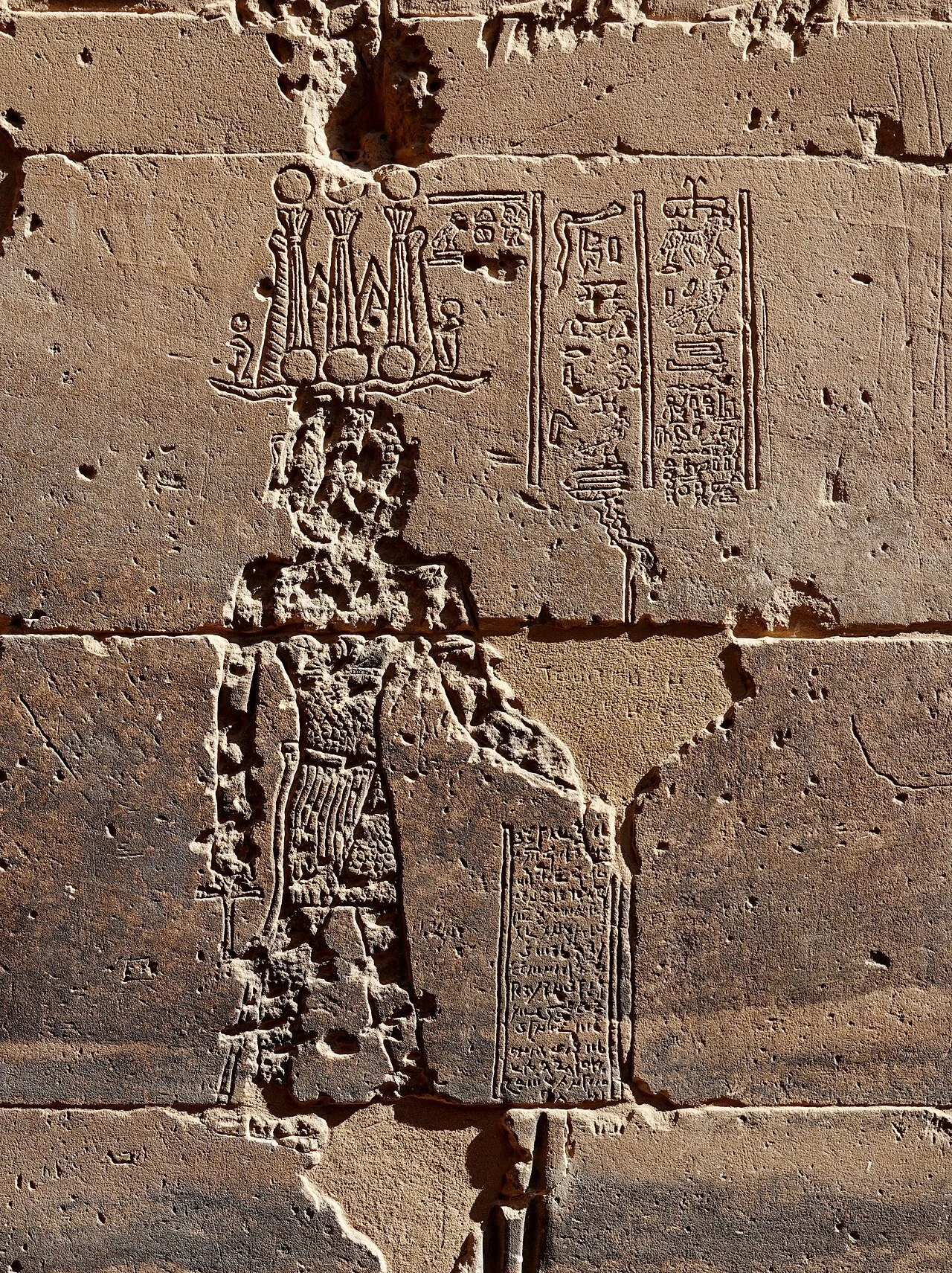
On the Birthday of Osiris, in the year 394 CE, a man named Nesmeterakhem — Second Priest of Isis, son of a Second Priest of Isis, probably the last person alive who could read hieroglyphs — carved the final inscription in a four-thousand-year writing tradition onto the wall of Hadrian's Gate at the Temple of Isis on Philae island. He asked it to last "for all time and eternity." It did. No one carved another hieroglyph after him. The image of the god beside his words was later deliberately damaged by Christians.
The Roman Senate banned the Isis cult eight times between 80 BCE and 392 CE — the first consul to personally swing an axe at her altars did so because the workmen refused; the last emperor banned all pagan religion in the empire
Every ban failed until 392 CE; after each demolition, worshippers rebuilt the temples, often immediately
Tiberius's 19 CE suppression was the most violent: priests executed, cult statue thrown into the Tiber, 4,000 devotees conscripted and sent to Sardinia — the cult was reinstated within 20 years
Philae survived Theodosius's 391–392 CE temple closures because it was just outside the Roman border; the Blemmye tribe's political treaties guaranteed access to their sacred site
Nesmeterakhem's family staffed the temple for generations after the ban; the last known demotic inscription (452 CE) was also by a son of a Priest of Isis, from the same family lineage
For 0–300 CE, Isis and Mary were simultaneously worshipped across the same cities; art historians document the nursing Isis as the direct visual template for the nursing Mary; in ambiguous Egyptian images from this period, the identification depends entirely on context
Hieroglyphs became unreadable within one generation of 394 CE; they remained unreadable for 1,400 years — until the Rosetta Stone was found in 1799 and Champollion deciphered it in 1822. Everything written in hieroglyphs was inaccessible because the last practitioners were arrested and their tradition deliberately ended.
The spine: one argument across all seven pieces
The transmission chain — in full
Neith→Primordial Egyptian mother goddess, predynastic. The oldest. Self-created, weaver of the world, goddess of war and creation simultaneously.pre-3100 BCE
Merneith→"Beloved of Neith." The first Mery-name. Possibly the first female ruler in recorded history. Erased from the New Kingdom king lists 1,500 years after her death.c. 2950 BCE
Inanna→Sumerian. "Lady of Heaven." Oldest named goddess with surviving literature. Her chariot, her descent, her war function. The planet Venus. The prototype.c. 4000–2300 BCE
Aset / Isis→"Throne." Egyptian. Source of all royal legitimacy. Resurrects the dead. Nurses the divine child. Absorbs every other goddess. Spreads from Egypt to Rome to Afghanistan to London.c. 3100 BCE–537 CE
Astarte / Ishtar→Canaanite/Akkadian. The chariot goddess. Traveled with the weapon that changed warfare. Entered Egypt with the Hyksos. Condemned in the Bible under the name Ashtoreth — 40+ times.c. 2000–500 BCE
Meritaten→"Beloved of Aten." Daughter of Akhenaten, possibly ruled Egypt. Phonetically the most direct ancestor of the Hebrew name Miriam. Her era: maximum Egyptian influence into the Levant.c. 1352–1336 BCE
Miriam / Mary→From Egyptian Mry (beloved) → Hebrew Miriam (sister of Moses, prophet) → Greek Maria → the most common Jewish woman's name in first-century Judea → six women named Mary in the New Testament → Queen of Heaven at Ephesus, 431 CE.c. 1300 BCE–present
The ten claims this research makes
𓇋The sound-led method works. Following a name phonetically — before consulting the historical record — reveals connections that category-based research organizes away. Laodicea, Asia Minor, Aset, Merneith: all found first by sound, confirmed by archaeology.
𓁹The divine feminine tradition is not multiple traditions. It is one tradition, continuously transmitted across cultures through trade routes, military conquest, and diplomatic marriage, acquiring new names at each stop while retaining its structural core: the cosmic mother, the divine child, love and war as the same force.
𓀭The name Mary is Egyptian before it is Hebrew. The root mry (beloved) appears in Egyptian royal names from Dynasty 1, c. 3000 BCE. By the time it became Miriam in Hebrew, it had been sacred in the Nile Valley for seventeen hundred years. The saturation of the name across the New Testament is not coincidence — it is the residue of that deep sacred history.
𓅃The chariot is a goddess's vehicle before it is a weapon. Inanna's chariot carries her through hymns a thousand years before the military war chariot exists. The chain from Sumerian temple wagon to Egyptian war machine runs directly through Anatolia — through the Hurrians, the Hittites, and the Hyksos — and the goddess travels with it at every step.
𓆓Asia Minor is not "minor." The Roman diminutive papers over the origin point of iron smelting, the war chariot, the world's first organized libraries, the first natural philosophy, and the diplomatic framework that produced the oldest surviving international peace treaty. Its current economic precarity is the compound result of being the most valuable piece of land in the ancient world, and therefore the most repeatedly conquered.
𓏏Merneith was the first. Not Hatshepsut. Not Sobekneferu. The first Mery-name in the royal record belongs to a woman who ruled Egypt in the very first dynasty, whose tomb the excavator initially classified as a male king's because it was too large and too royal to be a woman's. She was erased. Her wine jars are still being found.
𓇳The Roman Senate failed to kill Isis eight times across four centuries. The cult was more powerful than the state that banned it. Its power came from the same source that made every iteration of this goddess powerful: it offered personal, universal, emotionally immediate salvation to anyone, regardless of rank. The Senate kept banning what it couldn't provide.
𓂋The transition from Isis to Mary was not a theological revolution. It was a renaming. For at least two centuries — roughly 100–300 CE — art historians cannot reliably distinguish images of the nursing Isis from images of the nursing Mary in the archaeological record of Roman Egypt. The composition did not change. The name changed.
𓁐The last hieroglyph was carved on the Birthday of Osiris, by the Second Priest of Isis, in a script he knew was illegal, asking it to last for all time. He was arrested — along with the last members of his family's priestly lineage — within 143 years. Hieroglyphs were unreadable for the next 1,400 years because the people who knew them were arrested and their tradition deliberately ended.
𓊹The "Queen of Heaven" declared at Ephesus in 431 CE is the oldest religious title in the written record. Nin-an-ak. Lady of Heaven. Inanna's title from c. 4000 BCE. The Catholic Church assigned it to Mary at a meeting held in the city of the goddess. The title did not originate with Mary. It arrived on her head from the oldest source available.
"The series began with a sound. It ended with a name carved on a wall on an island in the Nile, asking to last forever, by the last man who knew how to write it. He was right. It lasted. We just forgot how to read it for a while."
This summary covers all research and writing produced in this conversation session of the Sound-Led Research Series. The seven pieces are: Place Spotlight: Laodicea · Place Spotlight: Asia Minor and the Chariot · The Goddess Chronology and Appendix: Two Expansions · The Mery→Mary Name Catalog · Merneith and Aset: The Women Almost Lost · August 24, 394 CE: The Last Hieroglyph. All pieces are designed to feed the larger book projects in progress: The Sacred Year / Playing with Fire (holiday and sacred calendar origins), The Missing Peace / The Reclamation Series (suppressed feminine divine across Abrahamic traditions), and the broader ancestral knowledge recovery work of Rational Body.
The ten claims section can each be their own chapter, or book.
The Meritaten → Miriam phonetic link can be traced through:
The timing (Amarna period, maximum Egyptian influence in the Levant),
the phonetics (Mryt-Itn dropping to Mrym),
and the cultural saturation all point the same direction.
Image: Nesmeterakhem — the man with the chisel.


A crude drawing of the god Mandulis from Hadrian's Gate at Philae, accompanied by a hieroglyphic inscription (above right) and a demotic inscription (lower right). The hieroglyphic text is the last one written in ancient times, and its author had a weak grasp of the writing system. The demotic inscription reads: "I, Nesmeterakhem, the Scribe of the House of Writings (?) of Isis, son of Nesmeterpanakhet the Second Priest of Isis, and his mother Eseweret, I performed work on this figure of Mandulis for all time, because he is fair of face towards me. Today, the Birthday of Osiris, his dedication feast, year 110 [of the reign of Diocletian]." The date is thus 24 August, 394 AD/CE. The hieroglyphic text says: "Before Mandulis son of Horus, by the hand of Nesmeterakhem, son of Nesmeter, the Second Priest of Isis, for all time and eternity. Words spoken by Mandulis, Lord of the Abaton, great god." (Source: Richard Parkinson, Cracking Codes: The Rosetta Stone and Decipherment (1999), p. 178.)
But even all this, does not stop here. I am not satisfied that the earliest mention of any named queen is as late as 3k BC, in Turkey, rather than in Egypt. But I also know of a few more connections that lead me to feel unfullfilled here. Following to even deeper roots:
The Queen's Forgotten Throne
Tracing the African Origins of Sovereignty in Language, Land, and Memory
𓇋
Look up the etymology of "queen" and you will find a Germanic root meaning "woman, wife, queen." Notice what sits in the middle: wife. The queen is immediately framed as an appendage. But look up "king" and you find something different: "a man of his kin," a leader defined by his relationship to his people. Not to a woman. Not to a marriage. His authority stands alone. This asymmetry is not accidental. It is the residue of an older story, bent by the hands that rewrote it.
What if the word "queen" does not begin in Germanic languages? What if those languages are simply the final chapter in a journey that started 25,000 years ago, at the source of the world's longest river, in the hands of a woman counting the moon?
The Bone at the Nile's Source
In 1950, a Belgian geologist named Jean de Heinzelin was excavating the shores of Lake Edward in what is now the Democratic Republic of Congo, at the site of a prehistoric fishing village called Ishango. At the mouth of the Semliki River — one of the farthest sources of the Nile — he found a small bone, dark brown, about the length of a pencil, with a piece of quartz fixed to one end like a blade. In the surface of the bone were notches: grouped, ordered, deliberate. Not random scratches. A pattern.
The bone was first dated to around 9,000 BCE. Then re-dated, in the 1980s and 1990s, to 25,000 years old. This was not a minor adjustment. It moved the Ishango bone far beyond any established civilization — past Sumer, past Egypt, past the Bronze Age, past the agricultural revolution, back into the Ice Age, when Europe was under three to four kilometers of glacial ice and could not have produced a single city, a single temple, or a single palace. Central Africa was creating mathematics while the continent that would eventually claim to have invented civilization was frozen solid.
The notches on the bone add up in patterns: 60 in one set of columns, 48 in another. Sixty corresponds to two lunar months. Forty-eight is a month and a half. In 1972, the archaeologist Alexander Marshack examined the bone microscopically and proposed it was a six-month lunar calendar. In 1979, the mathematician Claudia Zaslavsky asked the question that had not yet been asked: who would need a lunar calendar? Who tracks the moon with that kind of precision, across months, in relation to cycles of approximately 29 days?
A woman tracking her own body.
"Who but a woman keeping track of her cycles would need a lunar calendar?" — Claudia Zaslavsky, Women as the First Mathematicians, 1979
The moon and the menstrual cycle are not metaphorically connected — they are structurally the same duration. The Proto-Indo-European root *mḗh₁n̥s meant both "moon" and "month" — the same word, before the concepts were separated. Latin mensis means both "month" and "menstruation." Arabic hayd translates as both "menstruation" and "monthly." These are not poetic associations. They are a record of who was keeping time — and why.
The woman at Ishango was not doing abstract mathematics. She was doing the most practical possible thing: mapping her body against the sky. She was noticing that the moon and her blood moved together, in the same rhythm, across the same span of days. And she was recording it, so she would not forget, so the pattern would persist beyond a single cycle, beyond a single season, beyond her own memory. She was building a record of cosmic order out of her own flesh and bone.
This was the first throne. Not stone. Not gold. Not a palace. The knowledge that creation was measurable, cyclical, and carried in the body of a woman.
The ISH sound — a linguistic breadcrumb
The site is called Ishango. The Semliki River flows out of it toward the Nile. Cultural memory and language patterns travel with rivers — downstream, with the current, not against it.
The "Ish/Is/Ash/Aset" sound pattern that begins here at the Nile's source appears at every major node of divine feminine power as you travel north: Ishango → Isis/Aset (Egypt) → Ashraf, Isbât, Ash Sharqi (Qena region place names) → Ishtar (Mesopotamia) → Asherah (Canaan) → Isidora, Isabel (surviving goddess names in European languages).
This is not coincidence. It is linguistic archaeology: sound patterns deposited along the path of cultural transmission, like sediment left by a river that has since changed course.
Isis Was Not Beside the Throne. She Was the Throne.
When Egyptian civilization rises along the Nile — a civilization whose own evidence of mathematical and fishing technology traces back to this same Ishango region — the feminine principle is not an afterthought. It is the foundation. The goddess Aset, whom the Greeks called Isis, has a name that in Egyptian hieroglyphs is rendered as the image of a throne. Not a woman holding a throne. Not a woman sitting on a throne. The throne itself.
Every pharaoh who ever ruled Egypt was understood to be Horus — the divine son. Aset was Horus's mother. This made her, structurally, the mother of every ruler in Egyptian history. Without her, no pharaoh had legitimacy. The throne was not furniture. It was the living feminine principle through which all royal authority flowed. You could not sit on a throne without sitting in her.
For three thousand years, Aset's name appeared on temple walls, in hymns, in healing spells, in funerary rites, in the prayers of farmers and kings alike. She grew over those three millennia — absorbing Hathor's solar disk and cow horns, absorbing Neith's weaving and war, absorbing Renenutet's serpentine agricultural power, absorbing the attributes of nearly every other Egyptian goddess until her devotees could say, without exaggeration, that she contained all feminine divine powers in the world.
And she was not alone in the ancient record. The Lebombo bone — a baboon fibula with 29 notches, one lunar month — was found in Eswatini (Swaziland) and dated to 37,000 years ago. Older than Ishango. In the Swazi culture that still exists in that land, the Queen Mother — the iNdlovukati — plays the central spiritual role in the nation's sacred calendar. The Incwala ceremony, the most sacred in the Swazi year, structures masculine and feminine energies in deliberate circular balance. The women are not auxiliary. They are the moral shields of the society.
This is the deep pattern: wherever we find the oldest lunar-counting bones, we find goddess worship. Wherever we find goddess worship, we find evidence that women's bodily cycles were understood as the original calendar — the first measurement of time, the first mathematics, the first throne.
The ISH/IS/AS sound — from source to word
Ishango
Congo, c. 25,000 BCE
Site of humanity's oldest mathematical artifact. Women tracking lunar-menstrual cycles at the Nile's source. First known recording of cyclical time.
The "Ish" pattern is established at the origin point. Geographic, not borrowed.
Aset / Isis
Egypt, c. 3100 BCE+
"She of the Throne." The divine feminine as the source of all legitimate royal power. Nursing the divine child; resurrecting the dead; governing fate. Her hieroglyph is the throne itself.
The "Is/As" sound carries the Ishango root into the world's first great civilization — downstream, with the Nile.
Qena / Kwena
Upper Egypt / southern Africa
The Qena region of Upper Egypt is a center of ancient goddess worship and political authority. "Kwena" in Setswana means crocodile — sacred symbol of territorial power. The "Qu/Kw" pattern encodes the political layer of feminine sovereignty.
Qena → Kwena → Cwēn → Queen. Political authority added to the theological root.
Ishtar / Asherah
Mesopotamia / Canaan
The ISH/ASH pattern follows the goddess westward. Ishtar: love, war, the chariot. Asherah: mother of seventy gods, "She Who Walks on the Sea," possibly consort of Yahweh. Both carry the original sound. Both are targets of systematic suppression in their respective traditions.
Condemned 40+ times in the Hebrew Bible as "Ashtoreth." Frequency of condemnation = measure of her persistence.
Cwēn → Queen
Old English, c. 900 CE
The Germanic word cwēn carried "woman, wife, queen" — already showing the patriarchal compression of meanings. But the sound survived, and with it, the ghost of the original: she who was the throne, long before a king ever sat on one.
Final chapter of a 25,000-year journey. The meaning bent; the sound endured.
The Asymmetry in the Language
The linguistic evidence of the power shift is not subtle. Compare the etymologies side by side:
King vs Queen — what the etymology preserves
King: Proto-Germanic kuningaz — "a man of his kin," scion of noble kin
Defined by: Bloodline, lineage, people
Marriage required?: Never — authority is independent
When a queen reigns: Her husband becomes "Prince Consort" — he cannot be called King, because King implies ultimate authority above hers
What this tells us: The title carries inherent, standalone legitimacy
Queen: Proto-Germanic kwenō — "woman, wife" — primary definition: consort of a king
Primary definition: Wife of a king
Secondary definition: Woman ruling in her own right
Marriage required? Under patriarchal definition, yes — or the title is explicitly secondary
What this tells us
The original meaning (she of the throne, source of legitimacy) was inverted. A queen became the appendage of a throne she once was.
This is not etymology by accident. In the original African and Egyptian systems, authority flowed through women. Men married into it. Legitimacy was acquired through the female bloodline. The Kushite Dynasty — the 25th Dynasty of Egypt — passed succession through the king's sisters, not his sons. Kushite queens held titles meaning "ruler" and "queen-mother" and led armies into battle. Queen Amanirenas negotiated with Rome after defeating Augustus's forces in open combat. She was not a consort. She was a sovereign.
Atlas of Sacred Roots
Chapter X
The Queen's Forgotten Throne
Tracing the African Origins of Sovereignty in Language, Land, and Memory
𓇋
Look up the etymology of "queen" and you will find a Germanic root meaning "woman, wife, queen." Notice what sits in the middle: wife. The queen is immediately framed as an appendage. But look up "king" and you find something different: "a man of his kin," a leader defined by his relationship to his people. Not to a woman. Not to a marriage. His authority stands alone. This asymmetry is not accidental. It is the residue of an older story, bent by the hands that rewrote it.
What if the word "queen" does not begin in Germanic languages? What if those languages are simply the final chapter in a journey that started 25,000 years ago, at the source of the world's longest river, in the hands of a woman counting the moon?
The Bone at the Nile's Source
In 1950, a Belgian geologist named Jean de Heinzelin was excavating the shores of Lake Edward in what is now the Democratic Republic of Congo, at the site of a prehistoric fishing village called Ishango. At the mouth of the Semliki River — one of the farthest sources of the Nile — he found a small bone, dark brown, about the length of a pencil, with a piece of quartz fixed to one end like a blade. In the surface of the bone were notches: grouped, ordered, deliberate. Not random scratches. A pattern.
The bone was first dated to around 9,000 BCE. Then re-dated, in the 1980s and 1990s, to 25,000 years old. This was not a minor adjustment. It moved the Ishango bone far beyond any established civilization — past Sumer, past Egypt, past the Bronze Age, past the agricultural revolution, back into the Ice Age, when Europe was under three to four kilometers of glacial ice and could not have produced a single city, a single temple, or a single palace. Central Africa was creating mathematics while the continent that would eventually claim to have invented civilization was frozen solid.
The notches on the bone add up in patterns: 60 in one set of columns, 48 in another. Sixty corresponds to two lunar months. Forty-eight is a month and a half. In 1972, the archaeologist Alexander Marshack examined the bone microscopically and proposed it was a six-month lunar calendar. In 1979, the mathematician Claudia Zaslavsky asked the question that had not yet been asked: who would need a lunar calendar? Who tracks the moon with that kind of precision, across months, in relation to cycles of approximately 29 days?
A woman tracking her own body.
"Who but a woman keeping track of her cycles would need a lunar calendar?" — Claudia Zaslavsky, Women as the First Mathematicians, 1979
The moon and the menstrual cycle are not metaphorically connected — they are structurally the same duration. The Proto-Indo-European root *mḗh₁n̥s meant both "moon" and "month" — the same word, before the concepts were separated. Latin mensis means both "month" and "menstruation." Arabic hayd translates as both "menstruation" and "monthly." These are not poetic associations. They are a record of who was keeping time — and why.
The woman at Ishango was not doing abstract mathematics. She was doing the most practical possible thing: mapping her body against the sky. She was noticing that the moon and her blood moved together, in the same rhythm, across the same span of days. And she was recording it, so she would not forget, so the pattern would persist beyond a single cycle, beyond a single season, beyond her own memory. She was building a record of cosmic order out of her own flesh and bone.
This was the first throne. Not stone. Not gold. Not a palace. The knowledge that creation was measurable, cyclical, and carried in the body of a woman.
The ISH sound — a linguistic breadcrumb
The site is called Ishango. The Semliki River flows out of it toward the Nile. Cultural memory and language patterns travel with rivers — downstream, with the current, not against it.
The "Ish/Is/Ash/Aset" sound pattern that begins here at the Nile's source appears at every major node of divine feminine power as you travel north: Ishango → Isis/Aset (Egypt) → Ashraf, Isbât, Ash Sharqi (Qena region place names) → Ishtar (Mesopotamia) → Asherah (Canaan) → Isidora, Isabel (surviving goddess names in European languages).
This is not coincidence. It is linguistic archaeology: sound patterns deposited along the path of cultural transmission, like sediment left by a river that has since changed course.
Isis Was Not Beside the Throne. She Was the Throne.
When Egyptian civilization rises along the Nile — a civilization whose own evidence of mathematical and fishing technology traces back to this same Ishango region — the feminine principle is not an afterthought. It is the foundation. The goddess Aset, whom the Greeks called Isis, has a name that in Egyptian hieroglyphs is rendered as the image of a throne. Not a woman holding a throne. Not a woman sitting on a throne. The throne itself.
Every pharaoh who ever ruled Egypt was understood to be Horus — the divine son. Aset was Horus's mother. This made her, structurally, the mother of every ruler in Egyptian history. Without her, no pharaoh had legitimacy. The throne was not furniture. It was the living feminine principle through which all royal authority flowed. You could not sit on a throne without sitting in her.
For three thousand years, Aset's name appeared on temple walls, in hymns, in healing spells, in funerary rites, in the prayers of farmers and kings alike. She grew over those three millennia — absorbing Hathor's solar disk and cow horns, absorbing Neith's weaving and war, absorbing Renenutet's serpentine agricultural power, absorbing the attributes of nearly every other Egyptian goddess until her devotees could say, without exaggeration, that she contained all feminine divine powers in the world.
And she was not alone in the ancient record. The Lebombo bone — a baboon fibula with 29 notches, one lunar month — was found in Eswatini (Swaziland) and dated to 37,000 years ago. Older than Ishango. In the Swazi culture that still exists in that land, the Queen Mother — the iNdlovukati — plays the central spiritual role in the nation's sacred calendar. The Incwala ceremony, the most sacred in the Swazi year, structures masculine and feminine energies in deliberate circular balance. The women are not auxiliary. They are the moral shields of the society.
This is the deep pattern: wherever we find the oldest lunar-counting bones, we find goddess worship. Wherever we find goddess worship, we find evidence that women's bodily cycles were understood as the original calendar — the first measurement of time, the first mathematics, the first throne.
The ISH/IS/AS sound — from source to word
Ishango
Congo, c. 25,000 BCE
Site of humanity's oldest mathematical artifact. Women tracking lunar-menstrual cycles at the Nile's source. First known recording of cyclical time.
The "Ish" pattern is established at the origin point. Geographic, not borrowed.
Aset / Isis
Egypt, c. 3100 BCE+
"She of the Throne." The divine feminine as the source of all legitimate royal power. Nursing the divine child; resurrecting the dead; governing fate. Her hieroglyph is the throne itself.
The "Is/As" sound carries the Ishango root into the world's first great civilization — downstream, with the Nile.
Qena / Kwena
Upper Egypt / southern Africa
The Qena region of Upper Egypt is a center of ancient goddess worship and political authority. "Kwena" in Setswana means crocodile — sacred symbol of territorial power. The "Qu/Kw" pattern encodes the political layer of feminine sovereignty.
Qena → Kwena → Cwēn → Queen. Political authority added to the theological root.
Ishtar / Asherah
Mesopotamia / Canaan
The ISH/ASH pattern follows the goddess westward. Ishtar: love, war, the chariot. Asherah: mother of seventy gods, "She Who Walks on the Sea," possibly consort of Yahweh. Both carry the original sound. Both are targets of systematic suppression in their respective traditions.
Condemned 40+ times in the Hebrew Bible as "Ashtoreth." Frequency of condemnation = measure of her persistence.
Cwēn → Queen
Old English, c. 900 CE
The Germanic word cwēn carried "woman, wife, queen" — already showing the patriarchal compression of meanings. But the sound survived, and with it, the ghost of the original: she who was the throne, long before a king ever sat on one.
Final chapter of a 25,000-year journey. The meaning bent; the sound endured.
The Asymmetry in the Language
The linguistic evidence of the power shift is not subtle. Compare the etymologies side by side:
King vs Queen — what the etymology preserves
King
Proto-Germanic kuningaz — "a man of his kin," scion of noble kin
Defined by
Bloodline, lineage, people
Marriage required?
Never — authority is independent
When a queen reigns
Her husband becomes "Prince Consort" — he cannot be called King, because King implies ultimate authority above hers
What this tells us
The title carries inherent, standalone legitimacy
Queen
Proto-Germanic kwenō — "woman, wife" — primary definition: consort of a king
Primary definition
Wife of a king
Secondary definition
Woman ruling in her own right
Marriage required?
Under patriarchal definition, yes — or the title is explicitly secondary
What this tells us
The original meaning (she of the throne, source of legitimacy) was inverted. A queen became the appendage of a throne she once was.
This is not etymology by accident. In the original African and Egyptian systems, authority flowed through women. Men married into it. Legitimacy was acquired through the female bloodline. The Kushite Dynasty — the 25th Dynasty of Egypt — passed succession through the king's sisters, not his sons. Kushite queens held titles meaning "ruler" and "queen-mother" and led armies into battle. Queen Amanirenas negotiated with Rome after defeating Augustus's forces in open combat. She was not a consort. She was a sovereign.
When patriarchal systems consolidated power, they could not erase the throne. The throne was too embedded in the language, the art, the religious architecture. So they did the next most effective thing: they redefined who occupied it. The queen did not lose the title. She lost the definition.
The Linguistic Inversions — When Sacred Words Are Bent
The pattern of patriarchal linguistic revision is not unique to "queen." It follows a consistent grammar of degradation: take a word associated with feminine power, leave the sound intact, and invert or diminish the meaning. The word becomes a ghost — still audible, but hollowed of its original force.
Crown→CroneOnce: the symbol of sovereign authority. Now: a dismissive term for an old woman. The wisdom that earned the crown was removed; the age remained, stripped of its prestige.
Venerate→VenerealOnce: to hold in the highest reverence. Root: Venus/Aphrodite, the goddess of love. The same root that once meant worship now designates disease. The body that was sacred became the body that was dangerous.
Hag→witch, ugly old womanFrom Old English hægtesse, related to hedge-rider — originally a woman with knowledge of the boundary between worlds. The wise woman at the edge became the threat at the edge.
Canaan (Kena'an)→"low, humble, subjugated"The standard etymology gives "to be low, humble." But Canaan was also connected to purple — royal dye — and to Asherah, the mother of seventy gods. The same sound that meant royal authority in one system was rewritten as subjugation in the next. Before and after patriarchal revision, in a single word.
Queen→"wife of a king"The most complete inversion: she who was the throne, the source of all legitimate authority, redefined as the appendage of the man who sits on what was once hers.
The Merneith connection — this series
The oldest female ruler we have recovered from the archaeological record — Merneith of Dynasty 1, c. 2950 BCE — carries the Egyptian word mry: "Beloved." Beloved of Neith, the primordial mother goddess whose own worship predates writing.
Neith is one of the deities eventually absorbed into Isis. Merneith — "beloved of the proto-Isis" — was the first Mery-name in the royal record. She ruled Egypt at the absolute origin of the dynastic period, was buried in a tomb so kingly that its excavator classified it as a male king's, and was erased from the New Kingdom king lists fifteen hundred years after her death.
She is the bridge between the Ishango woman and the throne of Isis. The beloved, at the beginning. The erased, in the middle. The recovered, now.
The Bones That Remember
The Ishango bone is not alone. Across the ancient world, in contexts that predate every civilization we usually name as foundational, women were carving the moon into bone. The pattern is global and old enough that it cannot be borrowed — it must be original, arising independently from the same human reality: women whose bodies moved with the sky, who needed to track that movement, who made the first records of time.
c. 37,000 BCE
Eswatini (Swaziland), southern Africa — The Lebombo Bone
The oldest of them all
A baboon fibula with exactly 29 notches — one lunar month — found in the Lebombo Mountains. Older than Ishango by 12,000 years. In the Swazi culture of this same land today, the iNdlovukati (Queen Mother) is the central spiritual authority of the nation. The Incwala ceremony structures masculine and feminine energies in deliberate circular balance. Women are the moral shields of society. The bone remembers why.
c. 25,000–16,000 BCE
Congo / Uganda border — The Ishango Bone
Mathematics at the Nile's source
At the Semliki River's outflow from Lake Edward — one of the farthest sources of the Nile — a small community of fishers and gatherers produced the oldest mathematical artifact in human history. 60 notches, 48 notches, groupings suggesting prime numbers or lunar cycles. Europe was under glacial ice. This community was counting. The harpoon technology found here later traveled north into Sudan and Egypt — upstream knowledge flowing downstream with the river.
c. 32,000–28,000 BCE
Dordogne, France — The Abri Blanchard Bone
The goddess region of Europe
Lunar-cycle pit patterns on bone from the same region as the Venus of Laussel — a 20,000-year-old relief carving of a woman holding a bison horn with 13 notches, widely interpreted as menstrual or lunar counting. The Dordogne is also associated with the goddess Vesunna, and with the Matres — mother goddess veneration found in inscriptions across the region. This is the same female-body-as-cosmic-calendar tradition, in a European context, at nearly the same time period as Ishango.
c. 18,000 BCE
Kyiv, Ukraine — The Mezin Bracelets
280 days — the length of a human pregnancy
Mammoth ivory objects engraved with patterns interpreted as lunar calendars based on 10 lunar months — exactly 280 days, the period of human pregnancy. Found with female figurines and red ochre, the same sacred pigment used in burial rituals across the ancient world. The calendar of the body and the calendar of birth, recorded on the same objects.
c. 2950 BCE
Abydos, Egypt — Merneith's Tomb
The Beloved, at the beginning of the dynasties
The first Mery-name in the Egyptian royal record belongs to a woman who may have been the first female ruler in history. Buried in a tomb the size of a king's, with forty servants, a solar boat, and a treasury inscription. Named "Beloved of Neith" — the mother goddess who predates writing, who is eventually absorbed into Isis. The woman at the origin of the dynasty. The woman erased from the king lists. The woman whose wine jars are still being found.
What "Queen" Actually Preserves
The Germanic etymology of "queen" is not wrong. It is simply the last page of a book that began 25,000 years earlier, in central Africa, at the source of the Nile. The sound pattern traveled downstream with cultural memory, through Egyptian theology, through Canaanite goddess worship, through Phoenician trade networks, through Hellenistic religious synthesis, through Roman adoption, and arrived in Old English as cwēn — still carrying the echo of the throne, even as patriarchal overlays compressed its meaning toward "wife."
Every use of the word — queen of the night, queen bee, drag queen, beauty queen, Queen of Heaven — invokes, whether the speaker knows it or not, the memory of when the title meant the highest possible authority: the woman whose body was understood as the source of all legitimate power, whose cycles synchronized with the cosmos, whose knowledge of time preceded every civilization that claimed to have invented it.
The throne was never empty. Merneith sat on it at the beginning of Egyptian history. Aset was it for three thousand years. Amanirenas held it against Rome. The iNdlovukati of Eswatini still holds it today, as she has held it for as long as human memory reaches in that place.
The boys were never the enemy. They, too, were born into the bent story. They, too, were handed a word for their title that said: your authority stands alone — and a word for hers that said: she is yours by marriage. Neither of them wrote those definitions. But both of them lived inside them.
To recover the queen's forgotten throne is not to condemn anyone. It is to return to the original architecture: balance, reciprocity, rhythm. The same balance written in bone and moon, 37,000 years ago on the slopes of the Lebombo Mountains, by a woman who looked up at the sky and understood that the cosmos and her body moved together — and that this was something worth recording, for all time and eternity.
"Isis was not beside the throne. She was the throne itself. And before Isis, there was a woman at the source of the Nile, counting the moon on a baboon's bone, and she was the throne too — though no one had yet made a word for it."
— Chapter X, Atlas of Sacred Roots
This chapter integrates research from the Sound-Led Research Series (this conversation) with the author's original research on the etymology of "Queen." Sources: the Ishango bone Wikipedia and Springer encyclopaedia entries; the Ishango site Wikipedia article; the Groffith and de Heinzelin primary archaeological documentation; Claudia Zaslavsky, "Women as the First Mathematicians" (1979/1992); the Lebombo bone archaeological record; the Swazi Incwala ceremony documentation; Merneith evidence from Livius.org, Ancient Egypt Online, and the 2023–2024 Köhler excavations at Abydos; Isis/Aset from Wikipedia, Britannica, and Ancient Egypt Online; the Roman ban chronology from the Temple of Isis and Serapis Wikipedia article and the UNRV Roman history documentation. The Proto-Indo-European moon/month/menstruation linguistic data is standard historical linguistics. The Qena/Kwena consonantal connection is the author's original comparative analysis.