Conditioner Bar:
Here is the 700g batch for 10 x 2-inch conditioner bars, listed in the exact order I add and mix everything.
Pool Conditioner Bar
700g batch | Makes 10 bars at ~70g each
cool down takes an hour!
1. Melt base phase
Heat to 140–150°F, do not exceed 160°F.
Cetearyl Alcohol — 222.1g (add 7.5g if not using protein)
Cetyl Alcohol — 55.3g
BTMS-50 — 200.9g
Cocoa Butter — 80.4g
Jojoba Oil — 30.2g
Add the jojoba oil last, after the waxes/BTMS/cocoa butter are fully melted.
2. Glycerin active phase
Warm gently to about 130–140°F and mix until smooth.
Glycerin — 50.2g
Sodium Citrate — 3.5g
GLDA 40% — 4g
Panthenol — 20.1g
Hydrolyzed Oat Protein or Hydrolyzed Rice Protein — 7.5g
can omit if worried about allergies, and replace with cetearyl alcohol
Silk Amino Acids — 3.5g
Add this active phase into the melted base when the base is around 130–140°F. Mix thoroughly.
3. Final powder phase
Add near the end and mix until evenly dispersed.
Colloidal Oatmeal — 16.6g
4. Cool-down preservative
Cool batch to 110–120°F, then add:
Geogard ECT or Geogard 221 — 5.6g
Mix very thoroughly so the preservative is evenly distributed.
5. Pressing
Let the mixture cool until it reaches 100–105°F. This could take an hour or so. Stir every 3–5 minutes. Don’t stir constantly the whole time, because that can make it grainy or overworked. You just want even cooling.
Then press firmly into molds.
If it’s above 110°F, it may smear or lose detail.
If it’s below 95°F, it may crack, crumble, or not press smoothly.
6. Freeze + cure
Freeze: 2–3 hours
Rest before unmolding: 3–5 minutes on counter
Air dry/cure: 10–14 days ideal, 5–7 days minimum before gifting/testing.
only note on conditioner: Since it already performed beautifully, I would only consider adding 0.5% sodium citrate if you want extra hard-water support. To make room, reduce cetearyl alcohol slightly.
Notes:
Press shampoo at 100–110°F.
Press conditioner around 100–105°F.
Use thin plastic or parchment rounds top and bottom.
Freeze shampoo 1–2 hours.
Freeze conditioner 2–3 hours.
Unmold after 3–5 minutes on the counter, not straight from the freezer.
Ideal timing:
Shampoo: 1–2 hours
Conditioner: 2–3 hours
Put into freezer for 2-3 hours (max 4 hours), especially important for conditioner bars (meaning maybe make them first).
🧱 Pressing workflow (key)
For 10 bars, pre-weigh portions: ~65–70g each
Then:
press one
freeze
repeat
Keep remaining dough covered loosely while waiting.
Gentle Swimmer Shampoo Bar (w/ GLDA)
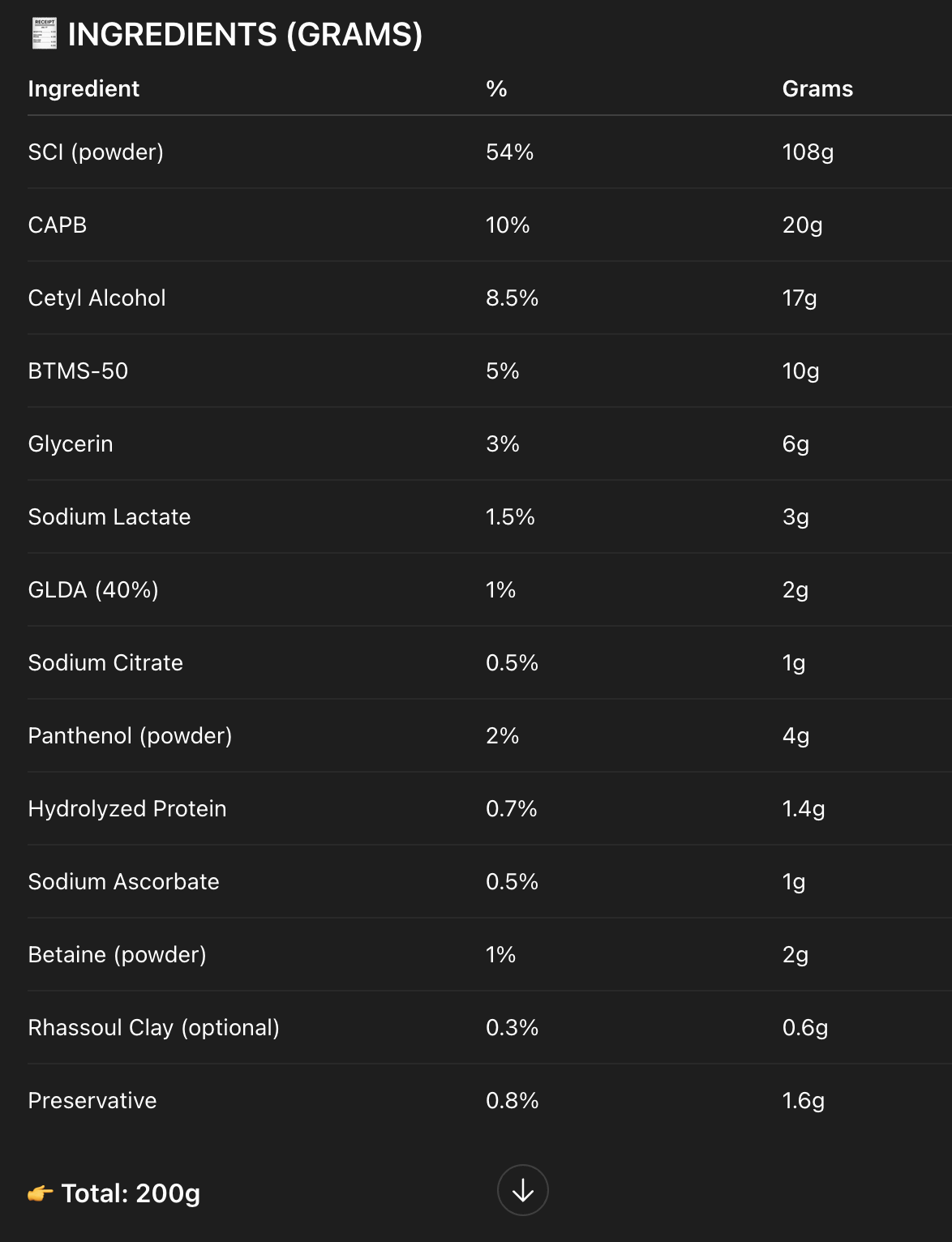
Phase 1 — Melt base (120–135°F)
Add:
cetyl alcohol
BTMS-50
Melt gently (don’t exceed ~140°F)
usually 10–20 minutes, depending on your double boiler, bowl, and batch size, to get to fullky uniform clear color.
Add liquid surfactant
warm capb separately until 120, warm
add CAPB to the other 2 melted to 135
stir until uniform
Add the CAPB after the cetyl alcohol + BTMS-50 are fully melted, while the bowl is around:
120–130°F ideal
135°F okay
Do not exceed 140°FAlso warm the CAPB separately first to about:
110–120°F
Add SCI slowly around 125, keep at this temp
sprinkle in gradually
mash + fold
This will take 3–5 minutes, more like 45 min with large batch
Goal: thick dough (mashed potato feel)
Phase 2 — Liquid actives
In separate small cup:
Warm gently (~120–130°F):
glycerin
sodium citrate
panthenol
hydrolyzed protein
sodium lactate
GLDA
Stir until fully dissolved
add liquid phase into dough
knead thoroughly
Add final ingredients
sodium ascorbate
betaine
clay (if using)
preservative
knead until smooth + uniform. Add the final ingredients after the main dough is fully uniform and has cooled a bit, around 110–120°F
CRITICAL STEP — PRESS TEMP
Press at 100–110°F
This is what fixed your last batch.
PRESSING
line mold (parchment or thin plastic)
press firmly
slight squeeze-out = GOOD
FREEZER
1.5–2 hours
CURE
wire rack
fan airflow
flip daily
5–7 days
🧴 Curly Conditioner Bar (Family Bar)
worth adding:
Sodium citrate at 0.5–1% — your shampoo bar has it but conditioner doesn't, worth adding for consistent hard water protection especially leave-on
Silk amino acids at 0.5% — already in your detangler spray, would complement nicely here too for curl definition, reduce oatmeal slightly to compensate
No mask needed, but gloves encouraged for handling BTMS.
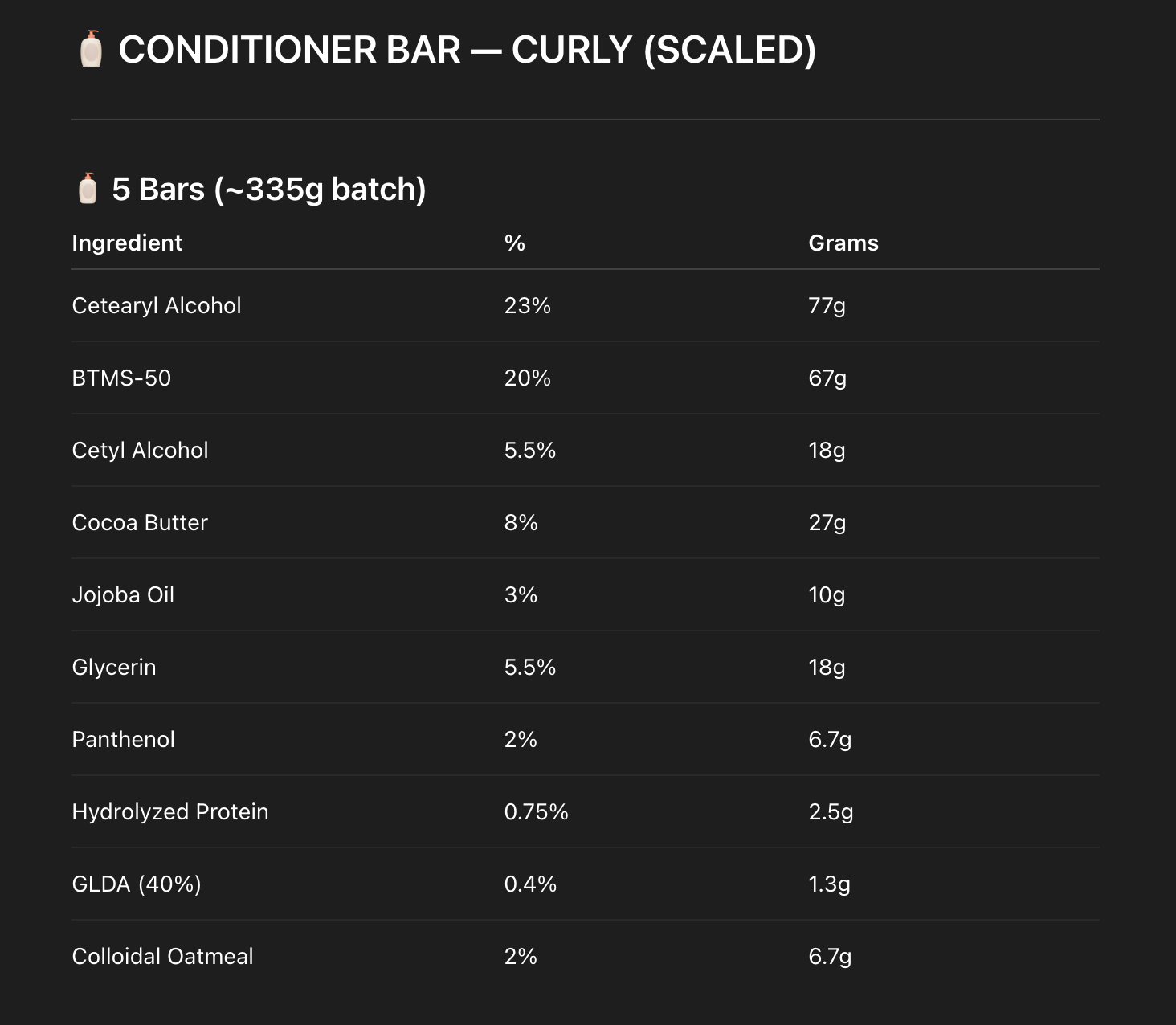
200g Batch | ~3 bars
🧪 INGREDIENTS
Base Phase (140–150°F)
Cetearyl Alcohol — 46g (23%)
Cetyl Alcohol — 11g (5.5%)
BTMS-50 — 40g (20%)
Cocoa Butter — 16g (8%)
Jojoba Oil — 6g (3%)
Actives Phase
Glycerin — 11g (5.5%)
Panthenol — 4g (2%)
Hydrolyzed Oat Protein — 1.5g (~0.75%)
GLDA (40% liquid) — 0.8g (0.4%)
Final
Colloidal Oatmeal — 4g (2%)
🔧 PROCESS
1. Melt Base (140–150°F)
Melt cetearyl (46g)+ cetyl (11g)
Add BTMS (40g) (wear gloves for dealing with this)
Add cocoa butter (16g)
Add jojoba last (6g)
2. Actives
Heat glycerin (~140°F), 11g, then:
Add GLDA (0.8g)
Add panthenol (4g)
Cool to ~120°F
Add protein (1.5g)
3. Combine
Add actives to base (~135°F)
Mix thoroughly
Add oatmeal last (4g)
Let cool down to 100 degrees. Will appear very wet, but will harden with the cacao etc. No not constantly stir, but apply controlled mixing. Let it sit, then mix occasionally, every couple minutes. You want it to cool evenly throughout, not just on outer layers.
4. Press
Ideal temp: 100–105°F
Line mold
Press firmly
5. Freeze
2–3 hours
6. Unmold
Wait 3–5 minutes
Remove cleanly
7. Cure
10–14 days
Indoors + airflow
—-
GENTLE SHAMPOO BAR — 200g Test Batch All Ages | Unscented | Pool and Hard Water Friendly | Danville CA
The two things that will matter most on the day:
Temperature discipline is everything. Trust your thermometer over how the dough looks or feels. Dough can look ready at 120F and actually be 130F near the bottom of the bowl. Check temperature in multiple spots.
Don't rush the unmold. The freezer does the work for you. Three minutes of patience on the counter after the freezer means a clean release almost every time.
The shampoo bar is set up to succeed because:
CAPB is at 12%, not the 16% that made your last batch marshmallow
No added water at all — every bit of liquid is glycerin or functional actives
SCI at 52% gives you enough surfactant mass to hold the bar together firmly
Warming CAPB separately before combining makes the dough dramatically smoother and more cohesive from the start
The conditioner bar is set up to succeed because:
No added water — your original pourable version failed because of excess water, this has none
Cetearyl plus cetyl plus BTMS together create a firm wax backbone that holds its shape
Cocoa butter is at 7% not 9%, which keeps it from being too soft or slow to firm
The freezer step gives you insurance that neither of these bars had before
GENTLE SHAMPOO BAR — 200g Test Batch All Ages | Unscented | Pool and Hard Water Friendly
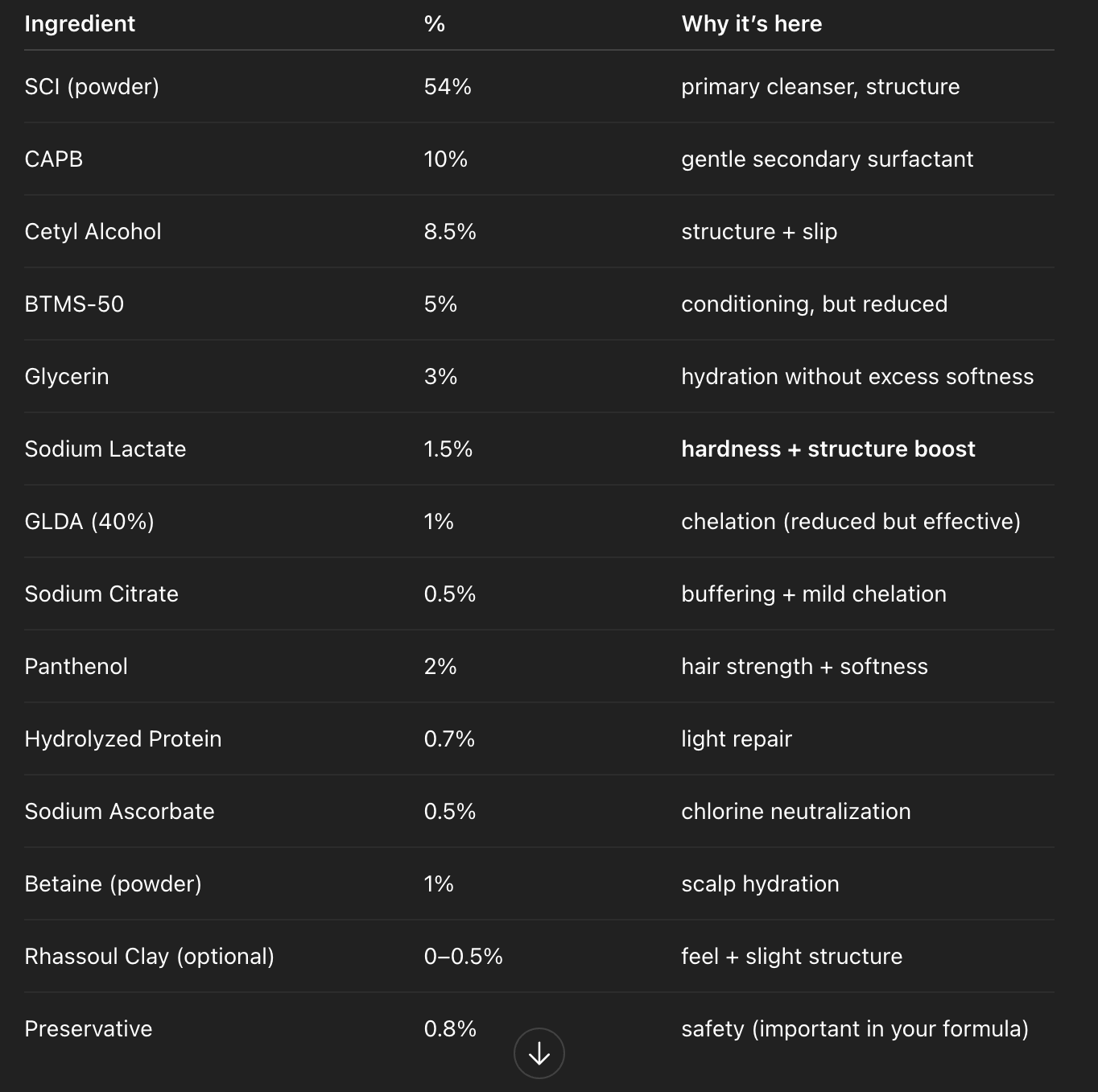
Cetyl Alcohol — 7% — 14g — heat to 120-135F, do not exceed 140F
BTMS-50 — 6% — 12g — heat to 120-135F, do not exceed 140F
CAPB — 12% — 24g — warm to 110-120F before combining, do not exceed 140F
SCI powder — 52% — 104g — heat to 120-135F, do not exceed 140F, add last gradually
Glycerin divided into 2 portions — 6% — 12g total — heat to 140F, do not exceed 150F
Sodium Citrate dissolved in 6g glycerin — 1% — 2g — 140F
Hydrolyzed Protein added to same glycerin — 1% — 2g — 140F
Liquid Panthenol added to same glycerin — 2% — 4g — 140F
Sodium Ascorbate dissolved in separate 6g glycerin — 0.5% — 1g — 140F
Total: 199g | Makes 2 bars approximately 90g each | No clay, no color
Process in order:
Warm CAPB to 110-120F in hot water bath first and set aside.
Melt cetyl alcohol and BTMS-50 in double boiler at 120-135F.
Add warmed CAPB and stir to combine.
Sprinkle SCI powder in gradually while mashing continuously to thick mashed potato texture. Do not exceed 140F at any point.
Parallel to this, warm 6g glycerin to 140F and dissolve sodium citrate fully, then add hydrolyzed protein and stir, then add liquid panthenol and stir until completely smooth.
In separate small dish warm remaining 6g glycerin to 140F and dissolve sodium ascorbate until clear.
Add glycerin actives mixture into dough and knead thoroughly.
Add sodium ascorbate mixture and knead until fully incorporated. L
et dough sit uncovered 3-5 minutes without touching it. Check temperature before pressing.
Press temp:
100-110F ideal,
95F minimum,
115F maximum
Tips:
Mold lining: parchment circles or thin plastic rounds top and bottom
Press: load 90g per mold, press firmly, hold 5-8 seconds
Freezer: immediately after pressing, 1-2 hours
Unmold: remove from freezer, rest on counter 3-5 minutes, then unmold gently onto wire rack
Cure: 5-7 days indoors on wire rack, small fan circulating, not in garage, flip every 12 hours for first 48 hours
pH target: 5.0-5.5 tested at 48-72 hours by shaving 0.5g into 10g distilled water, wait 15 minutes, test liquid only
Shelf life: use within 6-9 months for best chlorine neutralization
Troubleshooting:
Crumbly dough — mist 0.5g warmed CAPB and knead
Sticky dough — wait 2-3 minutes, do not add anything
Too stiff — warm hands and knead 60 seconds
Pulls apart on unmold — wait 2 more minutes in mold next time
Dough below 95F before second bar — set bowl back on double boiler heat off for 60 seconds and check temp
GENTLE CONDITIONER BAR — 200g Test Batch All Ages | Unscented | Pool and Hard Water Friendly | Rinse-Out
Cetearyl Alcohol — 26% — 52g — heat to 140-150F, do not exceed 160F
Cetyl Alcohol — 6% — 12g — heat to 140-150F, do not exceed 160F
BTMS-50 — 20% — 40g — heat to 140-150F, do not exceed 160F
Cocoa Butter — 7% — 14g — heat to 140-150F, do not exceed 160F
Jojoba Oil — 3% — 6g — heat to 140-150F, do not exceed 160F
Glycerin divided into 3 portions — 6% — 12g total — heat to 140F, do not exceed 150F
Sodium Citrate dissolved in 4g glycerin — 0.5% — 1g — 140F
Hydrolyzed Oat Protein added to same glycerin — 1% — 2g — 140F
Liquid Panthenol added to same glycerin — 2% — 4g — 140F
Sodium Ascorbate dissolved in separate 4g glycerin — 0.5% — 1g — 140F
Colloidal Oatmeal dispersed in remaining 4g glycerin — 2% — 4g — room temp
Total: 200g | Makes 2-3 bars approximately 70-80g each | No clay, no color
Conditioner application for curls — important: Never rub bar directly on hair. Rub between wet palms first to create a light cream, then apply to hair. This prevents wax buildup on his waves and your lengths.
Use within 6-9 months for best chlorine neutralization.
Process in order:
Add cetearyl alcohol and cetyl alcohol to double boiler first and heat to 140-150F until fully melted.
Add BTMS-50 and stir until completely incorporated.
Add cocoa butter and stir until melted through.
Add jojoba oil last and stir to combine. Do not exceed 160F at any point.
Parallel to this, warm 4g glycerin to 140F and dissolve sodium citrate fully, then add hydrolyzed oat protein and stir, then add liquid panthenol and stir until completely smooth.
In separate small dish warm 4g glycerin to 140F and dissolve sodium ascorbate until clear.
In third dish disperse colloidal oatmeal into remaining 4g glycerin at room temp, stir until no lumps remain. Let base cool slightly to 130-140F before combining.
Add glycerin actives mixture and knead thoroughly.
Add sodium ascorbate mixture and knead.
Add oatmeal dispersion last and knead until fully even throughout.
Let dough sit uncovered 3-5 minutes. Check temperature before pressing.
Press temp:
100-110F ideal,
95F minimum,
115F maximum
Tips
Mold lining: parchment circles or thin plastic rounds top and bottom
Press: load 70-80g per mold, press firmly, hold 5-8 seconds
Freezer: immediately after pressing, 2-3 hours
Unmold: remove from freezer, rest on counter 3-5 minutes, then unmold gently onto wire rack
Cure: 10-14 days indoors on wire rack, small fan circulating, not in garage, flip every 12 hours for first 48 hours
pH target: 4.5-5.0 tested at 48-72 hours by shaving 0.5g into 10g distilled water, wait 15 minutes, test liquid only
Shelf life: use within 6-9 months for best chlorine neutralization
Troubleshooting:
Too soft to unmold — wait 3 more minutes, do not rush
Smears on unmold — dough was too warm, press cooler next batch
Crumbles on press — too cool, warm hands and knead 60 seconds
Greasy feel after cure — reduce cocoa butter to 5g and increase cetearyl to 59g next batch
Leaves waves limp — reduce BTMS to 36g and reduce cocoa butter to 10g next batch
Does not rinse clean — hard water issue, sodium citrate is already working, try a longer rinse
How to use both bars together after pool: Wet hair thoroughly first to dilute chlorine — this alone removes a significant portion of chlorine load before any product touches hair. Apply shampoo bar to scalp, work lather through lengths, rinse fully. For conditioner bar rub between wet palms first to create a light cream, never apply bar directly to hair especially on curls. Apply cream mid-length to ends only. For his loose waves ends only and quick 30 second rinse. For your long hair mid-length to ends, leave one to two minutes, rinse thoroughly.
How to use both bars together after pool: Wet hair thoroughly first to dilute chlorine. Shampoo bar into scalp, let lather run through lengths, rinse fully. Conditioner bar rubbed between palms first to activate, then applied mid-length to ends only. For his loose waves ends only and quick rinse. For your long hair mid-length to ends, leave one to two minutes, rinse.
Shampoo bar: 1-2 hours in freezer before unmolding The high surfactant content means it firms up relatively fast. An hour is usually enough. Two hours is fine if you forget about it. Don't leave it overnight — the expansion and contraction from temperature swings can cause cracking.
Conditioner bar: 2-3 hours in freezer before unmolding The high emollient content holds heat longer and firms more slowly. It genuinely needs the extra time. Two hours minimum, three is better for your first batch when you're unsure.
The process for both:
Put molds in freezer immediately after pressing — don't wait for them to cool on the counter first. The faster the temperature drops the better the crystal structure, which is what gives you a hard bar that pops cleanly.
When you take them out, don't try to unmold immediately. Let them sit on the counter for 3-5 minutes first. The slight warming at the edges creates a tiny gap between bar and mold that makes release much cleaner. Going straight from freezer to unmolding is actually harder than waiting those few minutes.
One thing to watch: if your mold has any moisture on it going into the freezer, that can cause the bar surface to look frosted or pitted when it comes out. Pat molds dry before pressing.
After unmolding, straight onto a wire rack indoors — not back in the freezer, not in the garage.
Best mold release for your specific mold type:
For a cylinder hand press mold the best option is a small round of parchment paper top and bottom. Cut circles slightly larger than your mold diameter, maybe a quarter inch wider all around. Press the bottom circle in first, fill and press your bar, then lay the top circle on before your final press. Small pieces of plastic bag work even better than parchment because they're thinner, reusable, washable, and release more cleanly — the bar doesn't grip plastic the way it can grip paper. House of Tomorrow Save any thin plastic packaging coming through your house for this purpose.
Powder dusting — does it work?
Cornstarch or rice starch dusted lightly on the press face works well and prevents sticking, especially with intricate stamp designs. Boreal Bloom Homestead Use the absolute minimum — a light tap of a powder puff or your fingertip. Too much powder sits on the bar surface visibly and can affect lather slightly. For a simple cylinder with no stamp design, parchment or plastic is cleaner and easier than powder.
Coconut oil — skip it for these bars:
Fractionated coconut oil works for cold process soap molds but is the wrong choice for syndet bars. The oils interfere with the surfactant structure right at the surface where you want it most intact, and it can leave a greasy residue on the bar face that affects how it lathers. Avoid it entirely for shampoo bars specifically.
For the conditioner bar mold:
Same approach — parchment or thin plastic top and bottom. The conditioner bar is actually stickier than the shampoo bar when warm because of the high emollient content, so don't skip the liner thinking it'll be fine. It won't.
One extra tip nobody mentions:
Warming your CAPB in a hot water bath before combining it with SCI gives you a much smoother paste that sticks together perfectly and unmolds easily Soapmaking Forum — the texture difference is significant and it makes the whole dough more cohesive from the start, which means less sticking to the mold in the first place.
Quick reference:
Cylinder press mold — thin plastic rounds or parchment circles, top and bottom, cut slightly oversized. No oil. Light cornstarch optional on stamp face only if you add one later. Line every single time, never skip it even once you feel confident.
Watching other videos:
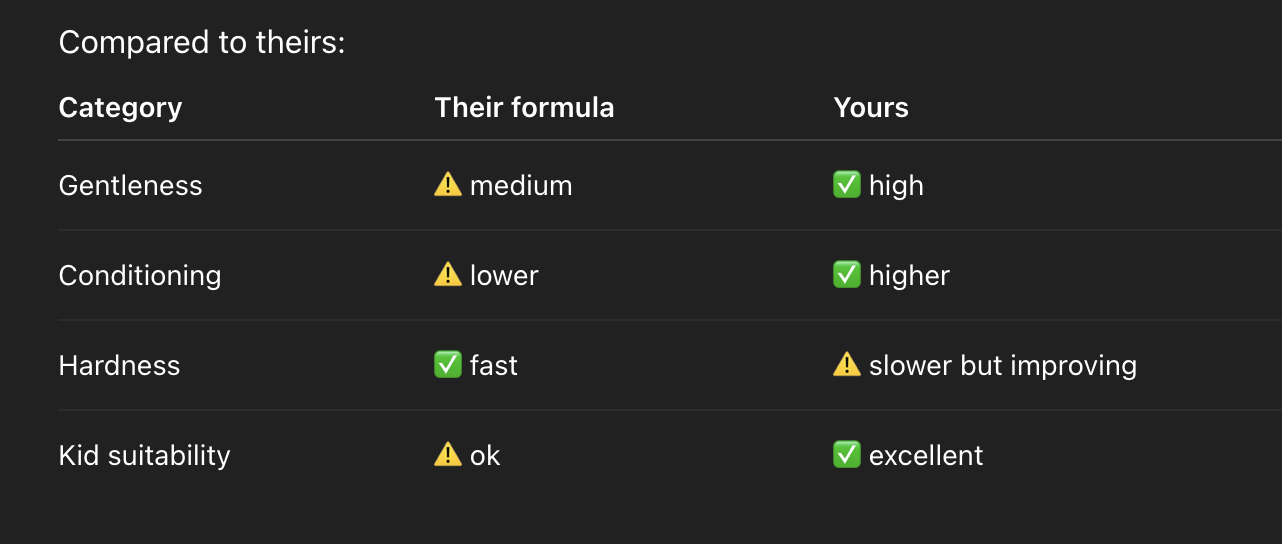
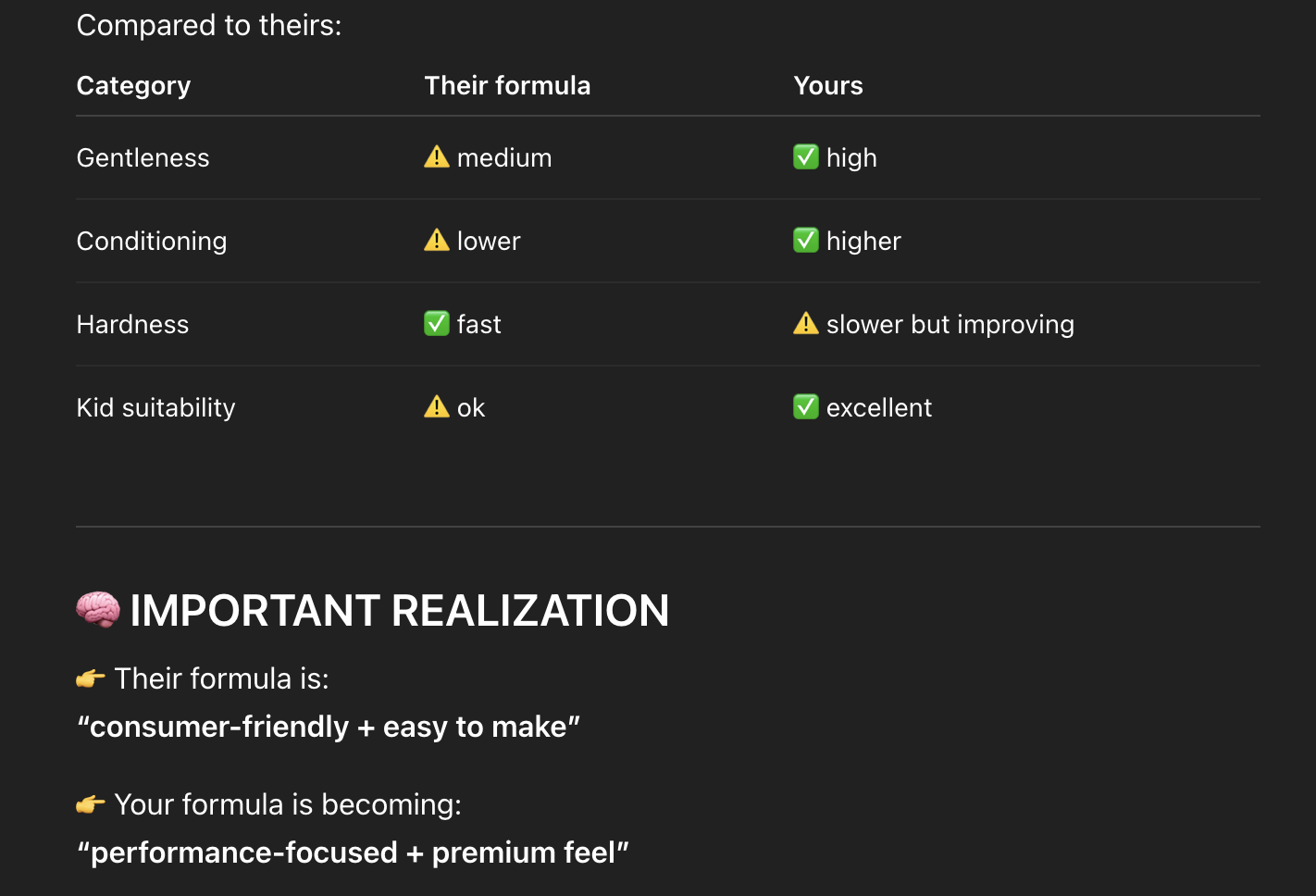
Their formula is drier than yours. Most videos use higher SCI percentages, often 55-65%, and lower CAPB, sometimes as low as 8-10%. Less liquid in the formula means the bar holds its shape almost immediately after pressing. Your formula is more conditioning and slightly wetter by design, which is better for your hair but slower to firm.
Their environment is likely drier than yours. Danville's humidity is genuinely higher than most places people film these tutorials. A maker in Arizona or Colorado pressing a bar at 40% humidity gets a completely different result from the same formula than you would at 70-90% morning humidity in the Bay Area.
Their bars are often smaller. A 60-70g bar firms faster than an 85-90g bar. More mass means more heat to dissipate before the bar holds its shape. Watch closely in those videos — the bars that unmold immediately tend to be narrower or thinner than yours will be.