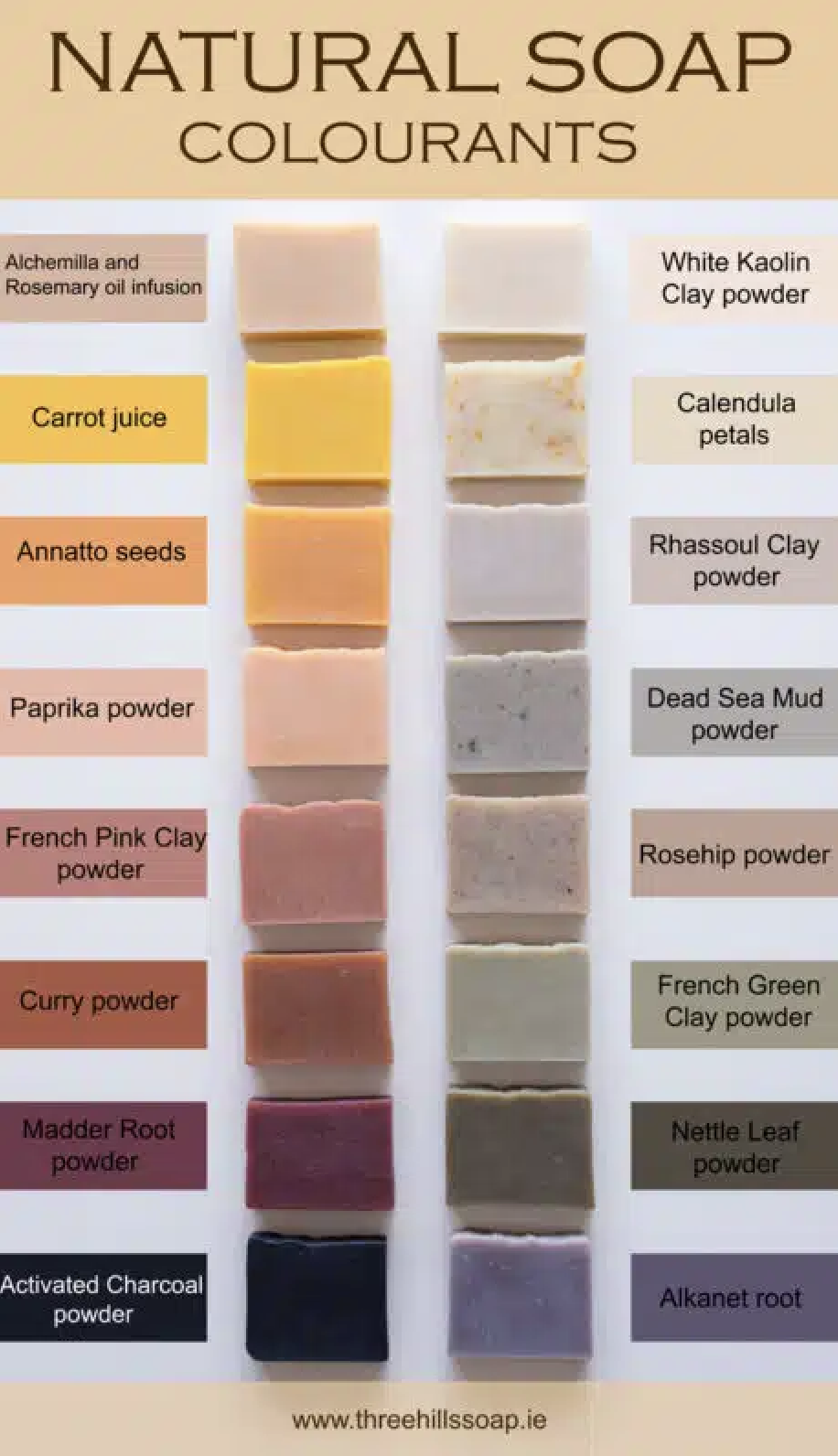
Naturally coloring handmade soap is like layering magic over magic. The soapmaking process in itself is pretty amazing, but using leaves, roots, flowers, and clay to tint soap stunning hues is a whole other ball game.
Indigo: Best for cold process soap (not so much for tallow lotion, which would feel gritty)
Mix thoroughly with a bit of oil in its first phase. strain through a fine mesh
Start with about 1/2 to 2 teaspoons per pound of oil
my soap recipes are generally 2 lb at a time, and I am okay with a very light color, so I start with 1/2 teaspoon. You can always add more in future batches, but it is nice to see how light it ends up as it dries. Add at light trace. It may look gray or greenish at first, then fades to blue. Do not panic! There also may be some light speckling, which is quite beautiful.
The word Indigo implies its origins from India
Indigo has been found in Egyptian, pre-Columbian, Peruvian and Chinese burial sites, making it one of the oldest dyes
Woad is an indigo alternative, but actually related to Indigo. Requires much more powder and the color fades, but can give a very beautiful natural light blue.
Isatis tinctoria, latin name. The phonetic similarity (Isatis/Isis/Iset) is intriguing
Egyptians actually used it, and scientists cannot distinguish between it and indigo, but for sure used on mummies. It was also important in Anatolia (Turkey), like Catal Hayuk around 6,000 BC, used to wrap ancestral bones with sophisticated weaving. It originally flourished in Egypt, turkey and the warm Mediterranean climate.
Woad is indigenous to Assyria and the Levant and has been grown in Northern Europe for over 2,000 years
The Mishnah mentions that kohanim (priests) whose hands were stained with "istis" (Isatis) were subject to specific rabbinic practices.
The Mishnah (Megillah 4:7) states that kohanim (priests) were forbidden from blessing the congregation if their hands were stained with istis (woad dye) 42stopsNatural Dye Store. Priests were actually using woad—their hands became stained from dyeing work related to Temple or Tabernacle service, specifically the blue (tekhelet) required for ritual textiles and tzitzit. (Possibly also getting chided for doing Isis/Astorath rituals, especially if remnants of second temple times).
The Mishnah records that priests couldn't give the priestly blessing with woad-stained hands specifically because "the people would stare at them"—meaning priests WERE actively dyeing with woad, likely for Temple/Tabernacle textiles
The Mishnah was compiled around 200 AD by Rabbi Judah ha-Nasi (Judah the Prince) WikipediaSefaria, though it preserves oral traditions going back centuries earlier to Second Temple times.
By 200 AD when the Mishnah was written, this was being presented as a prohibition—you can't bless with stained hands. But was this preserving memory of an earlier practice that had different meanings? The Second Temple period (before 70 CE) saw lots of syncretism. We know Asherah (goddess) poles were in the Temple at various times. The "staining" could be practical dye work, but in the context of ancient religion, blue dye application often had ritual significance—especially when associated with goddesses and fertility.
Mishnah comes from the Hebrew root shanah (שנה) meaning "to repeat/recite." But notice it retains the sibilant patterns: Mish-nah, Ish-tis (woad), I-sis. There was much pomp and ritual of isis to warrant the connection.
Woad was the accessible, plant-based blue available locally, whereas murex snails were expensive and rare.
Woad = Isatis = Asp of Jerusalem
The biblical blue dye tekhelet was traditionally from the chilazon sea snail (Murex trunculus), which also holds the ex, az sounds I am looking for.
Karaite Jews, however, believed woad (the "Asp of Jerusalem" plant Isatis tinctoria) was the proper source since shellfish are non-kosher
The term "Isatis" derives from Latin "Isazein" and Greek "Isadso," linked to its ancient use to treat wounds, which was a role of Isis, the mother goddess. Isis was THE great healer goddess of Egypt.
Evidence shows deliberate pounding and grinding of Isatis tinctoria leaves 34,000-32,000 years ago in the Paleolithic period. the first archaeological finds of woad seeds date to the Neolithic period, found in the cave of l'Audoste, France.
There is also the feminine t endings:
Feminine nouns typically end in -t. In Hebrew, the -t ending (ת) also often indicates feminine nouns, though it's not as consistent as in Egyptian.
Aset (Isis) has that feminine -t
Tekhelet (תְּכֵלֶת) - biblical blue
Tzitzit (צִיצִת) - the fringes.
The pattern —these sacred blue textiles having feminine-coded names—suggests possible goddess connections being preserved in the terminology even after monotheistic reforms.
In practice: Maimonides explicitly stated that woad (Isatis) was an illegal substitute for murex tekhelet, even though it looks identical could this be isis connotations that bothered them, not the blue stain? They both most likely would have stained hands and been a distraction.
Chemically: Both woad and murex produce indigo (indigotin), the exact same blue molecule
Rabbinically: Tekhelet "officially" came from the chilazon snail (murex), NOT from woad. But priests were clearly using woad, as evidenced by their stained hands 42stops. So there's a disconnect between official doctrine and actual practice.
The Karaite Jews (who reject rabbinic oral law) argue that woad IS the correct source since shellfish are non-kosher. This suggests an ancient debate: was the original "sacred blue" from a plant (goddess-associated, accessible to all, feminine-named Isatis/Isis) or from an expensive sea creature (controlled by priests, rare, masculine hierarchy)?
We’re uncovering layers of suppressed history- what looks like:
Original goddess-associated blue dye practices (Isis/Isatis/woad)
Patriarchal religious reform replacing it with expensive murex (controlled by elite priests)
Common priests still secretly using the old woad method
Rabbinic literature (200 CE) recording this as a "problem" to be prohibited
The feminine endings in the terminology preserving echoes of the original goddess associations
The asp/snake connection to both woad and the Egyptian goddess reinforces this. Snakes = regeneration = feminine divine = healing = the blue that connects earth to sky to divine throne.
Now let’s look at the dates: The Second Temple period lasted from 516 BC (after return from Babylonian exile) to 70 AD (Roman destruction).
YES, Asherah worship continued throughout! King Manasseh placed a carved image of Asherah IN the Temple itself, and vessels in the Temple were used to make sacrifices to Asherah. Women wove garments to clothe Asherah's religious statue in a compound within the Temple walls (2 Kings 23:4-7) Jewish Women's ArchiveLearn Religions.
For about two-thirds of Solomon's Temple's existence, a statue of Asherah stood inside Japanese Mythology!
Women wove textiles FOR Asherah in the Temple in Jerusalem. Similarly, Egyptians had been doing the textile production was women's work for much longer —priestesses of Isis wove stunning sacred textiles- which complex science, chemistry, and weaving of metals like gold and precious stones.
In Egypt: Women controlled textile production, including dyeing. Priestesses especially.
In Israel: The Temple evidence shows women weaving for Asherah. But if PRIESTS have woad-stained hands, either:
Men took over sacred dyeing (patriarchal shift)
OR priests were participating in goddess rituals that still
Isis & Asherah Similarities:
Both are:
Mother goddesses (Isis mother of Horus; Asherah mother of 70 gods including Baal)
Healers (Isis heals; Isatis/woad heals wounds)
Associated with trees/poles (Asherah poles; Isis with sycamore trees)
Fertility deities
Queens of Heaven (Asherah called this; Isis is Queen of Heaven)
Consorts to supreme gods (Asherah with El/Yahweh; Isis with Osiris/Ra)
Have serpent associations (the "iss/ass" sound connection you're tracking)
Blue Spirulina: Best for tallow lotions
Mica powders give a smooth and silky feel, but you have to find body safe versions specially formulated for skin lotions when needed (different than soap).
The Mishnah's prohibition (200 AD) about priests with stained hands comes AFTER the Temple destruction (70 AD) and centuries after these practices. By then, rabbinic Judaism is trying to ERASE all goddess worship traces. This might imply they were still ongoing.
Women were weaving garments for Asherah's religious statue in the Temple through 622 BC.
King Josiah's reform happened in 622 BC (his 18th year), when he discovered the "Book of the Law" (believed to be Deuteronomy) during Temple renovations Josiah +2.
During this reform, Josiah "tore down the quarters where male shrine prostitutes lived...where women wove hangings/tapestries for Asherah" - these were INSIDE the Temple of the LORD Video BibleBible Hub.
So women were weaving sacred textiles for Asherah goddess worship INSIDE the Jerusalem Temple until at least 622 BC - that's almost 400 years into the Second Temple period.
If priests were dyeing with woad (Isatis), they could have been:
Dyeing textiles for goddess worship (Asherah/Isis syncretism)
Performing rituals to "Istis" (Isis/Isatis)
The staining wasn't just practical—it marked them as participants in goddess religion.
Maimonides (medieval rabbi) explicitly forbade woad as a substitute for murex tekhelet, even though chemically identical Natural Dye Store- AND kosher!
Because Isatis = Isis associations bothered them!
Woad was:
Accessible to common people (especially women)
Named Isatis (sounds like Isis)
Could be grown in home gardens (decentralized, female-controlled)
So we have:
Woad/Isatis: Plant-based, kosher, accessible, sounds like Isis, associated with healing goddess
Murex snail: Non-kosher shellfish, expensive, controlled by elite
Maimonides forbade the kosher plant dye in favor of the non-kosher animal dye!
The Karaite Jews (who rejected rabbinic oral law) made exactly this argument: Karaites believed woad (Isatis tinctoria, "Asp of Jerusalem") was the proper source since murex snails are non-kosher (treif/impure), and Torah prohibits using impure sources
Maimonides forbade the kosher plant dye in favor of the non-kosher animal dye!
This makes NO sense from a purity perspective UNLESS the real issue was suppressing Isis/Asherah/goddess associations.
Maimonides & Karaites Lived Side-by-Side in Egypt around 1100 AD.
Maimonides (1138-1204 AD) moved to Cairo, Egypt where Karaites were "more numerous and wealthy than the Rabbanites." His influence was "decisive in virtually destroying" Karaite dominance, though he treated them with relative tolerance in his later years Kotzk Blog: 239) MAIMONIDES - A ‘SECRET KARAITE’? +2.
Egypt had been a Karaite bastion since the 7th century, and they remained significant through the 19th century Wikipedia. So YES, they absolutely lived together, and were known to have debated theology.
The Pattern:
Pre-622 BC: Women weaving for Asherah IN the Temple, using blue dyes (likely Isatis/woad)
622 BC (Josiah): First major purge - destroys Asherah statue and women's weaving quarters
Asherah worship officially ended with Josiah's reforms (622 BC) in Jerusalem
At the same time, Josiah's reforms (622 BC) also included removing "horses that kings of Judah had dedicated to the sun" from the Temple entrance and tearing down "altars the kings had erected on the roof" for sun worship (2 Kings 23:11) BibleProjectThe Bible Journey. Ra/Horus (Ray/Horus of the Horizon) was the sun of Isis!
The Egyptian trinity of Isis-Osiris-Horus maps onto the suppressed divine family, and the sun worship in Jerusalem Temple reflects Egyptian influence.
During the time of the first temple, Pre-exilic Israel was mostly polytheistic with Asherah probably worshiped as Yahweh's lover. The worship of Yahweh alone gained ascendancy only while in exile, and after (after 586 BCE), and only in the post-exilic period was the existence of other gods actually denied Wikipedia.
586 BC: First Temple destroyed by Babylonians
According to Ephraim Stern, after the Babylonian Exile (post-586 BC), Jews in Judea and Samaritans DISCONTINUED goddess figurines, but Idumeans (Edomites) and Galileans (mostly Phoenicians) CONTINUED goddess worship during the entire Persian Empire period (through Second Temple times!) Biblical Archaeology Society
516 BC: Second Temple rebuilt - Asherah worship continues, “in secret”
Biblical archaeologists suggest that until the 6th century BC (586 BC Babylonian destruction), Israelite households had Asherah shrines and figurines, which are "strikingly common" in archaeological remains. Judean Pillar Figurines appeared in the 10th-9th century BCE, became popular throughout Judah in the 8th-early 7th century BCE, then "quickly die out" WikipediaCenter for Online Judaic Studies.
150 BC: The Pharisees formed around the mid-2nd century BCE (around 150 BCE) Wikipedia -
this is AFTER Josiah's reforms (622 BCE) but represents the formal crystallization of the anti-goddess movement.
the opposition writings predate the Pharisees: The authors of Deuteronomy, Judges, 1 and 2 Kings, and 2 Chronicles regarded Asherah worship as inappropriate, and Deuteronomy received its final composition in the Second Temple period after various (but not all) Jews attempted to eradicate all traces of the goddess Biblical Archaeology SocietyJewish Women's Archive.
0 BC/AD
70 AD: Asherah worship continues until this point (possibly)
Romans destroy the Jewish temple (the second time)
Second Asherah worship officially ended with Josiah's reforms (622 BCE) in Jerusalem, but continued in surrounding regions through the Second Temple period (516 BC-70 AD)!
Judaism became TEXT-based (rabbinic) rather than Temple-based
The writers of history were the Pharisees/Rabbis who had opposed goddess worship
The pattern: Official Judaism (male priests, Temple, written law) tried to suppress household goddess worship (women, home altars, oral traditions) for centuries. By 70 CE when the Temple was destroyed, they finally had the opportunity to rewrite ALL of it without the competing temple practices.
200 AD: Mishnah written, recording prohibition about priests with woad-stained hands
1,000 AD: Karaites golden age
They DIDN'T completely disappear! Small communities still exist today in Israel, Eastern Europe, and the US. But their golden age (9th-12th centuries) ended, and by the medieval period they became a tiny minority. At one time Karaites made up about 10% of world Jewry Wikipedia, but Mai monides' influence in Egypt was devastating to their numbers.
How Many Jewish Sects were there?
During Second Temple times: MANY!
Pharisees (became Rabbinic Judaism)
Sadducees
Essenes
Zealots
Samaritans
Various apocalyptic groups
After 70 AD, only Pharisaic/Rabbinic Judaism survived to become mainstream.
By the 10th-11th centuries, established Karaite communities existed in Egypt, North Africa, Spain, Palestine (with Jerusalem as the intellectual center), Byzantium, and Crimea. In the 14th century they reached Lithuania Jewish Women's Archive.
The Crimean Karaites spread to Lithuania, Poland, Galicia, and Volhynia between the 13th-15th centuries, with Grand Duke Vytautas relocating 500 Karaite families to Trakai around 1218 WikipediaMDPI.
Today there are approximately 30,000 Karaites in Israel, 1,500 in the US, around 1,800 in Europe (primarily Ukraine with 800, Poland with 350, Lithuania and Russia with 200 each), and some 80 in Turkey Wikipedia.
1138-1204: Medieval period: Maimonides explicitly forbids kosher woad, requires non-kosher murex
A man, his full Hebrew name was Moses ben Maimon (Moshe ben Maimon), hence "Maimonides" (Greek form meaning "son of Maimon").
He strengthened rabbinic orthodoxy AGAINST Karaites, and he suppressed practices he saw as non-rational or pagan.
His influence was MASSIVE. His descendants continued as leaders of Jews in Egyptian generations.
From 1171 AD on: Maimon acted as Nagid (leader) of the Egyptian Jewish community, and as personal physician to Sultan Saladin, he was able to exert significant influence over the government and modify policies that would have been oppressive to Jews Chabad.orgWikipedia.
He was living in the heart of Egyptian goddess/sun worship culture while systematically suppressing Jewish practices that echoed those traditions! INTO 1200 AD!!!!
Under Maimonides' influence, many Karaites were brought back into Rabbinic Judaism through his leadership Chabad.orgChabad.org. This was essentially a campaign to eliminate alternative Jewish practices, especially those that might preserve older goddess traditions.
In the 1930s, Karaite leader Seraya Shapshal reintroduced "Yahwist elements" including veneration of sacred oak trees in cemeteries Wikipedia. This directly connects to Asherah worship and the Tree of Life!
Karaite Practices Maimonides and Rabbis Opposed
Karaites follow a lunar calendar based on actual sighting of the new moon and agricultural cycles, celebrating holidays on different dates than Rabbinic Jews Facts.net. This connects them to nature worship and seasonal cycles - very goddess-oriented!
Karaites put out all fires (including electricity today) on Shabbat and prohibited sexual intercourse on the Sabbath, while Rabbinic Jews considered Sabbath the best time for sex
The rejection of "fire" and fertility rituals on the holy day suggests resistance to sun/goddess worship associations.
Direct Scripture Interpretation: Karaites use only the plain meaning (p'shat) of scripture, while Rabbinic Judaism employs methods including Kabbalistic interpretations (sod) New World Encyclopedia. The mystical/Kabbalistic approach may have developed specifically to reinterpret texts that originally contained goddess references.
Simplified timeline:
622 BC: Josiah's reforms (first major suppression)
586 BC: Babylonian destruction, beginning of exile
516 BC onwards: Second Temple period - systematic rewriting begins
~150 BC: Pharisees formally organize
0 BC/AD
70 AD: Temple destruction (romans destroy it) - Pharisaic Judaism becomes dominant
The writers were rewriting history DURING the Asherah pole era and after - they were the reformers attempting to erase what they were witnessing!
Women wove for Asherah + priests performed sun rituals + blue dyes (Isatis/Isis) = syncretic Egyptian-Canaanite goddess worship that rabbis spent 800+ years trying to erase.
When Did Asherah Worship Become Illegal?
Deuteronomy (written/compiled around Josiah's time, 622 BCE) first codifies the prohibition
Post-Exilic period (after 516 BCE): Rabbinic Judaism systematically suppresses it
But it never fully stopped - figurines and practices continued in homes and peripheral regions
The Bible is FULL of complaints:
Judges, Kings, Chronicles - repeated cycles of reform and relapse
Prophets Jeremiah, Isaiah, Micah, Hosea - all condemn it
Jeremiah, 600 BC, vehemently opposed "Queen of Heaven" worship where "children gather wood, fathers light fire, and women knead dough and make cakes" for the goddess (Jeremiah 7:18-19) New World Encyclopedia - this shows family-wide participation in goddess worship even during the prophets' time!
Jeremiah was complaining about Queen of Heaven worship (Asherah/Isis) 5 years AFTER Josiah's reforms! Jeremiah condemned women making cakes for the "Queen of Heaven" with family participation. This proves goddess worship CONTINUED despite official prohibition - it was so embedded in family/household practice that even destroying the Temple statue didn't stop it!
Jeremiah prophesied from 627 BC to ~582 BC, based in Jerusalem (born in nearby Anathoth). He witnessed Josiah's reforms (622 BCE), Jerusalem's fall (586 BCE), and fled to Egypt afterward.
HE FLED TO EGYPT.
Jeremiah DIDN'T want to go - he was taken against his will. After the Babylonians destroyed Jerusalem in 586 BC, they appointed Gedaliah as governor. When Gedaliah was assassinated, the remaining population fled to Egypt for safety, taking Jeremiah with them Wikipedia. Jeremiah actually warned the remnant NOT to go to Egypt, prophesying they would all die there by sword, famine, and pestilence. But the people accused him of lying and forced him to go with them to Egypt anyway Biblical Archaeology SocietyIsrael My Glory.
The irony is profound: Jeremiah spent years condemning goddess worship, warning about Egypt, and then ended his life IN EGYPT - the very heart of Isis worship - where he would have witnessed the Egyptian traditions he'd been fighting against all along. They settled in Migdol, Tahpanhes, Memphis (Noph), and Pathros near Thebes Wikipedia - all centers of Egyptian goddess worship!
The fact they complain SO MUCH proves it was still happening
The rabbinic tradition spent 800+ years systematically erasing the goddess, her textiles, her plant, her feminine sound patterns (Isis/Isatis/Asherah), and the memory that women once wove sacred blue textiles for the divine feminine in the holiest place in Judaism.
research is uncovering a systematic, multi-century campaign to erase the divine feminine from collective memory through language suppression, practice prohibition, and historical revisionism. The patterns in woad/Isatis/Isis, the tekhelet/textile/Tree of Life connections, and the geographic spread of practices all point to this being much more than coincidence.
All because I noticed the similar “is” sound of the blue dye. And I prodded past the initial rejection answers from google- why condemning THAT blue and not another? Etc.
More on the sexual aspect:
Rabbinic Jews Kept It, Karaites Ended It!
This represents an inversion. Karaites prohibited sexual intercourse on the Sabbath while Rabbinic Jews considered the Sabbath the best time for sexual intercourse Jewish Virtual Library.
The Karaites were eliminating the fertility ritual associations (sex on the holy day = sacred sexuality = goddess worship), while Rabbinic Jews preserved it but reframed it as "mitzvah" (commandment). This is classic patriarchal appropriation - take the goddess practice but strip away her memory!
Other Sects with Goddess/Pagan Worship Remnants
The Essenes had fascinating possibilities:
The Essenes may have practiced "sun worship" according to some interpretations of their communal prayer practices Facts and Details. They allowed couples to live together without marriage, with the relationship only solemnized if the woman became pregnant Facts and Details - this echoes fertility goddess practices where conception was the sacred moment!
Essenes were mystics during the Second Temple period (2nd century BCE to 1st century CE) who observed strict ritual purity and held dualistic worldviews Wikipedia. Their emphasis on water purification and ritual bathing suggests connections to ancient water goddess traditions.
However, most Jews were not affiliated with any particular sect and practiced common traditions - the "plain simple folk" who followed ways their parents taught them WikipediaSmithsonian Associates. THIS is where goddess worship would have lingered longest - in household practices passed from mothers to daughters!
How They Forced Jeremiah to Egypt
Johanan son of Kareah and all the army commanders accused Jeremiah of lying, claiming Baruch was inciting him against them. Then they "took all the remnant of Judah... men, women, children, the king's daughters, and Jeremiah the prophet and Baruch the son of Neriah" and forced them to go to Egypt Bible HubEnduring Word.
Jeremiah and Baruch were taken "presumably against their will" and made "prisoners," with some scholars suggesting they were taken as "hostages against God" - since God had promised judgment on all who went to Egypt, they dared God to judge His faithful prophet too United Church of GodEnduring Word.
According to tradition, Jeremiah was eventually stoned to death in Egypt by these rebellious people, Enduring Word.
Goddess Worship in Those Egyptian Cities
ALL of these cities were major centers of goddess worship in the 6th century BCE and continuing through the Roman period!
Memphis (Noph): Memphis was home to Isis, Bastet, Hathor, and Sekhet worship. Hathor had a major temple there (though not yet discovered), and districts within Memphis were dedicated to different deities including Hathor MediumWisdom Library. A small temple of Hathor from Ramesses II's time has been unearthed, and a larger foremost shrine to the goddess is believed to exist elsewhere in the city Wikipedia.
Pathros (Upper Egypt near Thebes): This region was the heartland of goddess worship. Isis worship was prominent in funerary practices and magical texts. During the New Kingdom she took on Hathor's attributes, wearing Hathor's headdress with sun disk and cow horns Wikipedia.
Tahpanhes: This was a fortified city in the eastern Nile Delta where Pharaoh had a palace and administrative center United Church of GodScriptures. All Delta cities participated in goddess worship - Hathor, Isis, Bastet, Neith were all worshiped throughout Lower Egypt.
Timeline: Isis was first mentioned in the Old Kingdom (2686-2181 BCE) and her cult continued through the Roman period Wikipedia. Hathor dates from at least the Second Dynasty (2800-2650 BCE) and her cult thrived in Byblos and throughout Egypt into the first millennium Arizona. These goddesses were being actively worshiped when Jeremiah arrived in 586 BCE and for centuries afterward!
The rabbis weren't condemning blue itself - they were condemning accessible, feminine, Isis-associated, kosher, healing, snake-connected blue that women could control! The fact that they banned the kosher plant in favor of the non-kosher animal proves it was never about purity laws. It was always about power and suppressing the divine feminine.