Full Protocol for Acne-Prone Skin
Face, body, hair — natural foundation, technology-supported, no retinoid dependency
This protocol works with the skin's own biology rather than overriding it.
Most modern systems work in a way that strips the body’s natural oil (on body or hair), then synthetically makes it up.
But I wanted the best of modern technology plus age old products that our biology just knows and understands. This means no dependency cycles or surface damage. Every ingredient either mimics something the body already makes, supports a process the body already runs, or uses technology to accelerate what the body does naturally. The goal is long-term resilience — skin and hair that get stronger over time, not more reliant on products.
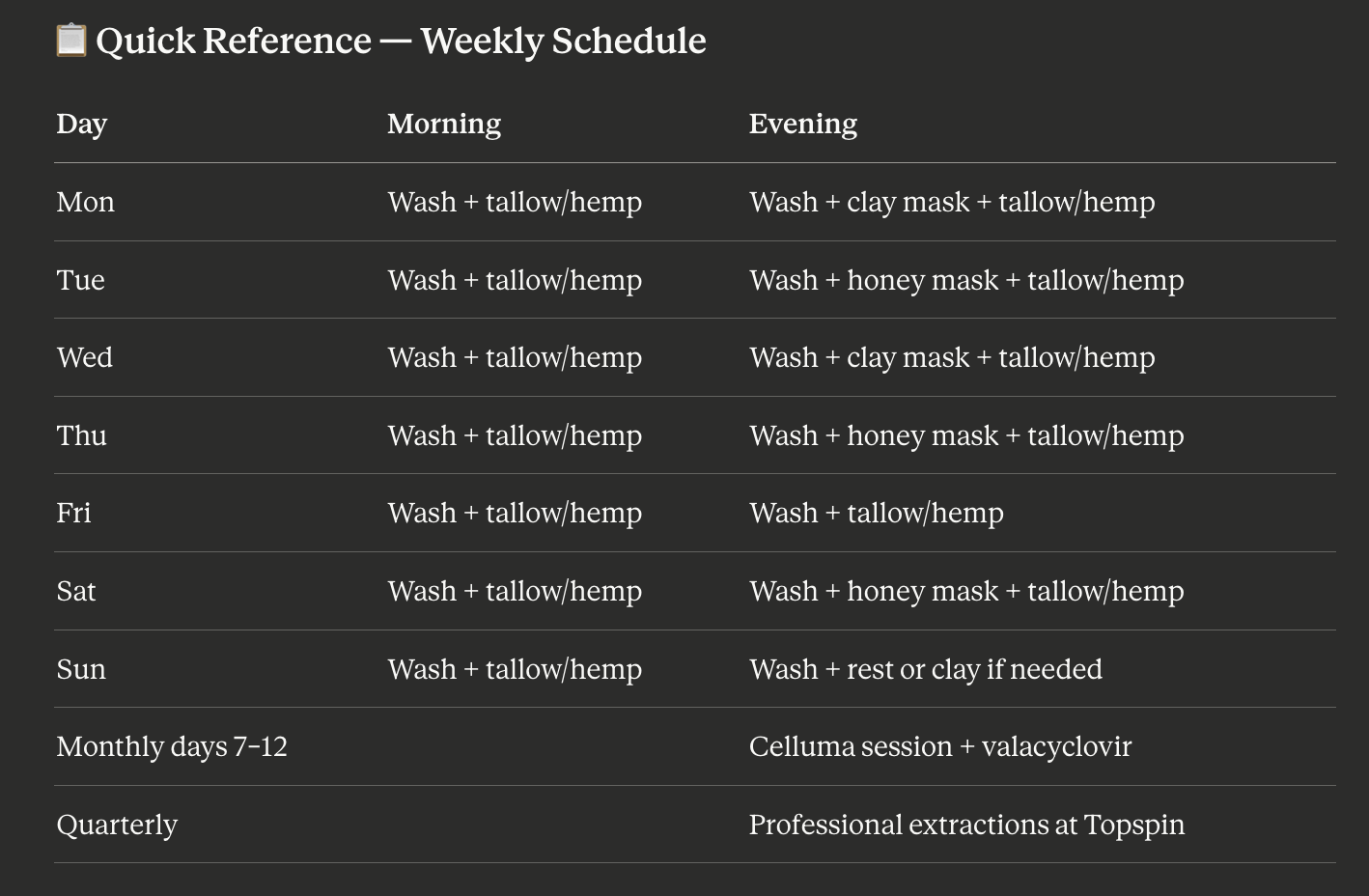
🌅 Morning Routine
(Optional) Cleanse — Adult Face Wash pH 5.3–5.6 glucoside-based wash. Maintains acid mantle, niacinamide at 2.5% begins oil regulation, green tea extract manages bacteria. Rinse thoroughly.
If you are not wearing makeup, washing your face in the morning is totally optional and unneccesary. I have my best feeling skin when I am not wearing makeup and don’t have to wash my face!
Moisturize — Tallow + Hemp Seed Oil While skin still slightly damp. Pea-size tallow warmed in palms, 1–2 drops hemp seed oil blended in. Apply to face. The linoleic acid in hemp seed gradually rebalances sebum composition over weeks, making it less thick and pore-clogging. Tallow repairs barrier. No occlusion, no clogging — biomimetic fats the skin recognizes.
Makeup (if wearing) Tallow-based stick foundation or tinted balm. See makeup section below.
Clean Deodorant (DIY or Primally Pure)
🌙 Evening Routine
Cleanse — Adult Face Wash Same as morning. Double cleanse on days wearing makeup — first pass with a small amount of plain jojoba oil massaged into dry skin for 60 seconds to dissolve makeup and sebum plugs, then follow with the wash. This oil cleansing step is particularly effective for blackheads — jojoba dissolves the waxy oxidized sebum in pores.
Clay Mask — 1–2x per week Kaolin (gentler) or bentonite (stronger) on chin, nose, cheeks. Not under eyes where skin is thin. Apply thin layer, leave until almost dry — not fully cracked. Rinse with lukewarm water. Apply tallow immediately after while skin still damp. Clay acts magnetically on sebum and dead cell buildup — physically drawing out what becomes blackheads before it oxidizes.
Manuka Honey Mask — 2–3x per week, alternating with clay Raw manuka honey (UMF 10+) applied to clean skin. Leave 20–30 minutes. Rinse with warm water, apply tallow immediately. Dual action: natural enzymes gently dissolve dead skin cells (mild enzymatic exfoliation), antibacterial properties directly address P. acnes bacteria. One of the few natural ingredients that tackles both congestion and bacteria simultaneously.
Tallow + Hemp Seed — every evening Same as morning application after cleansing and masking.
📅 Weekly / Monthly
Clay mask: Up to 2x per week
Manuka honey mask: 2–3x per week on alternating days
Blue light therapy: Once monthly (see protocol below)
Professional extractions: 1–4x per year — safer than DIY, clears what topicals cannot
💡 Blue Light + Infrared Therapy (Celluma)
Once monthly — builds to twice monthly if successful
The Celluma's triple wavelength combination addresses acne through three simultaneous mechanisms:
Blue light (415nm) — destroys P. acnes bacteria using their own porphyrins against them
Red light — reduces inflammation in surrounding tissue
Infrared — stimulates mitochondrial ATP production, collagen synthesis, circulation — responsible for that immediate softness and skin plumpness you notice
Collagen built from infrared is structurally real and persists long after treatment. Pores appear smaller not because they physically shrink but because inflammation and congestion causing them to stretch is reduced, and collagen support around pore walls builds over time.
Session protocol. For those who have susceptibility to cold sores, blue light therapy can trigger outbreaks. To minimize this, use the light on days when body is least stressed.
For women, on Days 7–12 of menstrual cycle only (post-period, pre-ovulation — when the immune system is strongest)
Good sleep the night before — non-negotiable
Well hydrated that day, and days before
Try to do on a non-sweaty day (a non-workout day) so fully hydrated
Take 500mg valacyclovir with breakfast morning of session
Use device that evening — 25 minute session
Take second 500mg valacyclovir with breakfast following morning
Drink extra water both days
Do not use if: period arriving within a week, poor sleep, late luteal phase (days 18–24), feeling run down or stressed, dehydrated
🚿 Body & Back Protocol
Shower order matters for back acne:
Shampoo hair first
Apply conditioner — clip hair up or away from back
Cleanse body including back with adult body wash — lather, leave 60 seconds
Rinse conditioner from hair last — this ensures conditioner residue (a common back breakout trigger) runs down your back after you've already cleansed it, not before
Final rinse of back after conditioner — important step
Use a loofah on back and shoulders — gentle mechanical exfoliation removes dead cell buildup that contributes to body acne. Replace loofah monthly as they harbor bacteria
Pat dry — don't rub
After shower: Apply tallow with hemp seed to back and shoulders while still slightly damp. The linoleic acid addresses the same sebum imbalance driving face breakouts.
Clothing: Breathable natural fabrics (cotton, linen) against back and shoulders where you break out. Synthetic fabrics trap heat and sweat against skin.
💇 Hair Routine for Acne-Prone Skin
Shampoo: Liquid gentle wash (kids or adult wash both work for hair). Glucoside surfactants are gentle enough for regular hair washing without stripping.
Conditioner: Apply mid-lengths to ends only — keep away from scalp and hairline. Forehead and hairline breakouts are often conditioner residue. Rinse thoroughly.
Key rules:
Always rinse conditioner before cleansing back (see shower order above)
Rinse hairline thoroughly — conditioner residue along forehead and temples is a common overlooked breakout trigger
Keep hair off face while sleeping — tie back loosely
Wash pillowcase frequently — 2x per week if breaking out actively. Hair product and sebum transfer to pillowcase overnight and then back to face
🧴 Foundation & Makeup — Philosophy Check
Rational Body’s tallow makeup formulas are genuinely well aligned with our philosophy. Here's an honest assessment of each ingredient:
Completely aligned — body knows these:
Grass-fed tallow ✅ — biomimetic, skin identical
Beeswax, carnauba wax ✅ — natural waxes, long history
Jojoba oil ✅ — liquid wax, sebum-mimicking
Castor oil ✅ — natural, excellent pigment dispersal
Vitamin E ✅ — natural antioxidant, body produces it
Iron oxides ✅ — mineral pigments, inert, safe
Sericite mica ✅ — natural mineral, finer and safer than craft mica
Tapioca starch ✅ — food-grade plant starch
Arrowroot powder ✅ — same category as tapioca, slightly better for oily skin
Good additions, body-compatible:
Meadowfoam seed oil ✅ — extremely stable plant oil, skin-compatible
Green coffee seed oil ✅ — antioxidant, collagen support, linoleic acid content good for acne-prone skin
Elderberry extract ✅ — natural antioxidant, skin tightening
Sal tree resin ✅ — natural resin, pore-refining, traditional ingredient
Copaiba resin ✅ — natural resin, anti-inflammatory, body-compatible
Sunflower oil ⚠️ — good linoleic acid content but can go rancid quickly in a stick formula and has some comedogenic risk for very acne-prone skin. Fine at 1–3% but worth watching
Worth discussing:
Tetrahexyldecyl ascorbate (THD ascorbate) — this is a synthetic lipid-soluble vitamin C ester. It's genuinely effective for skin brightening and collagen support and is very stable in anhydrous formulas. It's not something the body produces naturally but it converts to ascorbic acid in skin. The question for your philosophy is whether a stable synthetic vitamin C derivative fits — it's about as clean as synthetics get, with real long-term skin benefit. Your call, but it's not harmful and arguably earns its place
Silica microspheres — synthetic amorphous silica used for light diffusion and texture. Inert, not absorbed, purely surface-acting. No biological activity — just physical texture benefit. Acceptable if you're comfortable with inert mineral ingredients
Acai fruit oil ✅ — antioxidant rich, good fatty acid profile, body-compatible
Rice powder ✅ — natural, gentle, mattifying
One ingredient to reconsider:
Sunflower oil in a stick formula that will sit in warm conditions (farmers markets, bags) — it oxidizes faster than other oils. The vitamin E and rosemary extract help but worth monitoring. Could swap for more meadowfoam which is far more stable
Breakout prevention built into makeup formulas:
Tapioca/arrowroot replacing kaolin keeps pores clearer ✅
Sericite mica instead of craft mica ✅
Cosmetic grade iron oxides only ✅
Fully dispersed pigments in castor oil ✅
Beeswax kept at or below 12% ✅
Zinc removed from face formula ✅
🌿 The Foundation — What Everything Rests On
No topical protocol compensates for what happens internally. In order of impact:
Sleep — cortisol spikes directly increase sebum production. Every hour of consistent sleep improvement reduces oil production meaningfully. This is the single highest leverage change for chronic congestion.
Water — dehydrated skin overproduces oil to compensate for moisture loss. 2–3 liters daily minimum.
Diet — high glycemic foods spike insulin which increases sebum. Dairy, particularly skim milk, has strong association with adult female acne. Neither requires elimination — just awareness.
Stress — same cortisol pathway as sleep. Orange Theory workouts are actively helping here — exercise reduces cortisol long-term even though it spikes it short-term during a session.