
this is the text my husband sent to his best friend who was asking about what a doula is, why we chose to have a natural birth in the hospital:
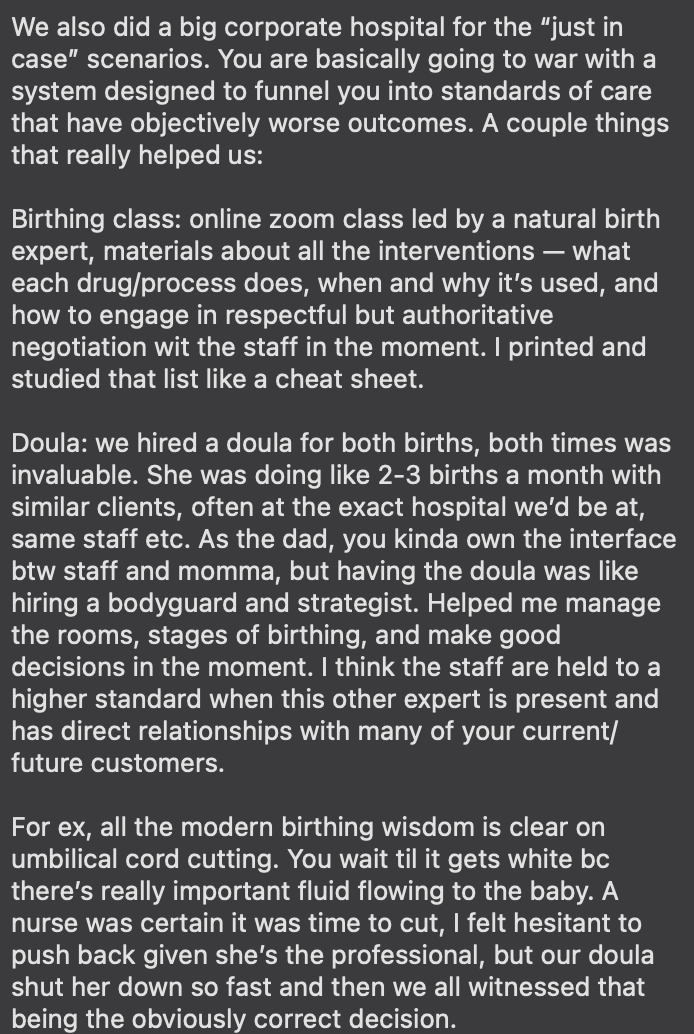
“Hiring a doula was like hiring bodyguard and strategist” -My husband
What Is a Doula?
And Why You Probably Need One — Even If You've Never Heard the Word
By Victoria Siegel | Community Herbalist & Founder of Rational Body
This is part of an ongoing series on natural childbirth, pregnancy preparation, and the fourth trimester.
I had never heard the word doula until I was an adult. It did not come up in health class. It was not something my mother mentioned. When I finally encountered it, I filed it somewhere vague — probably near "midwife" and "birth center," things I associated with a very specific kind of person making a very specific kind of statement.
Then I made a friend who was one. And I had to actually learn what she did.
What she did turned out to be one of the most important things anyone can do for a family bringing a new baby into the world. And once I understood it, I couldn't believe it wasn't something everyone knew about automatically — the way everyone knows to hire a photographer for a wedding or a contractor for a renovation. For something as significant as birth, this role should be common knowledge.
It isn't. So here is the explanation I wish I had been handed earlier.
There Are Two Kinds of Doulas
Before anything else, it helps to know that the word covers two distinct roles that happen at different moments. Most people, when they first learn about doulas, are thinking about only one of them.
A birth doula supports you during labor and delivery. She is there for the birth itself — before it starts, through all of it, and into the first hours afterward. This is the role most people mean when they say "doula."
A postpartum doula supports you after you come home. She is there for the weeks and months following birth — the period that is, in many ways, harder than the birth itself, and the period for which almost nobody prepares.
They are different jobs, done by different (or sometimes the same) people, at different moments. Both exist because someone recognized that families going through these transitions need more support than our current systems provide. We will cover both. Start with birth.
What a Birth Doula Is
A birth doula is a trained labor support professional. She is not a midwife — she does not catch babies or perform clinical assessments. She is not a nurse — she does not manage medications or document in the hospital system. She is not a therapist, a birth class instructor, or your partner.
She is the person you hire specifically to support you through labor and delivery, whose only job on the day of your birth is your family.
Not the monitor. Not the chart. Not the next patient down the hall. Your family.
She has typically attended dozens or hundreds of births. She has seen what early labor looks like, what active labor looks like, what transition looks like, what the difference is between a pause and a problem. She knows which position to suggest when things slow down. She knows when to push back on a nurse and how to do it without creating conflict that lands on the laboring mother. She knows what hip squeezes are — a technique where one person presses firmly inward on each side of the mother's hips through a contraction — how to do them correctly, and how to teach the partner to do them on exactly the right side. She knows when to speak and when to be completely silent.
She works for you. Not for the hospital. Not for your insurance company. Not for any protocol written before you walked through the door.
But Don't I Have a Doctor for That?
This is the most natural response, and it deserves a direct answer.
Your doctor will spend a small fraction of your labor in the room with you. They are trained for emergencies — which means they come in oriented toward what might go wrong and what they would do about it. They are exactly who you want when something deviates from normal. But for the hours of labor that are progressing exactly as they should? They are elsewhere.
Your nurse is managing multiple patients simultaneously, documenting constantly in a system that requires her attention. Her eyes, for most of your labor, are on a screen.
No one is criticizing anyone here. These are good people doing demanding jobs within a system that was not designed to provide continuous, individualized human presence to a laboring woman. The institution is designed for throughput and safety monitoring. It is genuinely extraordinary at emergencies. It was not built for the hours in between.
A doula fills that gap. She is the continuous human presence the medical system cannot structurally provide.
She is not watching a screen. She is watching you.
What She Does for the Partner
This is the most underappreciated argument for a doula, and the one most worth making clearly.
When a baby arrives, everything a partner knew about how to be helpful becomes insufficient. He has never done this before. He loves you and wants desperately to be useful and does not know what useful looks like when you are eight centimeters dilated and he cannot tell whether what he is seeing is normal or cause for alarm. He does not know which position to suggest. He does not know whether to speak or be quiet. He does not know how to read the monitor, what the nurses are actually suggesting, when to push back, or how.
He is also the person the hospital will approach for administrative information at the worst possible moments. Your insurance card. Your date of birth. Your signature on a form. He is trying to be your emotional anchor and your administrative manager and your medical advocate simultaneously, in an institution he doesn't understand, on no sleep.
Birth involves a constant stream of decisions — interventions offered, procedures suggested, protocols proposed — many of them presented quickly, during a contraction, from someone in scrubs who speaks the language of the institution fluently. Your partner does not speak that language. Neither do you, not yet. A doula does. She can translate in real time what is being offered, what the evidence says, what the alternatives are, what the questions to ask are — so that both of you can make real decisions rather than defaulting to whatever reduces friction in the moment.
When a doula is in the room, the partner's entire job simplifies. He is no longer managing the situation. He is present in it. There is a significant difference between a man managing a labor room and a man being present for the birth of his child. A doula is often what determines which one you get.
And her eyes are on your family. Not a screen. Not a clipboard. Your family.
She Is Not Just for Natural Birth
This is worth saying plainly because the association is strong and wrong.
Doulas are often linked to unmedicated births — the impression being that they are for women who have made a particular philosophical choice about pain management. They are not. Doula support improves outcomes regardless of how you give birth.
If you have an epidural, you are tethered — IV line, monitor, catheter, unable to move freely. A doula knows what positions are still possible. She knows how to make you comfortable within those constraints. She knows what each stage looks like and can tell you, specifically, "this is exactly what is supposed to be happening right now" — which, when you are numb and frightened and watching a monitor you don't understand, matters more than you might expect.
If you end up with a cesarean, she can stay with you while your partner goes with the baby. Someone is always with you. Someone is always with the baby. No one is alone.
The data is consistent across birth types: shorter labors, lower rates of cesarean delivery, lower rates of epidural use, higher APGAR scores, higher rates of breastfeeding success, lower rates of postpartum depression. She is not for natural birth. She is for birth.
The Moment That Paid for Everything
With my second son Jaden, the moment he was born, Marcus and I were consumed by him completely. Nothing else existed — the world narrows to that face, that weight, that smell, and you are simply not available for anything else.
While we were in that moment, a nurse moved automatically to cut the cord. Hospital protocol. Routine. Nothing personal.
Our doula stopped her. Quietly, firmly, without creating a scene. She had been watching for exactly that — because she knew we had asked for delayed cord clamping, and she knew that when the baby arrives, the parents will not be watching anything except the baby.
Marcus told me about it afterward. He said that moment alone — her catching what we had missed, advocating when we were in no state to advocate for ourselves — was worth the entire cost of hiring her. By itself. Everything else was a bonus.
One-third of your baby's blood volume is still in the cord at birth. It is rich in stem cells and immune factors. Your baby deserves to receive it in their own body first. But in the moment of birth, you will not be watching the nurse. Your doula will be.
From the Partner's Side
I want to share what Marcus wrote to a close friend when that friend found out they were expecting for the first time. He was answering the question: what is a doula, and why did we choose a natural hospital birth? I am sharing it here because it says something I could not say as well from my own perspective — what the doula actually does for the person who is not the one giving birth.
"We also did a big corporate hospital for the 'just in case' scenarios. You are basically going to war with a system designed to funnel you into standards of care that have objectively worse outcomes.
Doula: we hired a doula for both births, both times was invaluable. She was doing like 2-3 births a month with similar clients, often at the exact hospital we'd be at, same staff etc. As the dad, you kinda own the interface between staff and momma, but having the doula was like hiring a bodyguard and strategist. Helped me manage the rooms, stages of birthing, and make good decisions in the moment. I think the staff are held to a higher standard when this other expert is present and has direct relationships with many of your current/future customers.
For example, all the modern birthing wisdom is clear on umbilical cord cutting. You wait til it gets white because there's really important fluid flowing to the baby. A nurse was certain it was time to cut, I felt hesitant to push back given she's the professional, but our doula shut her down so fast and then we all witnessed that being the obviously correct decision."
Bodyguard and strategist. That is exactly right. She knew the hospital, she knew the staff, she knew the protocol — and she knew when the protocol was wrong. The partner in a labor room wants to advocate but often doesn't know enough to know when to push back. She does. And the staff, knowing she is there and knowing she has relationships with many families who pass through those same rooms, tend to be more careful.
The Spinning Babies organization, which trains birth workers in fetal positioning, put it this way in a recent piece on doulas: "A steady voice softens the room. A grounded posture slows the pace. A calm reminder to breathe shifts the energy. When a birthing person senses safety, the nervous system responds. Muscles soften. Hormonal rhythms regulate more smoothly."
That is not sentiment. That is physiology. And it is what a doula brings into a room where almost nothing else is designed to produce it.
Now the other kind. And if anything, this one might matter more.
The hospital stay ends after one or two days. You go home with a newborn, whatever you've managed to learn, a body that just did something equivalent to running a marathon, and the beginning of months of broken sleep, round-the-clock feeding, and the most demanding physical and emotional transition of your life.
Nobody prepares you adequately for this part. The books focus on pregnancy and birth. The postpartum chapter is an afterthought. The medical system's follow-up is typically a single six-week appointment, and that is not sufficient.
A postpartum doula fills this gap. She is trained to support families in the weeks and months after birth. She comes to your home. She holds the baby while you sleep. She helps with feeding — breastfeeding support is one of her most important functions, and inadequate support in the early weeks is one of the most common reasons women stop nursing before they want to. She helps with light household tasks so you can rest. She can help a partner understand what his role is and what the mother's body is going through. She provides knowledgeable, continuous support during a period when most families are isolated and improvising.
There is research from around the world — traditional cultures, indigenous communities — suggesting that a ratio of approximately three adults to one newborn is closer to what the early months actually require. Not because anything is wrong, but because a new baby genuinely needs that much care, and a recovering mother genuinely needs that much support. That support used to come from extended family, neighbors, communities that gathered around a birth without being asked.
That village does not assemble itself anymore. A postpartum doula is one way to rebuild a piece of it intentionally.
What It Costs
Birth doulas typically cost between $1,500 and $2,500. Postpartum doulas typically charge by the hour or by the visit, ranging from $30 to $60 per hour depending on location and experience.
Both are reimbursable through FSA and HSA accounts. Insurance coverage is expanding — worth checking your specific plan. Many doulas offer sliding scale fees and payment plans; most would rather work with you than not work with you. Doulas-in-training provide support at significantly reduced cost while building their hours. Community doula organizations exist in most cities specifically to serve families who cannot afford standard rates.
In context: what a birth doula costs is roughly what most families spend on a stroller. It buys documented improvement in outcomes, one experienced professional whose attention is entirely on your family, and — in our case — someone watching the room when we were not.
How to Find One
Start looking in the second trimester for a birth doula. Good ones book months in advance.
DONA International (dona.org) and CAPPA (cappa.net) maintain searchable directories of certified doulas by location. DoulaMatch.net is another useful resource. Ask your OB or midwife — most have names they trust. Ask mothers whose birth experiences you admire.
Interview two or three. You are looking for someone whose presence makes you feel calmer rather than managed. Someone who listens to your preferences without an agenda. Someone your partner also feels comfortable with, because she will be working alongside him. Someone who has experience with your hospital or birth center.
For a postpartum doula, you can start looking later — but ideally before the birth, so she is already arranged when you need her.
The Last Thing
I made a friend who was a doula and had to learn what she did. What I learned was that this role — a trained, experienced, knowledgeable person whose attention is entirely on the laboring family — used to be simply what happened when a baby came. The grandmother, the neighbor, the midwife at the house. The women who gathered. The village.
It stopped being automatic. It became something you have to deliberately seek out and pay for, because the community structures that used to provide it no longer exist in most of our lives.
But it still exists. The people who do this work are still there, still trained, still available.
You just have to know to look.
Resources:
DONA International — dona.org
CAPPA — cappa.net
DoulaMatch — doulamatch.net
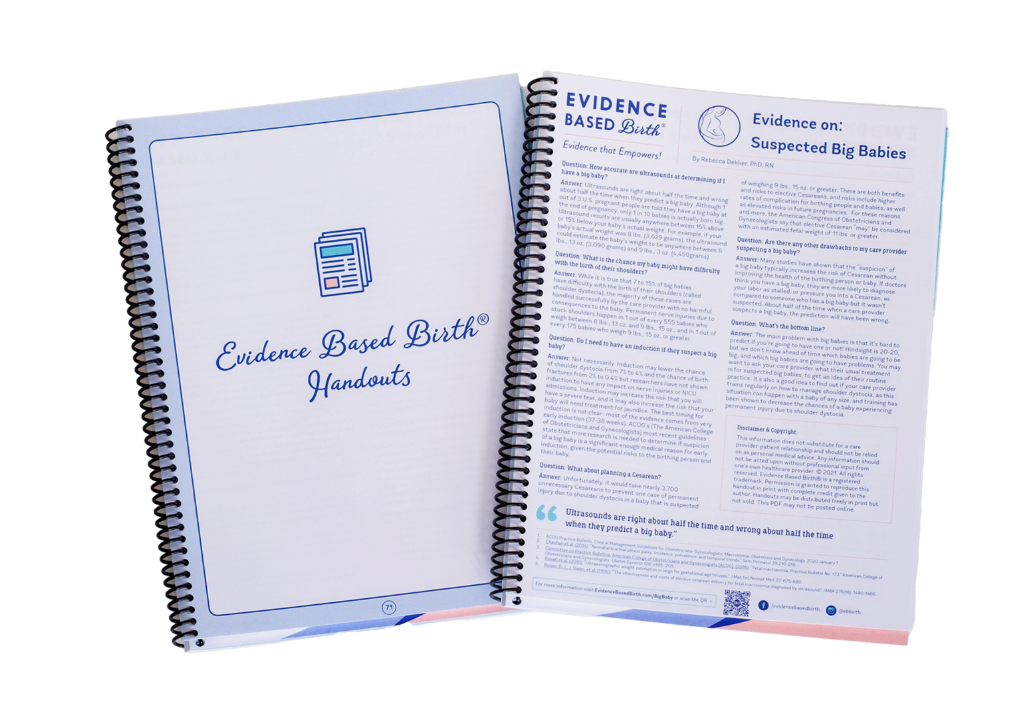
Evidence Based Birth Doula Workbook: A full-color, 115-page spiral-bound workbook designed to support meaningful, focused conversations, $34
Podcasts:
Victoria Siegel is a certified community herbalist (California School of Herbal Studies), mechanical engineer, and founder of Rational Body Natural Skincare. She lives in Danville, California with her husband Marcus and their two sons, both born unmedicated in hospital settings.
rationalbody.com