Happy Tummies Are Part of the Celebration
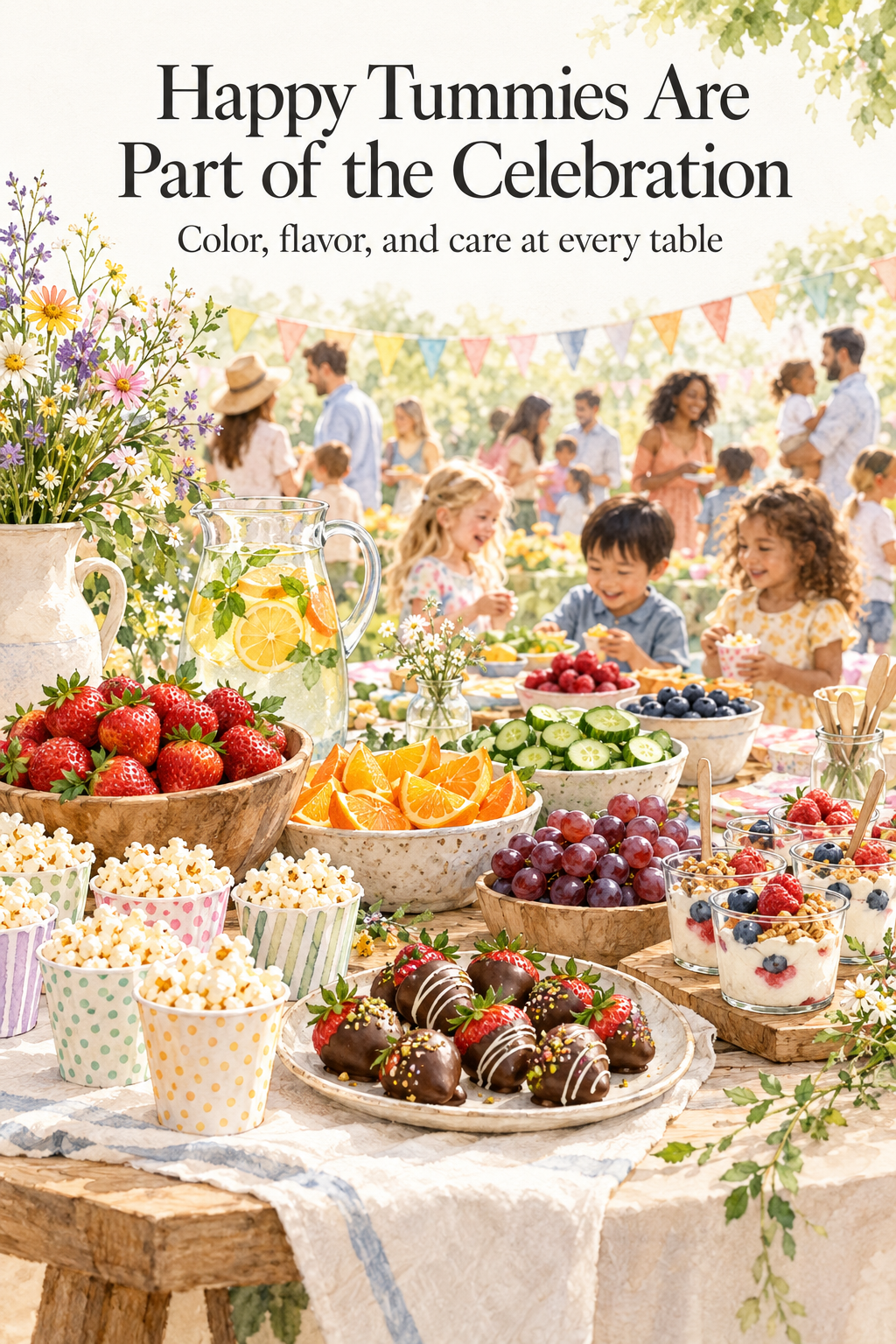
Imagine walking into a school celebration and seeing a table full of color.
There are strawberries and orange slices, purple grapes and bright green cucumbers. There are little cups of yogurt with berries, popcorn, cheese, and sandwiches cut into fun shapes. There are treats, too—perhaps a homemade oat bar sweetened with maple syrup or a chocolate-dipped strawberry.
The children are excited. They see choices. They fill their plates. They run back to play.
And their parents can enjoy the event knowing that someone put thought into what was offered.
This is what I mean when I say “happy tummies.”
At events I’ve hosted, parents have told me how relieved they felt knowing the food had been considered with care. They didn’t have to spend the whole event negotiating with their children about what was on the table. They could enjoy being together.
I want that feeling to be part of our school culture.
We can celebrate with abundance
Somewhere along the way, we seem to have accepted that a children’s celebration requires a table overflowing with candy, brightly colored drinks, and heavily sweetened treats. We put them at the center of the event, then act as though questioning those choices means wanting to take the joy away.
I see the opposite possibility.
A celebration can be colorful, delicious, generous, and fun while offering food that helps children feel good. Color can come from fruit and vegetables. Sweetness can come from berries, apples, dates, maple syrup, or honey. Flavor can come from cinnamon, vanilla, chocolate, fresh herbs, and all the wonderful things real food has to offer.
We can make a fruit rainbow, build little snack cups, offer a popcorn bar, or invite children to assemble their own plates. We can serve water with slices of citrus or berries and make it feel special. We can bring in a baker or local business that shares the goal of making something beautiful and thoughtful.
And we can make sure there are non-food activities that are just as exciting: dancing, crafts, games, music, bubbles, and time with friends.
The details matter. A beautiful table doesn’t have to be an expensive one, and a thoughtful event must consider allergies, dietary restrictions, cultural traditions, food access, and the children who may need familiar foods. There is no single menu that works for everyone. We can ask families what they need and plan from there.
Someone is already making the choices
What surprises me is how much resistance there can be to having this conversation—even from people in important positions who help shape the environment our children experience every day.
When I have raised questions about nutrition and wellness in our school community, I have heard concerns that discussing food choices could make families feel judged or restricted. I take those concerns seriously. Children deserve a healthy relationship with food, and parents deserve respect for the choices they make.
But the PTA, the school, and other organizations are already making food choices when they purchase, advertise, sell, or offer food at events. A table full of candy is a choice. A fundraiser built around sweets is a choice. A celebration where children encounter food dyes and large amounts of added sugar is a choice.
Those decisions affect more than one family. They shape the environment shared by an entire school.
I am not asking to inspect anyone’s lunchbox. I am asking whether we can talk openly about the food we collectively choose to put in front of children—and whether those choices support the wellness goals our district says it values.
That should be a conversation, not a threat.
We can listen and improve
I have asked for a wellness role that could help bring these conversations to our school. The PTA board decided not to create a separate chair. Existing activities, such as Harvest of the Quarter and Run Club, were offered as examples of the wellness work already underway.
I appreciate those programs. I would also love to know: How do families participate in them? What other needs do parents see? Who can a parent talk to about wellness? How do our events and donated foods connect with the district’s wellness policy? And how do we make that information easy for everyone to find?
Those are reasonable questions for a community to explore together.
I have also found it difficult to find enough space for discussion. Members may prepare ideas, wait through meeting business, and then be asked to leave as the room transitions to a closed board meeting. A short presentation can introduce a subject, but it cannot replace a conversation in which parents ask questions, share experiences, and help shape what happens next.
The adults in a school community should model the qualities we hope to see in our children: listening, openness, curiosity, and respectful disagreement. We don’t need to agree on every food or every policy to make room for those qualities.
Care is something we can build into the plan
None of this means every parent has to make everything from scratch or spend more money. It means that, when we plan an event, we can ask a few better questions:
What food and drinks will be available to children, and how often are they being offered?
Can we make the colorful, nourishing options appealing and easy to choose?
Have we considered allergies, dietary needs, cost, and access?
Can we offer non-food activities and gifts that children will love?
Are we making it easy for families who want to help?
Sometimes the answer might be a grocery-store fruit tray and cheese. Sometimes it might be a parent who volunteers to bring a big bowl of popcorn. Sometimes it might be choosing a different fundraiser or putting as much creativity into the food as we put into decorations.
It does take attention. It can take more planning. But we put tremendous effort into creating memorable moments for our children. Their well-being belongs in that planning.
I keep coming back to the parents who have told me they felt cared for at our events. That is the feeling I want more families to experience: you can come as you are, enjoy yourself, and know we thought about your children.
Happy tummies. Ready minds. A community that celebrates with care.
We already know how to throw wonderful events. Let’s make them even better.