Closing Our Eyes Doesn’t Clean Up the Lawn
I was cleaning up after a fundraiser, literally cleaning a lawn, when the metaphor jumped out at me.
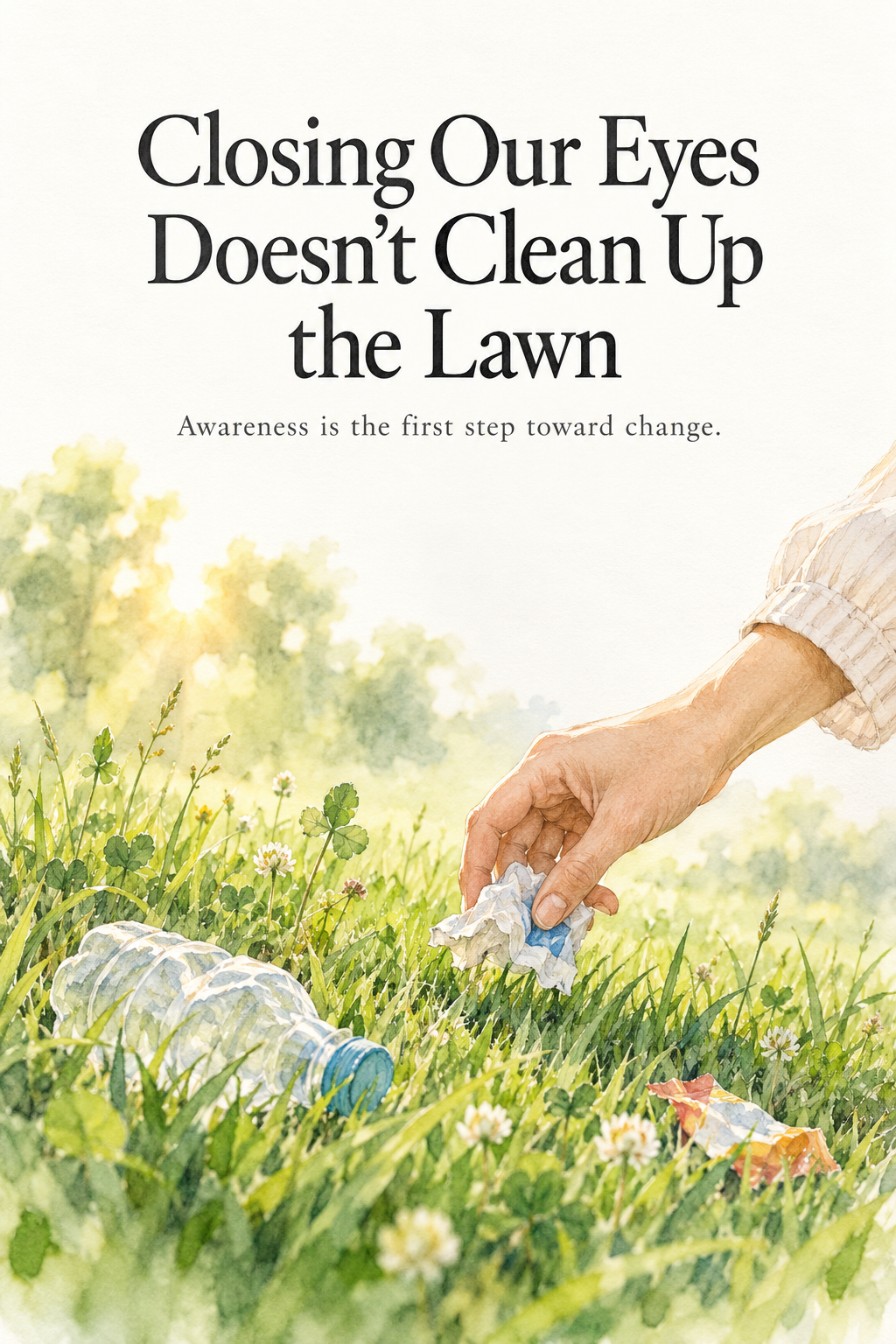
Imagine seeing trash scattered across a lawn where children play.
You point it out: “There’s trash here. Some of it could be harmful. We can do something about it.”
Someone responds, “Why are you scaring people? You can’t say that.”
But you didn’t put the trash there. You only noticed it. You spoke up because you care about the children playing there, and because leaving it there isn’t a possibly option in your mind.
That is how I feel about discussing environmental chemicals in our bodies.
But the research examining this uncovers something far more intimate than a lawn: blood collected from an umbilical cord, documenting exposures that can begin before a child takes their first breath.
Researchers have measured environmental pollutants in maternal and umbilical-cord blood, including certain pesticides, flame retardants, industrial chemicals, and metals. These findings are documented in scientific research. This is not conspiracy theory- this is a fact of modern existence. And that deserves our attention.
And fine - there are personal reactions that make a difference, but we are finding almost 300 known toxins in the average umbilical cord blood- but I am being told saying that in flyers is offensive to some people.
But I do not see this as a scare tactic for a quick sound bite. I say it out of love- because there is something we can do about it. And yes, we should be careful with the evidence and messaging. But we should also be willing to discuss it.
The American College of Obstetricians and Gynecologists recognizes prenatal exposure to toxic environmental chemicals as a health concern and recommends helping patients reduce exposure at home, at work, and in their communities. Educating families about environmental health is part of established medical guidance.
While I offer handouts with the details of these toxins, I also include another handout of 20 things we can do to reduce them. It is not about me selling something. Sure, I sell handmade lotion and soaps, but I also give away all my recipes. My goal is empowerment, not scare tactics, and more importantly - not closing our eyes to known scientific studies that say our babies are in harms way. I am a mama bear, and what I know of most other mamas, is they want to be told the truth- not a sugar coating, or worse, a lie, that the lawn is clean. It is not. Our metaphorical lawn is full of trash, and we need to do some damage control.
If you consider that a threat, then put your headphones on and watch your screens. But if you are a mama bear like me, you want to do something about it. Sometimes I get confident and post about something like this, and I get some negative feedback (with far more positive responses). Often, they are saying there is too much to stress about so please don’t tell me. Okay, fine, then move on then. But many, and I would venture to say MOST parents want to know.
What breaks my heart the most are the silent supporters. The many moms with kids who are harmed in someway, with autism or severer ADHD, saying they fully support the message, but cannot say so puclay. They fear the shame in saying they wish their child was any different. This is not about that, not about guilt. It is about saying if there is a POSSIBLE connection to harm, we should act. We learn more every single day, and tehre is a lot of competing information. But we should err on the side of caution.
Yet conversations about these findings can quickly become conversations about whether mentioning them makes people uncomfortable.
I understand that discomfort. Parents already carry an enormous amount of responsibility. No mother needs another message suggesting that she has failed her child. No family should be told that protecting their children requires buying an entirely new household or achieving some impossible standard of purity.
But withholding useful information does not give families more choices. Understanding an avoidable exposure—and having a realistic way to reduce it—can.
My purpose in sharing this information is to connect awareness with action. That means discussing practical changes within a family’s reach, while recognizing that cleaner products, safer workplaces, and healthier environments also require action from manufacturers and public institutions. Families cannot carry this responsibility alone.
And reducing exposure should never become a promise that a product can “detox” our blood or erase everything we have encountered.
The lawn analogy has its limits. Environmental exposures are less visible and more complicated than litter. Still, it captures something important: asking people to stop pointing out a problem leaves the problem in place.
Martin Luther King Jr., speaking about racial injustice, warned of “the appalling silence of the good people.” His words remind me that good intentions do not relieve us of the responsibility to respond when we recognize harm.
For me, that responsibility includes speaking carefully, sharing sources, acknowledging uncertainty, and offering something people can actually do.
I welcome questions about the research. If a number needs context, let’s provide it. If a statement overreaches, let’s correct it. Those conversations make public education stronger.
But discomfort alone should not end the conversation.
I want families to have the information they need to make informed choices. I want us to be able to notice a problem without being accused of creating it by speaking.
If there is trash on the lawn, I want us to see it—and work together to clean it up.
Just to clarify- I was selling at an event where I was asked to remove a small handout that said “Toxins found in umbilical cord blood”. This is not conspiracy, this is sharing findings of a real study, along with ways to help reduce them.