On the grief that sometimes follows new understanding — and why it is still worth it to look
There is a particular kind of grief that no one warns you about. On the one hand, there is a grief that comes with losing something you had, but a whole other entirely from discovering something was missing that you never knew about.
Rachel Carson wrote about it beautifully. In Silent Spring, she documented the loss of birdsong from American landscapes — the eerie quiet left by pesticide poisoning. Her words, written after a lifetime of biological studies, earned her the income and passion to spend 5 years writing about something that could have cost her her reputation. She did it anyway, and boy, did the attacks come. But she was still able to get JFK to ban the pesticide DDT, to hire a whole group of experts to review her findings and find them to be valid. And to save our bald eagles in the process, while doing so much more.
What haunted her most wasn't just the damage to the environment, it was about the loss of its beauty to people who would never know to miss it. The only people equipped to grieve the silence were the people who held the memory of its sound. Those born after the birds were gone could not mourn what they had never heard. To them, the quiet was simply the world.
Bird song is one of the most calming sounds we have ever studied. That, along with trickling water and the sound of children laughing. It puts our whole bodies at rest. It means something terrible is NOT happening, at least not overtly. And Rachel asked us to imagine us to wake up one spring day, and hear nothing at all. How eerie would that be?
I've been thinking about this kind of loss for years now. Deeper than birdsong, but of something older and harder to name.
I am connecting worlds that many would argue with- music and science and religion and connection, in language and in the names of holidays we still celebrate without knowing why — before they were methodically, deliberately, removed.
I grew up in the church. I begrudgingly sat in Catholic mass. I’ve traveled and felt something in the churches and sacred places visited, and felt something real there — in the glass windows lined up with the rising sun, the singing, in the shaking hands asking for peace. All that was not performative, I felt it.
But I never felt like I had a religious experience with the words in bible. The closest I ever got was in a heated yoga class, singing together at the end, tears rolling down my cheeks. And with a smile.
In church, it felt like I was sitting in a room spoken by another language. And in a way, it was. At the very least, it was a translation- often mistranslation and manipulations of older books, much older than jesus’s supposed time.
I kept noticing the gaps between what I was told - about love and giving and acceptance- and the reality of what the language itself seemed to say
Some of the things worth pointing out are the Holy Ghost, two men at the seat of creation alone, everyting about a father and son, nothing about a mother, or of a child that could be a daughter.
Then the traditions that make no sense related to religion, santa, reindeer, spring holidays full of eggs and bunnies and flowers with no clear Christian origin story.
The mismatch tells us much more of what was lost than what was gained.
A holiday built around eggs and bunnies tells us something else was here. The shape of a Trinity with no mother tells you a mother was removed.
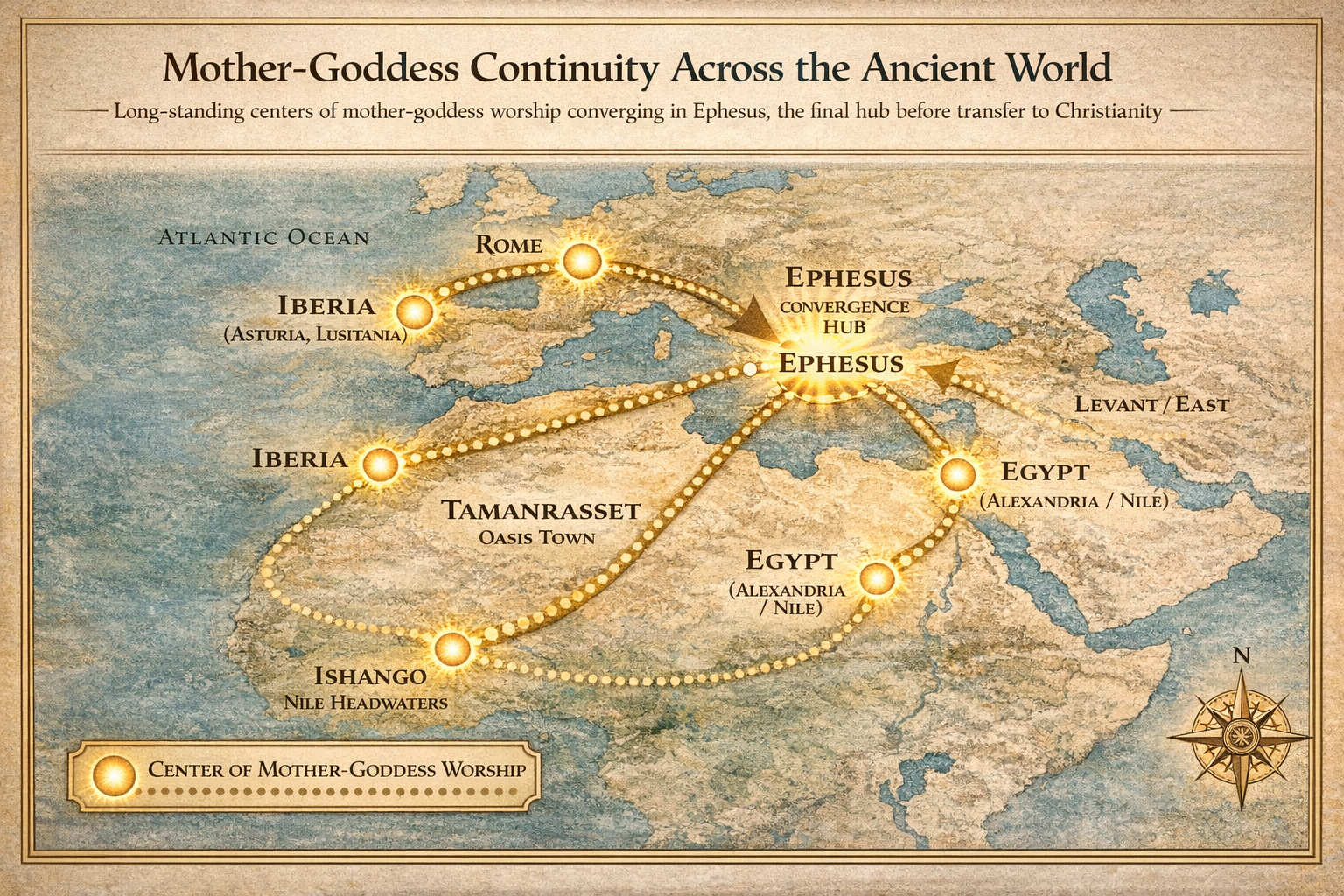
When I began following that shape — through linguistics, through archaeology, through comparative religion — I discovered that I was not the first to notice the gaps. The suppression of the feminine divine is not a fringe theory. It is documented in the texts themselves, in the scratching of names from stone walls, in the letters of Pope Gregory I instructing missionaries not to destroy pagan temples but to repurpose them. The Romans had a word for it: damnatio memoriae. The condemnation of memory. Strike the face from the coin. Melt the monument. Remove the name from every record. And then proceed as though the person — or the tradition, or the goddess — had never existed at all.
It worked. It worked for approximately two thousand years.
Until now. Until enough women became educated. Until the suppressed texts were digitized. Until the DNA evidence arrived connecting populations that were supposed to have had no contact. Until a woman, in stolen hours between everything else life requires of her, chose to look.
The grief no one told you was coming
What does it feel like, to discover this? To begin pulling the thread and find it doesn't end?
It feels like standing in a room full of people, hearing a silence that no one else seems to notice. It feels like knowing what the morning is supposed to sound like and realizing, in a slow cold way, that it hasn't sounded like that for a very long time. It feels like a specific kind of loneliness: the loneliness of witness.
And underneath that loneliness, for many of us who come to this from inside a lived faith, is something more complicated than anger. There is grief. Not just for the history — for the burning of libraries, the silencing of traditions, the women who were called witches for what they knew about plants and birth and the moon — but for the personal faith that must now be held differently. For the community that was real. For the love that was genuine, even inside a structure that had edited out half the sacred.
I want to say clearly: the love inside the church was real. The community was real. The peace be with you that I meant when I said it was real. The institution's history of suppression does not cancel the sincerity of every person who ever found God in a cathedral, or comfort in a prayer, or belonging in a congregation. Those people were not the architects of the damnatio memoriae. They were, like all of us, born into the silence. They simply don't yet know what they're missing.
This is the hardest thing to hold: knowing what was done, and maintaining genuine compassion for the people inside the system it built.
Martin Luther King wrote that he who passively accepts evil is as much involved in it as he who helps to perpetrate it. I believe that. I also believe that you cannot hold a person accountable for a silence they were born into, any more than you can hold responsible the child who never heard the birds for failing to mourn them.
The archaeology of the soul
So what do we do with what we now know?
I am not here to burn anything down. The churches that were built on top of ancient sacred sites — and this is documented, not contested, explicitly recorded in a letter from Pope Gregory I in 601 CE — those buildings still have the old springs running beneath them. The sacred trees still grow by their walls, still facing the sunrise. The substrate is still there. You don't demolish the building to reclaim what was under it. You look through the floor.
What I've come to understand, slowly and sometimes painfully, is that the discovery of what was suppressed is not an attack on what replaced it. It is an expansion. It is the return of a chord that was missing its root note. The love that people found in these traditions was real — but there is more available, if we're willing to look at what was there before the architecture was built over it.
This is what I mean when I say it is archaeology. Not destruction. Not score-settling. The patient, careful work of brushing away centuries of accumulated erasure to find what is still, remarkably, there — in the sound of a word, in the shape of a holiday, in the grammar of a dead language, in the bones of a tradition still walked by millions who do not know its first name.
What it means to give the next generation the sound
I think about my sons. I think about what I am giving them when I dye the eggs and set the table and make the day beautiful, even knowing now what Easter contains beneath its Christian frame — the goddess Eostre, the spring equinox, the return of light, the egg as the oldest symbol of beginning there is.
I am giving them the memory of the full sound.
They will grow up knowing what the morning is supposed to sound like. And when they encounter a silence — and they will, every life does — they will recognize it as silence. They will know something is missing. And they will go looking for it.
That is the most profound gift I can imagine passing forward. Not a fixed belief system. Not a closed answer. The capacity to notice an absence. The willingness to follow the shape of what isn't there toward what once was.
My mother gave that to me, without meaning to, simply by loving me in a way that was fully present and fully seen. When she died, the loss was unmistakeable. I knew exactly what was gone because I had known exactly what I had. That specificity of grief was a compass. It sent me looking.
The religious traditions that were suppressed left behind people who could still hear something off in the silence. Who heard a word like Easter and felt it didn't quite match the official explanation. Who noticed the motherless Trinity like a missing note. Who followed the sound.
This is what the long game of silencing could not fully defeat. Memory. The archive of having once heard the birds. Remnants in language and tradition and the body's instinctive reaching toward the sacred in its oldest, fullest form.
It took a long time. It is taking us still. But we are here, brushing the floor, listening for what the silence is shaped like, passing the sound forward.
Just like that.
This piece draws from ongoing research into the linguistic and archaeological roots of religious tradition, the history of the suppression of the feminine divine, and the personal experience of faith reconstructed from the ground up. It is part of a larger work-in-progress.