
The Last Lit Room
The Last Lit Room
Reading the sky with my children, and the man at the border who says it is all coincidence
I. The man at the border
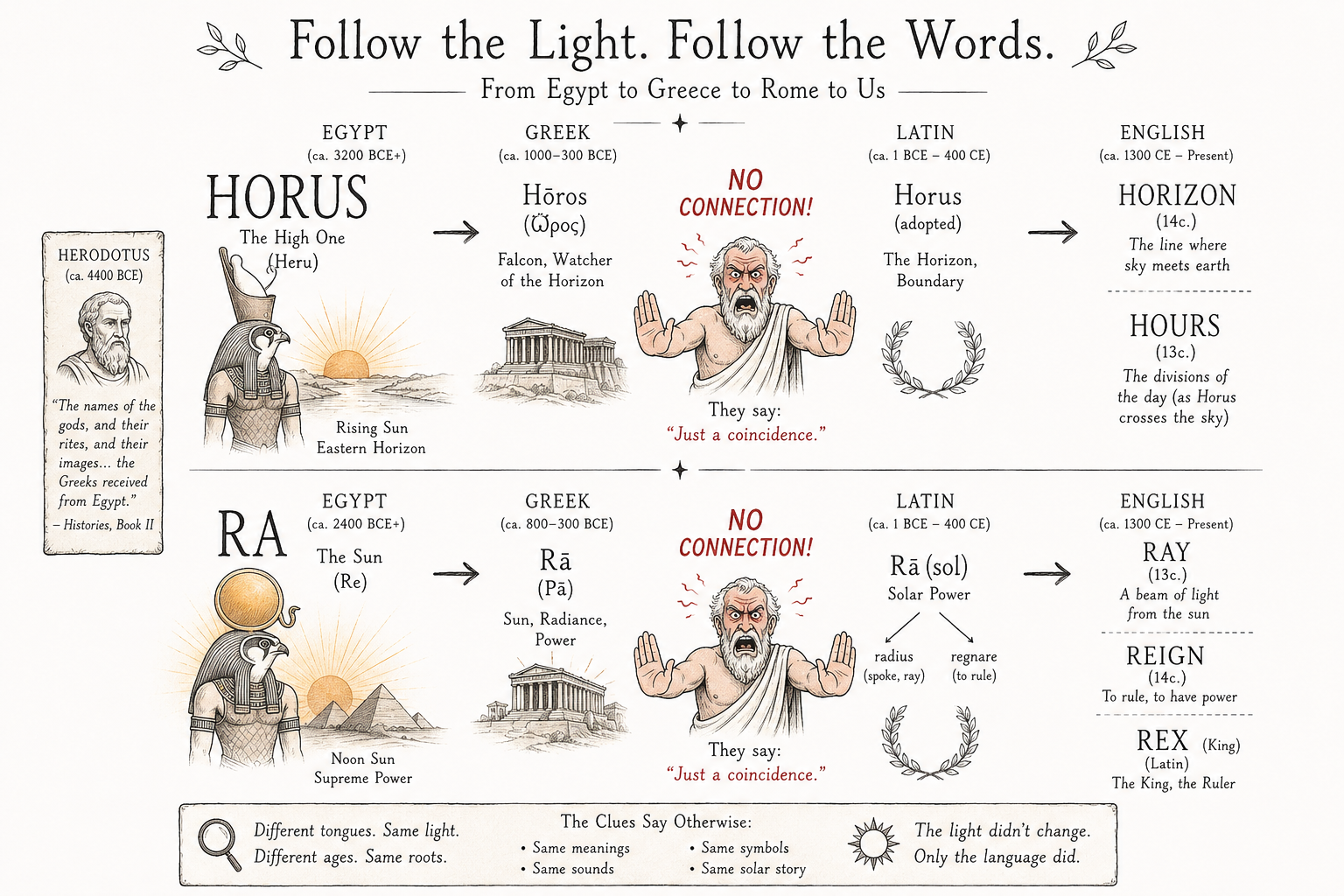
Picture Herodotus in Egypt, around 450 BCE, scribbling in his notebook like a tourist who has just realized the place is older than his whole civilization and is a little shaken by it. He writes the line that will get him in trouble for the next twenty-four centuries: the Greeks, he says, took the names of nearly all their gods from Egypt. The festivals too. The processions. He is not whispering it. He is the Father of History and he is writing it down in ink.
Now picture the other man. He stands at the border between Egypt and the rest of the story, older than he looks and angrier than he should be, arms thrown straight out like a crossing guard who has caught a child sprinting toward traffic. His face is the color of a pomegranate. He has one word, and he shouts it at every idea that tries to walk across:
NO CONNECTION.
I am going to give that man his due before I am through, more honestly than he tends to give anyone. But I want to start where the question actually started for me, which is not in a library. It started at a window, with two small boys.
II. Sunrise, sunset
My sons are three and five. Every clear morning the light comes up gold over the hills to the east, and every evening it goes down red in the west, and at some point a child wants to know which is which and why the colors change and where the sun goes at night. You can answer that with astronomy, and I do, eventually. But the first answer I gave them was a story, because a story is what a small mind can hold.
In the morning, I tell them, the sun is young and rising and fierce, and that is Ra, and his falcon, Horus, who owns the eastern sky. In the evening the light gets old and angry and red, and it sinks into the desert in the west, and the west has always belonged to Set, the brother of storms, the lord of the edge of things. Rise in the east. Set in the west. My five year old can already point to the right horizon for each.
Now, I want to be honest in this article, because it is the article I will come back to, so let me lay the layers down side by side rather than pretend they are one thing.
The dictionary will tell you that rise is an old Germanic word, that set is simply the causative of sit, the sun sitting itself down, and that ray came into English from a Latin word for the spoke of a wheel. All of that is true, and I will put it in the tables below without flinching. These English words did not descend from Ra and Set. On the page, they are cousins of sit and wheel.
And yet here is the thing the dictionary cannot take from me, because it is not a claim about spelling at all. The mythology is sound. In Egyptian religion the rising and eastern sun really does belong to the falcon, to Khepri and Ra and Horus of the two horizons, and the west, the dusk, the desert, the chaos at the edge of the ordered world, really does belong to Set. So when my son points east at the gold coming up and I say that is Ra's, and points west at the red going down and I say that belongs to the storm brother, I am not lying to him. I am handing him a map the Egyptians drew four thousand years before us.
The sound-echoes, rise and Ra, set and Set, are the part I cannot prove. I hear them. I will not pretend I do not hear them. But I will keep them in their right drawer, marked as echoes, as clues I am still turning over, and not dress them up as descent. That is the whole discipline of this piece: keep the drawers straight, and then look at how full they all are at once.
III. How I read a puzzle
I do not read history one letter at a time. I read it like a crossword.
You do not prove fourteen across by staring at fourteen across. You write in your best guess, and then you check whether the words coming down through it agree. When the third letter is also the first letter of a word you are sure of, and the fifth lands exactly where another answer needs it, you stop doubting. Not because anyone proved that single word alone, but because too many other things had to be true at once for it to be wrong. The pattern locks. The crossings become the proof.
So before I get to the words, let me fill in the crossings that are not words at all, the ones no one can argue with.
IV. The water was already moving
Around 1400 BCE, women buried in Bronze Age Denmark went into the ground wearing little cobalt-blue glass beads. Centuries later, chemists read the trace elements in that glass, and it matched the workshops of Amarna in Egypt and the furnaces of Mesopotamia. Egyptian glass, on a northern woman's throat, three thousand four hundred years ago. Going the other way, Baltic amber turns up all across the Bronze Age Mediterranean and down into Egypt itself.
The world was one web long before Rome was a village on a hill. Things moved. Ideas moved. Names moved. That is the answer already inked into the grid, and every word that tries to cross it has to agree.
And the alphabet is the crossing I love most, because the old man fills it in with his own hand. The letters he writes NO with did not begin in Europe. They began as Egyptian hieroglyphs, reworked by Semitic-speaking workers inside Egypt into the first alphabet, which became Phoenician, which became Greek, which became the Latin letters on this page. The very shapes he uses to forbid the connection came up out of Africa to reach him. That is not my theory. It is in his own textbooks, first chapter, before he gets angry.
V. The tables
Here are the words, laid out honestly. I am using a legend so that every drawer stays labeled. The strength of my case does not come from blurring these categories. It comes from how many of them point the same direction at once.
Legend
[Anchor] an Egyptian source word, attested in stone.
[Borrowed] a name or word that documentably crossed a border.
[Native] a word that grew up inside the Proto-Indo-European family. Unrelated in origin to Egyptian, even when it looks like a twin in English.
[Contested] a comparison from the Diop, Obenga, and Bernal tradition. A real scholarly conversation, not a settled fact.
[Echo] a sound-and-sense resemblance I hear and keep as a clue. An honest coincidence, not a derivation.
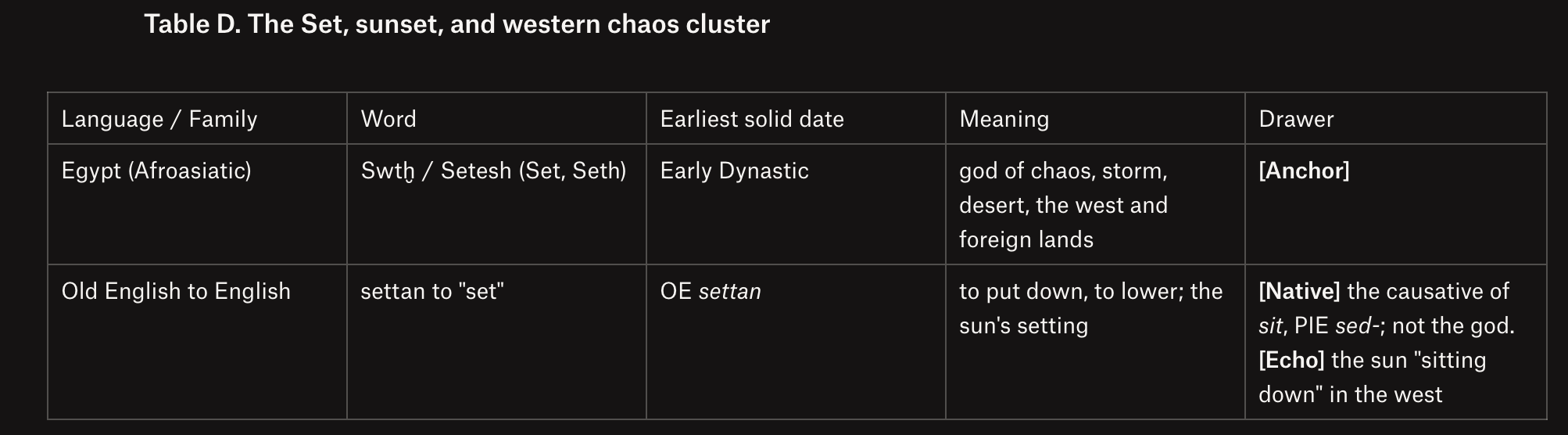
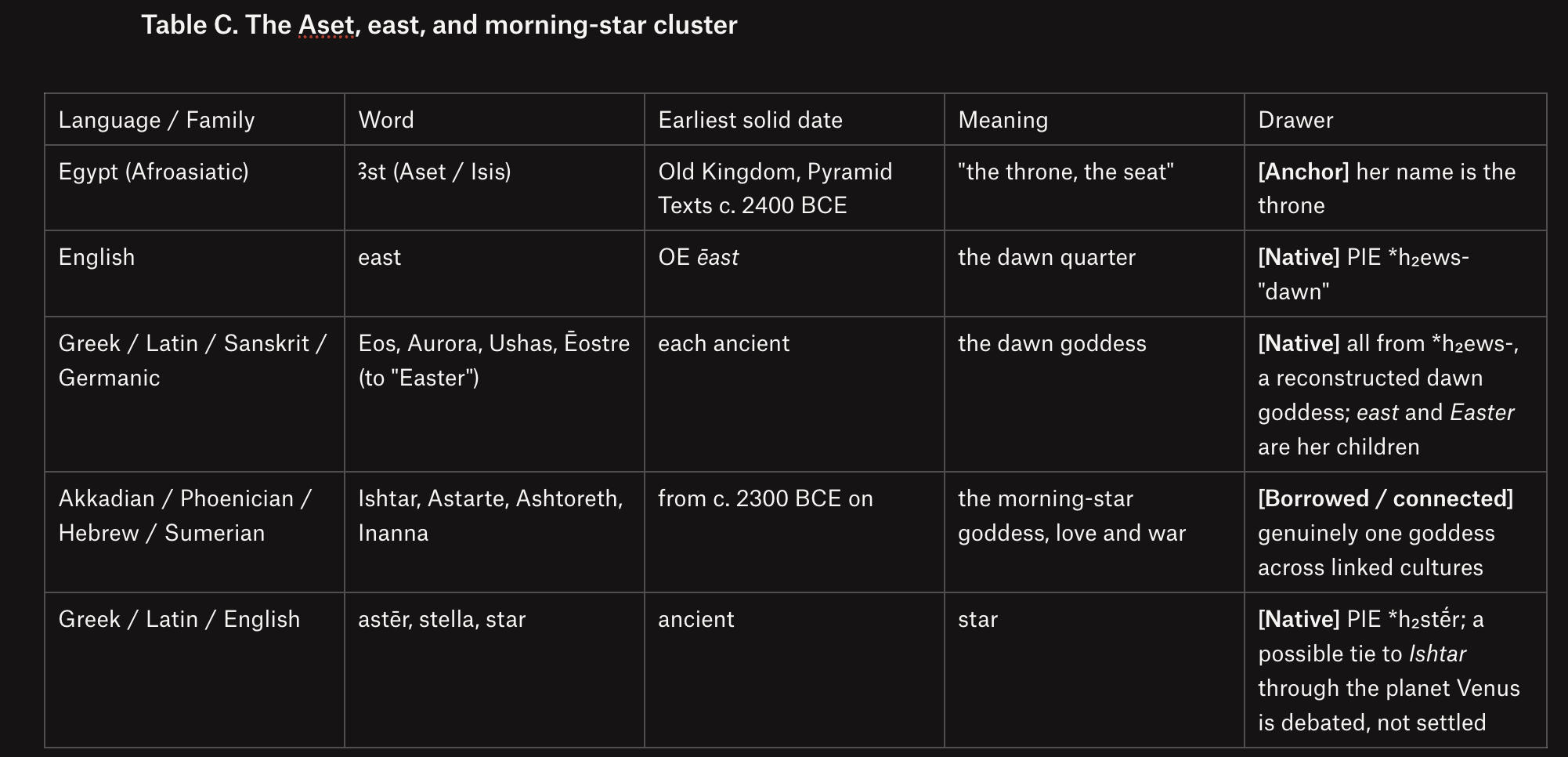
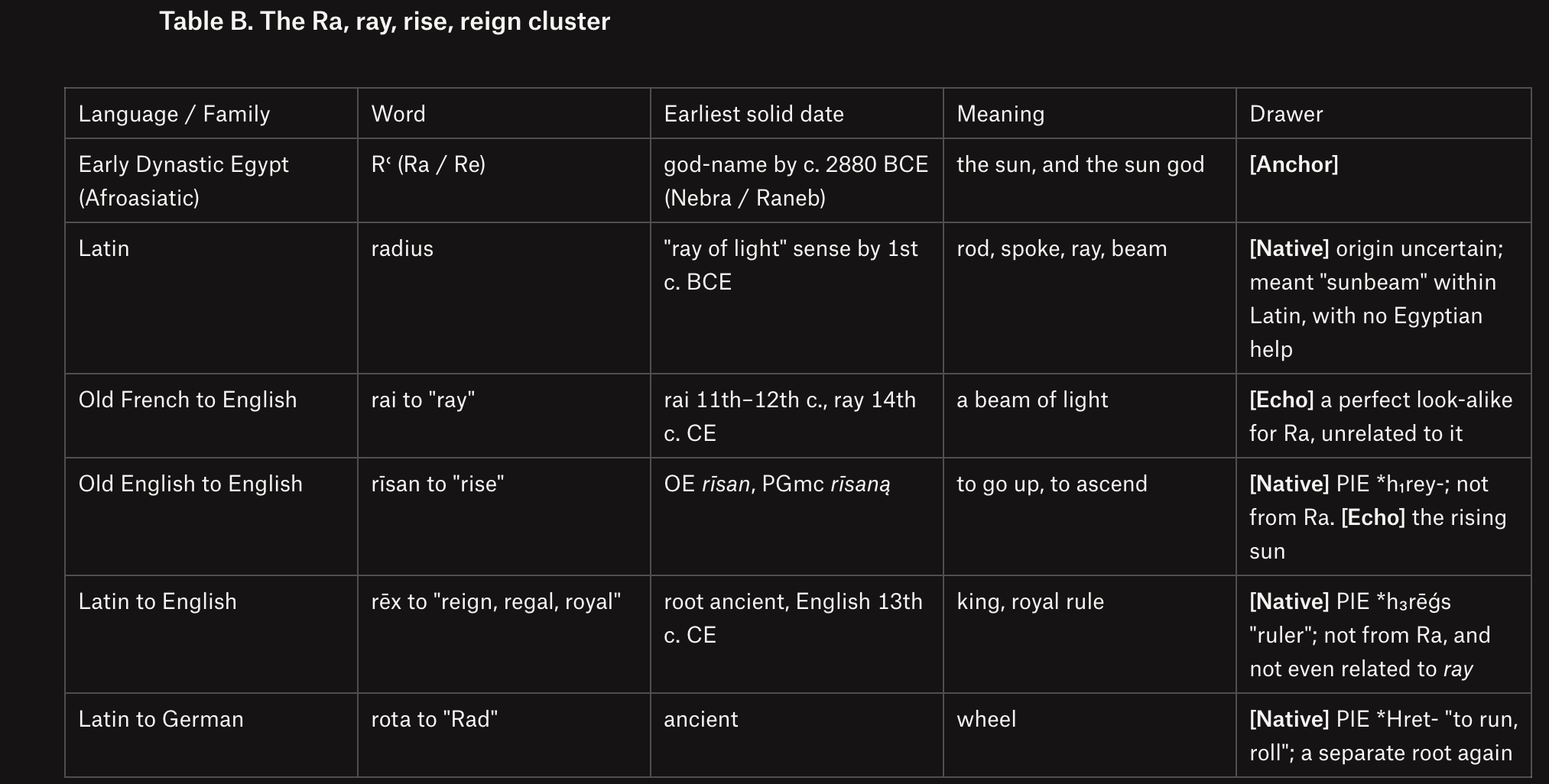
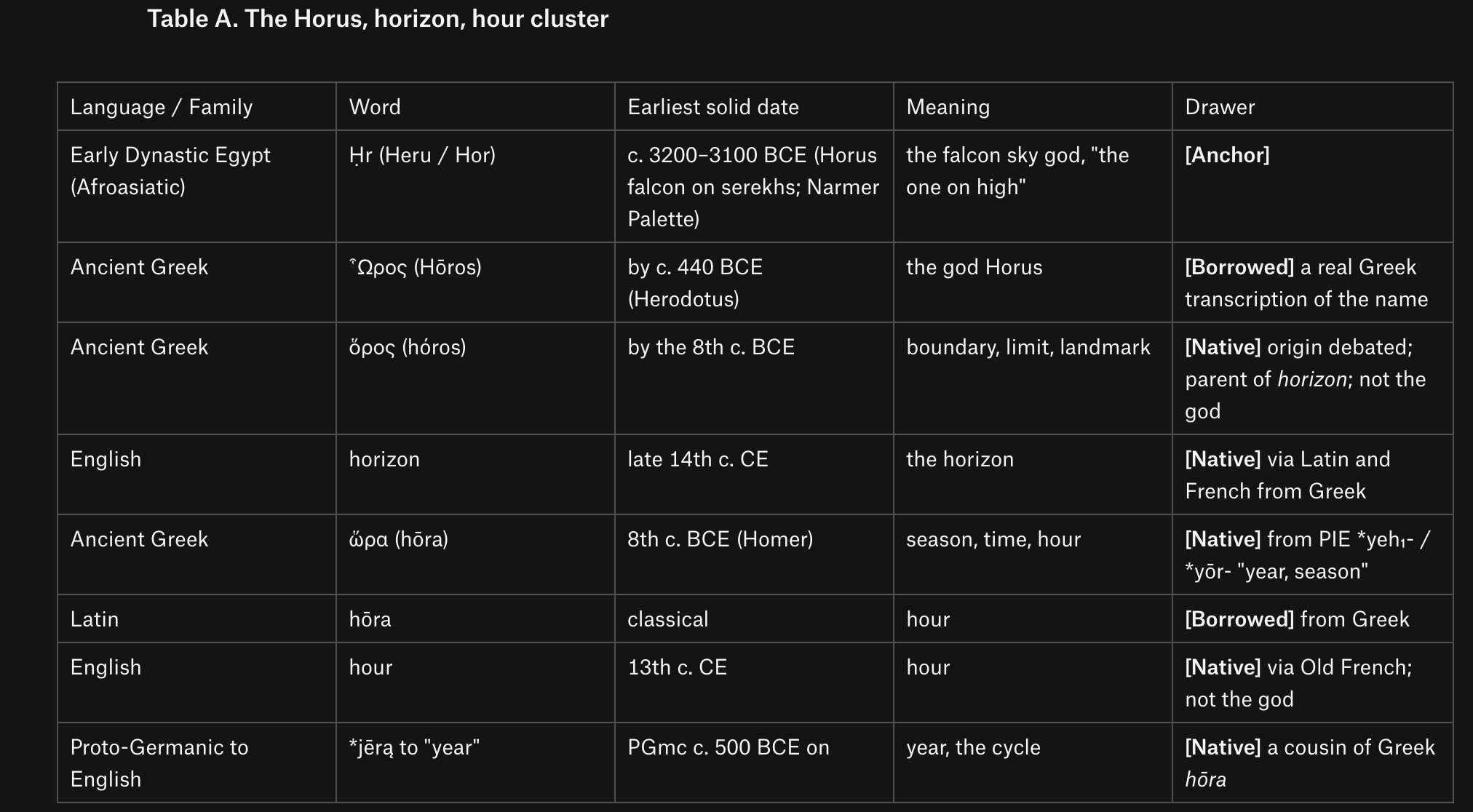
Table A. The Horus, horizon, hour cluster
Language / Family Word Earliest solid date Meaning Drawer Early Dynastic Egypt (Afroasiatic) Ḥr (Heru / Hor) c. 3200–3100 BCE (Horus falcon on serekhs; Narmer Palette) the falcon sky god, "the one on high" [Anchor] Ancient Greek Ὧρος (Hōros) by c. 440 BCE (Herodotus) the god Horus [Borrowed] a real Greek transcription of the name Ancient Greek ὅρος (hóros) by the 8th c. BCE boundary, limit, landmark [Native] origin debated; parent of horizon; not the god English horizon late 14th c. CE the horizon [Native] via Latin and French from Greek Ancient Greek ὥρα (hōra) 8th c. BCE (Homer) season, time, hour [Native] from PIE *yeh₁- / *yōr- "year, season" Latin hōra classical hour [Borrowed] from Greek English hour 13th c. CE hour [Native] via Old French; not the god Proto-Germanic to English *jērą to "year" PGmc c. 500 BCE on year, the cycle [Native] a cousin of Greek hōra
The quiet joke of Table A: three different Greek words hide under the English look-alikes. The god (Hōros), the boundary (hóros, which gives horizon), and the hour (hōra, which gives hour and is cousin to year). English smushed them into twins. Greek never confused them. The genuine, undeniable fact in this table is the first row: the falcon in stone at 3100 BCE, more than two and a half millennia before the Greeks write his name down.
Table B. The Ra, ray, rise, reign cluster
Language / Family Word Earliest solid date Meaning Drawer Early Dynastic Egypt (Afroasiatic) Rʿ (Ra / Re) god-name by c. 2880 BCE (Nebra / Raneb) the sun, and the sun god [Anchor] Latin radius "ray of light" sense by 1st c. BCE rod, spoke, ray, beam [Native] origin uncertain; meant "sunbeam" within Latin, with no Egyptian help Old French to English rai to "ray" rai 11th–12th c., ray 14th c. CE a beam of light [Echo] a perfect look-alike for Ra, unrelated to it Old English to English rīsan to "rise" OE rīsan, PGmc rīsaną to go up, to ascend [Native] PIE *h₁rey-; not from Ra. [Echo] the rising sun Latin to English rēx to "reign, regal, royal" root ancient, English 13th c. CE king, royal rule [Native] PIE *h₃rēǵs "ruler"; not from Ra, and not even related to ray Latin to German rota to "Rad" ancient wheel [Native] PIE *Hret- "to run, roll"; a separate root again
The honest punch line of Table B: the English words that all seem to circle Ra come from three unrelated places. Ray from a Latin word for a stick, reign from a Latin word for a king, the wheel words from a Latin word for rolling. They are not even cousins of one another. The resemblance to Ra is the universe trolling four languages at once. I keep ray and rise in the [Echo] drawer. I do not throw them away. I also do not put a crown on them.
Table C. The Aset, east, and morning-star cluster
Language / Family Word Earliest solid date Meaning Drawer Egypt (Afroasiatic) Ꜣst (Aset / Isis) Old Kingdom, Pyramid Texts c. 2400 BCE "the throne, the seat" [Anchor] her name is the throne English east OE ēast the dawn quarter [Native] PIE *h₂ews- "dawn" Greek / Latin / Sanskrit / Germanic Eos, Aurora, Ushas, Ēostre (to "Easter") each ancient the dawn goddess [Native] all from *h₂ews-, a reconstructed dawn goddess; east and Easter are her children Akkadian / Phoenician / Hebrew / Sumerian Ishtar, Astarte, Ashtoreth, Inanna from c. 2300 BCE on the morning-star goddess, love and war [Borrowed / connected] genuinely one goddess across linked cultures Greek / Latin / English astēr, stella, star ancient star [Native] PIE *h₂stḗr; a possible tie to Ishtar through the planet Venus is debated, not settled
Table C is where the crossings light up. East really does open onto the dawn, and the dawn really was a goddess, and that is in the old man's own dictionary, not mine. The morning-star goddess really does walk the trade routes under one traveling name. Dawn, morning star, the radiant feminine, all meeting at the eastern edge of the sky at the same hour. He sees those crossings and writes coincidence in the margin. I see them and watch the puzzle solve itself. And when I set Aset, the great seated mother of the Nile, at the head of that same family of light, I know her name belongs to a different root. I add her anyway, in pencil, because the picture wants her there, and I am not required to unsee where she fits.
Table D. The Set, sunset, and western chaos cluster
Language / Family Word Earliest solid date Meaning Drawer Egypt (Afroasiatic) Swtḫ / Setesh (Set, Seth) Early Dynastic god of chaos, storm, desert, the west and foreign lands [Anchor] Old English to English settan to "set" OE settan to put down, to lower; the sun's setting [Native] the causative of sit, PIE sed-; not the god. [Echo] the sun "sitting down" in the west
A note for accuracy, since this is my reference copy. In the strict Egyptian daily cycle the rising sun is Khepri, the noon sun is Ra, and the setting, aging sun is Atum, not Set. Set is the chaos and desert god of the west and the edge, and, worth remembering, he is also the one strong enough to ride the night barque and fight the chaos-serpent Apophis in the dark, so he is a defender as much as a villain. My sunrise-Horus, sunset-Set framing is my own poetic construction. It is loosely grounded in Set's genuine western and chaotic associations, and it is a fine story to teach a child. It is not the canonical solar triad. I want to know the difference, so I am writing the difference down.
VI. The mother and the child
There is one entry that, once you write it in, will not let you put the pencil down.
Isis, seated, the infant Horus at her breast. The divine mother holding the divine child. You find it in Egypt, and then you find it again, and again, until you find it in a cathedral with the names changed, where scholars who are not cranks trace a quiet line from Isis and Horus into the Madonna and child. In the Greek and Roman world Isis was openly identified with Astarte, with Aphrodite, with Demeter. The mother and child is the entry that breaks the whole grid open. She is everywhere. That is not an accident. That is a current.
VII. Two eyes in the sky
This is the part I love most to tell, and the part I will tell my boys only in its gentle form for a while yet.
The Egyptians looked up and saw two great eyes in the sky. The right eye was the sun. The left eye was the moon. And they told a story to explain why the one eye, the moon, keeps changing, growing and shrinking and vanishing, while the sun stays whole.
In the long quarrel between Horus and his uncle, the chaos god of the west, the uncle tears out the lunar eye and breaks it into pieces and scatters it. The eye goes dark. That is the new moon, the eye gone from the sky. Then a wise one, Thoth, the keeper of writing and reckoning, gathers the broken pieces and fits them back together, a little more each night, the way you would rebuild something patiently in the dark. Two weeks of mending, and the eye is whole again. That is the full moon. The Egyptians had a name for the healed eye, the wedjat, which means the whole one, the one made sound again. The moon was named for its own restoration.
I will tell my three and five year old the soft version. The moon's eye gets hurt, and every month a patient healer mends it back to round, and that is why it changes shape. The tearing-out and the scattering can wait for an older child. But I keep the whole myth here, because it is one of the most beautiful pieces of sky-reading any people ever did: an explanation of the lunar month that is also a promise that what is broken and scattered can be gathered and made whole again. The sun does not need this story. The sun is constant. It is the wounded, recovering eye that the Egyptians loved enough to name after its healing.
VIII. His logic, stated plainly
Now I will give the man his due, because his argument has a spine, and you should see it at full strength before you watch me decline it.
First: resemblance is cheap. There are thousands of languages and only so many sounds a mouth can make, so any two tongues on earth will share a few words that sound alike and mean the same thing, by pure chance. His favorite example is real, and I will hand it to him. In Mbabaram, an Aboriginal Australian language, the word for dog is dog. Same sound, same meaning, and not one thread of history between them. A fluke.
Second, and this is his real blade: a true family bond is not a pile of look-alikes, it is a system. The same sound in one language must answer the same sound in the other, over and over, predictably, across hundreds of words. English f answers Latin p every single time. Foot and pes, fish and piscis, father and pater. That regularity is the thing chance cannot fake.
Third, for a borrowed word he asks something gentler, only that you show contact and a path. Canoe gets in because we can document the Spanish meeting Taino speakers in the Caribbean.
Those are his rules. I have read them. I understand them. They are not nonsense.
IX. And I will not stay there
But I am not going to spend my life inside his courtroom, because the courtroom is built so I can only ever lose.
Here is the trap. He accepts a connection only when the paper survived. He knows the paper did not survive. He knows the record he demands was written, if it was written at all, on materials the desert ate, in oral lines he refuses to count, across a continent his own discipline spent two centuries insisting had no history worth tracing. So he asks for the one thing he is sure is gone, and when it cannot be produced, he calls the silence proof of absence. That is not a search for truth. It is a lock built to look like a door.
New proofs have never come from inside that lock. They come from someone who walks around it, who looks at the same evidence everyone else filed under coincidence and says, what if it is not. The crossword does not get solved by the man who refuses to write anything down until every letter is notarized. It gets solved by the one willing to trust the crossings.
X. The borrowed tongue
Look at our own language honestly. The conservative count says the bulk of English is Latin, French, and Greek, well over half of every word you are reading right now. And then ask the question he would rather you not ask. Where did Latin and Greek get theirs.
Some have pushed hard on exactly that. Martin Bernal spent three volumes arguing that a quarter or more of the Greek vocabulary may rise out of Egyptian and Semitic ground, and the bolder voices in that line put the foreign share of our inherited classical words as high as a third. The exact count is fought over, and many a single etymology is still in the ring, and I will not pretend the field has settled it, because it has not. But the direction is not really in doubt, and here is the part that should stop you cold.
Anytime an etymology tells you a word comes to rest at a Greek or a Latin or a Germanic root, you are not looking at the beginning. You are looking at the last lit room before the evidence runs out. Those were never the first people to speak. They could not have been. Someone older handed them the word, and someone older than that, back and back, until you reach mouths that left no stone at all. The root is not the bottom. The root is just as deep as his rules let him dig. And the truth I love is the one underneath that: nearly every word we own is on loan from people we were taught not to credit.
XI. Every voice they crossed out
This is why I keep faith with the disregarded ones.
The priest in 440 BCE telling a Greek to his face that he was a child with no old memory. The scribe pressing a sound into clay that a later empire buried. The grandmother carrying a name in her mouth across a desert with no library to keep it for her. The scholar in 1990 laughed out of the room for saying out loud that Egypt was African. Every one of them was a dissonant voice, and the broken method was very good at teasing them apart one at a time, debunking a single word here, an isolated claim there, and calling the whole chorus silence.
But you do not refute a chorus by proving one singer flat. They all matter. The pattern is made of them.
XII. So does he win?
He will tell you he does. Lay all of it in front of him, the beads, the alphabet, the dawn goddess at the eastern edge, the mother and her child, the two eyes in the sky, the borrowed half of our own speech, and he will adjust his glasses and say that none of it meets his standard, and that by his rules he is still standing.
And here is the thing I will not do.
I will not say he wins.
Because if his rules can look at the dawn and the morning star and the great seated mother all gathered at the same eastern horizon and call it nothing, then it is not the pattern that is broken. It is the rules. A method that has to throw away a picture this coherent to keep its footing has a snapped link somewhere inside it, and that snapped link is the whole point. He is not seeing more than I am. He is seeing less, and calling the blindness rigor.
The wall is not stopping anything. It catches the water, renames it in a European accent, and pretends it invented the rain.
I came at it with a clear mind and an open one, and it took me somewhere his method cannot follow. I stood in his last lit room, and then I kept walking into the dark, where the older voices are, the ones who spoke before the lights were ever switched on.
I will not be confined by his broken logic.