
The Hidden Chamber: Sacred Union and the Rooms Religion Forgot
A research article for the Reclamation Series
There is a room at the center of almost every sacred tradition that ordinary people are not allowed to enter. Sometimes only priests may cross the threshold. Sometimes only the king. Sometimes no one at all, except on a single appointed day of the year. Modern religion tends to explain this room as a place of purity, mystery, or divine absence. But when the architecture is traced across cultures, a different pattern emerges underneath the theology: the hidden chamber is very often a place of union, birth, or renewal. Not always sexual. Not always literal. But the structure of the room, the veil, the garment, and the bridegroom keeps reappearing in places that had no contact with one another.
This piece follows that thread through Egypt (North Africa), Sumer (modern-day Iraq, Western Asia), Rome (modern-day Italy, Southern Europe), and Christian Europe, and closes with the places where it touches the arguments already built in Playing With Fire. As with the rest of the Reclamation Series, the claims below are sorted by evidence tier: Documented (attested in primary or well-sourced academic material), Pattern (a structural resemblance across cultures that is real but not proof of direct transmission), and green-hat speculation (an interpretive leap worth naming honestly rather than smuggling in as fact).
The Shape of the Pattern
Across the ancient world, sacred space typically narrowed inward by degrees: public courtyard, restricted hall, priestly chamber, inner sanctuary. The deeper one went, the closer one came to a presence that ordinary daily life was not permitted to touch directly.
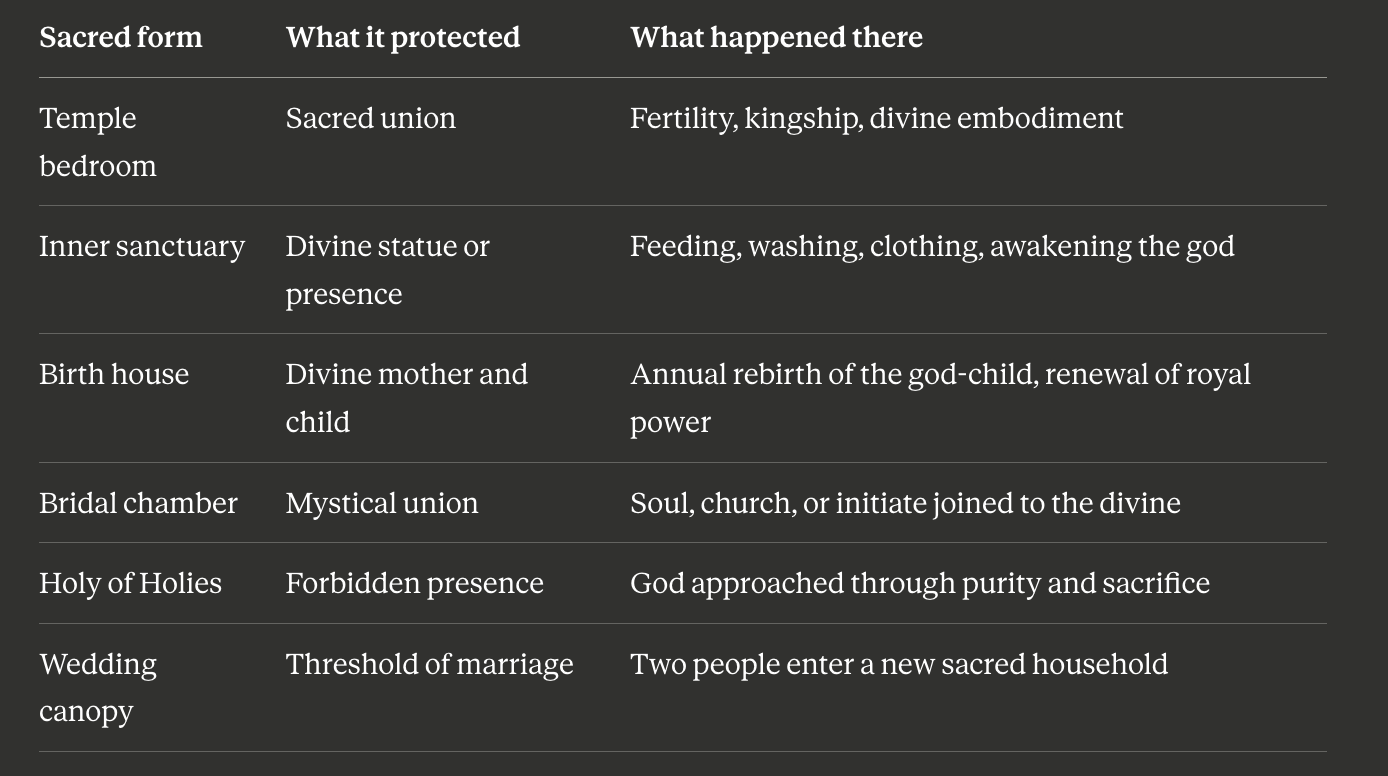
Sacred form What it protected What happened there Temple bedroom Sacred union Fertility, kingship, divine embodiment Inner sanctuary Divine statue or presence Feeding, washing, clothing, awakening the god Birth house Divine mother and child Annual rebirth of the god-child, renewal of royal power Bridal chamber Mystical union Soul, church, or initiate joined to the divine Holy of Holies Forbidden presence God approached through purity and sacrifice Wedding canopy Threshold of marriage Two people enter a new sacred household
(Pattern.) The recurring logic is that the deepest room is where transformation happens. This is a structural observation across traditions, not a claim that any one tradition borrowed the idea from another.
Egypt: Not "Temple Sex," But Absolutely Divine Birth
The common corrective people run into online, that Egyptian temples were not sites of sexual ritual, is mostly accurate in the narrow sense. (Documented.) Egyptian temples were understood as residences for the gods, who could manifest in a cult statue housed in the sanctuary. Priests performed daily rites: opening the shrine, purifying the space, offering food and drink, burning incense, and clothing or adorning the god. This was maintenance of cosmic order, not a public sex rite.
But if the question is widened, from "was this a brothel" to "was this saturated with birth, embodiment, and the god entering a vessel," the answer becomes yes. (Documented.) In the Late Period and continuing into the Ptolemaic and Roman periods, many major temple complexes added a mammisi, or birth house, a small temple attached to the main sanctuary. Its function was to ritually re-enact the birth and coronation of the divine child born to the local god and his consort, a rite tied directly to the renewal of kingship.
This is not the Mesopotamian bridal chamber. It is something more particularly Egyptian: a ritual nursery, a womb-building, where the child's birth stood as proof that cosmic order still held.
Egyptian royal theology went further still. (Documented, with theological framing.) At temples including Deir el-Bahri and Luxor (both modern-day Egypt, North Africa), divine-birth relief cycles depict a god approaching the queen, the future king being conceived, formed, and presented. This was political theology rather than literal narrative history: the point was legitimacy, not biography. A ruler was not merely born of two parents; a ruler was born of divine will made visible in stone.
The Opet festival at Thebes (modern-day Luxor, Egypt, North Africa) carried the same logic through the city itself. (Documented.) The gods of Karnak, Amun, Mut, and Khonsu, were carried by sacred barque in procession to Luxor, where the king's power was ritually renewed. The public saw a procession; the priests handled the hidden god; the king received renewal. The chamber did not stay still. It processed through the streets and came back.
Rome and the Isis Scandal: When the Old Grammar Gets Weaponized
One of the more unsettling pieces of evidence for how alive this idea remained comes not from Egypt but from Rome, in a story told by the first-century Jewish historian Josephus. (Documented as a literary source; treat the underlying event with appropriate caution.) A Roman noblewoman named Paulina was the target of an aristocrat, Decius Mundus, who allegedly bribed priests of Isis to convince her that the god Anubis desired to meet her in the temple. She came believing she was entering a genuine divine encounter. Mundus impersonated the god and assaulted her in the sacred space.
This is not evidence that Isis worship normally included sacred sex. It is evidence of the opposite: a fraud that only works if the underlying cultural grammar is already legible to the victim. A deity could desire a chosen woman; a temple could be the meeting place; the night could be the appointed hour. The scandal borrows the shape of the older sacred pattern and abuses it. That the fraud was intelligible at all tells us the old architecture, veiled chamber, chosen woman, divine visitor, was still culturally live enough in Rome to be exploited.
Sumer: Where the Sacred Marriage Says the Quiet Part Loudly
If Egypt keeps the erotic current folded inside birth and kingship, Sumer (modern-day Iraq, Western Asia) states it far more openly. (Documented, with some scholarly debate over the ritual's exact enactment and period.) The goddess Inanna and her consort Dumuzi form one of the great erotic-sacred pairings of the ancient Near East. In later ritual and literary tradition, the king could take the ritual role of Dumuzi, paired with a priestess or with the temple institution representing the goddess. Their union was understood to renew the fertility of the land and confirm royal legitimacy. This is the hieros gamos, the sacred marriage, and it is a genuine scholarly category, not a modern projection, though scholars continue to debate how literally it was performed versus recited or symbolically enacted in different periods.
The love poetry of Inanna and Dumuzi is unembarrassed by the body: longing, fruit, honey, opening, abundance. Fertility here is not a polite metaphor draped over sex. Sex is the visible human form of a cosmic agricultural process, and the sacred precinct at Uruk (modern-day Iraq, Western Asia), the Eanna, "House of Heaven," was a major complex of platforms, courts, and processional space, its walls set with cone mosaics that dressed the architecture the way a garment dresses a body. The parallel is worth naming directly: the holy place is clothed, the god is clothed, the bride is clothed, the altar is clothed. Sacred architecture is rarely left bare. It is veiled.
Christianity: The Bridal Chamber Survives, But the Bed Becomes the Soul
Christianity did not preserve sacred sex as temple ritual. It kept the architecture and moved the sexuality into mystical union. (Documented.)
In Christian Orthodox Holy Week, the services of the early days are formally called the Bridegroom services. The central hymn describes seeing the bridal chamber adorned, and having no wedding garment with which to enter it. This is threshold language: the chamber is ready, the bridegroom is coming, the soul is not yet prepared. It is initiation language wearing liturgical clothes.
The thread runs earlier still. (Documented.) The Christian Gnostic text known as the Gospel of Philip uses the phrase "bridal chamber" directly, and the veil it describes has been read by scholars as the same veil that separated the Holy Place from the Holy of Holies in the Jerusalem Temple. Some scholarship treats the Gnostic bridal chamber as symbolically equivalent to the Holy of Holies itself, not merely a wedding metaphor layered on top.
The pattern holds even in ordinary Christian sanctuary architecture, especially in Eastern churches, where the iconostasis or altar screen marks a threshold that not everyone crosses. (Pattern, stated carefully.) The claim is not that the Christian altar is a disguised fertility shrine. The claim is that Christianity preserved the architecture of approach, outer space, threshold, veil, hidden presence, and overlaid it with nuptial language: bridegroom, bride, wedding garment, chamber. The marriage bed becomes the soul. The desire is not erased. It is redirected.
Cleopatra: The Last Queen Who Tried to Hold the Old Grammar and Lost
Cleopatra VII belongs in this thread because she stood at the hinge point where Egyptian divine kingship collided with Roman propaganda, and lost the collision in a way that still shapes how she is remembered. (Documented, with the propaganda dimension flagged explicitly.)
She was not simply, as Roman sources framed her, a seductress who corrupted Roman men. She was a ruler operating in the older language of divine motherhood and dynastic legitimacy, in a world where Rome was actively swallowing every kingdom around it. With Julius Caesar she had a son, Caesarion, who could claim both Egyptian kingship and Caesar's blood. With Mark Antony she had three more children: twins Alexander Helios and Cleopatra Selene, named for sun and moon, and a younger son, Ptolemy Philadelphus. This was not romance. It was cosmic branding, an Isis-queen claiming sun and moon as her own children.
Octavian, who would become Augustus, understood exactly what he was fighting: not just an army, but a story. To defeat it, he reframed Antony as a Roman man corrupted by an eastern queen, then erased Antony's memory formally through damnatio memoriae after Actium. After the conquest, Egypt became too dangerous to leave in ordinary provincial hands. Senators could not enter without the emperor's personal permission. Rome knew precisely what Egypt represented: grain, wealth, divine kingship, and a rival claim to sacred legitimacy. Of the four children, only Cleopatra Selene survived into adulthood; her brothers were killed following Antony and Cleopatra's deaths.
Shakespeare inherited the Roman propaganda and turned it into tragedy. Hollywood inherited Shakespeare and turned it into spectacle: the 1963 film nearly bankrupted its studio, and Elizabeth Taylor became the first actress paid a million dollars to play the role. The chamber becomes a film set. The goddess becomes an actress. The myth keeps consuming money and attention two thousand years later, which is itself a data point about how much cultural weight the original pattern still carries.
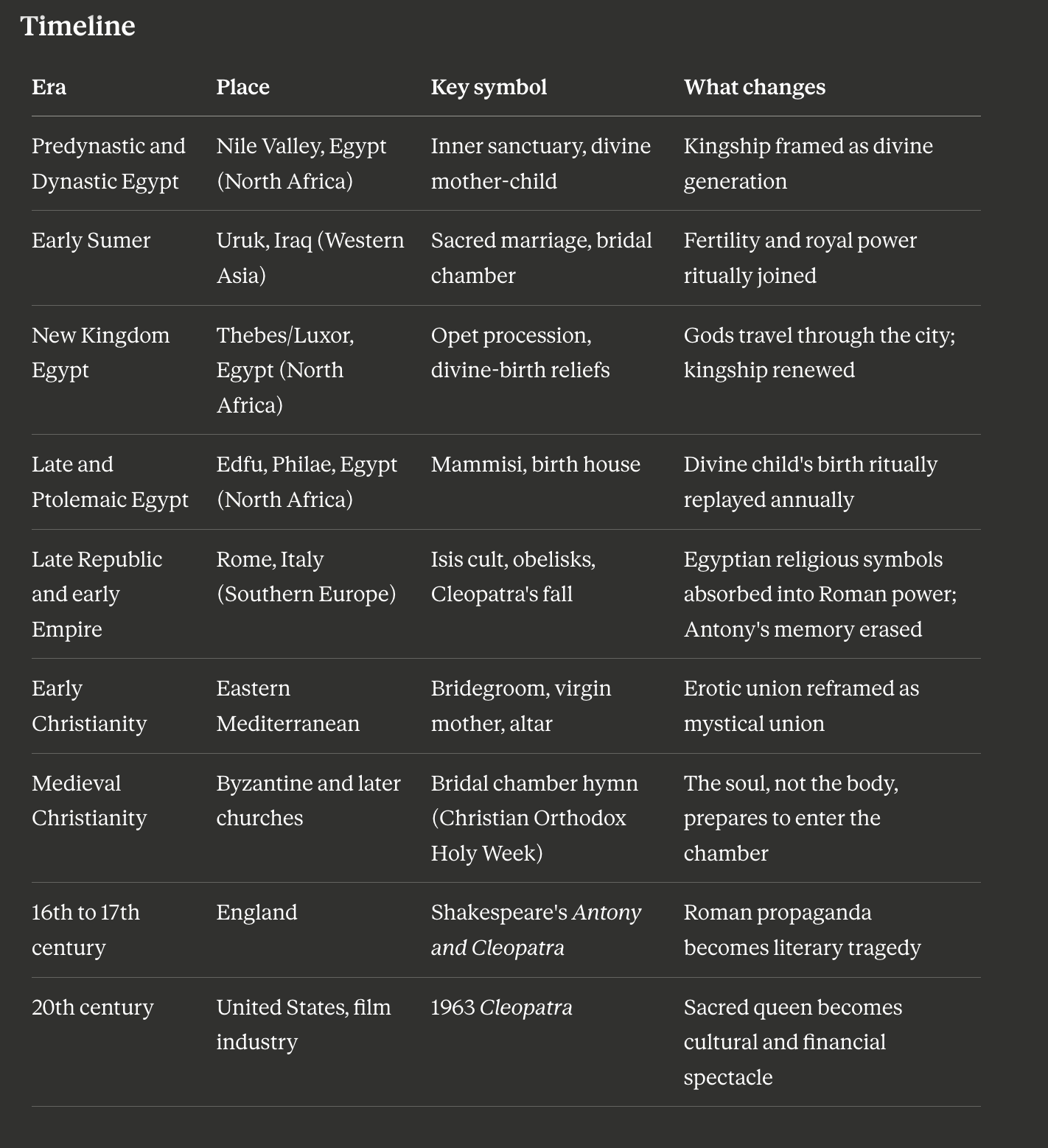
Timeline
Era Place Key symbol What changes Predynastic and Dynastic Egypt Nile Valley, Egypt (North Africa) Inner sanctuary, divine mother-child Kingship framed as divine generation Early Sumer Uruk, Iraq (Western Asia) Sacred marriage, bridal chamber Fertility and royal power ritually joined New Kingdom Egypt Thebes/Luxor, Egypt (North Africa) Opet procession, divine-birth reliefs Gods travel through the city; kingship renewed Late and Ptolemaic Egypt Edfu, Philae, Egypt (North Africa) Mammisi, birth house Divine child's birth ritually replayed annually Late Republic and early Empire Rome, Italy (Southern Europe) Isis cult, obelisks, Cleopatra's fall Egyptian religious symbols absorbed into Roman power; Antony's memory erased Early Christianity Eastern Mediterranean Bridegroom, virgin mother, altar Erotic union reframed as mystical union Medieval Christianity Byzantine and later churches Bridal chamber hymn (Christian Orthodox Holy Week) The soul, not the body, prepares to enter the chamber 16th to 17th century England Shakespeare's Antony and Cleopatra Roman propaganda becomes literary tragedy 20th century United States, film industry 1963 Cleopatra Sacred queen becomes cultural and financial spectacle
Relevance to Playing With Fire
Several threads here connect directly to material already built in the manuscript, and are worth flagging for cross-reference or a possible appendix note.
The Vestal Virgins and hieros gamos chapter. The Sumerian sacred marriage material gives a cleaner, better-documented anchor for the broader argument that sacred female-male ritual union was a known, named, high-status religious category in the ancient Near East, rather than a fringe practice. It strengthens the case that later discomfort with the idea is a historical development, not a universal human instinct. (Pattern, supporting an existing argument rather than introducing a new one.)
The Holy Ghost as originally feminine Aramaic ruha, and the broader suppressed-feminine thread. The Christian Orthodox Holy Week bridal chamber hymn and the Christian Gnostic Gospel of Philip both preserve explicitly nuptial, embodied language survivng inside orthodox and heterodox Christian tradition respectively. This is a strong, well-sourced addition to the argument that the erotic and feminine dimension of sacred experience was not erased so much as relocated, from body to soul, from goddess to Church. Worth its own paragraph or sidebar.
Damnatio memoriae and the pattern of erasure appendix. Augustus's formal erasure of Antony's memory, paired with Egypt's subsequent lockdown as a personal imperial possession, is a clean, well-documented case study for the existing "pattern of erasure" material. It shows erasure functioning as statecraft in real time, not only as later religious reinterpretation.
Evidence tier discipline. The Egypt material in particular is a useful cautionary example for the manuscript's own methodology. The instinct to say "Egyptian temples were secretly about sex" is the kind of overreach the book already works to avoid elsewhere. The more defensible and, honestly, more interesting claim is that Egypt encoded embodiment, birth, and divine presence into its architecture without needing literal sex ritual to do it. That distinction is worth preserving carefully if any of this material makes it into the manuscript proper, rather than staying in the Reclamation Series essays.
Sources drawn from this research pass include material on Egyptian temple ritual and the mammisi birth-house tradition, Josephus's account of the Isis temple scandal in Rome, scholarship on the Sumerian sacred marriage and the Eanna precinct at Uruk, and Christian Orthodox Holy Week liturgical texts alongside scholarship on the Gospel of Philip's bridal chamber imagery. As with other Reclamation Series pieces, primary source citations should be verified and formatted against the manuscript's existing bibliography before publication.
The Hidden Chamber: Sacred Sex, Divine Birth, and the Rooms Religion Forgot
There is a room at the center of almost every sacred tradition.
It is hidden, veiled, guarded, restricted, or forbidden. Ordinary people cannot enter it. Sometimes only priests can. Sometimes only kings. Sometimes no one enters at all except on a single appointed day.
Modern religion often explains this room as a place of purity, mystery, divine presence, or sacred absence. But if we follow the older thread, another pattern appears underneath: the hidden chamber is often a place of union, birth, renewal, or embodiment.
Not always sex. Not always literally. But again and again, the architecture remembers a body.
A chamber.
A veil.
A bridegroom.
A goddess.
A divine child.
A king reborn.
A god entering a vessel.
A forbidden interior where life is renewed.
This is not a story about reducing religion to sex. It is the opposite. It is about how ancient people understood sex, birth, food, kingship, the sun, and fertility as sacred technologies of renewal. Later religions often spiritualized these patterns, moralized them, or stripped them of their erotic charge. But the rooms remained.
The sacred bed became an altar.
The womb became a sanctuary.
The bride became the soul.
The divine child became theology.
The old chamber did not vanish. It was reinterpreted.
The Central Pattern
Across the ancient world, sacred space often moved inward by degrees. Public courtyard, restricted hall, priestly chamber, inner sanctuary. The deeper you went, the closer you came to divine presence.
That inner place could mean many things:
Sacred formWhat it protectedWhat happened thereTemple bedroomSacred unionFertility, kingship, divine embodimentInner sanctuaryDivine statue or presenceFeeding, washing, clothing, awakening the godBirth houseDivine mother and childAnnual rebirth of the god-child and renewal of royal powerBridal chamberMystical unionSoul, church, or initiate joined to the divineHoly of HoliesForbidden presenceGod approached through purity, sacrifice, or silenceWedding canopyThreshold of marriageTwo people enter a new sacred household
The recurring logic is simple: the deepest room is where transformation happens.
Egypt: Not “Temple Sex” Exactly — But Absolutely Divine Birth
Egypt is where the thread becomes both powerful and tricky.
People will often say, “Egyptian temples were not about sex.” In the narrow sense, that is mostly right. The daily Egyptian temple ritual was not a public sex rite. Temples were understood as residences for the gods. The deity could manifest in a cult statue kept in the sanctuary, and priests performed daily rites: opening the shrine, purifying, offering food and drink, burning incense, clothing or adorning the god, and maintaining cosmic order.
So if we ask, “Were Egyptian temples basically sacred brothels?” the answer is no.
But if we ask, “Were Egyptian temples filled with birth, union, fertility, divine embodiment, and the god entering a vessel?” the answer becomes yes.
That is the nuance.
The Egyptian god was not an abstraction. The god lived, ate, breathed, appeared, withdrew, traveled, and renewed power through ritual. The temple was a house for divine presence. The sanctuary was not empty. It was a chamber of manifestation.
And then there were the birth houses.
The Mammisi: Egypt’s Birth Architecture
In later Egyptian temples, especially from the Late Period into the Ptolemaic and Roman periods, we find the mammisi, or birth house. These small temples were attached to major temple complexes. Their purpose was to ritually re-enact the birth and coronation of the divine child of the local god and goddess.
That is enormous.
Egyptian religion did not merely worship gods who had once been born. It built architecture to replay divine birth.
The mammisi is not a bedroom in the Mesopotamian sacred-marriage sense. It is more like a ritual nursery, a womb-building, a divine maternity chapel. The god and goddess produce the child; the child’s birth renews the town, the temple, and the legitimacy of kingship.
In other words, Egypt does not always give us “sex in the temple.” It gives us something more Egyptian: ritualized birth, divine motherhood, sacred kingship, and the child as proof that cosmic order still works.
Divine Conception and Royal Power
Egyptian royal theology often imagined the king as divinely generated. At temples such as Deir el-Bahri and Luxor, divine-birth scenes show the god approaching the queen, the future ruler being conceived, formed, presented, and legitimized.
This is not ordinary sex. It is political theology.
The king’s body becomes a bridge between heaven and earth. The queen becomes a sacred vessel. The god’s power enters the royal line. A human birth is elevated into cosmic fact.
The point was not pornography. The point was legitimacy.
A ruler is not merely born from parents. A ruler is born from divine will.
The Opet Thread: Procession, Union, Renewal
The Opet festival at Thebes is another key piece. The gods of Karnak — Amun, Mut, and Khonsu — were carried in sacred barques from Karnak to Luxor. This was not just a parade. It was a ritual movement of divine power through the city.
At Luxor, the king’s power was renewed. Amun’s creative force, the goddess, the divine child, the royal ka, and the fertility of Egypt were ritually bound together.
The public saw procession.
The priests handled the hidden god.
The king received renewal.
The city watched divine fertility move through space.
This is the old pattern again: the god travels, enters, renews, returns.
The sacred chamber does not stay still. It processes.
Rome and the Isis Scandal: When the Belief Becomes Dangerous
One of the juiciest remnants of this whole structure appears not in Egypt itself, but in Rome, in a scandal involving the cult of Isis.
Josephus tells the story of Paulina, a noble Roman woman, and Decius Mundus, an aristocratic man obsessed with her. When she refused him, he allegedly bribed priests of Isis. They convinced Paulina that the god Anubis desired to sleep with her. She came to the temple believing she was entering into a divine encounter. Mundus impersonated the god and had sex with her in the sacred space.
The story is disturbing. It is deception, exploitation, and sexual fraud.
But it matters because the deception only works if the underlying idea is culturally intelligible: a god could desire a woman, enter a temple encounter, and be physically mediated through ritual space.
That does not prove that Isis temples normally practiced sacred sex. In fact, the story is framed as scandal and abuse. But scandals reveal the boundaries of belief. Mundus could exploit Paulina because the mythic grammar already existed: deity, temple, night, union, chosen woman, divine presence.
This is where the thread peeks through.
Officially: no, this is not normal temple ritual.
Symbolically: yes, the old idea is still alive enough to be weaponized.
Mesopotamia: Where the Sacred Marriage Is Explicit
If Egypt hides the sexual current inside divine birth and kingship, Mesopotamia says the quiet part louder.
In Sumer, the goddess Inanna and her lover Dumuzi formed one of the great erotic-sacred pairings of the ancient world. In later ritual imagination, the king could take the role of Dumuzi, while the goddess was represented by a priestess or by the temple institution itself. Their union renewed the fertility of the land and confirmed royal power.
This is the sacred marriage, or hieros gamos.
The body was political.
The bed was agricultural.
The king’s virility was cosmic.
The goddess’s desire authorized civilization.
The love songs of Inanna and Dumuzi are shockingly sensual. They are not embarrassed by the body. They speak of longing, sweetness, fruit, fields, milk, honey, opening, entering, abundance.
Here, fertility is not a metaphor pasted over sex. Sex is the visible human form of a cosmic process.
Uruk and the Sacred City
Uruk, city of Inanna, gives us a powerful architectural image. The Eanna district — “House of Heaven” — was not a single chapel but a major sacred precinct of platforms, courts, temples, processional zones, and decorated surfaces.
Its cone mosaics created geometric patterns like textiles embedded into walls. The temple was clothed. The sacred precinct wore a body of color, pattern, and surface.
This matters because textile, veil, garment, wall, womb, and chamber are often linked. The holy place is dressed. The god is dressed. The bride is dressed. The altar is dressed. The hidden room is screened.
Sacred architecture is rarely naked. It is veiled.
Christianity: The Bridal Chamber Survives, But the Bed Becomes the Soul
Christianity did not preserve sacred sex as a temple rite. It transformed it.
But the bridal language survived everywhere.
Christ is the Bridegroom.
The Church is the Bride.
The soul needs a wedding garment.
The Eucharist is bodily union.
Mary is the fruitful virgin.
The sanctuary is veiled.
The altar is dressed.
The faithful approach but do not own the mystery.
In Eastern Orthodox Holy Week, the Bridegroom services make this explicit. The hymn says: “I see Thy bridal chamber adorned, O my Savior, but I have no wedding garment that I may enter.” That is not casual metaphor. That is threshold language. The chamber is ready. The Bridegroom is coming. The soul is not yet prepared.
This is purification before union.
Christianity takes the ancient erotic architecture and internalizes it. The wedding chamber becomes mystical readiness. The body becomes the soul. The bride becomes the Church. Desire is not erased; it is redirected toward salvation.
The old structure remains:
Veil.
Chamber.
Bridegroom.
Garment.
Entry.
Union.
Transformation.
The Holy Room Nobody Can Enter
Many sacred traditions preserve a restricted inner room. What changes is what the room means.
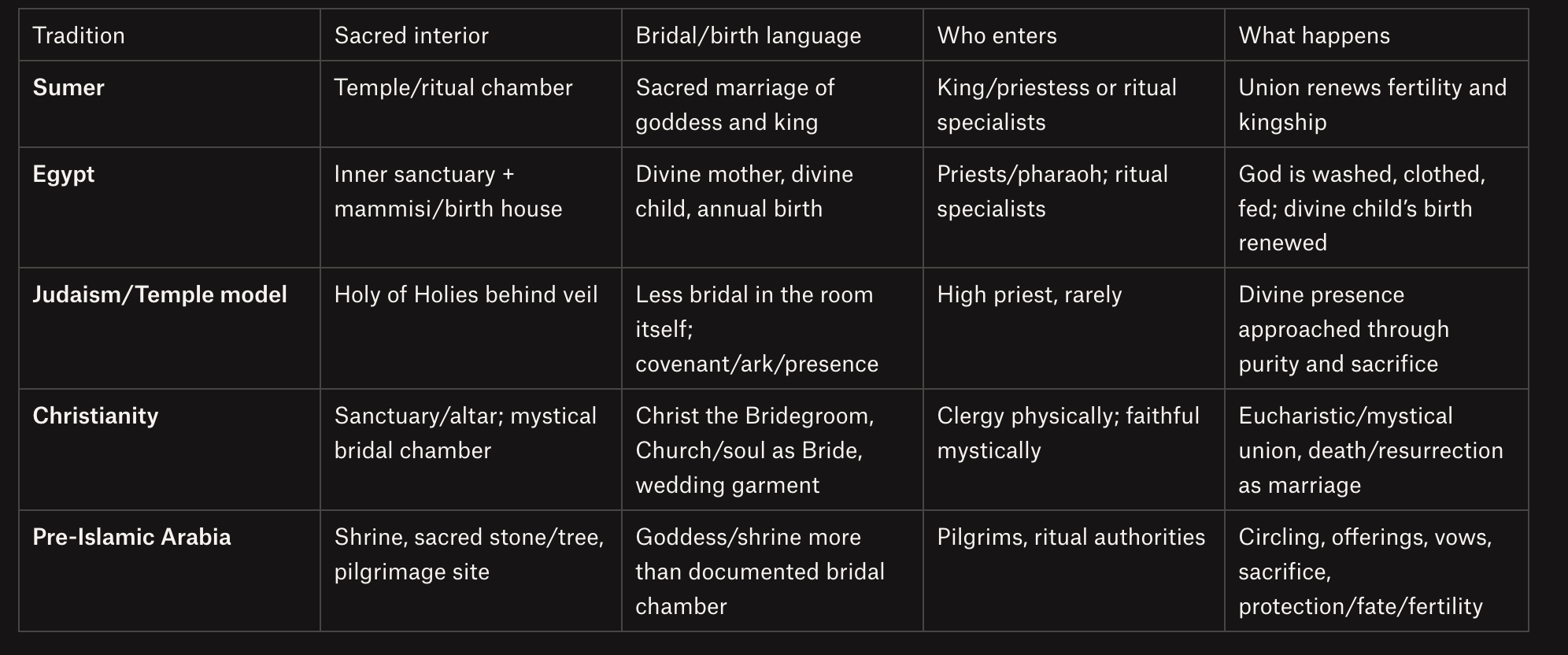
TraditionHidden or restricted spaceOlder bodily readingLater spiritual readingEgyptInner sanctuary, mammisiGod housed, fed, renewed; divine child bornCosmic order maintained through priestly ritualSumerTemple bridal chamber/giparSacred marriage of goddess and kingFertility and kingship joinedJudaismHoly of HoliesDivine presence behind veilCovenant, purity, sacrifice, sacred absenceChristianitySanctuary, altar, bridal chamber imageryBridegroom enters, bride/soul preparedMystical union with ChristIslamKaaba interior, qibla, circumambulationSacred center, stone, pilgrimage, pre-Islamic shrine memoryAbsolute unity of God; no image, no incarnationModern weddingChuppah/canopy/altarThreshold to sexual and household unionLegal, spiritual, communal marriage
The more abstract the theology becomes, the less physical the union appears. But the architecture still points to the same pattern: a center, a threshold, a prepared body, a sacred entry.
Holidays as the Public Version of the Same Pattern
The same hidden-chamber logic appears in the calendar.
Christmas gives us birth in darkness: mother, child, winter, the return of light.
Valentine’s Day gives us desire before bloom: birds pairing, lovers writing, hearts, red, blood, warmth returning.
Carnival gives us chaos before discipline: masks, flesh, food, inversion, the city losing its mind before Lent.
Lent gives us purification: fasting, restraint, cleansing, preparation.
Easter gives us fertility and return: eggs, rabbits, flowers, resurrection, the body of spring coming back.
This is not one simple pagan conspiracy. It is a biological and ritual grammar:
Birth in winter.
Desire in thaw.
Chaos before cleansing.
Purification before conception.
Fertility in spring.
Gestation toward the next birth of light.
The calendar is a body.
The Obelisk: Egypt’s Sunbeam in Rome
Rome did not just conquer Egypt politically. It physically moved Egypt into Rome.
Egyptian obelisks — solar monuments, stone rays of the sun — were hauled across the Mediterranean and raised in Roman public space. Later, Christian Rome placed crosses on them. St. Peter’s Square still has an Egyptian obelisk at its center.
People see the cross and read Christianity. But underneath is Egypt: sun, time, empire, stone, and cosmic measurement.
The obelisk becomes the perfect symbol of the whole investigation.
Rome conquers Egypt.
Christianity crowns the monument.
The public forgets the original solar grammar.
But the shadow still tells time.
Cleopatra: The Last Great Embodied Queen
Cleopatra belongs in this story because she lived at the hinge between Egypt, Rome, divine kingship, and later myth.
She was not simply a seductress. That was Roman propaganda. She was a ruler using the ancient language of divine motherhood, Isis imagery, royal fertility, and dynastic legitimacy in a world where Rome was swallowing kingdoms.
With Julius Caesar, she produced Caesarion, a child who could claim both Egyptian kingship and Caesarian blood. With Mark Antony, she had three more children: Alexander Helios, Cleopatra Selene, and Ptolemy Philadelphus. The twins were named for the sun and moon.
This was not just romance. It was cosmic branding.
Sun child.
Moon child.
Isis queen.
Roman fathers.
Egyptian dynasty.
Mediterranean future.
Octavian understood the danger. To become Augustus, he had to defeat not only Antony and Cleopatra but the story they represented. So he reframed Antony as a Roman man corrupted by an eastern queen. He made Egypt seductive, excessive, dangerous, feminized, foreign. Then he took Egypt for himself.
After the conquest, Egypt became too valuable to be treated like any normal province. Senators could not enter without imperial permission. Rome knew what Egypt was: grain, wealth, time, kingship, divinity, and danger.
Cleopatra lost the war. But Rome, Shakespeare, Hollywood, and modern archaeology never stopped needing her.
Shakespeare and Hollywood: The Sacred Body Becomes Spectacle
Shakespeare inherited Rome’s propaganda but turned it into theater.
Julius Caesar becomes the drama of republican collapse.
Antony and Cleopatra becomes the drama of empire, desire, east and west, body and state.
Then Hollywood inherits Shakespeare and Rome. Cleopatra becomes spectacle: jewels, eyeliner, beds, politics, money, doom. The 1934 film was lavish; the 1963 Cleopatra nearly broke 20th Century Fox and made Elizabeth Taylor the million-dollar queen of cinema.
The ancient pattern becomes mass media.
The goddess becomes actress.
The sacred chamber becomes film set.
The queen becomes industry risk.
The myth keeps eating money, men, and empires.
The Thread Underneath
What this investigation keeps revealing is not that every religion secretly means the same thing. That would be too easy, and wrong.
The deeper point is that humans keep building rituals around the same thresholds:
sex
birth
food
blood
purification
death
rebirth
marriage
sunrise
spring
kingship
the hidden room
the forbidden center
Ancient religion did not separate biology from holiness. The body was not an embarrassment. The body was the way the invisible entered the visible.
Later traditions often translated this into metaphor:
Sex becomes union.
Birth becomes incarnation.
The mother becomes the Church.
The goddess becomes Mary or disappears.
The sacred bed becomes the altar.
The temple chamber becomes the Holy of Holies.
The bride becomes the soul.
But the language survives.
Bridegroom.
Wedding garment.
Veil.
Chamber.
Entry.
Purification.
Conception.
Birth.
Resurrection.
The rooms remain. The architecture endures. The sacred beds may be empty — but the old grammar is still written into the walls.
Timeline: Sacred Union to Sacred Chamber
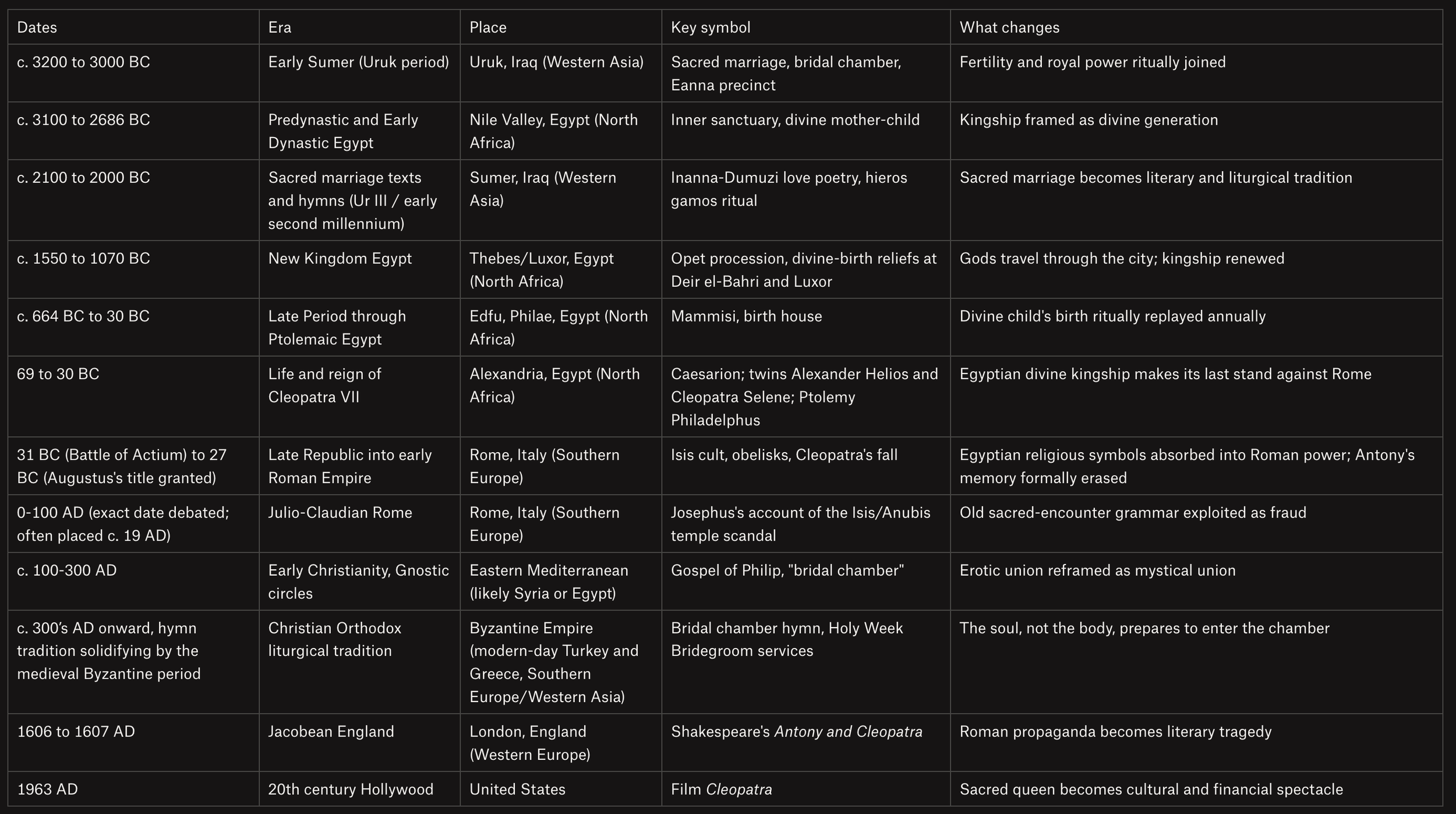
EraPlaceKey symbolWhat changesNeolithicAnatolia / early farming worldsHouse-shrine, fertility figures, bed platformsDomestic and sacred life overlapPredynastic / Dynastic EgyptNile ValleyInner sanctuary, divine birth, mother-childKingship becomes divine generationSumer / MesopotamiaUruk, Inanna cultSacred marriage, bridal chamberFertility and royal power are ritually joinedNew Kingdom EgyptThebes, Luxor, KarnakOpet procession, divine birth scenesGods travel; kingship is renewedLate / Ptolemaic EgyptEdfu, Philae, other templesMammisi birth houseDivine child’s birth is ritually replayedRomeIsis cult, obelisks, imperial EgyptEgyptian religion enters empireSacred Egyptian symbols become Roman powerEarly ChristianityMediterraneanBridegroom, Virgin Mother, altarErotic union becomes mystical unionMedieval ChristianityChurches, Holy WeekBridal chamber hymnThe soul prepares to enter the chamberModern holidaysChristmas, Valentine’s, Carnival, EasterChild, lover, chaos, egg, rabbit, bloomSeasonal fertility survives as popular symbolismModern mediaShakespeare, Hollywood, archaeologyCleopatra as iconSacred queen becomes cultural obsession
Table: Literal Sex, Sacred Birth, or Mystical Union?
Tradition or exampleIs it literal sex?What is the better description?Sumerian sacred marriagePossibly / ritually yes, depending on period and interpretationSacred union of goddess and king to renew land and kingshipEgyptian daily temple ritualNoPriest tends the god’s living presence in statue formEgyptian divine-birth scenesMythic/theological sexGod conceives king through queen; royal legitimacyEgyptian mammisiNo public sex riteRitual architecture of divine birth and child renewalOpet festivalSymbolic sacred unionProcession and renewal of Amun, king, fertility, and royal kaRoman Isis scandalSex through deceptionAbuse exploiting belief in divine encounterChristian Bridegroom servicesNoErotic/marital language spiritualized into soul-unionEucharistNoBodily intimacy transformed into sacred consumptionValentine’s / Easter sequenceNot directlyCourtship, fertility, purification, bloom encoded in calendar
The Best Thesis
The hidden chamber was never just a room.
It was the place where life crossed over.
In Egypt, the god entered the statue, the queen, the king, the child, the procession.
In Sumer, the goddess and king renewed the land through sacred marriage.
In Rome, Isis carried the dangerous glamour of divine embodiment.
In Christianity, the bridal chamber became the soul’s union with God.
In modern holidays, the same cycle returns as child, lover, feast, fast, egg, rabbit, flower.
This is not religious fluff. It is not mistranslation. It is not a single conspiracy. It is a thread.
And once you see it, the old calendar becomes readable again:
Prepare the body.
Clean the chamber.
Call the beloved.
Open the veil.
Let life enter.
Let the child be born.
Let the sun return.