
The facts:
William Shakespeare (1564–1616) wrote his plays under two opposite rulers: Queen Elizabeth I (reigned 1558–1603), then King James I (reigned in England 1603–1625).
Elizabeth, rallying her troops at Tilbury in 1588, said: "I know I have the body but of a weak and feeble woman; but I have the heart and stomach of a king." (Her words, not mine — and note it's "of a king," not "of a man.")
The same King James who commissioned the translation in 1604 — handing his ~47 scholars roughly 15 strict rules to keep church and royal hierarchy intact — was also the man who, in 1597, wrote Daemonologie, a witch-hunting manual arguing women were the "frailer" sex, more easily snared by the devil.
How the King James Version (1611) stripped out the female — concrete examples:
Phoebe: "deacon" → "servant" (Romans 16:1). Paul calls her diakonos. The KJV renders that exact Greek word as "minister" or "deacon" for men — but "servant" for her.
"Anyone" → "any man" (throughout). The Greek tis means anyone, no gender attached. The KJV renders it "any man" or "if a man" hundreds of times.
"Brothers and sisters" → "brethren" (throughout). The Greek adelphoi, used to address mixed congregations, becomes "brethren" — making the early churches read as all-male.
The "silence" double standard (1 Timothy 2:11–12 vs. 2 Thessalonians 3:12). The same Greek root (hēsychia) is rendered "work quietly / settle down" for men, but "silence" and "subjection" for women.
Junia: the female apostle, kept then erased (Romans 16:7). The KJV (1611) actually kept her female name, "Junia." The stripping came later — the RSV (1952) changed her into the invented male "Junias"; the ESV (2001) kept the name but reworded it to "well known to the apostles" instead of "among" them. (Worth stating precisely: 1611 left her standing; men claiming to improve on the past wrote her out.)
The King Who Feared Women, and the Playwright Who Trusted Them
What a deep dive into Shakespeare, a Queen, and the King James Bible taught me
I just watched the new movie Hamnet — the (Academy & Golden Globes) award winning story of the relationship between Agnes and Shakespeare.
It tore me apart. I was crying so hard throughout. At its center is grief, due to a plague in 1596, and how that grief can be transformed into masterpieces of art- for whatever psychological reason that humans en masse pick up with tragedy.
What surprised me most was that William’s plays were written during the same time the king that later sponsored him, was also sponsoring a new translation of teh English Bible.
More personally, I found it interesting that Shakespeare’s first plays were mostly comedies and histories, and not until his loss, that it turned to tragedy, and even healing work that is used today by those traumatized. He was a genius that used more unique words than the bible translated in the same era- a book that is worth laying out alongside his work at the time. Shakespeare's linguistic footprint is nearly double to triple the size of the King James Bible's vocabulary. For a man without formal professional education, he was able to capture the messy spectrum of human psychology. The same King that wrote demonologie about witchcraft, also commissioned the most popular bible translation used today, and took control over the popular, and messy, Shakespeare of the time. He understood the power of story.
around 1596, Shakespeare experienced a devastating personal loss: the death of his only son, Hamnet, at just 11 years old. Following this trauma, his writing took a sharp, profound turn into deep, existential tragedies—giving birth to Hamlet, Macbeth, and King Lear. He stopped trying to merely entertain and began processing profound grief, betrayal, and madness on the stage.
Because Shakespeare’s vocabulary was so massive and his psychological insights so precise, his tragic works have uniquely survived as therapeutic tools today:
PTSD and Trauma Therapy: Organizations like Feast of Crisp-and-Crispian and Shakespeare with Veterans actively use his plays to help combat veterans and trauma survivors. [1]
The Power of Expression: Traumatized individuals often suffer from "motoric motor speech loss" or an inability to articulate their pain. By speaking Shakespeare’s uniquely rich, explosive, and agonizing vocabulary, survivors find the exact words for feelings they previously could not name.
That's what a good story does — it hands you the people intimately, so that names half-remembered from a school syllabus suddenly have faces, a household, a grief, a wife who turns out to be the most interesting person in the room. His name was not even mentioned until the last scene of the movie, it was about the family life in the background, that which he left behind, but appeared to deeply love, even if their story does not often get showcased. So of course I had to keep learning more about it.
Then there is the issue of censorship. Though King James was the ultimate Kanye of his era, editor of what gets shown, Shakespeare still was able to bring so much forward. He was forced to heavily anonymize his political critiques. He set his most biting commentary safely in ancient Rome (Julius Caesar, Coriolanus) or the distant medieval past (Macbeth) to bypass the King's censor. King James's government grew highly paranoid about how religious and political concepts were handled on the public stage. In response, Parliament passed a sweeping censorship law. The law made it a severe, fineable offense for any actor to "jestingly or profanely speak or use the holy name of God, or of Christ Jesus, or of the Holy Ghost, or of the Trinity." [1]
Shakespeare's existing plays had to be retroactively bowdlerized. When comparing early Elizabethan printings (Quartos) of his plays to the post-1606 Jacobean printings, hundreds of changes appear. For instance, in Othello, explicit exclamations like "Zounds!" (God's wounds) or "By Christian shame" were systematically stripped out and replaced with sanitized secular phrases like "Heaven" or "Alas" to comply with the royal decree.
When King James took the English throne in 1603, he brought a deep, well-documented psychological obsession with witchcraft and assassination (having survived the Catholic Gunpowder Plot of 1605). Shakespeare wrote Macbeth explicitly to flatter and appease his new royal patron, but the text shows clear signs of state-mandated engineering. The character of Banquo was a real historical ancestor of King James. In the actual medieval chronicle sources Shakespeare used (Holinshed's Chronicles), Banquo was a co-conspirator who helped Macbeth murder the king. Shakespeare suppressed the historical truth, radically rewriting Banquo into a flawless, innocent martyr to protect the "pure" lineage of King James's absolute rule, and killing of a king totally unacceptable. Though written during Elizabeth's reign, Shakespeare’s Richard II remained highly volatile under King James. The play features a weak monarch being forced to hand over his crown to a successor—the ultimate nightmare scenario for a king who claimed a divine right to rule. The pivotal "Deposition Scene" (Act 4, Scene 1), where Richard physically surrenders his crown, was entirely banned from print editions during Shakespeare’s lifetime.
And somewhere in that reading I got pulled back to an argument I'd had online a while before. The same King James that took Shakespeare under his wing, was the same that commissioned the most popular English Translation of the Bible that is still in use today.
The thread had started with a comment someone once wrote on a post about the abuse of children — a man was insisting the fix was to "protect our children from abuse by bringing them back to God." I asked the question: what about protecting children from priests themselves? This man then reached for scripture as his Ace card: a woman shall not teach a man, he said, literally calling them God’s words. He did not like that I was telling him anything. Except they aren't God's words. They're some guy named Paul's, to Timothy, about one fractious congregation in one specific city. The line had been lifted out of its context and has been used as a weapon by men like him even in the modern day as a timeless gag order. There was more to it- He himself said the translation of the King James Bible was basically the most pure.
I brought up Abraham, following the Old Testament back to its root — back to Abraham leaving the city of Ur — landing in a world thick with powerful goddesses, a thread very much worth pulling. He knew it. He filed it under sin. It was remembered, yes, but it was a mistake that Abraham had to repent for. At least he knew there was a goddess first.
And then the move I keep seeing: the King James Bible held up as the pure one, the least biased, the perfectly preserved Word — exactly when what I'd just been reading said the opposite. The KJV has been found riddled with choices and errors that don't look remotely accidental. The scholars who made it knew the Greek they were working from; they weren't confused; they were DIRECTED. And that Greek was itself already a translation, a text with a history, not a pristine signal from heaven. There is no untouched original sitting at the bottom of this. There never was.
But the main point, every time I pointed at a failure — the abuse, the deliberate edits, the politics baked into a "sacred" translation — the answer was never the system might be flawed. It was always the system is perfect; something foreign got in. Priestly abuse? Babylonian influence, infiltration, anything but the institution itself. Errors in the text? Contamination, never design. It's a sealed loop: the thing is flawless, so every flaw must have come from outside — and meanwhile everyone else is the one who's corrupted. You cannot lose an argument built that way. You also cannot learn a single thing from it.
But we all have to come back to HIS god or we are labeled as “Unbelievers”. Who said anything at all about what i do or don’t believe in. I definitely am not drinking his coolaid.
That's the pattern I wanted to chase down- all these threads modern day people are using to put a choke hold on history of a religious text. History is not a perfect system. We are not just a species of progress alone.
And I wanted to understand the world that produced both William Shakespeare and the most famous Bible in the English language — the two came out of the same forty-year window, and they could not have treated women more differently.
History records a messy story of a pendulum, and about who is holding the pen when it swings.
We're taught, especially in church traditions, to read history as a staircase: the Old Testament gives way to the New, the primitive gives way to the mature, humanity ascends above nature, the past gives way to a better present.
It is all in the name of progress. CHristianity purified and cleaned up and refined everything that came before it- which I agree with on one thing alone: that there was MUCH to pull from before it. The early christians, when trying to convert people, literally said, nothing they are saying is new- so it is to be trusted. Later, it was seen as prophecy, all those that came before were predicting the real truth to come. As if you were caught plagiarizing, and you can just say those that wrote the words first were predicting yours. Good luck.
We have been living longer as a human species, up until our own generation. We are the first expected to live shorter lives than our parents. Evolution is not all progress. It is about survival. And there are many dark ages and extinctions and impossible survival stories.
Progress, we're told, is the natural direction of things. But that's a story told by whoever happens to be standing at the top of the stairs at the moment. The actual record moves in fits and spasms — leaps forward, long regressions, dark ages, sudden reversals. A woman could be named an apostle in the first century, kept as an apostle in 1611, and quietly turned into a man in 1952. That is not a staircase. That is a pendulum, and the hand on it belongs to whoever holds power.
So let me lay out what I learned, in order, because the order is the argument.
Two men, one era, opposite verdicts
Shakespeare wrote his plays roughly between 1590 and 1613. The King James Bible was authorized by James I and published in 1611, smack in the middle of that span. These men breathed the same patriarchal air. The King called Shakespeare and his company The King’s Men. He understood the power of controlling the story.
Then there is a patriarchal air of the time. A woman had just ruled alone, for 44 years. Then the King came along. The hammer was swinging. As we say in China. There was a woman in power for 50 years, under an amazing reign that brought the academic requirement, not just inherited right to rule in the government administration. She spent her rule asking scholars to uncover and record buried traditional stories that had been supressed. After her rule? The tradition of binding of women’s feet. Deeper supression. Fits and spasms of progress. That story is important here. King James was not just afraid of losing power, he was afraid of losing power to women. They were something to fear. He himself wrote a book on demonoligie, or witch hunting.
Stories match policy. England in this period ran on a legal doctrine called coverture, under which a married woman's legal identity was largely folded into her husband's — the two were treated as one person, and that person was him. Women could not act on the professional English stage at all; female roles were played by boys until Charles II changed the rule in 1662. This was a culture that assumed male authority as the water everyone swam in.
And yet, inside that same culture, one man kept writing women who were sharper, braver, and morally clearer than the men around them — while another authorized a book whose translation choices, and the centuries of interpretation layered on top of it, did the quiet work of writing women's authority down.
The difference between them is the whole point. The misogyny of the era was not a law of physics. It was a choice, made over and over, by people who could have chosen otherwise. Shakespeare proves it could be chosen otherwise.
The Queen who made female power impossible to dismiss
To understand James, you have to understand who came before him: Elizabeth I, who ruled from 1558 to 1603 — forty-four years, one of the longest and most stable reigns in English history.
Her very existence was a problem for patriarchal political theory. If women were naturally subordinate, how could a woman govern England for nearly half a century, defeat the Spanish Armada, and preside over a cultural golden age? Elizabeth's solution was not to argue that women were equal. It was to perform a kind of doubled identity. In her famous speech to the troops at Tilbury during the Armada crisis, she told them she had the body of a weak and feeble woman, but the heart and stomach of a king. She made herself the exception — woman in body, king in will and divine right.
She never married. That was strategy, not accident. A husband could have subordinated her, or dragged England into a foreign entanglement. Instead she cultivated the image of being wed to the realm itself, married to England through her coronation ring. Virgin queen, mother of the nation, king in all but anatomy. She did not dismantle the patriarchy. She mastered it, and stayed on top of it for four decades.
She was Henry's daughter by Anne Boleyn. But her mother mattered politically, because attacking Anne — the executed, slandered, supposedly witch-tainted second wife — was a way of attacking Elizabeth's legitimacy. So the line ran legally through the father and was defended, image by image, against the vulnerability of the mother. Even efforts later in her reign to rehabilitate Anne Boleyn's reputation were, in part, efforts to shore up the daughter's right to rule. Female power was never simply held. It had to be constantly defended.
Shakespeare's women: strong precisely where the world tried to shrink them
Shakespeare's women are at their most powerful exactly in the places society worked hardest to limit them.
Rosalind in As You Like It runs the language, the romance, the disguise, and the resolution of the entire play. Portia in The Merchant of Venice saves a man's life through sheer legal brilliance — though she has to dress as a man to be allowed into the courtroom to do it. Viola in Twelfth Night survives on wit and emotional intelligence. Beatrice in Much Ado About Nothing reads the rot in male honor culture more clearly than any man on stage. Paulina in The Winter's Tale rebukes a king to his face and is proven right. Cordelia refuses to perform obedience and is the only honest person in the room.
Notice the recurring catch, though: Portia must become a man to enter the court. Viola survives by disguise. The independence is real, but it so often has to be smuggled in costume, contained, made exceptional, or — in the tragedies — punished. Desdemona chooses her own husband against expectation and is destroyed by male jealousy. Lady Macbeth's ambition is genuinely powerful and genuinely terrifying to a culture that equated female ambition with cosmic disorder. Shakespeare gives his women agency, judgment, and inner life. He also writes them inside a world that keeps trying to take those things back. That tension is not a flaw in his work. It is his work. It's him telling the truth about the era while refusing to endorse it.
And it isn't only women. Look at who else Shakespeare lets puncture the powerful: children and fools — exactly the people a rigid hierarchy is built to dismiss. In Love's Labour's Lost, the pompous schoolmaster Holofernes, who fancies himself the cleverest man in the kingdom, gets run in circles by Moth, a young page. In The Merry Wives of Windsor, a schoolmaster drills a terrified boy named William in Latin grammar on a public street — a scene widely read as Shakespeare mocking his own childhood schooling and the uselessness of beating abstract rules into a child. The Fool in King Lear is the one who tells the king the truth no courtier dares to. Shakespeare keeps handing the moral clarity and the sharpest lines to the people at the bottom of the ladder — women, children, jesters — and keeps letting them make the men at the top look like fools for not listening. That is not an accident of plot. It is a worldview, and it is the precise inverse of the one James was busy carving into scripture.
There's a sorrow under the later plays, too. Shakespeare's only son, Hamnet, died in 1596 at age eleven. After the late 1590s his work turns toward grief, broken families, lost children, inheritance, madness, and the collapse of old certainties. Whatever the cause, the emotional register deepens. This pain seemed to have registered with the attendees. And its popularity then caught the King’s attention in the next decade.
His fortunes rose under the new king. When James came down from Scotland in 1603, Shakespeare's company, the Lord Chamberlain's Men, became the King's Men under direct royal patronage. James made the most celebrated playwright in England his own. Which means Shakespeare's later, darker, women-rich plays were written under, and partly for, the very king whose Bible would help do the opposite work. Macbeth — Scotland, kingship, prophecy, witches, lineage — was tailored to flatter and unsettle James, who was sitting in the audience.
The Bible James Commissioned
Now the pivot. This is where I remembered the conversation with the troll in comments on an unrelated post not that much earlier. He was insisting the King James Version of the bible is the one perfect, unbiased Bible. And on top of that "Paul said women should never speak, or teach a man," end of discussion.
First fact: James did not translate the Bible. He authorized it. But he did write the book on Demonologie, about witch craft, in the years before.
The work for translating the bible was done by roughly forty-seven scholars — the top linguists and theologians of Oxford, Cambridge, and Westminster — working in committees. Published in 1611, it remains, 400 years later, one of the most-read and best-selling English Bibles in the world; it's still the most culturally iconic translation in the language, even though the NIV version now leads in everyday church use. So its influence is not in dispute. The claim that it's neutral is.
No translation is neutral. None. The bible translations into English had to make several steps, losing nuance and color, and adding in the local cultural bias every time. Every translator chooses words, grammar, which manuscript tradition to follow, and which theological frame to honor when a word could go two ways. The question is never "is there bias" but "whose, and pointed where."
And we know exactly where James pointed his. He issued a set of rules to the translators, and the relevant ones were about control and continuity. He cared about how the story was shaped:
Rule 1: Follow the existing Bishops' Bible, altering it as little as the original languages allowed.
Rule 3: Keep the "old ecclesiastical words" — church, not congregation, for example.
Rule 6: No argumentative marginal notes, only brief notes explaining a difficult Hebrew or Greek word.
Rule 14: Earlier English translations (Tyndale, Geneva, and others) could be consulted only where they fit the text better than the Bishops' Bible.
The rules were designed to crush the Geneva Bible's subversive anti-monarchical margin notes and to lock in the existing hierarchy: king over church, bishops over congregations, clergy over laypeople, men over households.
Quick note on the bibles that came before: The Geneva Bible was made by English exiles in Switzerland. Unlike the state-approved translations of the era, these annotations were written by ardent Reformed scholars, who promoted active resistance to tyranny, directly challenging the divine right of kings. Some of their notes highlighted specific biblical scenarios to justify civil disobedience. For example, Daniel 3:19 and 6:15 support the right of governors and citizens to disobey wicked laws when they conflict with their faith. And Romans 13:1, stating that if "unlawful things be commanded us," believers are obligated to disobey. King James I outlawed the Geneva Bible. But more interesting to me, when it comes to female-leading representation, the Geneva Bible stands out as remarkably progressive for its time, preserving crucial female leadership titles and highlighting strong women in its marginal notes far more than later versions like the King James Version (KJV) did. In the Old Testament Wisdom literature (specifically Proverbs 1, 8, and 9), Wisdom is heavily personified as a powerful woman—traditionally referred to as Chokmah in Hebrew or Sophia. Gnostic groups viewed Sophia as a literal goddess, the Geneva Calvinists viewed her as an allegory for the mind and voice of God. The Geneva margins lean into this feminine imagery. The notes for Proverbs 8 describe her as an active, eternal co-creator with God, maintaining the vivid, authoritative feminine voice of the text without watering it down into abstract, gender-neutral concepts. But, the Geneva translators used their margin notes to heavily attack historical regional goddesses mentioned in the text. The preserved women in power, in positions of important dissent from bad rules, but condemned those who saw them as holy still. The margin notes mocked the worshippers of the goddess Diana/Artemis, and gave warning to those who showed religious sentiment to goddesses like Astarte or Ishtar. But at least, he preserved their names. The Geneva bible at least records the historical reality of Hebrew goddess worship to a Queen of Heaven. The marginal notes for Jeremiah 7:18 in the Geneva Bible explain the "Queen of Heaven" as "the starres, or the moone." The reformers stripped the entity of its personified goddess identity, reducing the practice to basic astrological paganism. [1]
The primary objective of the Geneva annotators was to attack contemporary Roman Catholic Marian piety. By labeling the Queen of Heaven as a demonic, celestial idol that brought wrath and destruction upon Jerusalem, the notes directly implied that the Catholic practice of hailing Mary as the "Queen of Heaven" was a modern revival of the exact same forbidden Hebrew idolatry. King James I did not share the aggressive hatred toward Mary worship that was championed by the radical christians who wrote the Geneva Bible. His christianity instead made a careful distinction between honoring Mary and worshipping her. James considered her higher than any other human or angel, but rejected the Catholic practice of praying to her.
The Genevan Puritans—who viewed any high reverence for Mary as a symptom of the "Queen of Heaven" idolatry—James openly stated that Mary was worthy of high respect and memory, provided it did not cross into divine adoration. Interestingly, the Puritan Christians saw Mary as a tool used by Rome to revive ancient goddess worship.
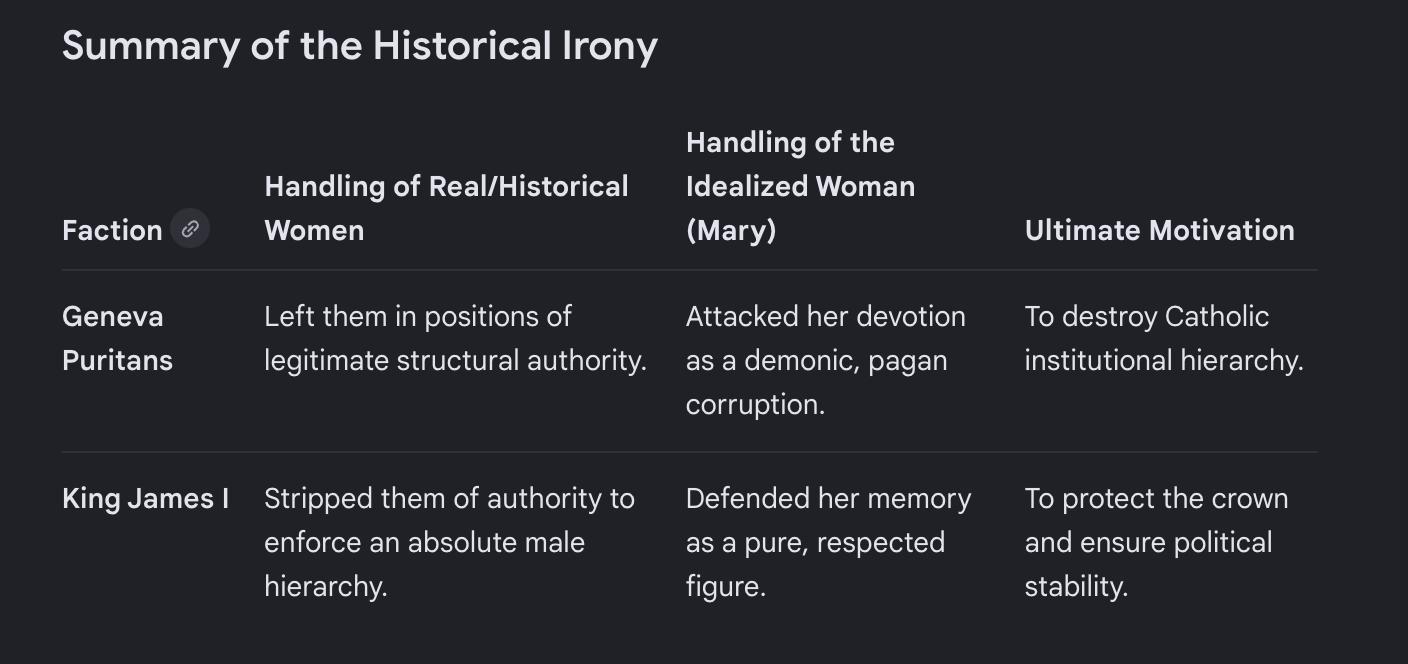
So they both hated on women in different ways, for different purposes. geneva left women in power, and essentially called mary devotion pagan. James removed women from power, and erased any evidence of mary as pagan, kept her as pure. Both the Puritan creators of the Geneva Bible and King James I weaponized gender, textual translation, and theology, but they did so to achieve completely opposite political and ecclesiastical goals.
The Puritans valued a literal, unvarnished translation of the original Greek and Hebrew texts. Because the original text supported female leadership (like Deborah judging Israel or Junia recognized as an apostle), they preserved it exactly as it was. [1]
The Genevan hostility was directed entirely at the institutional hierarchy of the Roman Catholic Church. To dismantle Catholic authority, they aggressively attacked the religion of Mary, framing it as a continuation of ancient, forbidden pagan goddess worship that brought down God's wrath. James wanted to protect a divine right of kings, which included ensuring no women could use scripture to claim authority over men, his translators neutralized the titles of prominent biblical women. His hostility was directed at the radical Puritans, whose anti-Marian, anti-clerical rhetoric threatened to cause civil unrest and destabilize his geopolitical relationships with Catholic Europe. By keeping Mary "pure," "blessed," and protected from aggressive marginal attacks, James preserved a traditional, orderly, and politically stable religious landscape.
Either way, evidence of female power remains in the evidence of her attempted suppression time after time. Either way, both had ways of hating on women, but King James took some things a step further, removing women from positions of power at all in the stories chosen by the official bible. James was more political. The marginal notes of the Geneva Bible explicitly attacked Catholic states, the Pope, and Catholic practices. James felt these notes were overly aggressive and politically dangerous, as they antagonized Catholic superpowers like Spain and France.
King James altered verses regarding women to better fit his absolute patriarchal rule. He instituted strict translation rules designed to safeguard the hierarchy of his Church. He changed pronouns to remove women from main players and leaders, changed female “ministers” to “servants”. and change “brothers and sisters” to just “brothers” and “men”. Even a woman named Junia was changed to Junias, a masculinization.
By making the Weird Sisters in Macbeth explicitly malicious, grotesque, and treasonous, Shakespeare was explicitly validating the King's real-world paranoia. Shakespeare’s earlier plays treated women with vastly more independence, wit, and narrative agency than his later plays. This shift was directly tied to the political transition from an unmarried female monarch, Queen Elizabeth I, to an absolute patriarch, King James I.
Shakespeare's early comedies featured women who actively drove the plot forward: [1, 2, 3]
Architects of the Plot: In early plays like Much Ado About Nothing or The Merchant of Venice, women possess the highest intellect. Portia outsmarts an entire courtroom of male lawyers to save a man's life. [1, 2]
The Power of Cross-Dressing: Shakespeare relied heavily on cross-dressing heroines—such as Rosalind (As You Like It) and Viola (Twelfth Night). By donning male attire, these women stepped outside societal boundaries, spoke freely, and instructed men on love, philosophy, and governance. [1, 2]
Triumphant Resolutions: Though these women faced patriarchal restrictions, the plays ended in marriages where the women retained their sharp tongues and mutual respect.
Once James came to power, women in power were tied to destruction, as Astorath was used in the Hebrew Bible. Lady Macbeth and Cleopatra are depicted as psychologically unraveling or inherently corrupting. Good, submissive women are systematically crushed, silenced, or murdered by the toxic environments of broken patriarchies. Desdemona (Othello), Ophelia (Hamlet), and Cordelia (King Lear) possess little structural power and are reduced to tragic casualties of male aggression. Even these idealized women were not getting any favor. Shakespeare delivers a profound critique of broken systems. He demonstrates that absolute patriarchal control does not protect the innocent; instead, it poisons the entire social structure.
Examples:
In Othello, Hamlet, and King Lear, the tragedies occur because powerful men refuse to listen to female voices.
Desdemona's submissive loyalty and Ophelia's absolute obedience do not save them. Their deaths prove that blind obedience to a corrupted male authority leads directly to slaughter.
Shakespeare warns his Jacobean audience that when a state replaces mutual respect with tyrannical surveillance, the most vulnerable citizens are destroyed first.
In Hamlet, Queen Gertrude operates within a rigid, hyper-patriarchal surveillance state. In the final scene, Claudius commands her, "Gertrude, do not drink." For the first time in the play, she explicitly defies a direct male command, declaring, "I will, my lord; I pray you pardon me." By drinking the poisoned wine, she unwittingly exposes Claudius’s treachery, shifting from a passive pawn into the catalyst that dismantles the corrupt regime.
The stark contrast between Juliet (Elizabethan, 1597) and Ophelia (Jacobean, 1601–1603) illustrates how female characters lost autonomy as England transitioned under King James I. Juliet explicitly rejects her father's choice of husband (Paris), initiates her own marriage (to Romeo), and her mastermining a plot is all of her own will and choice, even with blessing from the friar, and death by her own hand. Ophelia obeys her father Polonius without question, agreeing to spy on Hamlet and stating, "I shall obey, my lord." She has no control over her destiny; she is used as political bait by the King and abandoned by her lover. Her death is entirely passive and accidental. She falls into a brook while singing madly.
James was preserving a system in which women were already shut out of formal authority. The bias is structural. But there are also some smoking gun mistranslations worth noting.
The actual edits — told accurately, because accuracy is what wins the argument
Online debates about this get sloppy fast, and the sloppiness lets the trolls off the hook. So here is the careful version, example by example.
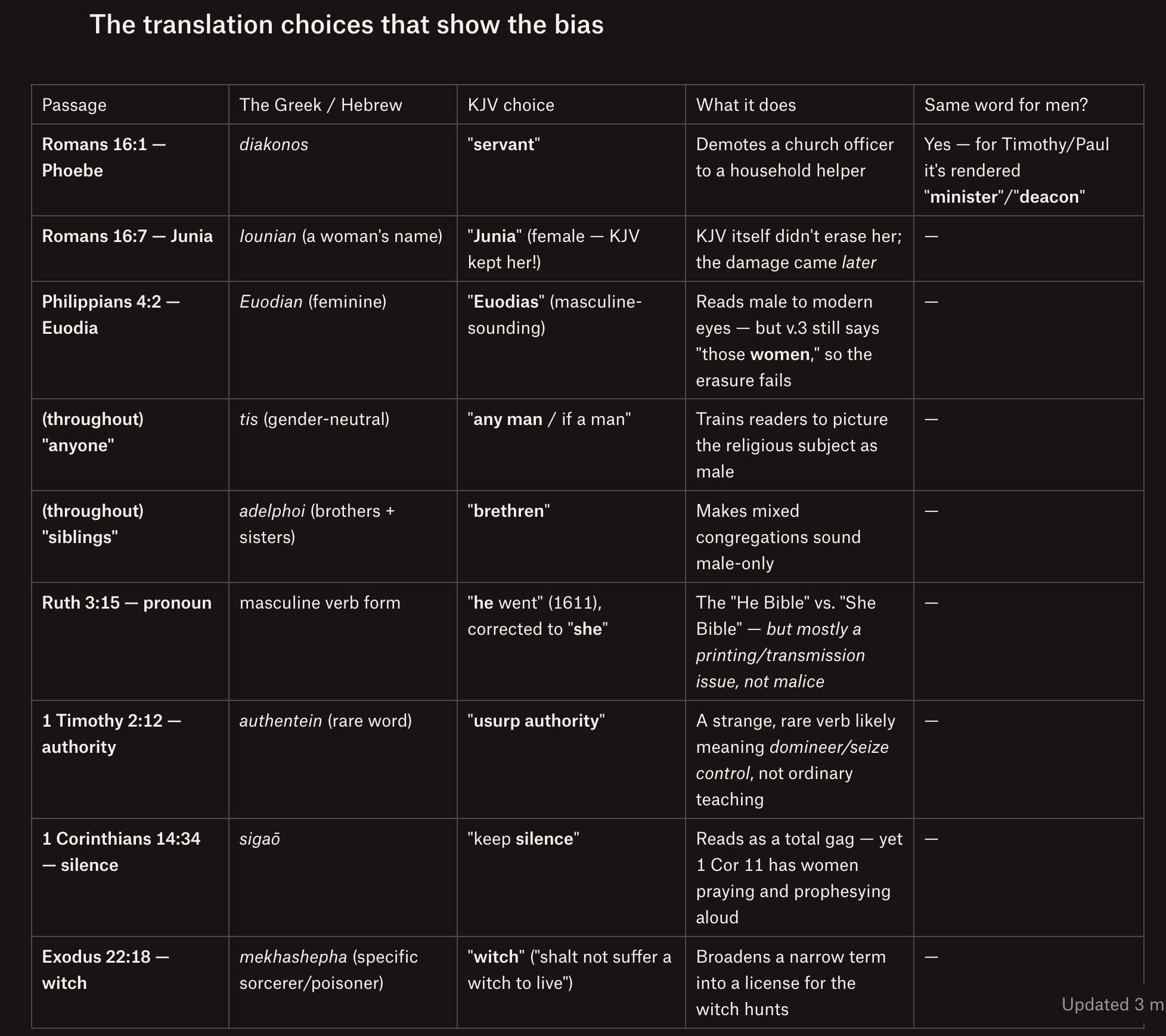
Phoebe (Romans 16:1) — this is the cleanest case. Paul calls Phoebe a diakonos of the church at Cenchreae. That same Greek word, applied to men like Timothy or Paul himself, gets translated with full official weight: minister, deacon. Applied to Phoebe, the KJV renders it servant — domestic, subordinate, deflated. Now, servant is technically one possible meaning of diakonos, so this isn't a fabrication. But the pattern is the bias: the same title sounds like an office when a man holds it and like housework when a woman does. Give her the word "deacon" and you've just contradicted James's state church, which barred women from ecclesiastical office. So she became a servant.
Junia (Romans 16:7) — and here's where I have to correct a popular overstatement. Paul greets Andronicus and Junia and calls them notable "among the apostles." Junia is a woman's name. A female apostle. And here's the part the memes get wrong: the King James Version kept her female. It says "Junia." The KJV did not turn her into a man. The masculinization — inventing the male name "Junias," a name with essentially no evidence in ancient Roman records — became common later, and the most striking erasure happened in the twentieth century. The 1952 Revised Standard Version actually changed her into the male "Junias" and called them "men of note among the apostles," because modern male scholars apparently could not conceive of a female apostle and assumed a copyist's error. The 1989 NRSV restored her. The ESV (2001) kept the name "Junia" but altered the grammar to "well known to the apostles" rather than "among them" — recognized by apostles, not one herself.
Sit with that sequence: 1611 keeps her, 1952 erases her, 1989 restores her, 2001 minimizes her again. If history were a staircase climbing toward enlightenment, that could not happen. It happens because the pendulum swings with whoever's holding it.
Euodia / "Euodias" (Philippians 4:2) — useful, but don't overclaim it. The KJV does spell this woman's name "Euodias," which reads as masculine to a modern eye. But the very next verse calls Euodia and Syntyche "those women which laboured with me in the gospel." So the KJV doesn't actually succeed in hiding her — it admits, a line later, that they're women who did gospel work alongside Paul. I'd use this not as a "woman turned into a man" example but as something better: even a translation produced inside a male monarchy and a male church could not erase the plain fact that Paul's coworkers included women.
The generic masculine — "any man," "brethren." The Greek tis means "anyone," "someone," with no gender attached. The KJV renders it "any man" or "if a man" hundreds of times. The Greek adelphoi literally means "brothers," but in addressing a mixed congregation it functioned like "brothers and sisters." The KJV gives you "brethren." No single one of these is a scandal — some of it is just how old English worked. But the cumulative effect is real and corrosive: drip by drip, readers were trained to picture the normal religious subject as a man and women as the exception, the footnote, the special case.
Ruth 3:15 — the "He Bible" and the "She Bible." I'll be honest about this one because the trolls will pounce if I'm not. One 1611 printing reads "he went into the city"; a corrected printing reads "she." Collectors still sort original folios into "Great He Bibles" and "Great She Bibles" on this single pronoun. It's a genuine gendered-pronoun episode — but it's mostly a story about manuscript transmission and a printing-house correction (the Hebrew verb form is masculine while the narrative points to Ruth), not about James personally masculinizing a woman. I include it for honesty, not as a centerpiece. Overclaiming it would weaken everything else.
"Women should be silent" — why that's a misreading, not a verse
Now the big one, the line I keep getting hit with: Paul said women should never speak. Usually it's 1 Timothy 2:11–12, sometimes 1 Corinthians 14:34–35.
The simplest refutation is internal. In 1 Corinthians 11, Paul straightforwardly assumes women are praying and prophesying out loud in the gathered church — and gives instructions about how, not whether. Three chapters later, 1 Corinthians 14 appears to tell women to be silent. Both can't be a blanket rule, or Paul contradicts himself within one letter. Even conservative interpreters concede that the "silence" language cannot mean literal muteness, precisely because it would collide with chapter 11. So scholars read chapter 14 as addressing disorderly interruption, or as Paul quoting and then rebutting a Corinthian slogan, or as a later insertion — but "women must never make a sound" is not the obvious reading, and it fights the rest of the text.
The Greek word behind "silence" in 1 Timothy 2 carries the sense of quietness, calm, non-disruptive learning — settledness — more than total speechlessness. There's a strange irony here too, the one about men "working in silence." The same culture prized male contemplative quiet as a virtue and turned female quiet into a cage: when a man is silent he is wise and weighty; when a woman is told to be quiet it becomes a standing rule about her place. Same word, opposite weight, depending on who it's aimed at — exactly like diakonos.
And the whole "women shut up" reading collapses the moment you list the women Paul actually names as doing the work: Phoebe the deacon and patron, Priscilla teaching Apollos in Acts 18, Junia connected to the apostles, Euodia and Syntyche laboring in the gospel. You don't get to flatten Paul into a gag order while Paul is busy thanking his female coworkers by name.
The detail that changes everything: Ephesus and the goddess
Here's the piece that turned my understanding upside down, and it's where I want to land the plane.
1 Timothy was not dropped into a neutral void. It was written to Timothy, who was in Ephesus — a city whose entire identity, economy, and prestige revolved around the cult of the goddess Artemis, whose temple was one of the Seven Wonders of the ancient world. In Acts 19, the city literally riots when Paul's mission threatens the Artemis trade. Christianity's challenge in Ephesus wasn't just one religion versus another; it was an upstart faith trying to displace an immense, civic, economic religious order built around a powerful female deity. The real wonder isn't only the temple — it's that Christianity managed to usurp it at all.
So read 1 Timothy 2 in that room. The rare Greek word in verse 12, authentein, is not the ordinary word for "have authority." It's unusual, and a strong line of scholarship argues it means something sharper — to domineer, to seize control, to assume authority improperly. The instruction may not be "women everywhere are unfit to teach men." It may be "in this Ephesian crisis, don't let people steeped in local goddess-myth teach falsely or domineer in the assembly." Even the famously bizarre line about being "saved through childbearing" snaps into focus here: Artemis was a goddess associated with protection in childbirth. To women who feared dying in labor and looked to Artemis for safety, the line may mean "you don't need the goddess to survive this — you can trust God," not "a woman's purpose is to produce babies." And Paul's appeal to Adam being formed first reads less like timeless biology and more like a direct counter to local traditions that put the female first.
That is the whole game. A specific, local, first-century corrective — aimed at a particular church in a particular goddess-dominated city, written in a contested word — got lifted out of its room, stripped of its context, and recast as a universal, timeless ban. Men in 2026 deploy it as if it fell from the sky pre-translated and bias-free. And women internalize it as if the silence were the voice of God, when it was the product of a translation history, a rare verb, a riot over a goddess, and four hundred years of institutional power deciding what the words were allowed to mean.
The other side of the same fear: witches
If you want proof that James's anxiety wasn't abstract theology but a live fear of uncontrolled female power, look at what else he wrote. In 1597 he published Daemonologie, a treatise on witchcraft — the only reigning monarch ever to author such a handbook. In it he argues that women are more easily ensnared by the devil because they are the "frailer" sex, descendants of Eve, easier prey.
It was personal. In 1589, sailing home from Denmark with his new bride Anne, his fleet was nearly sunk by violent storms. James became convinced a coven had conjured the weather to kill him. He personally presided over the North Berwick witch trials around 1590; under torture, an accused woman named Agnes Sampson allegedly repeated to him the private words he and Anne had spoken on their wedding night — and that broke his skepticism for good. In 1604, under James, England passed a harsher Witchcraft Act, pushing prosecutions into the ordinary courts.
The logic is the same logic as the Bible rules and the silence verses, just turned to a different target. James believed in the Divine Right of Kings — top-down, male, ordained by God. Witchcraft was, in his framing, high treason against God himself, a satanic inversion of the cosmic order. And who held the kind of power that frightened him most? Midwives, healers, herbalists, widows, independent women — people with decentralized, communal, unofficial, female-coded influence that answered to no bishop and no crown. To a king who needed everything to flow downward from the throne, that wild, lateral, women-held power was the enemy. The witch and the unsilenced woman and the female deacon are, in his cosmology, the same threat wearing different clothes.
Salem, 1692: the pendulum swings again
And it didn't stay in England. Drag the thread across the Atlantic and a century forward to Salem in 1692, and you watch the same machinery run again — proof that progress is not a direction but a tide.
It began with children accusing Tituba, an enslaved woman, then Sarah Good and Sarah Osborne — the poor, the marginal, the easy targets. Under magistrates John Hathorne and Jonathan Corwin, the absence of real evidence didn't slow anything down. Bridget Bishop, singled out partly for unconventional dress and behavior that grated against rigid Puritan codes, became the first executed. Before it burned out, more than 200 people were jailed and at least 19 hanged — fourteen women and five men — with Giles Corey pressed to death under stones.
There was a financial engine underneath the hysteria, and it rhymes with everything above. Historian Carol Karlsen, in The Devil in the Shape of a Woman, showed that a striking share of accused women in New England stood in an uncomfortable relation to property and inheritance — widows and daughters who stood to inherit land with no male heir to absorb it. Under the law of the time, a woman generally couldn't hold real estate unless it came to her for lack of a man, and a capital conviction could mean her property was seized and redistributed, often to her accusers' circle. (Giles Corey's refusal to enter a plea — which kept him from being convicted and so kept his land out of the colony's hands and in his sons' — is the exception that proves how the seizure logic worked.) I want to be careful here: Salem was not simply a land grab. It was also frontier-war trauma, family feuds, religious panic, and genuine fear. But property was one of the engines that made an accusation useful — and the "right" woman to accuse was so often the one without a man to protect her or her acreage.
And the two kings named James frame even this. James I was the intellectual grandfather of it: his 1604 Witchcraft Act became the legal template the colonies inherited, and his Bible's rendering of Exodus 22:18 — "Thou shalt not suffer a witch to live" — was treated in Massachusetts as a direct divine command (the underlying Hebrew word pointed at a specific kind of malevolent sorcery, but the KJV's blunt phrasing became a license). His grandson James II then revoked the Massachusetts charter in the 1680s; when he was overthrown in 1689, the colony was left in a legal vacuum with no settled government. Into that vacuum, in 1692, the accusations poured — with no legitimate authority in place to stop them. The hysteria ran unchecked partly because a king's grip on power had dissolved the institutions that might have contained it.
Why this matters in 2026
So here's where I end up, and it's the opposite of the staircase.
Go back far enough and the staircase story collapses entirely. The first author known by name in all of human history — the first person who ever signed a written work and said, in effect, I made this — was not a king or a prophet or a man of any kind. She was a woman: Enheduanna, high priestess at Ur, the very city Abraham would later leave, writing around 2300 BCE. And what did the first named voice in literature choose to write? Hymns of fierce, personal devotion to a goddess, Inanna. Thousands of years before Homer, before the Hebrew prophets, a woman was signing poetry to the divine feminine and putting her own name and her own anguish into the text. If history were a staircase, we would have climbed upward from her. Instead she was buried so completely that most people have never heard her name — while the man who merely authorized a translation got his stamped on the spine of the best-selling book on earth.
We're sold a story that history matures — that the New improves on the Old, that the present is wiser than the past, that translation marches steadily toward truth. But a woman named Junia was an apostle in the first century, an apostle still in 1611, a man by 1952, and a footnote again by 2001. Phoebe was a deacon in the Greek and a servant in the English. A local instruction to one goddess-haunted city became a universal muzzle. Women were named as Paul's coworkers in the same scriptures later used to silence their descendants. That is not progress and regression as accident. That is a pendulum, and the hand on it has almost always belonged to whoever needed women quiet to keep their own order intact — an insecure king, a male committee, a frightened colony, a man in a comment section.
Shakespeare, working in the same air, the same decade, under the very same king, chose to write Rosalind and Portia and Paulina and Cordelia — women who out-think, out-argue, and out-see the men around them. He proves the misogyny was never inevitable. It was a choice. It was always a choice.
And maybe that's why a film like Hamnet — quiet, female-centered, built around a grieving mother and a wife history had shrunk to a footnote — wins its awards and fills theaters in 2026. Or why Wicked takes the most famous "wicked" woman in popular culture and simply asks what the story looks like from her side. These aren't accidents either. They're the pendulum moving the other way: audiences hungry for the perspective the official version left out. The witch gets to speak. The wife turns out to be the most interesting person in the room. The point of view that power buried gets told at last — and people line up for it.
So when someone tells you in 2026 that the King James Bible is the one perfect, unbiased translation, and that Timothy settled forever that a woman must not teach a man — you can answer them with the history itself. No translation is neutral; this one was made under explicit royal rules designed to protect a male hierarchy. The "silence" was never muteness — Paul's own letters have women praying, prophesying, teaching, and leading. The verse they're quoting was aimed at one specific church in a city built around a goddess, and it hangs on a rare word that may well mean domineer rather than teach. And the very book they're holding kept a female apostle on its page in 1611 — it took later men, claiming the mantle of progress, to write her out.
The claim of a neutral translation isn't the absence of bias. It's the most powerful bias of all, because it's the one that hides. Name it, and it loses its grip.
—-
Here's the companion reference — a timeline, the rules, and the translation-choices table, with the modern corrections that exposed the manipulations.
The timeline (the order tells the story)
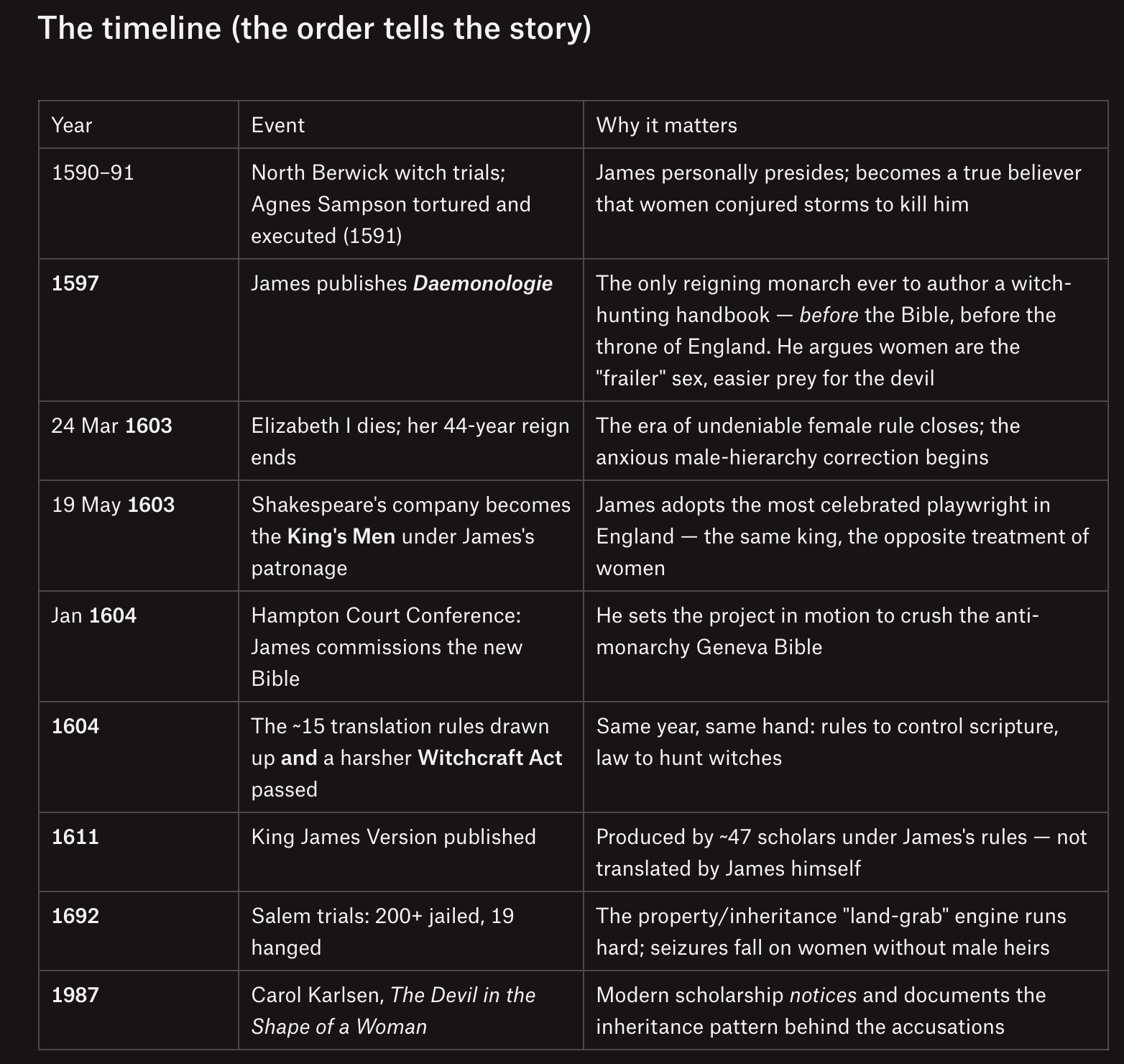
The sequence is the argument: he wrote the witch book first (1597), watched female rule end (1603), took the playwright (1603), then in a single year (1604) commissioned the Bible and sharpened the witch law. This was not a man stumbling into bias. He was deliberately shaping the frame.
The rules: ~15 instructions to lock in his framing
James didn't issue a rule saying "subordinate women." He did something more durable — he controlled the framing so the existing male hierarchy survived intact. The most telling of the roughly 15 rules:
Rule 1 — Follow the old Bishops' Bible; change as little as possible.
Rule 3 — Keep the "old ecclesiastical words" (church, never congregation).
Rule 6 — No argumentative margin notes (this killed the anti-monarchy Geneva notes he hated).
Rule 14 — Use earlier translations only where they fit the Bishops' Bible better.
The point: by freezing the old church order in place, he preserved a system that already excluded women from authority. The rules prove intent — he knew that controlling vocabulary, notes, and source text would control what the book was allowed to mean.
The translation choices that show the bias
Modern revelations — where these turned out to be manipulations
Junia's accent mark. Ancient Greek was written without accents. Later editors added a masculine accent to turn the woman "Junía" into the invented man "Junías." Eldon Epp's Junia: The First Woman Apostle (2005) showed that the male name has essentially no evidence anywhere in the ancient world, and that the early church (e.g., Chrysostom) plainly read her as a woman. The 1952 RSV masculinized her to "Junias"; the 1989 NRSV restored "Junia"; the 2001 ESV kept the name but reworded it to "well known to the apostles." A female apostle was real in 1611, erased by 1952, restored by 1989, minimized again by 2001 — regression, not progress.
Phoebe's title. Scholars now widely agree diakonos here means deacon/minister, the same office word used for men. The NRSV and others restored "deacon." "Servant" was a choice, not a necessity.
The rare verb authentein. Studies by Linda Belleville, Cynthia Westfall, and others show this word carries the sense of domineering or usurping, not ordinary teaching authority — which collapses the "women may never teach" reading.
The internal contradiction nobody can resolve. 1 Corinthians 11 has women praying and prophesying in church; 1 Corinthians 14 says they should be silent. Both can't be a blanket rule — so the "silence" verse is now widely read as addressing disorder, a quoted slogan, or a later insertion.
Other notes from a troll:
The bible he's calling perfect and untouched was produced under ~15 royal rules designed to protect a specific hierarchy, and its own translators said other translations were valid. "Neutral" is the claim, and it's the weakest one he's got.
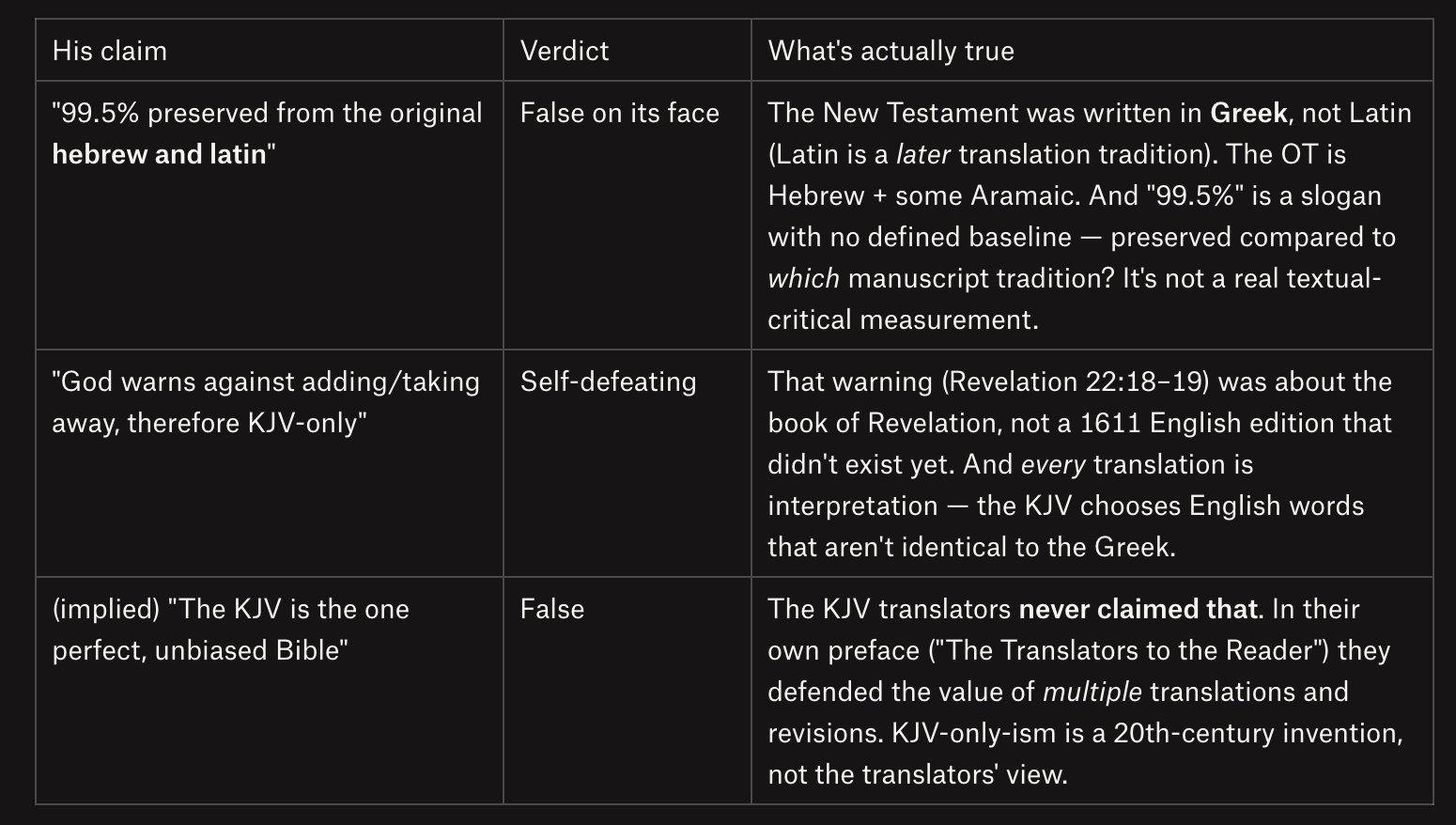
These hold up no matter how hard he pushes:
Phoebe (Romans 16:1). Same Greek word, diakonos — rendered "minister"/"deacon" for men, but "servant" for her. Cleanest single example of gendered softening.
The "silence" double standard (image 7 — this one's excellent). In 2 Thessalonians 3:12 men are told to work quietly (hēsychia); the same root applied to women in 1 Timothy 2:11–12 becomes "silence." Same word, opposite weight by gender. (Note: 1 Corinthians 14:34 uses a different word, sigaō — don't merge them.)
"Help meet" / ezer kenegdo (image 3 — solid). It never meant "subordinate assistant." Ezer is used elsewhere for God as rescuer. A corresponding ally, not a sidekick.
The ~15 rules (image 8 — accurate). Banning Geneva's notes (Rule 6), keeping "church" not "congregation," stripping politically radioactive words — engineered to teach readers to obey God, honor bishops, and stay loyal to the Crown.
No translation is neutral, and the KJV translators said so themselves.
This one is just for fun: El Shaddai = "God with breasts", KJV shattered it into a militaristic Almighty. Most scholars link Shaddai to "mountain" (Akkadian šadû) or an unknown ancient title. BUT, "Breast" (shad) lends some interesting context to the word. God with lumps. Lady lumps perhaps?
Resources:
For an academic exploration of the intersection between early modern political transitions, gender roles, and biblical translations, look into these foundational texts:
1. 1611: Authority, Gender and the Word in Early Modern England by Helen Wilcox ($75!!!)
This book analyzes the monumental literary year of 1611. It looks at the publication of the King James Bible alongside secular drama to explore how language, gender anxieties, and political authority were being systematically renegotiated right as Shakespeare was finishing his career. [1]
The Reality: Published by Wiley-Blackwell. It retails between $73 to $102 for physical copies because it is designated as an academic library textbook.
Budget Access: You can legally view, rent, or read individual digital chapters online via the Wiley Online Library or find a digital rental on VitalSource. [1, 2]
2. The Daughter's Seduction: Gender and Genre in Jacobean Tragedy by Lynda E. Boose
The Past Tense of Gender on the Early Modern Stage
This text offers an extensive look at how the shift from Queen Elizabeth to King James changed family dynamics on the stage. It specifically breaks down how Jacobean tragedies began systematically punishing daughters and wives to reinforce the absolute authority of the household patriarch.
This is a seminal academic journal essay, not a standalone book. It was published in the journal Theatre Journal (1986). You can read it completely for free with a basic personal account on the academic digital vault JSTOR.
3. Manhood and Masculinity in Shakespeare's Tragedies by Jennifer Feather
This book explores how the definitions of gender, power, and violence transformed in Shakespeare’s later works. It tracks how the psychological trauma of characters like Hamlet and Macbeth reflects the broader societal pressures of King James's hyper-masculine, authoritarian state.
This is an academic research paper and review series. You can find her foundational breakdown on Shakespearean patriarchal fractures published via Wiley's Literature Compass. [1]
4, Shakespeare and Masculinity, by Jennifer Feather
The peculiar challenge posed by studying Shakespearean masculinity is its resistance to inquiry. Patriarchal ideologies function precisely by taking a specific form of male power, the power of the father, as neutral, given and, therefore, not an available object of study. Scholars have faced this challenge by examining masculinity at those very moments when it falters and fractures. The study of Shakespeare's male characters has an extensive history, and for much of that history, these characters were interesting and significant because they told us something about mankind, about human beings in general. Examining masculinity rather than men, scholars rethought the study of maleness as a feminist project and made a fertile space for historical study that draws out the contours of manliness in all its historical specificities. Such study lays the groundwork for new analyses that interrogate the association between masculine attributes and culturally valued forms of self. These analyses do more than simply question the dominance of men but propose alternative ideas of the masculine and alternative forms of human flourishing.
Accessible, Affordable Alternatives ($15 – $30)
If you prefer physical books that you can buy easily on standard platforms without university-press price tags, these three trade books handle the exact same ideas:
1. Shakespearean Tragedy and Gender by Shirley Nelson Garner & Madelon Sprengnether
The Focus: This book explicitly studies how Shakespeare's major tragedies systematically isolate, mute, and destroy female authority to elevate the tragic male hero. [1]
Availability: Widely available in paperback and open digital formats. You can read it directly for free online via the open-access portal OAPEN Library. [1, 2]
2. Will in the World: How Shakespeare Became Shakespeare by Stephen Greenblatt
The Focus: A beautifully written, highly accessible biography. Chapter 11 focuses heavily on the death of Shakespeare's son, Hamnet, and how that devastating loss fundamentally shifted his psyche out of lighthearted comedies into the deep trauma and grief of Hamlet.
Availability: A massive bestseller. You can find paperback copies anywhere for under $18.
3. The Daughter's Tragedy: Gender, Family, and State in Shakespeare by Ruth Nevo
The Focus: This book tracks how early modern family dynamics shifted on stage under James I, examining daughters caught in the crosshairs of intense patriarchal control.
Availability: Readily found on used book sites like ThriftBooks or AbeBooks for around $15 to $20.