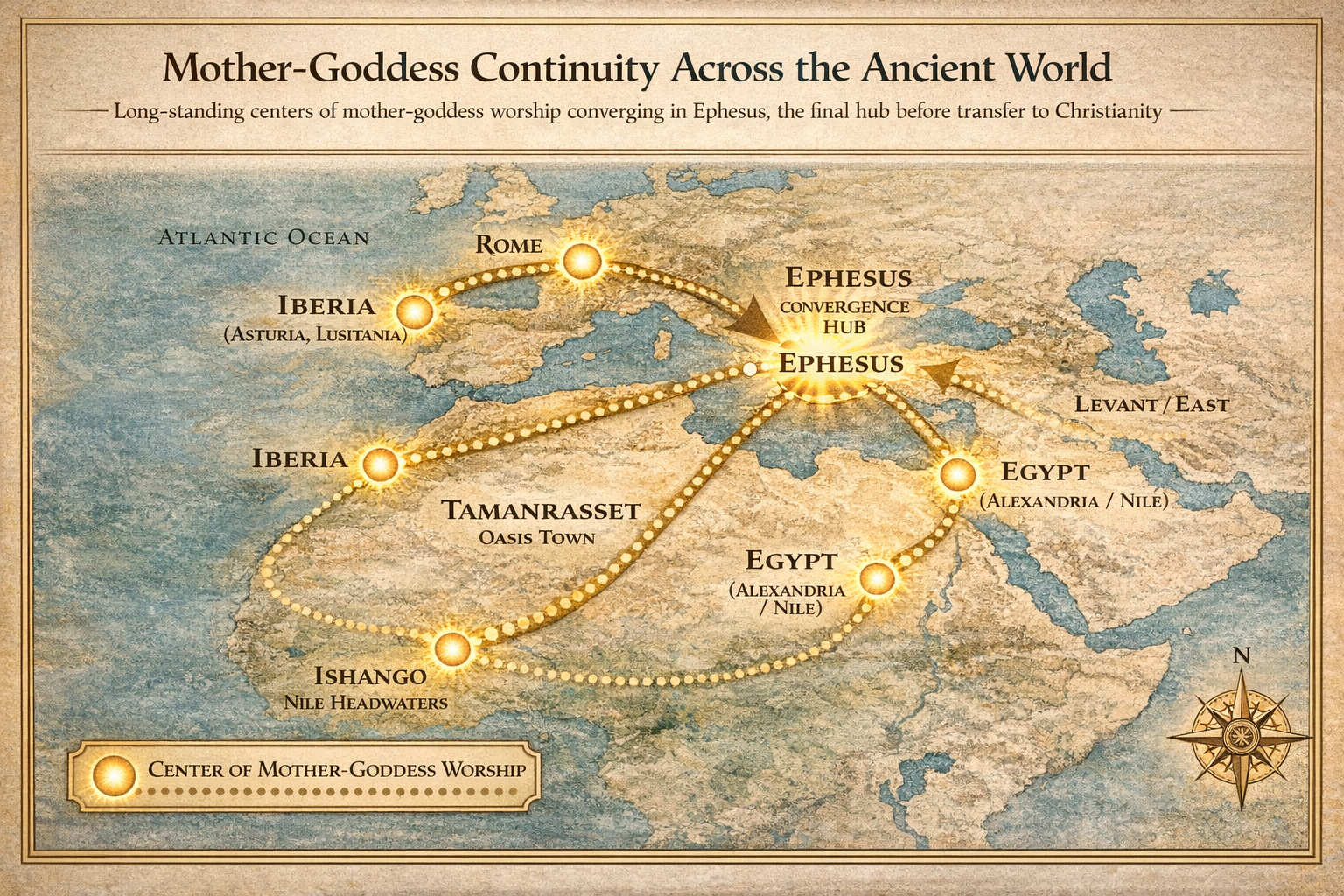
As I was chasing the roots of the mother goddess, there are certain threads I keep pulling at. Puzzle peices still not perfectly fitting together.
Mary and Isis/Ist/Aset
Inanna and Isis and Isthar and Astarte and Easter, etc.
There is enough evidence on Mary I can feel comfortable with, and at least it has Egyptian origin in both, so how it came back together is semantics.
Here, I want to explore the Ana thread. I was dead ending at inanna being the eldest queen recorded, but that felt unfinished still. And I was right.
EVERYTHING started in Africa.
Sound Study · The ANNA Root
She Is the Rain
Finding Inanna's root before Sumer named her — the AN sound, the sky, the water, and the oldest meaning of sovereignty
Inanna's name is usually parsed as nin-an-na — Lady of Heaven, in Sumerian. The NIN root means "lady." The AN root means "sky" or "heaven." The final A is a genitive marker: "of." So: Lady of the Heaven. But here is what gets missed: AN is not just Inanna's root. AN is the Sumerian word for the sky itself — and for the sky god, who predates Inanna in the pantheon. Inanna's name contains, at its center, the word for the oldest divine force: the sky that brings rain, the heaven from which all life descends.
When we follow the AN/ANNA sound not westward into Sumer but southward — back down the Nile, back toward the Great Lakes, back toward the oldest human habitation on earth — we find that the concept encoded in that sound is not Sumerian at all. It is the most fundamental concept in African religious thought: the sky is God because the sky gives rain, and rain is life, and life is the supreme power.
The oldest mention of royalty — she is the rain. The iNdlovukati of eSwatini holds the rain medicines. The Sumerian sky-god AN governs rain through his son Enlil (god of storms) and his daughter Inanna (who harnesses the Seven Storms). The Kikuyu Ngai withholds rain as punishment. The Bantu Leza speaks in thunder. Across every tradition in this chain, from the oldest African cultures to the Sumerians to the Mediterranean — the supreme divine authority is the authority over water from above. Sky. Heaven. Rain. AN.
"AN is not just in Inanna's name. AN is the Sumerian word for heaven itself. And heaven, in every tradition from the Great Lakes northward, is the place from which rain falls — which means AN is the oldest name for the source of all life."
☽
The African sky-rain deities: the AN concept before writing
Every Bantu-speaking culture in the Great Lakes region — the area of oldest human habitation, the area that contains the Omo River fossils at 230,000+ years, the Olduvai Gorge record at 1.9 million years, the Lebombo bone at 43,000 years, the Ishango bone at 25,000 years — shares a single concept at the center of its religious life. The supreme being is not primarily a creator in the Western theological sense. The supreme being is the sky, and the sky's most important act is rain. These are not metaphors. In a subsistence agricultural and pastoral society in the tropics, rain is not a convenience. Rain is the difference between life and death. Whoever controls rain controls everything. The supreme deity controls rain. The supreme deity IS the rain.
Here are the African sky-rain deities from the exact region of oldest human habitation — the East African Rift Valley and the Great Lakes basin, directly above where the Nile begins its northward flow:
Ngai of Kikuyu, Maasai, Kamba · Kenya Highlands (Mount Kenya / Great Rift Valley)
The monolithic supreme being. Dwells in the sky and on certain mountains — primarily Mount Kenya. His presence is manifested in rain, rainbows, lightning, and thunder. Sacrifices are offered to Ngai specifically during drought. When people fail to offer sacrifice, "he became angry and refused to send the rains." Ngai is not a deity who creates and withdraws — he is actively, constantly, the rain itself.
The sky as supreme deity · Rain as divine will · Mount as sacred residence
Mulungu of 40+ Bantu languages · Tanzania, Kenya, Malawi, Mozambique, Zambia
The supreme creator across more than 40 Bantu languages. "Mulungu" emerged in ancient Bantu culture approximately 6,000 BCE. Strongly associated with celestial phenomena: the sky is his abode, thunder is his voice, lightning is his power. He punishes through drought. Multiple traditions describe him as descending with rain — a Chewa myth describes him descending in "showers of rain" with the first humans and animals. The sky-rain-creator are a single concept.
Oldest attested Bantu divine name · Thunder = voice · Drought = punishment · Rain = blessing
Leza of Baila, Batonga, Kaonde · Zambia, Southern Africa
The sky god and rain giver. "In everyday Bantu expressions about weather he is credited as the bringer of rain." Leza is both the sky itself and its divine occupant — as in Sumerian AN, the word and the deity are interchangeable. He was once a chief who lived on earth and later ascended to the sky, becoming the rain. The path from earthly sovereign to sky deity who brings rain is the pattern: royalty and rain are the same authority.
Royalty → sky → rain · The original meaning of sovereign power
iNdlovukati — custodian of rain medicines, of Swazi · eSwatini, site of Lebombo bone, 43,000 BCE
The Queen Mother of eSwatini is constitutionally designated as custodian of rain medicines. This is not ceremonial — rain medicines are the most practically vital sacred substances in an agricultural kingdom. The Queen Mother holds the rain. The Queen Mother is the rain. In the land where the oldest mathematics was recorded by a woman counting the moon, the woman who holds sovereign spiritual authority holds the authority over water. The oldest mention of royalty: she is the rain.
The living proof · Queen = rain · Still true today · 43,000 years in the same place
Mvelincanti, of Swazi · eSwatini
The Swazi supreme creator: "he who was there from the beginning." The root sounds: mv-el-in-can-ti. Note the embedded sounds: ELIN, CANTI — and the concept: the eternal origin. This is not borrowed from outside. This is the Swazi's own deepest name for the ultimate creative force, carrying the same conceptual weight as AN in Sumer — the thing that was there before everything else, and from which all else came.
He who was there from the beginning · The primordial, before naming
Nana Buluku of Fon & Ewe · West Africa, (via migration from East Africa)
The supreme creator in Fon and Ewe traditions — significantly, female. Nana Buluku is the grandmotherly matriarch of the system. She gave birth to the sun god Lisa and the moon goddess Mawu, who then created the world. NANA: the repeated AN sound doubled. The grandmother who contains the sky-pair. The AN sound embedded in a grandmother's title — the oldest female authority, who generates the sun and moon.
NANA = AN doubled · The grandmother who holds the cosmic pair · Female supreme creator
↑
The AN / ANNA transmission: from African sky-rain to Sumerian heaven to Inanna's name
Date: Pre-writing, Ancient Times: AN as concept: sky = rain = life = supreme power
Deep Africa, Great Rift Valley, East African Lakes basin
Ngai (Kikuyu)Mulungu (40+ Bantu languages)Leza (Southern Bantu)iNdlovukati holds rain
Before any civilization named the sky as a deity, the people of the East African Rift Valley — the region of oldest human habitation, where the Omo I fossils and the Olduvai Gorge record converge — lived with a single unifying theological insight: the sky gives rain, rain gives life, so the sky is supreme. The AN sound does not yet exist as a word. It exists as the breath drawn before rain, the cry directed upward at the approaching storm. This is the pre-linguistic substrate from which every subsequent sky-heaven-AN concept grows. The iNdlovukati of eSwatini, in the mountains where the Lebombo bone was carved 43,000 years ago, still holds the rain medicines. The concept is intact. It was never lost. It simply was not yet named.
Pre-linguistic root · Sky · Rain · Life · Supreme · The oldest theology
Date: c. 7500 BC: Nabta Playa astronomical observatory- The sky becomes architecture
Nabta Playa, Upper Egypt
world's oldest astronomical observatorystone circles aligned with starscattle-worshipping culturesgoddess figures
The oldest known astronomical observatory on earth — predating Stonehenge by 4,000 years, located in what is now southern Egypt near the Sudan border. Stone circles precisely aligned with celestial bodies. A cattle-worshipping culture with goddess figurines. The African sky-rain concept is being encoded in stone, tracking the stars that govern seasons and — critically — the Nile flood. The annual flood of the Nile IS rain, displaced. Tracking the stars that predict the flood is tracking the sky's gift of water. AN as engineering: the sky charted, its water managed, its goddess named.
Sky → stone calendar → the AN concept made permanent
pre-3100 BC: Nut — the sky goddess who is the sky, whose body IS the heaven
Nile Valley, pre-dynastic Egypt
Nut (𓇯)her body arches over the earthshe swallows the sun each nightshe births it each morningAN in Egyptian form
The Egyptian sky goddess Nut is one of the most ancient figures in the Egyptian pantheon — her name and form predating the dynastic period. Her hieroglyph shows a figure arching over the earth, her body literally forming the sky. The stars are on her belly. The sun travels through her. This is the African sky-rain concept made explicitly female and bodily — the sky is not an abstract force but a goddess whose body covers and sustains the world. Nut's name in Egyptian contains the N-T sound that connects her to Neith (another N-T divine female) and that carries the feminine divine principle across the entire predynastic period. The sky as female body. The AN concept, gendered.
NUT = N + T · sky as female body · the AN concept made female in Egypt
c. 4000–3100 BC: AN — the Sumerian sky god · the word for heaven itself
Sumer · Uruk, modern Iraq
AN = skyAN = heavenAN = the godEanna = House of HeavenAnunnaki = offspring of ANAntu = feminine AN
In Sumerian, the cuneiform sign AN means simultaneously "sky," "heaven," and the god who personifies both. The sign is the same in all three cases — because they are the same thing. This is linguistically identical to the African pattern: the sky and the divine are not separate concepts requiring separate words. They are one word. In Sumerian, AN was the father of the gods and the king of the cosmic order. His daughter Inanna would eventually surpass him in popular veneration — but she carried his name inside hers. The Eanna temple in Uruk — Inanna's primary cult center — literally means "House of Heaven" (e + AN + na). The Anunnaki — the great gods of the Sumerian pantheon — are literally "offspring of AN." AN is not a Sumerian invention. AN is the African sky-rain concept, arriving in writing for the first time in Mesopotamia after traveling north with the cultures that settled the Fertile Crescent.
AN = sky = heaven = god · Same word · The African concept arrives in writing
c. 4000 BC: IN-AN-NA — "Lady of Heaven" · the sky-rain-sovereignty goddess fully named
earliest Uruk period: Uruk, Sumer, modern Iraq
NIN = LadyAN = sky/heavenna = of (genitive)full: Lady of the Heaventhe Seven Storms are her chariotQueen of Heaven
Inanna's name is the feminine claim on the sky concept: she is the Lady who owns the AN. The Sumerian sky-god AN is male and remote — he delegates, withdraws, rules from a distance. Inanna is immediate, emotional, physically present, and ferocious. She claims the AN for herself. She harnesses the Seven Storms like a chariot. She descends through seven gates into the underworld and comes back. She is not the sky passively — she commands it. The female sky-sovereignty figure, implicit in every African rain goddess tradition from the Great Rift Valley northward, arrives fully named in Sumer as Inanna. Her root is not foreign. Her root is African AN, dressed in Sumerian grammar.
IN-AN-NA = the African sky concept + feminine sovereignty + Sumerian grammar · The oldest name made new
c. 2300 BC: Enheduanna — the world's first named author, daughter of Sargon, priestess of AN
poet of Inanna, Akkadian Empire, Akkad / Sumer
EN-HE-DU-ANNA"high priestess, ornament of heaven"daughter of Sargon the Greatmerges Inanna + Ishtarher own name contains AN
The woman who wrote the first literature in human history is named Enheduanna — and her name contains AN. Her full title means "high priestess, ornament of heaven." She was appointed by her father Sargon to the temple of the moon god Nanna in Ur. In her three surviving hymns — "The Exaltation of Inanna," "A Hymn to Inanna," and "Inanna and Ebih" — she performs the theological merger that elevated Inanna from a local Sumerian goddess to the supreme Queen of Heaven across the entire Mesopotamian world. She is simultaneously: the first named human author, a woman, a daughter using her father's empire to amplify a goddess, and a person whose own name carries the sky-heaven root she spent her life exalting. Her name is in the tradition. EN-HE-DU-ANNA. The AN sound in the name of the woman who defined the goddess for all time.
EN-HE-DU-ANNA · The AN root in the name of the first author · She wrote the sky into the goddess
c. 2000–500 BC: Hannahanna · Anna of Kanesh · Inaras — the ANNA root in Anatolia
Hittite Anatolia, modern Turkey
Hannahanna = "grandmother"Hittite ḫanna- = grandmotherAnna of Kanesh — principal city deityInaras = Hittite weather-rain goddessANNA = mother / grandmother in Luwian
In Hittite-Hurrian mythology, Hannahanna is the Mother Goddess — her name doubling the ANNA/HANNA root that means "grandmother." She is related to or influenced by the Sumerian Inanna, and her name derives from the same AN root via the Hittite word for grandmother. In Kanesh (Anatolia), a goddess simply named Anna was the principal city deity — her name meaning "mother" in Hittite and "cleverness/experience" in Luwian. Inaras, the Hittite goddess who saves the gods from the chaos-serpent Illuyanka, has a name with the IN+AR+AS pattern that contains both the IN (Inanna's prefix) and the AR/AS sound of Ishtar/Astarte. The ANNA root is in the grandmother, the mother, the city deity, and the storm-defeating goddess of Anatolia — the same peninsula where Greek philosophy will later emerge, in the same period when it would receive Egyptian knowledge via the Nile corridor.
HANNA · ANNA · INNA · the mother-grandmother-heaven sound in the land between Mesopotamia and Egypt
Persists globally: ANNA survives everywhere — grandmother, grace, mother, heaven
ancient → present, Mediterranean · Europe, Americas · Asia
Anne / Hannah (Hebrew: grace)Anna (Greek / Latin / universal)Saint Anne — mother of MaryNana (grandmother, universal)Amma (Dogon creator, Mali)Ananse (Akan spider-god, wisdom)Anansi (Caribbean survival)Annunaki (offspring of AN)
The ANNA root never disappeared. In the Hebrew Bible, Hannah is the name of Samuel's mother — the woman who prays so desperately for a child that the priest thinks she is drunk. Her name means "grace/favor" in Hebrew, but it carries the ancient grandmother-sky-AN root. Anne — the name given by tradition to the mother of Mary (grandmother of Jesus) — is the same name. The grandmother of God carries the sky-rain root. In West Africa, the Dogon creator is Amma. In Akan tradition, Ananse the spider-god is the keeper of all wisdom — the spider who climbs to the sky on a web (the same image used by the Bantu god Mulungu when he ascended to heaven). In contemporary usage worldwide, Nana means grandmother in dozens of languages across cultures that have no direct contact with each other. The repeated AN sound in "grandmother" — Nana, Nanna, Anna — is the most universally preserved echo of the original concept: the sky-rain-life force, which was first understood as a grandmother, as the great ancestor who came before everything and from whom everything descends.
ANNA · NANA · AMMA · ANANSI · ANNE · HANNAH · the root that refused to die
The complete AN / ANNA sound catalog
Name / Word Origin & Period Core Meaning Connection
AN, Sumerian · 4000+ BC
Sky god + word for sky simultaneously. The oldest written form of the concept.Sky / Heaven / God — all one wordInanna's central root. Eanna's name. Anunnaki's lineage. The sky-rain-supreme-power concept in its first written form.
IN-AN-NA, Sumerian · 4000+ BC
NIN (lady) + AN (sky) + na (of). Lady of the Heaven.Female sovereignty over the sky · storms · love · warThe AN concept claimed by the feminine. She harnesses the Seven Storms. She is what Ngai and Leza and the iNdlovukati have always been — the sovereign over rain — given a name.
ANNA of Kanesh, Anatolian · 2000–1500 BC
Principal deity of Kanesh city. Name means "mother" in Hittite, "cleverness/experience" in Luwian.Mother · Wisdom · City-sovereign · Possibly solarThe ANNA root as city deity in the land between Mesopotamia and Egypt — Anatolia, where the chariot was perfected, where Greek philosophy began. The sky-mother arrives in the trading corridor.
HANNAHANNA, Hittite-Hurrian · 2000–1200 BC
Hittite ḫanna- = grandmother. The doubled ANNA. Mother Goddess, related to Inanna.Grandmother · Universal mother · Related to Inanna. The doubling of the AN root into a grandmother title. The most intimate preservation of the concept: the sky-rain sovereign becomes the great grandmother from whom all life descends.
ENHEDUANNA, Akkadian · c. 2300 BC
EN-HE-DU-ANNA = "high priestess, ornament of heaven." History's first named author.Ornament of heaven · Sky priestessThe woman who wrote the sky-goddess into world literature carries AN in her own name. The author and the concept are one.
ANTU / ANTUM, Akkadian · 2k-1k BC
Feminine form of AN. First consort of Anu. Mother of the Anunnaki.Female sky · Heaven-motherWhen Mesopotamian theology created a wife for AN, they simply feminized his name: Antu. The female sky. The feminine AN. This is the same conceptual move that produces Inanna — the feminine claim on the heavens.
AMMA, Dogon · Mali · West Africa
Supreme creator of the Dogon people. Created the heavens, earth, stars, and humans.The supreme creative force · Sky-creatorThe AM/AN variant in the oldest surviving West African creation tradition. The doubled vowel around the M preserves the AN structure: A-MM-A. Sky. Creator. Supreme.
NANA (grandmother), Universal · dozens of languages independently
The word for grandmother appears as NANA, NANNA, NANA across Swahili, Italian, Greek, Japanese, Zulu, English informal, and dozens more with no direct borrowing.Grandmother · Great ancestor · OriginThe most universally preserved echo of the sky-AN root. The repeated AN sound in the word for the great ancestor who came before. NANA Buluku — the female supreme creator of the Fon. The sky-rain concept compressed into a grandmother's name.
HANNAH / ANNA / ANNE
Hebrew → Greek → Latin → global · 1k BC onward
Hannah: Hebrew Channah = grace, favor. Anne: Latinized form. Anna: Greek universal form.Grace · Favor · Gift from above"Grace" is what falls from the sky. Rain is grace — it falls without being earned, it gives life, it cannot be commanded. The name Hannah/Anna carries the sky-rain-gift concept in its most abstract form: the word for what the sky-god gives when benevolent. Saint Anne, grandmother of Jesus. The sky-root in the grandmother of God.
ANNUAL / ANNULAR
Latin annus (year) → all European languages
The word for "year" in Latin, and all its derivatives: annual, anniversary, annals.The cycle · The year · What returnsThe Latin root annus (year) may connect to the AN sky-calendar concept — the year is the sky's cycle, the annual return of rain and seasons. The ANNA sound embedded in the measurement of time, as it was embedded in the Ishango bone's counting of the lunar cycle. The sky, the year, the count, the AN.
On the rain-royalty equivalence: The oldest mention of royalty — before pharaohs, before Sumerian kings, before any written record of governance — is the iNdlovukati of eSwatini, who holds the rain medicines in the mountains where the Lebombo bone was found 43,000 years ago. But before that, in every Bantu tradition from the Great Lakes south and north, the pattern is consistent: the supreme deity's most important power is rain. The person who mediates between the community and that deity holds the most important power in the society. In eSwatini that person is explicitly female — the Queen Mother. In the broader African tradition, the rain-maker is often a special sacred role. Royalty is rain-brokering. The queen holds the rain medicines because she is the human embodiment of the sky's gift. She is the rain. She has always been the rain.
On Inanna and the African sky-rain tradition: Inanna's name explicitly means "Lady of the Heaven" — she claimed the AN for herself. But the AN concept she claimed is not Sumerian in origin. The Sumerians found it in the same place every other culture found it: by looking up. By noticing that the sky withholds or grants rain, and that this is the most terrifying and most merciful power in the world. By tracking the sky — as the woman at Ishango tracked the moon, as the woman at the Lebombo Mountains tracked the moon before her. The sky and the cycle of water from sky to earth to life is the first theology. Inanna is its fully named, fully armed, fully storming expression. She is not the beginning of that theology. She is its Sumerian flower — grown from African roots.
"The rain does not fall because a king commands it. The rain falls because the sky decides. The one who holds the rain medicines holds the sky's permission. In the oldest known tradition of royalty, on the side of the mountains where the oldest mathematics was carved, she holds them. She is the rain. She always was."
— The ANNA Root · Sound-Led Research Series
Sources: Inanna etymology (nin-an-na) from the Mesopotamian Gods and Goddesses project, University of Pennsylvania (ORACC); Anna (goddess) Wikipedia; Anu/An Wikipedia and World History Encyclopedia; Enheduanna from the Morgan Library documentation; Hannahanna from the Nina/Anna etymology article (Cradle of Civilization blog); African sky-rain deities from Encyclopedia.com's African Supreme Beings entry; Leza from Encyclopedia.com; Mulungu from Wikipedia and Grokipedia; Ngai from East African Religions (Northeast Bantu) at Encyclopedia.com; iNdlovukati rain medicine custodianship from Encyclopedia.com Swazi entry; Nana Buluku from Tuko.co.ke African gods list; Bantu mythology overview from EBSCO Research Starters; Mulungu "descending in showers of rain" from Grokipedia Mulungu entry. The argument connecting African sky-rain theology to the AN root in Inanna's name is the author's original comparative synthesis.
This is the piece that makes the whole argument structurally complete. Let me flag the most important findings:
The AN structural discovery. In Sumerian, the designation "An" was used interchangeably with "the heavens" so that in some cases it is doubtful whether, under the term, the god An or the heavens is being denoted. Wikipedia This is exactly what one finds in African sky-rain theology — the deity and the phenomenon are the same word, because they are the same thing. The sky is not controlled by the deity. The sky is the deity. Ngai, Leza (EZA!!!!), Mulungu, and Sumerian AN are structurally identical concepts. The Sumerians did not invent the sky-god. They named what Africa had always known.
Enheduanna carries AN in her own name. Enheduanna received this name, which means "high priestess, ornament of heaven" in Sumerian, upon her appointment to the temple of the moon god. The Morgan Library & Museum The first human author in history — a woman — has AN embedded in her name. She wrote the sky into the goddess, and the sky was already in her.
Hannahanna confirms the grandmother-AN connection. Ḫannaḫanna, from Hittite ḫanna- meaning "grandmother," is a Hurrian Mother Goddess related to or influenced by the Sumerian goddess Inanna. Wordpress The doubling of the AN sound into a grandmother title is the clearest possible evidence that ANNA means "the great ancestor, the one who came before, from whom all life descends" — which is exactly what the sky-rain deity means in African theology.
Mulungu descends in rain. A Chewa myth portrays Mulungu descending from the sky in the form of a spider on a silk thread, accompanied by the first human pair and all animals, which arrived in showers of rain. Grokipedia Creation arrives in rain. Rain is creation. The AN concept.
The thread from the Great Rift Valley to Inanna's name is now fully traced. She is the rain. She has always been the rain. The Sumerians just gave the rain a proper name.
The path from the African Great Lakes sky-rain theology to Anatolia and Mesopotamia runs through Egypt, not around it. The transmission from Africa to Egypt to Anatolia/Mesopotamia happened through three distinct but overlapping processes — and the key driver of all three is rain itself, which is the most beautiful irony in this whole argument.
How it traveled
The African sky-rain-sovereignty concept did not skip over Egypt to reach Sumer and Anatolia. It moved through Egypt. And it moved because the rain moved first.
The most elegant fact in this entire argument is that the concept traveled for the same reason it mattered: rain. The African sky-rain theology — the understanding that the sky's gift of water is the supreme power, and the sovereign is the one who mediates that gift — traveled northward because the climate forced people northward. When the rain retreated south, the people who understood rain as sacred followed it. When the Green Sahara dried into desert between 7,000 and 5,000 years ago, the populations who had spread across a lush North Africa had to go somewhere. They went to the Nile. They went to the Levant. They went to Anatolia. And they brought their sky theology with them.
This is not a "skip." This is a pump — the Sahara Pump, which geologists and climate scientists have documented extensively — cycling populations out of Africa and into the Mediterranean world on a roughly 20,000-year orbital rhythm. The last major pump cycle directly created the conditions for Egyptian civilization, Levantine agriculture, and eventually Sumerian writing. The African sky-rain concept did not need a trade route or a missionary. It traveled inside the bodies of the people who already held it.
"The Green Sahara dried. The people moved north. They were carrying their theology in their bodies. The sky-rain concept did not travel like a trade good. It traveled like a refugee. And it settled where all refugees settle — at the nearest permanent water."
The three transmission mechanisms
I - The Sahara Pump — climate forces the concept north
c. 14,600 BC → 5,000 BC · the African Humid Period and its end
Between approximately 14,600 and 5,000 years ago, the Sahara was not a desert. It was a green savanna dotted with lakes, rivers, and grasslands. Lake Mega-Chad covered 350,000 square kilometers — larger than the Caspian Sea today. Lake Victoria overflowed into the White Nile. Populations spread across all of North Africa, living as pastoralists and semi-sedentary farmers, following the rain.
Then, between 7,000 and 5,000 BCE, the monsoons retreated southward. The lakes dried. The rivers became wadis. The grasslands became sand. These populations — who had been carrying the sky-rain theology for generations across the Green Sahara — had to move. Climate scientists have documented this precisely: "the large-scale exodus was coincident with the rise of sedentary life and pharaonic culture along the Nile River." The people who built Egypt did not come from nowhere. They came from the drying Sahara, which they had come from because of the lakes and rivers of East Africa before them.
The ancient genetic record confirms this. A 2025 whole-genome study of an Old Kingdom Egyptian individual revealed approximately 80% North African/Nile Valley ancestry and 20% from populations linked to the Fertile Crescent — the blend was established before the pyramids. The sky-rain theology traveled in that 80%.
The Nile was not a conduit for culture flowing in from outside Africa. The Nile was the refuge of a culture that had been all across Africa and was forced to concentrate there when the rain left.
II - The Natufian Bridge — African-descended people in the Levant and Anatolia
c. 15,000–9,000 BC · the pre-agricultural corridor
The Natufians were the pre-agricultural culture of the Levant — the people who inhabited Syria, Lebanon, Palestine, Jordan, and the edges of Anatolia between roughly 15,000 and 9,000 BCE. They are the direct ancestors of the farmers who later created the Neolithic Revolution in the Fertile Crescent. And genetic analysis has repeatedly shown that they carried African lineages.
Craniometric analysis shows Natufian skulls with "Mediterranean type with negroid affinities" — physical evidence of African origin. Their mtDNA haplogroups U6 and M1 are distinctly North African markers. Natufian sites contain parthenocarpic figs originally from Africa, shellfish from the Nile Valley, and evidence of plant-use practices that scholars like UCLA's Christopher Ehret trace back to North Africa as precursors to Fertile Crescent farming.
The Natufians also practiced dental ablation — the ritual removal of teeth — which is a documented culture trait of Nilotic peoples, still practiced by the Luo of East Africa. This is not trade. This is migration carrying embodied cultural practice. These people were physically in the Levant, bringing with them the sky-rain theology of the cultures they had come from, making them the theological ancestors of the Canaanite sky-rain gods (Baal, Hadad, El) and the Hurrian/Hittite weather-deity tradition that eventually gave Anatolia the storm-god cult — in the same mountains where the war chariot was perfected, where the Hurrian Hannahanna sat as the grandmother-goddess.
The Natufians are the African-descended human bridge between the East African sky-rain theology and the Levantine-Anatolian religious traditions. They were physically there. They carried it in their bodies and their practices.
III - The Nile as one-way pipeline — technology, theology, and naming flow north
c. 90,000 BC → 3,000 BC · continuous northward flow
The Nile flows north. This is a physical fact with cultural consequences. Technology, ideas, people, and goods that enter the Nile system in central Africa travel north toward the Mediterranean. We have documented this specifically: harpoon technology developed at Ishango, on the shores of Lake Edward in Congo, and the discoverer himself traced it northward to Sudan and Egypt. The Ishango bone's mathematical practices connect directly to the "commencement of mathematics in ancient Egypt," in the discoverer's own words. The fishing technology of the Great Lakes traveled upstream — which is to say, downstream on the Nile — into the civilization that later produced hieroglyphs and pyramids.
The same one-way flow applies to the sky-rain concept and its associated naming traditions. The Nabta Playa astronomical observatory in southern Egypt, dated to 7,500 BCE, is built by people who came from the drying Sahara and the Nile corridor — people who had been tracking the sky for tens of thousands of years. Their star alignments tracked the same celestial bodies that the woman at Ishango tracked with notches on a bone. By the time Egyptian civilization coalesces at the Nile around 3,100 BCE, it has been receiving and synthesizing sky-rain theology from the south for thousands of years. Nut arches over the world. Neith weaves the cosmos. The Nile flood is the sky's annual gift.
From Egypt, the pipeline connects to the Levant and Mesopotamia through trade, diplomacy, and the shared languages of the ancient world. The Amarna Letters — the Bronze Age diplomatic archive found at Tell el-Amarna, written in Akkadian between Egypt and Anatolia, Canaan, and Babylon — document that these civilizations were in constant, sophisticated contact by 1350 BCE. But the theological transmission is much older than writing. It traveled with the people themselves, through the Natufian corridor, along the Nile, and through the Green Sahara before the desert closed the door.
The Nile is not a neutral conduit. It is a directed pipeline, flowing one way, carrying everything from its source region northward. The sky-rain concept traveled this pipeline the same way the harpoon did and the fish did: with the current, toward the sea, into the world.
The route, simplified
300,000+ BC · origin: Great Rift Valley
oldest human remains, oldest sky-rain theology, rain = supreme power
14,600–7,000 BC: Green Sahara
populations spread across a wet North Africa, carrying the theology
7,000–5,000 BC: Sahara dries
mass migration to the Nile, the Levant, and Anatolia simultaneously
5,000–3,100 BC: Nile Valley · consolidation
Nabta Playa observatory, predynastic goddess cults, Neith, Nut, Merneith
15,000–9,000 BC · Natufian Levant, parallel
African-descended people in Syria/Palestine/Anatolia, pre-agricultural sky-rain worship
5,000–3,000 BC: Fertile Crescent
Ubaid culture, early Sumerian settlements, sky-god AN, proto-Inanna
4,000–2,300 BC: Sumer / Uruk
writing invented; sky-rain theology receives its first name: Inanna
2,000–1,200 BC: Anatolia / Hurrians
Hannahanna, Anna of Kanesh, Hittite weather-god tradition, chariot goddess
𓂀
The deepest irony: rain moved the rain theology
The most profound structural observation in this entire argument is this: the sky-rain theology — the understanding that the sky's gift of water is the supreme sacred power — spread northward precisely because the rain retreated southward. The people whose entire spiritual framework was organized around rain followed the rain's absence into the corridors where civilization later emerged. They arrived in the Nile Valley, in the Levant, in Mesopotamia, carrying with them the theological conviction that the sky is supreme and rain is its mercy — and they arrived in places where rain was scarce, where water from the sky was even more precious and unpredictable than in the lush Sahara they had left.
In Sumer, the sky-god AN and his family of sky-and-storm deities were worshipped by people who knew intimately what it meant to live without guaranteed water. The Tigris and Euphrates could flood catastrophically or fail entirely. The fear and reverence for sky-water in Mesopotamian religion is not abstract theology. It is the survival anxiety of people in an arid land who remembered, culturally and genetically, a world where the sky was generous. Inanna, who harnesses the Seven Storms and descends through the underworld and comes back — she is the embodiment of rain that comes and goes, that can be withheld, that requires the right relationship to maintain.
In Egypt, the Nile flood — which was itself the sky's rain, displaced by a year and channeled through East Africa — was the supreme gift that made civilization possible. Egypt tracked the Nile flood with astronomical precision because the flood's arrival was literally life or death. The sky goddesses Nut and Neith are not metaphors. They are the theological expression of a culture that understood, at its deepest level, that the sky's relationship to water determines everything.
The theology did not skip over Egypt. Egypt is the middle chapter. The concept flowed south-to-north through Egypt and continued to Mesopotamia through the Natufian corridor and through trade and diplomacy. It arrived in Sumer already ancient, already named in a thousand ways across the cultures it passed through. Inanna was not an invention. She was a recognition — the naming of something that had been understood for longer than civilization itself.
On why Inanna came out of the underworld and came back: The descent and resurrection myth is not a metaphor for agricultural seasons, as it is often interpreted. It is a rain myth. Rain disappears — it goes "down," to the underworld, to the dry season, to the place where water hides. It comes back. The one who controls this disappearance and return is the goddess. Her descent is drought. Her return is flood. The theological structure maps perfectly onto the experience of rain-dependent agriculture in a place where rain is not reliable. This is why the same descent-and-return pattern appears in Egyptian Osiris mythology, in the Persephone myth in Greece, and in the Inanna myth in Sumer. It is the same experience — the terror of the rain's absence and the relief of its return — expressed in the language of each culture's goddess.
On Anatolia specifically: Anatolia did not need to receive the sky-rain concept from Egypt or Sumer directly. The Natufians — African-descended people — were in the Levant and the edges of Anatolia 15,000 years before Sumer existed. The Hurrians, who later occupied eastern Anatolia and northern Syria, had their own goddess tradition (Shaushka, equated with Ishtar) and their own mother-goddess (Hannahanna). The Hittites absorbed both. When the Hittites built their capital at Hattusa and carved 60+ gods into the rock face at Yazılıkaya, they were not drawing on Sumerian theology. They were drawing on a tradition that ran through the Hurrians, through the Natufians, through the Green Sahara populations, all the way back to the same Great Rift Valley origin point. Anatolia was not a recipient of the theology. Anatolia was another branch of the same root system.
Sources: African Humid Period Wikipedia (Green Sahara dates, Nile overflow, migration correlation with pharaonic rise); African Humid Period Nature Scitable article (Green Sahara populations, exodus and Egyptian civilization coincidence); Sahara Pump Theory Wikipedia (mechanism of repeated African-Eurasian migration); Natufian culture Wikipedia (African DNA lineages, Nile Valley shellfish at Natufian sites, Ehret's North African plant-use precursor work); Let Africa Speak / thinkafrica.net on Natufian genetics (haplogroups U6, M1 as North African markers); Lazaridis et al. 2016 via Sumer Wikipedia (partial North African origin for Natufians in genomic analysis); Ancient Egypt DNA 2025 whole-genome study (80% North African / 20% Fertile Crescent blend in Old Kingdom individual); Sahara Wikipedia (Natufian harpoon technology and Nabta Playa). The argument connecting these mechanisms to the AN/Inanna theological transmission is the author's original synthesis.
It didn't skip. That's the whole point — and it's worth sitting with that for a second because the framing of "skip" is exactly what the standard history implies.
There are three mechanisms, and they operated simultaneously, not sequentially. Here's the short version:
Mechanism 1: The Sahara Pump. Between 14,600 and 5,000 BC the Sahara was green savanna with lakes, rivers, and cattle pastoralists spread across all of North Africa. The progressive desiccation of the region between 7,000 and 5,000 years ago led to a widespread depopulation and abandonment of North African sites — but these populations did not disappear. The large-scale exodus was coincident with the rise of sedentary life and pharaonic culture along the Nile. (Nature) When the rain left, the people followed it north. They were carrying sky-rain theology in their bodies when they arrived at the Nile, at the Levant, at the edge of Anatolia — simultaneously, not sequentially. Egypt didn't receive the concept and then pass it on. Egypt was the concept, concentrating, as the people who held it concentrated at the nearest permanent water. (Funny too, because it never rains in Egypt!)
Mechanism 2: The Natufian Bridge. The Natufians were primarily an African-descended population, carrying East African and North African paternal and maternal lineages, who had migrated into and settled in Southwest Anatolia, Syria, Lebanon, Jordan, Israel, Palestine, and the Upper Euphrates. Think Africa Their mtDNA haplogroups U6 and M1 are distinctly North African markers. They practiced dental ablation — the ritual removal of teeth — which is a documented Nilotic cultural practice. Distinguished Research Professor at UCLA Christopher Ehret notes that the intensive use of plants among the Natufians was first found in Africa, as a precursor to the development of farming in the Fertile Crescent. Blogger These people were physically in the Levant and the edges of Anatolia 15,000 years before Sumer existed — carrying the sky-rain theology before Inanna had a name.
Mechanism 3: The Nile as one-way pipeline. The Nile flows north. Everything that enters the Nile system from the Great Lakes region travels toward the Mediterranean. Harpoon technology from Ishango traveled north. Mathematical practices from the Lebombo-Ishango tradition traveled north. Lake Victoria reappeared and overflowed; Lake Albert also overflowed into the White Nile, and Lake Tana overflowed into the Blue Nile Wikipedia — the entire Great Lakes system fed Egypt's civilization directly through its water. The sky-rain concept traveled the same route.
The deepest irony — and the one that belongs in the book — is this: <strong>the rain theology spread northward because the rain retreated southward.</strong> The people whose entire spiritual framework was organized around rain followed rain's absence into the corridors where civilization emerged. They arrived in the Nile Valley, in Mesopotamia, in Anatolia with a burning understanding of what it means to live without guaranteed water from the sky. That's why sky-rain terror and reverence is so intense in Sumerian religion — Inanna harnesses Seven Storms, AN governs through withholding, the flood myths are existential. These are not the myths of people who have plenty of rain. These are the myths of people who remember when they did, and live in daily fear that it won't come back.
Inanna's descent into the underworld and return is not a metaphor for agricultural seasons as scholars usually say. It's a rain myth. Rain disappears. It goes down. Drought. Then it comes back. The goddess who controls that disappearance and return is the one with ultimate power. The same structure appears in Osiris, in Persephone, in the Incwala ceremony timed to the rains of the summer solstice. It is one experience, named differently in each place where the people arrived and waited for the sky to be merciful again.
Anatolia specifically did not need Egypt or Sumer as an intermediary. The Natufians were already there, 15,000 years before Sumer. The Hurrians absorbed that tradition and built their own goddess (Shaushka, equated with Ishtar) and their own grandmother-mother deity (Hannahanna). The Hittites absorbed both. When they carved 60+ gods into the rock at Yazılıkaya, they were not drawing on imported Sumerian theology. They were drawing on the same root system — just their branch of it.
The concept didn't skip Egypt. Egypt was never the origin point. Egypt was the funnel.
It didn't skip Egypt
Water runs downhill. Information runs with the water. The bias toward Egypt is not a scholarly bias — it's physics.
When someone says "you have blinders, you're forcing everything through Egypt" — the answer is simple. The Nile runs north. The land elevation drops from the Great Lakes toward the Mediterranean. You cannot backflow. The bias toward Egypt is not a bias at all. It's gravity.
↓
The elevation argument: water does not flow uphill
The Great Rift Valley — where the oldest human fossils are found, where the oldest mathematics was recorded, where Lake Victoria and Lake Turkana and Lake Edward and Lake Albert all sit — is at the top of the drainage system that becomes the Nile. It is literally higher than Egypt. The elevation gradient is real and it runs one way.