
Place Spotlight: Hezingen
What the dig actually found, versus what the reanalysis made of it
The Sermon article works from a secondary source. This one, "Diobolgeldæ (The Devil's Money): The Early-Medieval Cult Site of Hezingen, The Netherlands," published in Medieval Archaeology in December 2024, is the primary excavation report, written by the nine archaeologists who actually dug the site: Jan-Willem de Kort, Otto Brinkkemper, Jan van Doesburg, Bert Groenewoudt, Stijn Heeren, Mirjam Kars, Johan Nicolay, Bertil van Os, and Arent Pol. Reading it against Sermon's piece is a useful exercise in exactly the kind of evidence-tier discipline the book runs on, because the two articles do not actually agree on what the equinoctial alignment means, and the difference is instructive.
Documented: the site and the excavation
Hezingen sits in the Twente region of the eastern Netherlands, close to the German border, on top of the Ootmarsum ice-pushed ridge, the highest point in the surrounding landscape and a watershed dividing water flow east from west. The immediate area is dense with prehistoric burial mounds, and the site itself sits at the junction of two ancient long-distance routes, one running north to south and the other east to west. A spring lies about two hundred meters to the southeast. Four kilometers west is Vasse, a contemporary high-status settlement with a possible magnate's residence (Herrenhof) next to an enclosed building the excavators read as a cult house, itself built inside an older Neolithic burial mound enclosure, the same appropriation-of-ancestors move documented at Yeavering.
Metal detectorists found the first coin fragments in 2019. Excavation across 2020 and 2021 turned up a thirty-meter, east-west row of postholes (seventeen, in this final published count, most quite small, eight larger and flat-bottomed) running in line with a large boulder, alongside 202 individual finds: mostly gold and silver coins (tremisses and sceattas), four fragmentary embossed gold pendants in the Germanic animal style, silver earring fragments, a pierced Roman denarius, and fragments of a possible small silver vessel or drinking horn rim. The coins date from roughly 590 to 700 AD. Seventeen coins were found inside the postholes themselves, in positions that rule out a buried hoard and point instead to objects placed against, on, or near the posts over many return visits across roughly a century. Geochemical testing found elevated phosphate around one large posthole, consistent with decomposed bone, and the excavators read this alongside the total absence of hearths, cooking pits, or food waste as evidence against a feasting or assembly function and in favor of a modest, undefended, open-air ritual site.
The excavators tested five explanatory models directly: hoard, burial, ritual deposit, cult site, assembly site. They rejected hoard and burial early. They conclude, in their own words, that the site "represents a 7th-century cult site consisting of clusters of precious metal objects associated with a row of wooden posts and a large boulder," with animal sacrifice likely and the whole complex probably controlled by a regional elite family, plausibly ancestors of one Oodhelm, who in 799 AD donated a farmstead called Hasungun at this location to the church of the missionary Liudger. That written form, Hasungun, is the earliest attested name for the place, two centuries after the cult site itself was already falling out of use.
Pattern: where the two articles actually diverge
This is where the comparison earns its keep. Sermon's piece foregrounds Eostre specifically, correcting Yeavering's alignment math and reading Hezingen through that same lens. But the primary excavation report, the peer-reviewed English-language account written by the people who held the finds in their hands, never names Eostre at all. Not once. The gods it names, on the strength of a ninth-century Old Saxon baptismal vow, are Wodan, Donar (Thunor), and Saxnote. Where the report does address the equinoctial alignment, under the heading "When Were Offerings Made?", it reads the sunrise-sunset alignment as evidence for "an agrocentric religion with earthbound deities in a fertility cult," a general seasonal-fertility framing, not a named solar or dawn goddess. The Eostre connection that Sermon quotes and builds on comes from a different, earlier document: the excavators' own 2023 Dutch-language technical report, in a single footnoted passage where they float Eostre as one possibility among others, explicitly weighing it against Rudolf Simek's competing read of Eostre as a fertility goddess rather than a goddess of the sunrise, and credit the suggestion to a third party, researcher John Palmer, not to their own conclusion.
That's worth sitting with as a case study in how a green-hat speculation in a footnote of a Dutch grey-literature report can migrate, article by article, into something that reads like an established fact by the time it reaches a second author's reanalysis. Nothing in that migration is dishonest exactly, Sermon cites his sources correctly throughout, but it is a textbook example of exactly the evidence-tier discipline your own book insists on: track a claim back to where it was actually established, and don't let a plausible suggestion pick up the authority of a conclusion just because it gets repeated.
Where the two pieces agree, they agree usefully. Both treat the post row as functioning like a solar observatory, since a vertical post's sunrise and sunset shadows only align into a single straight line on the two equinoxes. Both connect the posts to the broader Germanic tradition of sacred pillars, the Irminsul destroyed by Charlemagne in 772 AD, the Old English terms bēam and stapol for holy tree-posts, Bishop Aldhelm's seventh-century complaint about pillars carved with "foul snake and stag." Both note the explicit architectural and functional parallel between the Vasse cult house and the temple building at Yeavering, a parallel the excavators themselves draw in a footnote, listing Yeavering alongside Borg, Lærkefryd, and Tissø in Scandinavia as comparable elite ceremonial buildings. And both sites show the same specific pattern of legitimizing new settlement by architecturally absorbing older, unrelated burial mounds, treating them as if they were ancestral graves whether or not that was ever true.
Green-hat speculation: a sound-cluster worth scanning for, not a claim to close
The ezi resonance in Hezingen is worth holding open rather than either proving or dismissing. The earliest documented form of the name isn't close to the modern spelling at all: it's Hasungun, recorded in the 799 AD donation charter discussed above, most likely parsing as "the people of Haso" on the common Germanic -ingen/-ungun place-name pattern (founder's name plus kinship suffix). That form still carries the vowel-s-vowel cluster the modern name does, just in a different vowel color, asu rather than ezi, and it sits close enough to the Germanic ans-/os- root, "god," the root behind the Æsir and behind Old English names like Oswald and Osric, that a generic "of the god" or "of the god-favored one" sense is a live, checkable possibility for this name, independent of any single named deity.
The right way to hold this isn't to decide yet whether it connects to Eostre, or to Isis, or to nothing. It's to treat the vsv cluster (as/es/is/os/us and their voiced variants) as a pattern to scan for systematically across goddess names, generic divinity terms, power and rulership titles, and matrilineal kinship terms, as far back and as far across cultures as the record allows, and log both the hits and the misses. That scan is now underway as its own working document (see the companion piece), and Hezingen's entry in it should carry exactly the evidence weight the scan itself earns, no more, no less, once enough of the table is filled in to see whether the concentration is real or just the ordinary background rate of a very common sound sequence.
For the Place Spotlight
If Hezingen becomes a full Place Spotlight entry, the strongest material isn't the goddess question at all, it's the layered site itself: a watershed ridge at a crossroads, already sacred enough to older populations to be ringed with burial mounds before anyone built the post row, absorbed by incoming Merovingian-period settlers who weren't Saxon or Frisian in any way archaeology can actually distinguish, used for a century of returning offerings that trace a slow decline in the coins' gold content as the local economy itself changed, then abandoned a full two generations before the region's formal Christianization, quietly, without recorded violence, plausibly because the elite family that ran it had already started attending church elsewhere. That's a complete story about how sacred landscapes get inherited, reused, and set down again, independent of whether the deity at the center of it was ever formally named Eostre at all.
The VSV Scan: A Working Table
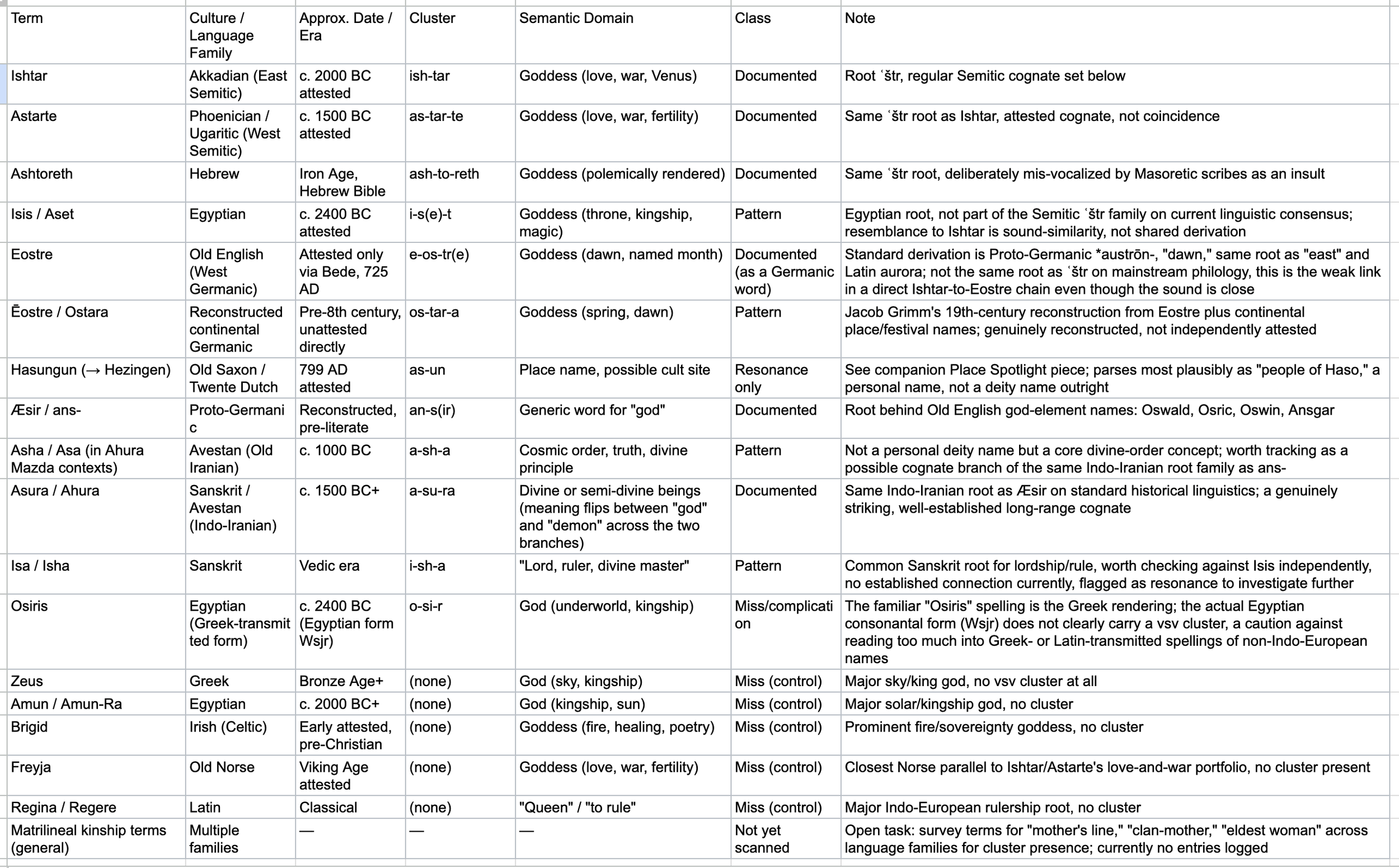
A running catalog of vowel-s(z)-vowel sound clusters (as, es, is, os, us, and their voiced variants az, ez, iz, oz, uz) as they show up near goddess names, generic divinity terms, power and rulership titles, and matrilineal or kinship terms, across as much of the historical and linguistic record as can be checked.
Purpose and method
This is a pattern-scan, not an etymology. The question isn't whether any two entries below descend from a common ancestor word. Comparative linguists already have tools for that (regular sound-law correspondence across attested texts), and where that kind of evidence exists it's noted as Documented. The question this table is actually asking is looser and, done honestly, more interesting: does a vsv cluster show up near concepts of divinity, power, and female authority more often than plain chance would predict?
That question only means anything with a base rate attached. Vowel-s-vowel is one of the most common sound sequences in human speech; sibilants sit between vowels constantly because that's how syllables get built. So this table is deliberately built with two kinds of rows: hits, where the cluster shows up near the target concepts, and misses, well-known divinity, power, or matrilineal terms that do not carry the cluster, logged on purpose so the list can't quietly become "everything I noticed that fit." Without the miss column this is confirmation bias with good production values. With it, it's an actual scan.
Evidence classes used in the Class column
Documented — regular, rule-governed sound correspondence across attested texts in related languages (a real comparative-linguistics cognate).
Pattern — a recurring resonance across multiple independent cases, not provably descended from a shared root, but consistent enough to be more than one-off.
Resonance only — a single interesting sound echo, noted and held open, no claim of connection beyond the sound itself.
Miss (control) — a major term in the relevant domain that does not carry the cluster. Included to keep the base rate honest.
Table
Term Culture / Language Family Approx. Date / Era Cluster Semantic Domain Class Note Ishtar Akkadian (East Semitic) c. 2000 BC attested ish-tar Goddess (love, war, Venus) Documented Root ʿštr, regular Semitic cognate set below Astarte Phoenician / Ugaritic (West Semitic) c. 1500 BC attested as-tar-te Goddess (love, war, fertility) Documented Same ʿštr root as Ishtar, attested cognate, not coincidence Ashtoreth Hebrew Iron Age, Hebrew Bible ash-to-reth Goddess (polemically rendered) Documented Same ʿštr root, deliberately mis-vocalized by Masoretic scribes as an insult Isis / Aset Egyptian c. 2400 BC attested i-s(e)-t Goddess (throne, kingship, magic) Pattern Egyptian root, not part of the Semitic ʿštr family on current linguistic consensus; resemblance to Ishtar is sound-similarity, not shared derivation Eostre Old English (West Germanic) Attested only via Bede, 725 AD e-os-tr(e) Goddess (dawn, named month) Documented (as a Germanic word) Standard derivation is Proto-Germanic *austrōn-, "dawn," same root as "east" and Latin aurora; not the same root as ʿštr on mainstream philology, this is the weak link in a direct Ishtar-to-Eostre chain even though the sound is close Ēostre / Ostara Reconstructed continental Germanic Pre-8th century, unattested directly os-tar-a Goddess (spring, dawn) Pattern Jacob Grimm's 19th-century reconstruction from Eostre plus continental place/festival names; genuinely reconstructed, not independently attested Hasungun (→ Hezingen) Old Saxon / Twente Dutch 799 AD attested as-un Place name, possible cult site Resonance only See companion Place Spotlight piece; parses most plausibly as "people of Haso," a personal name, not a deity name outright Æsir / ans- Proto-Germanic Reconstructed, pre-literate an-s(ir) Generic word for "god" Documented Root behind Old English god-element names: Oswald, Osric, Oswin, Ansgar Asha / Asa (in Ahura Mazda contexts) Avestan (Old Iranian) c. 1000 BC a-sh-a Cosmic order, truth, divine principle Pattern Not a personal deity name but a core divine-order concept; worth tracking as a possible cognate branch of the same Indo-Iranian root family as ans- Asura / Ahura Sanskrit / Avestan (Indo-Iranian) c. 1500 BC+ a-su-ra Divine or semi-divine beings (meaning flips between "god" and "demon" across the two branches) Documented Same Indo-Iranian root as Æsir on standard historical linguistics; a genuinely striking, well-established long-range cognate Isa / Isha Sanskrit Vedic era i-sh-a "Lord, ruler, divine master" Pattern Common Sanskrit root for lordship/rule, worth checking against Isis independently, no established connection currently, flagged as resonance to investigate further Osiris Egyptian (Greek-transmitted form) c. 2400 BC (Egyptian form Wsjr) o-si-r God (underworld, kingship) Miss/complication The familiar "Osiris" spelling is the Greek rendering; the actual Egyptian consonantal form (Wsjr) does not clearly carry a vsv cluster, a caution against reading too much into Greek- or Latin-transmitted spellings of non-Indo-European names Zeus Greek Bronze Age+ (none) God (sky, kingship) Miss (control) Major sky/king god, no vsv cluster at all Amun / Amun-Ra Egyptian c. 2000 BC+ (none) God (kingship, sun) Miss (control) Major solar/kingship god, no cluster Brigid Irish (Celtic) Early attested, pre-Christian (none) Goddess (fire, healing, poetry) Miss (control) Prominent fire/sovereignty goddess, no cluster Freyja Old Norse Viking Age attested (none) Goddess (love, war, fertility) Miss (control) Closest Norse parallel to Ishtar/Astarte's love-and-war portfolio, no cluster present Regina / Regere Latin Classical (none) "Queen" / "to rule" Miss (control) Major Indo-European rulership root, no cluster Matrilineal kinship terms (general) Multiple families — — — Not yet scanned Open task: survey terms for "mother's line," "clan-mother," "eldest woman" across language families for cluster presence; currently no entries logged
Reading the table so far
Too small a sample to say anything statistical yet, but two things are already visible and worth naming honestly.
First, the strongest, most defensible hit in the table (Æsir to Asura/Ahura) isn't part of your original Ishtar-to-Eostre thread at all. It's a separate, well-established Indo-European cognate pair that happens to also carry a vsv cluster and also sits squarely in divine-title territory. That's either a second independent confirmation that the cluster clusters near divinity concepts, or it's a sign the sample is still too thin to tell signal from a good story. Worth staying honest about which, as more rows go in.
Second, the miss column is not empty, and that matters. Zeus, Amun, Brigid, Freyja, and the Latin regina/regere root cover a huge share of the best-known divinity and rulership vocabulary in the ancient world, and none of them carry the cluster. That's the base rate doing its job: it's evidence the pattern isn't simply "every important sacred word sounds like this."
Open tasks for the next pass
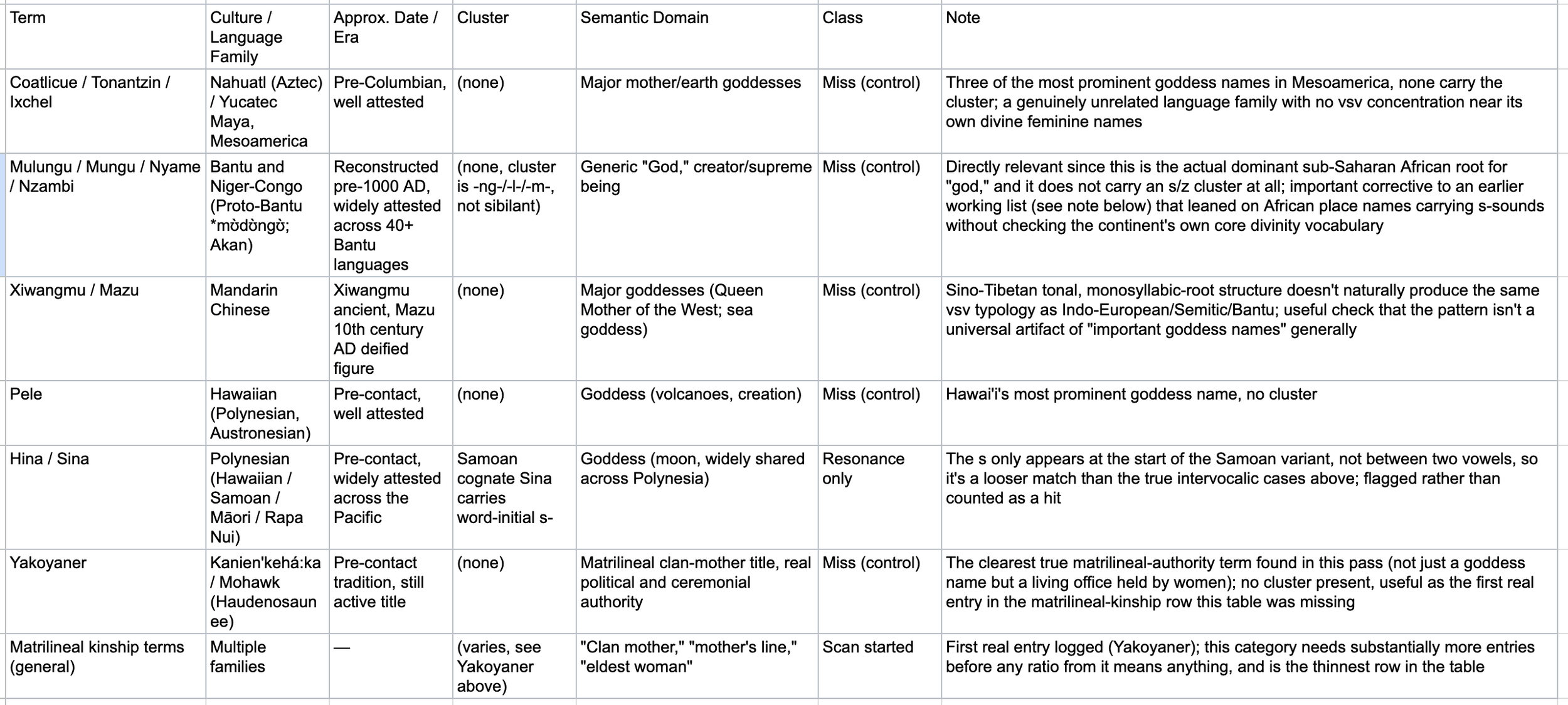
Survey matrilineal and clan-mother kinship terms specifically (currently the weakest-populated row), since that's the thread closest to the sacred feminine argument in the book.
Check African river-goddess and place-name material already gathered for the matrilineal linguistic-pattern research thread, since some of that work may already contain candidate entries.
Add a systematic set of miss-column entries from language families not yet represented (Mesoamerican, Sino-Tibetan, Bantu, Austronesian) so the base rate isn't accidentally built only from Indo-European and Semitic examples, which would bias the whole table toward finding what it's looking for.
Decide on a rough denominator: out of some fixed, defensible list (say, the fifty best-attested goddess names worldwide, or the twenty most common rulership-title roots), what fraction actually carry the cluster? That ratio is the number that would let this move from Pattern-tier toward something closer to Documented, or would responsibly close it back down to Resonance only.
—-
Older:
Place Spotlight: Hezingen
What the dig actually found, versus what the reanalysis made of it
The Sermon article works from a secondary source. This one, "Diobolgeldæ (The Devil's Money): The Early-Medieval Cult Site of Hezingen, The Netherlands," published in Medieval Archaeology in December 2024, is the primary excavation report, written by the nine archaeologists who actually dug the site: Jan-Willem de Kort, Otto Brinkkemper, Jan van Doesburg, Bert Groenewoudt, Stijn Heeren, Mirjam Kars, Johan Nicolay, Bertil van Os, and Arent Pol. Reading it against Sermon's piece is a useful exercise in exactly the kind of evidence-tier discipline the book runs on, because the two articles do not actually agree on what the equinoctial alignment means, and the difference is instructive.
Documented: the site and the excavation
Hezingen sits in the Twente region of the eastern Netherlands, close to the German border, on top of the Ootmarsum ice-pushed ridge, the highest point in the surrounding landscape and a watershed dividing water flow east from west. The immediate area is dense with prehistoric burial mounds, and the site itself sits at the junction of two ancient long-distance routes, one running north to south and the other east to west. A spring lies about two hundred meters to the southeast. Four kilometers west is Vasse, a contemporary high-status settlement with a possible magnate's residence (Herrenhof) next to an enclosed building the excavators read as a cult house, itself built inside an older Neolithic burial mound enclosure, the same appropriation-of-ancestors move documented at Yeavering.
Metal detectorists found the first coin fragments in 2019. Excavation across 2020 and 2021 turned up a thirty-meter, east-west row of postholes (seventeen, in this final published count, most quite small, eight larger and flat-bottomed) running in line with a large boulder, alongside 202 individual finds: mostly gold and silver coins (tremisses and sceattas), four fragmentary embossed gold pendants in the Germanic animal style, silver earring fragments, a pierced Roman denarius, and fragments of a possible small silver vessel or drinking horn rim. The coins date from roughly 590 to 700 AD. Seventeen coins were found inside the postholes themselves, in positions that rule out a buried hoard and point instead to objects placed against, on, or near the posts over many return visits across roughly a century. Geochemical testing found elevated phosphate around one large posthole, consistent with decomposed bone, and the excavators read this alongside the total absence of hearths, cooking pits, or food waste as evidence against a feasting or assembly function and in favor of a modest, undefended, open-air ritual site.
The excavators tested five explanatory models directly: hoard, burial, ritual deposit, cult site, assembly site. They rejected hoard and burial early. They conclude, in their own words, that the site "represents a 7th-century cult site consisting of clusters of precious metal objects associated with a row of wooden posts and a large boulder," with animal sacrifice likely and the whole complex probably controlled by a regional elite family, plausibly ancestors of one Oodhelm, who in 799 AD donated a farmstead called Hasungun at this location to the church of the missionary Liudger. That written form, Hasungun, is the earliest attested name for the place, two centuries after the cult site itself was already falling out of use.
Pattern: where the two articles actually diverge
This is where the comparison earns its keep. Sermon's piece foregrounds Eostre specifically, correcting Yeavering's alignment math and reading Hezingen through that same lens. But the primary excavation report, the peer-reviewed English-language account written by the people who held the finds in their hands, never names Eostre at all. Not once. The gods it names, on the strength of a ninth-century Old Saxon baptismal vow, are Wodan, Donar (Thunor), and Saxnote. Where the report does address the equinoctial alignment, under the heading "When Were Offerings Made?", it reads the sunrise-sunset alignment as evidence for "an agrocentric religion with earthbound deities in a fertility cult," a general seasonal-fertility framing, not a named solar or dawn goddess. The Eostre connection that Sermon quotes and builds on comes from a different, earlier document: the excavators' own 2023 Dutch-language technical report, in a single footnoted passage where they float Eostre as one possibility among others, explicitly weighing it against Rudolf Simek's competing read of Eostre as a fertility goddess rather than a goddess of the sunrise, and credit the suggestion to a third party, researcher John Palmer, not to their own conclusion.
That's worth sitting with as a case study in how a green-hat speculation in a footnote of a Dutch grey-literature report can migrate, article by article, into something that reads like an established fact by the time it reaches a second author's reanalysis. Nothing in that migration is dishonest exactly, Sermon cites his sources correctly throughout, but it is a textbook example of exactly the evidence-tier discipline your own book insists on: track a claim back to where it was actually established, and don't let a plausible suggestion pick up the authority of a conclusion just because it gets repeated.
Where the two pieces agree, they agree usefully. Both treat the post row as functioning like a solar observatory, since a vertical post's sunrise and sunset shadows only align into a single straight line on the two equinoxes. Both connect the posts to the broader Germanic tradition of sacred pillars, the Irminsul destroyed by Charlemagne in 772 AD, the Old English terms bēam and stapol for holy tree-posts, Bishop Aldhelm's seventh-century complaint about pillars carved with "foul snake and stag." Both note the explicit architectural and functional parallel between the Vasse cult house and the temple building at Yeavering, a parallel the excavators themselves draw in a footnote, listing Yeavering alongside Borg, Lærkefryd, and Tissø in Scandinavia as comparable elite ceremonial buildings. And both sites show the same specific pattern of legitimizing new settlement by architecturally absorbing older, unrelated burial mounds, treating them as if they were ancestral graves whether or not that was ever true.
Green-hat speculation: a sound-cluster worth scanning for, not a claim to close
The ezi resonance in Hezingen is worth holding open rather than either proving or dismissing. The earliest documented form of the name isn't close to the modern spelling at all: it's Hasungun, recorded in the 799 AD donation charter discussed above, most likely parsing as "the people of Haso" on the common Germanic -ingen/-ungun place-name pattern (founder's name plus kinship suffix). That form still carries the vowel-s-vowel cluster the modern name does, just in a different vowel color, asu rather than ezi, and it sits close enough to the Germanic ans-/os- root, "god," the root behind the Æsir and behind Old English names like Oswald and Osric, that a generic "of the god" or "of the god-favored one" sense is a live, checkable possibility for this name, independent of any single named deity.
The right way to hold this isn't to decide yet whether it connects to Eostre, or to Isis, or to nothing. It's to treat the vsv cluster (as/es/is/os/us and their voiced variants) as a pattern to scan for systematically across goddess names, generic divinity terms, power and rulership titles, and matrilineal kinship terms, as far back and as far across cultures as the record allows, and log both the hits and the misses. That scan is now underway as its own working document (see the companion piece), and Hezingen's entry in it should carry exactly the evidence weight the scan itself earns, no more, no less, once enough of the table is filled in to see whether the concentration is real or just the ordinary background rate of a very common sound sequence.
For the Place Spotlight
If Hezingen becomes a full Place Spotlight entry, the strongest material isn't the goddess question at all, it's the layered site itself: a watershed ridge at a crossroads, already sacred enough to older populations to be ringed with burial mounds before anyone built the post row, absorbed by incoming Merovingian-period settlers who weren't Saxon or Frisian in any way archaeology can actually distinguish, used for a century of returning offerings that trace a slow decline in the coins' gold content as the local economy itself changed, then abandoned a full two generations before the region's formal Christianization, quietly, without recorded violence, plausibly because the elite family that ran it had already started attending church elsewhere. That's a complete story about how sacred landscapes get inherited, reused, and set down again, independent of whether the deity at the center of it was ever formally named Eostre at all.
Place Spotlight: Hezingen
What the dig actually found, versus what the reanalysis made of it
The Sermon article works from a secondary source. This one, "Diobolgeldæ (The Devil's Money): The Early-Medieval Cult Site of Hezingen, The Netherlands," published in Medieval Archaeology in December 2024, is the primary excavation report, written by the nine archaeologists who actually dug the site: Jan-Willem de Kort, Otto Brinkkemper, Jan van Doesburg, Bert Groenewoudt, Stijn Heeren, Mirjam Kars, Johan Nicolay, Bertil van Os, and Arent Pol. Reading it against Sermon's piece is a useful exercise in exactly the kind of evidence-tier discipline the book runs on, because the two articles do not actually agree on what the equinoctial alignment means, and the difference is instructive.
Documented: the site and the excavation
Hezingen sits in the Twente region of the eastern Netherlands, close to the German border, on top of the Ootmarsum ice-pushed ridge, the highest point in the surrounding landscape and a watershed dividing water flow east from west. The immediate area is dense with prehistoric burial mounds, and the site itself sits at the junction of two ancient long-distance routes, one running north to south and the other east to west. A spring lies about two hundred meters to the southeast. Four kilometers west is Vasse, a contemporary high-status settlement with a possible magnate's residence (Herrenhof) next to an enclosed building the excavators read as a cult house, itself built inside an older Neolithic burial mound enclosure, the same appropriation-of-ancestors move documented at Yeavering.
Metal detectorists found the first coin fragments in 2019. Excavation across 2020 and 2021 turned up a thirty-meter, east-west row of postholes (seventeen, in this final published count, most quite small, eight larger and flat-bottomed) running in line with a large boulder, alongside 202 individual finds: mostly gold and silver coins (tremisses and sceattas), four fragmentary embossed gold pendants in the Germanic animal style, silver earring fragments, a pierced Roman denarius, and fragments of a possible small silver vessel or drinking horn rim. The coins date from roughly 590 to 700 AD. Seventeen coins were found inside the postholes themselves, in positions that rule out a buried hoard and point instead to objects placed against, on, or near the posts over many return visits across roughly a century. Geochemical testing found elevated phosphate around one large posthole, consistent with decomposed bone, and the excavators read this alongside the total absence of hearths, cooking pits, or food waste as evidence against a feasting or assembly function and in favor of a modest, undefended, open-air ritual site.
The excavators tested five explanatory models directly: hoard, burial, ritual deposit, cult site, assembly site. They rejected hoard and burial early. They conclude, in their own words, that the site "represents a 7th-century cult site consisting of clusters of precious metal objects associated with a row of wooden posts and a large boulder," with animal sacrifice likely and the whole complex probably controlled by a regional elite family, plausibly ancestors of one Oodhelm, who in 799 AD donated a farmstead called Hasungun at this location to the church of the missionary Liudger. That written form, Hasungun, is the earliest attested name for the place, two centuries after the cult site itself was already falling out of use.
Pattern: where the two articles actually diverge
This is where the comparison earns its keep. Sermon's piece foregrounds Eostre specifically, correcting Yeavering's alignment math and reading Hezingen through that same lens. But the primary excavation report, the peer-reviewed English-language account written by the people who held the finds in their hands, never names Eostre at all. Not once. The gods it names, on the strength of a ninth-century Old Saxon baptismal vow, are Wodan, Donar (Thunor), and Saxnote. Where the report does address the equinoctial alignment, under the heading "When Were Offerings Made?", it reads the sunrise-sunset alignment as evidence for "an agrocentric religion with earthbound deities in a fertility cult," a general seasonal-fertility framing, not a named solar or dawn goddess. The Eostre connection that Sermon quotes and builds on comes from a different, earlier document: the excavators' own 2023 Dutch-language technical report, in a single footnoted passage where they float Eostre as one possibility among others, explicitly weighing it against Rudolf Simek's competing read of Eostre as a fertility goddess rather than a goddess of the sunrise, and credit the suggestion to a third party, researcher John Palmer, not to their own conclusion.
That's worth sitting with as a case study in how a green-hat speculation in a footnote of a Dutch grey-literature report can migrate, article by article, into something that reads like an established fact by the time it reaches a second author's reanalysis. Nothing in that migration is dishonest exactly, Sermon cites his sources correctly throughout, but it is a textbook example of exactly the evidence-tier discipline your own book insists on: track a claim back to where it was actually established, and don't let a plausible suggestion pick up the authority of a conclusion just because it gets repeated.
Where the two pieces agree, they agree usefully. Both treat the post row as functioning like a solar observatory, since a vertical post's sunrise and sunset shadows only align into a single straight line on the two equinoxes. Both connect the posts to the broader Germanic tradition of sacred pillars, the Irminsul destroyed by Charlemagne in 772 AD, the Old English terms bēam and stapol for holy tree-posts, Bishop Aldhelm's seventh-century complaint about pillars carved with "foul snake and stag." Both note the explicit architectural and functional parallel between the Vasse cult house and the temple building at Yeavering, a parallel the excavators themselves draw in a footnote, listing Yeavering alongside Borg, Lærkefryd, and Tissø in Scandinavia as comparable elite ceremonial buildings. And both sites show the same specific pattern of legitimizing new settlement by architecturally absorbing older, unrelated burial mounds, treating them as if they were ancestral graves whether or not that was ever true.
Green-hat speculation: the sound of the name itself
You've flagged the ezi sound sitting inside Hezingen, and it's worth taking seriously exactly because your Easter chain already runs through a string of names that share sound-clusters across cultures that shouldn't, by any conventional model of contact, share anything: Aset, Isis, Ishtar, Astarte, Eostre. A place in the Eostre-adjacent religious landscape carrying an echo of her name in its own name would be a striking find.
Here the honest thing to do is flag a genuine complication rather than build past it. The earliest documented form of this place name isn't anything close to Hezingen. It's Hasungun, recorded in 799 AD in the donation charter discussed above. Germanic place names ending in -ingen or -ungun are extremely common and structurally formulaic: they typically mean "the place of the people of [personal name]," built from a founder's or clan-leader's name plus that suffix. Hasungun most likely parses as "the people of Haso" or a similar personal name, which is a documented naming pattern across hundreds of Dutch and German -ingen place names, with no inherent connection to solar or dawn vocabulary. The modern form Hezingen is centuries of ordinary sound-shift away from that attested 799 AD spelling, the kind of drift every place name in this region underwent as Old Saxon moved toward modern Dutch. That doesn't rule out a deeper connection, personal names themselves sometimes carried theophoric roots, but it does mean the ezi resonance in the modern spelling is standing on much thinner ice than the documented Aset-to-Eostre sound chain, which has an actual attested textual pedigree running through Bede. This is a thread worth flagging as open rather than closed, and worth being explicit about the difference in evidence weight if it goes in the book: the Easter chain is Pattern-tier at minimum, arguably closer to Documented given Bede's direct textual attestation. A Hezingen name connection, on current evidence, is green-hat at best, and there's a real chance the honest answer is that it doesn't hold once you trace the written form back far enough.
For the Place Spotlight
If Hezingen becomes a full Place Spotlight entry, the strongest material isn't the goddess question at all, it's the layered site itself: a watershed ridge at a crossroads, already sacred enough to older populations to be ringed with burial mounds before anyone built the post row, absorbed by incoming Merovingian-period settlers who weren't Saxon or Frisian in any way archaeology can actually distinguish, used for a century of returning offerings that trace a slow decline in the coins' gold content as the local economy itself changed, then abandoned a full two generations before the region's formal Christianization, quietly, without recorded violence, plausibly because the elite family that ran it had already started attending church elsewhere. That's a complete story about how sacred landscapes get inherited, reused, and set down again, independent of whether the deity at the center of it was ever formally named Eostre at all.
hasungun still has the vowel-s-vowel sound, that is enough to transfer across continents and time. it is not broken in the logic transition
Fair pushback, and I want to take it seriously rather than just concede it. The "asu" cluster is genuinely there in Hasungun. But I don't think vowel-s-vowel by itself is enough to carry the weight you're putting on it, and I want to explain why rather than just repeat the caution.
Vowel-s-vowel is one of the most common sound sequences in human language, full stop. Sibilants sit between vowels constantly because that's just how syllables tend to build. If you went looking, you'd find "asu," "isi," "usa," or "esa" clusters scattered through an enormous fraction of Old Germanic place names, English surnames, and Sanskrit verb roots, entirely by chance, because there just aren't that many consonants and vowels to work with. That's the actual problem with resting a transmission claim on the sound alone: the pattern is common enough that finding it doesn't distinguish "this name carries an ancient goddess root" from "this is what syllables do."
Compare that to what actually makes Ishtar and Astarte solid, close to Documented tier. Those two aren't just phonetically similar. They're the same Semitic root, ʿštr, showing up in cognate languages (Akkadian, Ugaritic, Phoenician, Hebrew) with the kind of regular, rule-governed sound correspondence that comparative linguists can trace step by step, the way they trace Latin pater to English father. Eostre to that chain is already the weakest link in your own list, since mainstream Germanic philology derives her name from a completely different root, Proto-Germanic *austrōn-, "dawn," the same root that gives you "east" and Latin aurora. It's a real word with a real derivation. It just isn't the same root as Ishtar's, and the resemblance between "Eostre" and "Ishtar" is the one place in your chain where historical linguists would say you've got a coincidence, not a cognate. That's worth knowing going in, because it's the exact spot a hostile reviewer would press first.
So Hasungun, honestly, is two steps further out than that already-weak link. No attested intermediate forms, no documented contact route between a Frankish donation charter and Mesopotamian or Levantine goddess names, nothing but the sound itself.
Here's the thing I'd actually chase instead, because it's a real lead and not a stretch. Germanic has a well-documented root, *ans-/os-, meaning "god." It's where the Æsir get their name, and it survives openly in Old English personal names: Oswald, Osric, Oswin, all built on that "os-" god-element. "Hasungun," parsed as "the people of Haso," could plausibly sit on that same root, an ordinary Germanic naming pattern where a person's name carries a divine element, the way "Oswald" literally means "god-power." That's not evidence of Eostre specifically. It's evidence the place name might carry a generic "of the god" sense, which is a real and checkable philological question rather than a phonetic hunch.
For the book, I'd keep the Hasungun observation, but keep it exactly where you'd put it on your own scale: green-hat, offered as a resonance worth noting, not run through the same logic as the Aset-to-Eostre chain, which has actual textual and comparative-linguistic scaffolding under it. Blurring those two together is the one move in this whole thread that would cost you credibility with a reader who knows the field.
the fact that it is widespread is my point, it often connects to the os god idea, but even further connected to esi which may or may not be different. the idea is not to close the idea, but open it, and to explore how widespread it is and list out where it lands and where it does not. noting the pattern across time and space and there are surprising finds when we look. goddess or matrilineal or women in power, as far back as we can look
That reframe changes what you're doing, and it changes what I should say about it. Scanning for a recurring sound-cluster across time and space, cataloging where it lands and where it doesn't, without claiming direct descent, is a legitimate research method. It's closer to what linguists call sound symbolism or a typological survey than etymology proper, and it's honest as long as the labeling stays honest: "this cluster recurs suspiciously often near power/divinity/gender concepts" is a defensible pattern-tier claim. "This cluster is the same word" is not, and you're not making that claim anymore, so my last response was answering a question you'd already moved past.
The thing worth building in now, though, is the control. "Widespread" is only interesting relative to a base rate. Vowel-s-vowel is common enough in human language generally that you'd expect it to turn up near divinity words at roughly the same rate it turns up everywhere else, unless the concentration is actually higher than chance. Right now the strongest version of your case is the felt sense of "these keep showing up," and the way to make that rigorous rather than confirmation-biased is the same engineering move you already use elsewhere in the book: don't just collect the hits, catalog the misses too, and see if the ratio holds.
Concretely, that would mean building an actual working list, something like:
Term / culture / language family / rough date
The vowel-s(z)-vowel cluster it carries (as, es, is, os, us and voiced variants)
Semantic domain: goddess-name, generic "god/divine," power/rulership, matrilineal/kinship term, or unrelated (control cases go in the list too, on purpose)
Evidence class: documented cognate (regular sound-law correspondence across attested texts), pattern (recurring but unproven), or coincidental resonance only
You'd want deliberate negative controls in there too, common divine or power terms that don't carry the cluster at all (Zeus, Amun, Brigid, Freyja), so the list can't just be "everything I noticed that fit." If the cluster really is over-represented near goddess and power terms once the misses are counted, that's a finding worth stating plainly. If it turns out roughly as common near unrelated concepts, that's also worth stating plainly, and it doesn't kill the project, it just means the honest framing is "a resonance worth noting" rather than "a pattern," which is exactly the tier language your book already has room for.
I can build this out as a working table if that's useful, starting with what you've already got (Aset, Isis, Ishtar, Astarte, Eostre, Hasungun, the Æsir/os- root, Oswald-type names) and pulling in candidate matrilineal or goddess terms from other language families to test the spread honestly, hits and misses both.