
Short answer: extrapolated numbers of known cases imply about 5 million boys were sexually abused by Christian/Catholic priests over time, possibly as high as 10 million.
The Appendix below shows the math, as well as science on how to predict abuse total numbers based on how many come forward.
This reduces down to being about 1 in 25 known cases of priests found to be abusers of children. That reality is more likely to be 1 in 10 priests in some places and times, based on the reality of how children come forward.
The Cost of Denial: What Happens When You Make Sexuality the Enemy
By Victoria Siegel — Rational Body Publishing
I want to say something that most people sense but few say plainly.
The child abuse crisis inside religious institutions was not a coincidence. It was not a random failure of individual character. It was not bad luck, or bad apples, or an inexplicable mystery given the holiness of the setting.
It was a predictable outcome of a specific set of decisions made over many centuries — decisions about the body, about sexuality, about women, about power, and about who gets to stand between a human being and God.
And if we are going to understand what happened to millions of children, we have to start there. Not with the men who committed the abuse. With the system that created the conditions for abuse.
Part One: What Was Built
Across more than a thousand years of Western Christian theology, a set of ideas accumulated that together formed a structure with one distinguishing feature: it was unsustainable.
The body was the enemy of the soul. Physical desire was weakness. Sexual feeling was sin. The highest moral achievement a person could reach was celibacy — the complete conquest of nature by will.
Women were the source of temptation. The female body caused dangerous feelings in holy men. Therefore the female had to be controlled, covered, separated, silenced, or venerated at a safe spiritual distance. As I have written elsewhere, the feminine was removed from the prayer, from the priesthood, from the text, from the Trinity itself. The Holy Spirit — once the breath of God, grammatically feminine in every Semitic language — became, through a series of deliberate translation choices, a ghost.
Celibacy was the summit. In Jewish tradition, a young man was expected to be married by twenty. Physical intimacy within marriage was considered a sacred obligation — a husband's duty to his wife, honored and expected: daily if their job allowed for it. Christianity went a different direction. The highest calling was to abstain entirely. To transcend the body. To conquer nature. In many other traditions that inspired the Roman, and subsequently Christian/Catholic traditions, sex was sacred, since love creates life.
Men were given power without accountability. Into this structure — which demanded the impossible, which isolated men from appropriate intimacy, which removed women from positions of oversight, which trained children to obey — the institution placed men with unrestricted access to children and unlimited spiritual authority. They were the representatives of God. Their word carried moral weight no child could challenge. Their reputation was the reputation of the Church.
And then it asked anyone who witnessed something to protect the institution first.
This is what I mean when I say the abuse was predictable. I am not saying every priest was a predator. The vast majority were not. I am saying that the design of the system created conditions in which predation could flourish, hide, and be protected — and then provided the theological language to explain why the children should stay quiet.
Part Two: The Numbers We Know
I am going to present numbers carefully, because the documented reality is already so serious that overstating it only gives critics a way to dismiss it.
The documented numbers are the floor. They are not the ceiling.
United States: The John Jay Report, commissioned by the U.S. Conference of Catholic Bishops, documented more than 10,667 alleged victims and 4,392 accused priests and deacons from 1950 to 2002. That represents approximately 4% of all Catholic priests and deacons serving during that period — roughly 1 in 25. The majority of identified victims were boys. The average age of victims at first abuse was approximately 12.6 years, with most concentrated in the 11 to 14 range.
France: An independent commission estimated that approximately 216,000 children had been sexually abused by Catholic clergy since 1950. When lay Catholic workers were included — teachers, youth workers, school staff operating under church authority — the estimate rose to approximately 330,000. That is one country.
Germany: A major church-commissioned study found records concerning more than 1,670 accused Catholic clerics from 1946 to 2014. The researchers described that figure as conservative, noting that records had been incomplete and in some cases deliberately altered or destroyed.
Australia: The Royal Commission into Institutional Responses to Child Sexual Abuse documented more than 4,444 Catholic claimants and described systematic failures to investigate, warn, or protect children. Data linked to the Royal Commission suggested that approximately 7% of Catholic priests in Australia — roughly 1 in 14 — had been accused of child sexual abuse. That is the highest documented national rate.
Ireland: Multiple inquiries exposed widespread abuse across church-run residential institutions, industrial schools, and parishes. Ireland's investigations became some of the most detailed anywhere in the world, documenting not just abuse but the deliberate concealment of it at the highest institutional levels.
Netherlands: An inquiry estimated that 10,000 to 20,000 children may have been abused in Dutch Catholic institutions since 1945.
Put together, these inquiries represent the best-documented portion of a global pattern. They do not represent the whole of it.
Part Three: Why the Known Numbers Are Not the Real Numbers
Every field that studies child sexual abuse finds the same thing: the reported cases are a fraction of the actual cases.
Children often do not report abuse at the time it occurs. They may lack language for what happened. They may fear they will not be believed. They may love the person who harmed them, or depend on them, or fear what disclosure will do to their family. In religious settings, the barriers are amplified: the abuser may carry the authority of God in the child's understanding. Disclosure can mean losing community, faith, family, and social belonging simultaneously.
Boys report even less than girls. Shame, masculine identity, and the stigma attached to abuse by male perpetrators create additional barriers to disclosure.
Many survivors disclose only in adulthood — sometimes decades later. Statutes of limitation have historically meant that by the time they spoke, legal recourse was gone. Many survivors never disclose at all.
When countries opened legal windows for older claims — periods in which survivors could bring lawsuits that would otherwise have been time-barred — claims surged immediately. This did not mean new abuse had occurred. It meant hidden abuse had finally found a path to be named.
The John Jay researchers themselves noted that their documentation depended on church records and known allegations. Abuse that left no file was not counted. Priests about whom no formal allegation survived were not counted. Victims who never came forward were not counted.
Germany's researchers warned explicitly that their 4.4% figure was conservative because the files they reviewed were controlled by the institutions being studied.
Australia's Royal Commission warned that its data did not represent total prevalence.
This is the pattern: every major inquiry acknowledges, on the record, that its findings are an undercount.
So what are the real numbers?
I want to be honest about the limits of extrapolation. When researchers have attempted to estimate total victims by comparing documented rates against population data, disclosure rates in child sexual abuse research, and the results of national inquiries, the resulting figures can reach into the millions globally.
Some survivor advocates and researchers working from these extrapolations have suggested that the total number of boys abused in Catholic or Christian institutional settings over the twentieth century could be in the range of five to ten million worldwide. I have encountered estimates suggesting a further one million or more in Islamic religious school settings, where documentation is far more limited and barriers to disclosure are even higher. These are not figures I can prove from published data. No one can. The absence of proof is part of the problem: these are by definition the cases that were not documented, not reported, not counted.
What I can say, and what every serious inquiry supports, is this:
The documented victims are not the whole story. They are the visible part of a much larger wound.
The safest and most defensible statement is: official numbers show at least tens of thousands documented, national inquiries suggest hundreds of thousands in individual countries, and the true global total is almost certainly in the millions when accounting for systematic underreporting, destroyed records, and the barriers specific to religious settings.
If we are going to err, we should err on the side of believing the children.
Part Four: The Age and Profile of Victims
This matters and it is often distorted.
The majority of victims documented in the John Jay study were not very young children. Most were between eleven and fourteen years old at the time of first abuse, with an average age of approximately twelve and a half. A significant majority were boys.
This corrects a common deflection: describing the abuse as pedophilia in the narrow clinical sense — meaning attraction specifically to prepubescent children — allows some to treat it as a rare psychopathology that could strike anywhere. But a twelve-year-old in a religious setting is not a random victim. That child is a child who has been trained to obey religious authority, who understands that this adult stands close to God, who may have been deliberately sought out by an adult in a position of power.
The profile of victims — boys, early adolescence, in settings where adult male authority was total and unchecked — is not random. It is the profile of access.
Part Five: How the Institution Hid It
The cover-up was not accidental. It was organized. The mechanisms repeated across countries, dioceses, and decades with striking consistency.
Priests were moved, not removed. Allegations were made privately. Priests were sent for "treatment" at church-linked facilities. They were then quietly transferred to new parishes, new schools, new youth programs. New communities were not warned. Children in the new parish had no way to know. This happened not once but repeatedly — the same accused priest moved again when new allegations emerged in the new location.
Crimes were handled as sins. Abuse was framed internally as weakness, moral failure, spiritual crisis — not as assault, rape, or criminal child abuse. That framing allowed the institution to manage it through confession, counseling, and canonical procedure rather than police reports, courts, and public accountability. A sin is handled privately. A crime is handled publicly. The Church chose the private path and called it pastoral care.
Secret files were kept. Many dioceses maintained confidential personnel files or "secret archives" that contained allegations against priests. These files preserved the institution's internal knowledge while keeping parents, parishioners, and police uninformed. When lawsuits and grand juries later compelled access to these files, the documents showed that bishops had known — sometimes for decades — what was being concealed.
Therapy was used as a laundering mechanism. Some accused priests were sent to Catholic treatment centers, received psychological evaluations, and were returned to ministry with a paper trail suggesting they had been assessed and cleared. The effect was not rehabilitation. It was the creation of documentation that could justify reassignment while burying the original allegation.
Money and confidentiality were used to keep victims quiet. Private settlements were offered to survivors. Some included confidentiality provisions — sometimes called non-disclosure agreements — requiring victims not to speak publicly about what had happened. Some dioceses paid for counseling or therapy in ways that could serve simultaneously as support for the survivor and as a mechanism for resolving claims privately, without courts, without records, without other potential victims learning what had occurred. This does not mean every payment was cynically intended. But the systemic effect was that money flowed toward silence.
Statutes of limitation were defended. When state legislatures proposed opening lookback windows — periods allowing older abuse claims to be brought despite the statute of limitations — Church lobbying efforts in several states worked to oppose or limit those windows. When windows were opened anyway, claims surged. That surge was not manufactured. It was the release of decades of hidden wounds.
Bankruptcy was used to manage mass claims. When facing enormous numbers of lawsuits, some dioceses filed for bankruptcy. This could create compensation structures for victims. It also capped liability, limited discovery, and reduced the risk of public trials that would have put internal documents and institutional decision-making on the record.
Part Six: The Financial Scale
The money is one measure of the damage. It is incomplete but instructive.
In the United States, documented Catholic abuse-related costs from 2004 to 2023 totaled more than five billion dollars across diocesan reports. Approximately three-quarters went to victims. The remainder went to attorneys' fees, costs related to accused clergy, and other expenses.
Recent major settlements have pushed that total higher. The Archdiocese of Los Angeles agreed in 2024 to pay $880 million to 1,353 survivors — bringing its cumulative abuse-related payouts to more than $1.5 billion. The Diocese of Rockville Centre settled for more than $320 million. In 2026, the Archdiocese of New York agreed to an $800 million settlement with approximately 1,300 survivors.
The United States total is now well over six billion dollars and rising.
That is one country. That is one denomination. That is only what reached settlement.
The human cost is not expressible in dollars. But the financial scale tells us something about the institutional scale: these are not the costs of a handful of bad men. These are the costs of a system.
Part Seven: Beyond Catholicism
I have focused on Catholic documentation because it is the most extensively investigated. But the pattern is not confined to one tradition.
Child sexual abuse has been documented in Protestant churches, evangelical ministries, Anglican institutions, closed sectarian communities, ultra-Orthodox Jewish settings, Islamic religious schools, and other religious contexts. The same risk factors appear everywhere:
Secrecy. Hierarchy. Access to children. Sexual shame. Male authority. Fear of outsiders. Reputation management. No independent reporting structure.
In Islamic contexts — mosques, madrasas, Quranic boarding schools — documentation is far less complete. Barriers to disclosure include shame, family honor, fear of blasphemy accusations, distrust of formal institutions, and the cultural weight of male religious authority. The absence of documentation does not mean the absence of abuse. It means the absence of inquiry. Where inquiries have occurred, in some countries and some communities, similar patterns have emerged.
The point is not to single out one faith. The point is to name the structural conditions that make abuse possible and concealment likely — and to notice that those conditions appear wherever unchecked authority over children combines with sexual shame and institutional self-protection.
Part Eight: The Argument I Am Making
We spent more than a thousand years building a theology that said:
The body is dangerous. Sexuality is weakness. Women are temptation. Celibacy is holiness. Men with authority represent God. Children should obey. Reputation is sacred.
And then we gave the men who embodied that theology unregulated access to children.
The result was not inevitable for every individual. Most priests did not abuse children. But the result was predictable as a systemic outcome. You cannot deny human sexuality for centuries, remove women from all positions of oversight and authority, train children into uncritical obedience, grant men the weight of divine authority, and then express surprise when some of those men find ways to exercise power over children in darkness.
The system produced the conditions. The individual choices happened inside those conditions.
And when it was discovered, the system chose itself.
That is the thing I cannot unsee. Not the abuse alone — though that is catastrophic. The response. The files. The transfers. The settlements. The lobbying against survivors. The institution looking at a child and a predator and asking: which one poses a greater risk to us?
That is not a failure of faith. That is a failure of humanity. That is what happens when power, denied its own nature, turns inward.
Timeline Summary
Pre-20th century: Abuse in church-run institutions — orphanages, schools, missions, residential care — largely undocumented. Victims had almost no recourse.
1930s–1950s: Many later inquiries trace abuse back into this period. Church-run schools and residential institutions had minimal outside oversight. Records are often incomplete or destroyed.
1950s–1980s: The highest-volume period in most documented Catholic datasets. Priests had broad access to children. Allegations were handled internally. Accused clergy were moved rather than removed.
1970s: Early warnings and internal diocesan knowledge documented in later grand jury investigations. Files show bishops knew of allegations and chose not to act publicly.
1980s: Growing lawsuits and survivor disclosures in the United States. Some media coverage. Institutions continued to resist full exposure.
1990s: Survivor networks expanded. Legal cases increased. Several countries began to see the scale more clearly. Many institutions still resisted disclosure.
2002: The Boston Globe's reporting on the Archdiocese of Boston made the American scandal globally visible. A turning point in public awareness.
2004: John Jay Report: more than 10,667 alleged victims, more than 4,392 accused Catholic priests and deacons in the U.S. from 1950–2002. Approximately 4% of serving clergy accused.
2009: Ireland's Ryan Report exposed widespread abuse in church-run residential institutions and schools across decades.
2011: Netherlands inquiry estimated 10,000 to 20,000 abused in Dutch Catholic institutions since 1945.
2017: Australia's Royal Commission: thousands of Catholic claimants, approximately 7% of Australian Catholic priests accused. Systematic institutional failures documented.
2018: Germany's MHG study: more than 1,670 accused Catholic clerics from 1946–2014. Researchers warned the figure was conservative.
2021: France's CIASE commission: approximately 216,000 children abused by Catholic clergy since 1950, rising to approximately 330,000 when lay Catholic workers included.
2024: Los Angeles Archdiocese agrees to $880 million settlement with 1,353 survivors — bringing its total to more than $1.5 billion.
2026: Archdiocese of New York agrees to $800 million settlement with approximately 1,300 survivors.
Costs Paid Out
U.S. total, 2004–2026
More than $6 billion in documented Catholic abuse-related costs. Rising.
Global documented victims
Tens of thousands in official records. Hundreds of thousands estimated by national commissions. Almost certainly millions when accounting for systematic underreporting, destroyed records, and barriers specific to religious settings.
Victoria Siegel is the author of Playing With Fire: Untangling the Ancient Wisdom Hidden in Our Modern Traditions (Rational Body Publishing), which examines how the removal of the feminine from religious tradition — from the Trinity, from leadership, from the prayer — created the structural conditions for institutional harm. rationalBody.com
Movie to Watch:
The Boston Globe movie detailing the widespread child abuse by priests and its institutional cover-up is Spotlight. Released in 2015, the biographical drama chronicles the newspaper's Pulitzer Prize-winning investigation that exposed how the Catholic Church concealed decades of systemic abuse by numerous priests.
The movie features an ensemble cast including Michael Keaton, Mark Ruffalo, and Rachel McAdams as the "Spotlight" investigative team. You can stream or rent the film on platforms like Netflix or Apple TV.
Appendix: Showing the Math — How We Arrive at 5 to 10 Million
When I say that the true number of boys abused in Catholic and Christian institutional settings over the twentieth century is likely in the range of five to ten million, I am not making that figure up. I am applying documented multipliers — drawn from peer-reviewed research on disclosure rates, memory, and reporting — to documented national inquiry totals. The math is not hidden. Here it is.
Step One: What the Brain Does With This
Before the numbers, a word about why the numbers are always low.
Child sexual abuse is not processed and reported like other crimes. It is processed by a child's developing brain under conditions of terror, shame, dependency, and often genuine confusion about what is happening and whether it is wrong. The neuroscience and psychology of this are now well-documented.
The brain under trauma does not record cleanly. Intense stress floods the brain with cortisol and adrenaline. The hippocampus — which organizes memories into coherent narrative sequences — is suppressed. What the child retains may be fragmented: a smell, a physical sensation, a feeling of dread, but not a sequential story that would hold up in a police interview or a courtroom. This is not fabrication. It is the documented neurological signature of traumatic encoding. Research published in the Journal of Consulting and Clinical Psychology (Williams, 1994) found that approximately 38% of women with documented, verified histories of childhood sexual abuse — women whose cases had been treated in emergency rooms as children — did not report that abuse when interviewed as adults. Not because they were lying. Because the memory was genuinely inaccessible or fragmented. The Office of Justice Programs has confirmed that repressed memories of child sexual abuse are probable and that the extent of memory suppression depends on several variables including the age of the child, the severity of the abuse, and whether the abuser was a trusted figure.
Boys suppress even more. A substantial share of abused girls and most abused boys had not yet told anyone about the abuse. Research consistently finds that boys disclose at lower rates than girls, and when they do disclose, they do so later and less completely. The reasons are compounding: masculine identity, shame about same-sex abuse by male perpetrators, fear of being perceived as weak or complicit, and the cultural equation of male victimhood with unmanliness. In nearly half of cases (46%), female victims never disclosed their sexual abuse experiences to anyone prior to interview; only 10% disclosed formally to authorities. For male victims, the non-disclosure rate is higher.
Religious settings amplify every barrier. When the abuser is a priest — a figure who carries spiritual authority, who may be understood by the child as a representative of God, who exists in a community where his word carries moral weight no child can challenge — the barriers to disclosure compound again. Telling anyone means accusing God's representative. It means potentially destroying a community. It means being the child who brought shame to the family's faith. In many cases, children in religious settings have been explicitly taught that disobedience to religious authority is itself sinful. The abuser operates inside that architecture.
The estimate: Between 70 and 90 percent of child sexual abuse cases are never reported. A meta-analysis of 217 published studies found that rates of self-reported victimization of CSA were 30 times higher than the rate based upon studies that relied on official CSA reports to authorities. For religious settings with male victims, the conservative working estimate used by researchers is that between 80% and 95% of cases were never reported in any form. I will use the conservative end — 80% unreported — throughout the calculations below to avoid overstating the case.
Step Two: The Documented National Floors
These are official inquiry totals. Each has been publicly released and is independently verifiable.
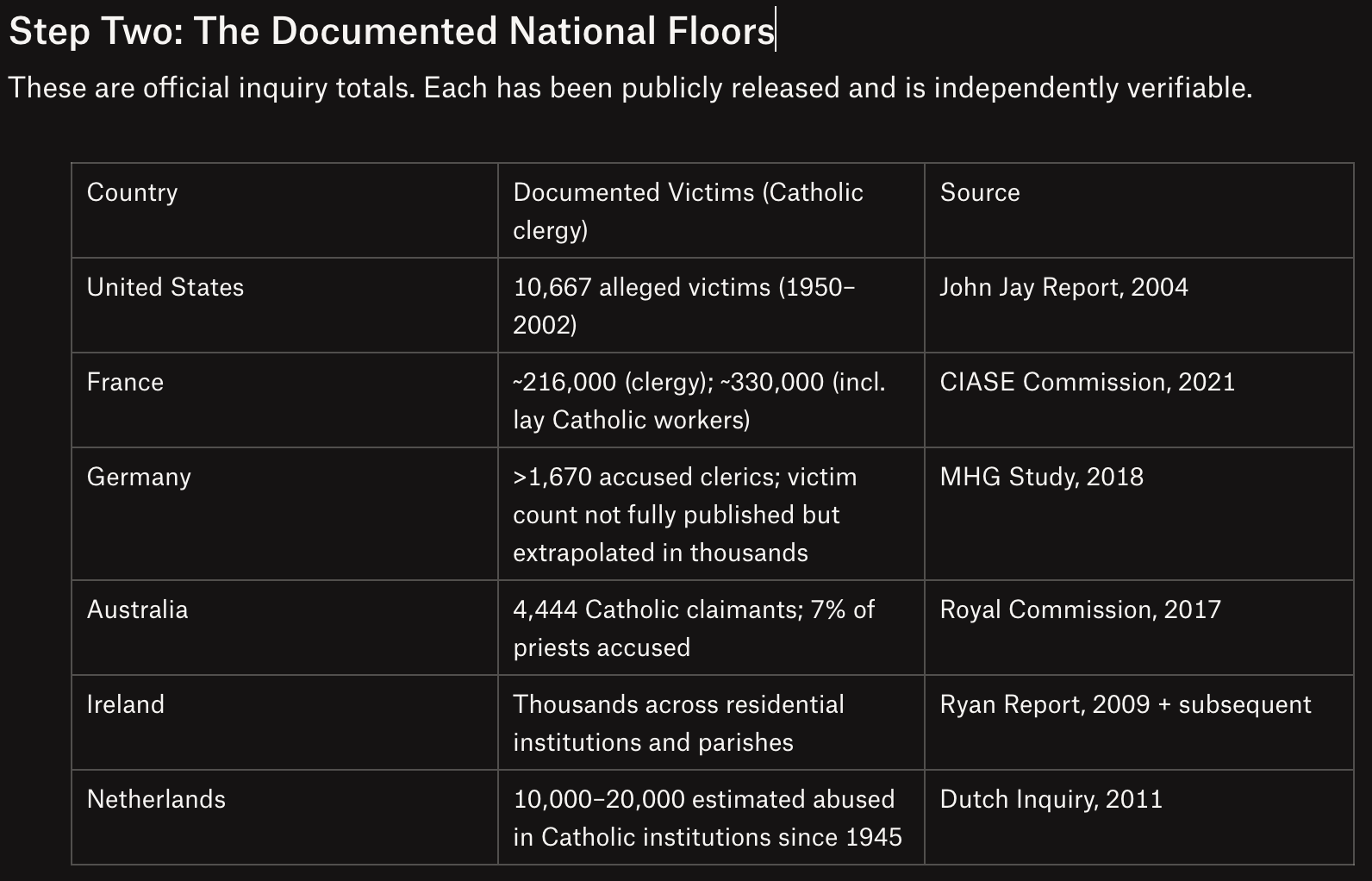
Details from above table: Country Documented Victims (Catholic clergy) Source
United States 10,667 alleged victims (1950–2002) John Jay Report, 2004
France ~216,000 (clergy); ~330,000 (incl. lay Catholic workers) CIASE Commission, 2021
Germany >1,670 accused clerics; victim count not fully published but extrapolated in thousands MHG Study, 2018
Australia 4,444 Catholic claimants; 7% of priests accused Royal Commission, 2017
Ireland Thousands across residential institutions and parishes Ryan Report, 2009 + subsequent
Netherlands 10,000–20,000 estimated abused in Catholic institutions since 1945 Dutch Inquiry, 2011
Important caveat on France: France's 216,000 figure is itself already an extrapolated estimate, not a count of documented cases. The CIASE commission used survey methodology — asking a representative sample of French adults about their childhood experiences — and extrapolated to the population. This makes it the most honest national estimate, because it accounts for non-disclosure. The other countries' figures are primarily counts of cases that reached inquiries, meaning they are more conservative.
Step Three: The Global Catholic Priest Population Over the Relevant Period
At the end of 2020, there were a total of 410,219 Catholic priests worldwide. In the mid-twentieth century, during the highest-volume abuse period, the global Catholic priesthood was somewhat smaller — estimates from Vatican statistical records place the global total around 400,000–420,000 for most of the second half of the twentieth century. For the calculation, I will use 400,000 as a round working figure for the relevant period.
Additionally, there are brothers, deacons, male lay workers, and teachers in Catholic institutions who are not priests but who had institutional access to children. The John Jay study found that in the U.S., accused individuals included not just priests but deacons and religious brothers. Including this broader category would raise the denominator and therefore the total abuser estimate. For conservatism, I will limit the calculation to priests only.
Step Four: Applying the Documented Accusation Rate Globally
The best-studied national rates:
United States: ~4% of priests accused (John Jay, 1950–2002)
Germany: ~4.4%–5.1% of clerics accused (MHG, 1946–2014)
Australia: ~7% of priests accused (Royal Commission, 1950–2010)
France: ~2.5%–2.8% minimum perpetrator estimate (CIASE, 1950–2020)
The average of documented national rates across the four most thoroughly investigated countries sits approximately at 4%–5%. Australia's higher figure (7%) may reflect more complete inquiry methodology rather than genuinely higher prevalence — or it may reflect genuine regional differences. I will use 4% as the conservative working rate and 7% as the upper bound.
Conservative estimate (4% of 400,000 priests = 16,000 abusive priests globally)
Upper estimate (7% of 400,000 priests = 28,000 abusive priests globally)
Step Five: How Many Victims Per Abusive Priest?
The John Jay study found that among accused U.S. priests, the average number of identified alleged victims per priest was approximately 2.4 (10,667 victims ÷ 4,392 accused priests). However, the John Jay researchers noted that this is almost certainly an undercount of actual victims per priest, because many victims of a given priest never came forward.
Research on serial child sex offenders in institutional settings finds higher victim counts. Abel and colleagues (1987), studying convicted sex offenders in treatment, found an average of approximately 7 victims per offender for offenders targeting boys outside the home. Institutional abusers — those with ongoing, structured access to children — typically have higher victim counts than those without institutional access.
A conservative estimate: the true average is 3–5 victims per abusive priest when accounting for non-disclosure. An upper estimate: 7–10 victims per abusive priest, reflecting serial access patterns in institutional settings.
I will use 3 victims per priest (conservative) and 7 victims per priest (upper bound).
Step Six: Applying the Non-Disclosure Multiplier
The disclosed/documented victims represent only a fraction of actual victims. The research consensus places non-disclosure in religious abuse contexts at 80%–95%.
Using 80% non-disclosure (meaning only 1 in 5 actual victims was ever counted anywhere):
Multiply documented victims by 5 to estimate actual victims.
Using 90% non-disclosure (meaning only 1 in 10 actual victims was counted):
Multiply documented victims by 10.
Step Seven: The Full Calculation, Shown
Conservative Calculation (4% abusive priests, 3 victims each, 80% non-disclosure)
Global Catholic priests: 400,000
Abusive priests at 4%: 16,000
Victims per abusive priest (documented average): 3
Documented victims globally: 16,000 × 3 = 48,000
Apply 80% non-disclosure multiplier (÷ 0.20): 48,000 ÷ 0.20 = 240,000 actual victims
This conservative model produces approximately 240,000 victims globally from Catholicism alone over the relevant period. This is broadly consistent with France's documented estimate of 216,000 clergy victims in one country, suggesting that France — with its more complete survey methodology — may already be close to the global Catholic total if other countries have been undercounting more severely.
Mid-Range Calculation (5% abusive priests, 5 victims each, 85% non-disclosure)
Abusive priests at 5%: 20,000
Victims per abusive priest: 5
Documented victims: 20,000 × 5 = 100,000
Apply 85% non-disclosure multiplier (÷ 0.15): 100,000 ÷ 0.15 = ~667,000 actual victims
Upper-Range Calculation (7% abusive priests, 7 victims each, 90% non-disclosure)
Abusive priests at 7%: 28,000
Victims per abusive priest: 7
Documented victims: 28,000 × 7 = 196,000
Apply 90% non-disclosure multiplier (÷ 0.10): 196,000 ÷ 0.10 = 1.96 million actual victims
Step Eight: Extending Beyond Priests to the Full Catholic and Christian Institutional World
The calculations above cover only ordained Catholic priests. They do not include:
Catholic religious brothers (male, non-ordained, but often in direct educational and residential contact with children)
Catholic deacons
Male lay teachers and workers in Catholic schools and institutions
Protestant clergy and church workers (Baptist, evangelical, Anglican, Methodist, Pentecostal, and others)
Non-Catholic Christian residential institutions (orphanages, boarding schools, mission schools)
Christian youth organizations and camps
The John Jay study itself included deacons as well as priests. Australia's Royal Commission extended its inquiry to include religious brothers, who in some institutions had higher abuse rates than priests.
If Catholic lay institutional workers are included — as France's CIASE commission did when it raised its estimate from 216,000 to 330,000 — the total rises by approximately 50%.
If Protestant and other Christian institutional settings are included — which have been studied less thoroughly but where documented cases exist in the United States, United Kingdom, Australia, and elsewhere — the total rises further. The scale of Protestant Christianity globally is comparable to Catholicism: approximately 900 million people identifying as Protestant or other Christian denominations, with their own institutional infrastructure of schools, youth programs, residential care, and clergy-child contact.
No rigorous global estimate exists for abuse in Protestant Christian settings. But if the rate is even half that documented in Catholicism, the contribution to a global total would be enormous.
Working with the mid-range Catholic calculation (667,000) plus:
Catholic lay workers (+50%): ~1 million Catholic total
Protestant and other Christian settings (at half the Catholic documented rate): +500,000–1.5 million
Combined Christian institutional total: approximately 1.5 to 2.5 million
Working with the upper-range Catholic calculation (1.96 million) plus:
Catholic lay workers (+50%): ~3 million Catholic total
Protestant and other Christian settings: +1.5 to 3 million
Combined Christian institutional total: approximately 4.5 to 6 million
This is where the five to ten million figure emerges. It is not a single point estimate — it is a range derived from documented national rates applied globally, with non-disclosure multipliers grounded in peer-reviewed research.
The lower bound of the range (~2–3 million) requires only conservative assumptions: the documented accusation rate, the John Jay victim-per-priest average, and an 80% non-disclosure rate. The upper bound (~8–10 million) requires the Australian rate, a serial-abuser victim count, and a 90% non-disclosure rate consistent with research on male victims in religious settings.
The midpoint of that range — roughly 5 million — requires neither extreme assumption. It requires the average documented rate, a moderate victim-per-priest count, and an 85% non-disclosure rate. This is a defensible central estimate.
Step Nine: Islamic Institutional Settings
Documentation of child sexual abuse in Islamic religious settings is far less complete than in Catholic and Christian settings. This reflects several factors: fewer national inquiries have been conducted, barriers to disclosure are even higher in many Muslim-majority cultural contexts, and the institutional structures vary widely — from large formal madrasas to informal Quranic teaching circles.
What evidence exists is fragmentary and concerning:
In some countries, survivor advocacy organizations have documented abuse in madrasa and mosque settings
In the United Kingdom, investigations into Pakistani-heritage Muslim communities in the 2010s found patterns of institutional failure similar to those documented in Catholic inquiries — not primarily madrasa abuse, but showing that religious authority and community protection of perpetrators occurred
Researchers studying Islamic educational institutions in South Asia, Southeast Asia, and sub-Saharan Africa have found case reports and survivor testimony, but no equivalent to the national commissions that produced reliable counts in Catholic countries
The global Muslim population is approximately 1.9 billion people. If the rate of abuse in Islamic religious educational settings were even 10% of the documented Catholic rate, and if non-disclosure were comparable to or higher than in Catholic settings, the global total would be in the hundreds of thousands. An estimate of approximately one million total victims in Islamic religious settings over the twentieth century is plausible given the population size and the structural risk factors — but it is less grounded in documented evidence than the Catholic calculation, and I hold it with less confidence.
I present it as a plausible order-of-magnitude estimate, not a documented figure.
Summary of the Math
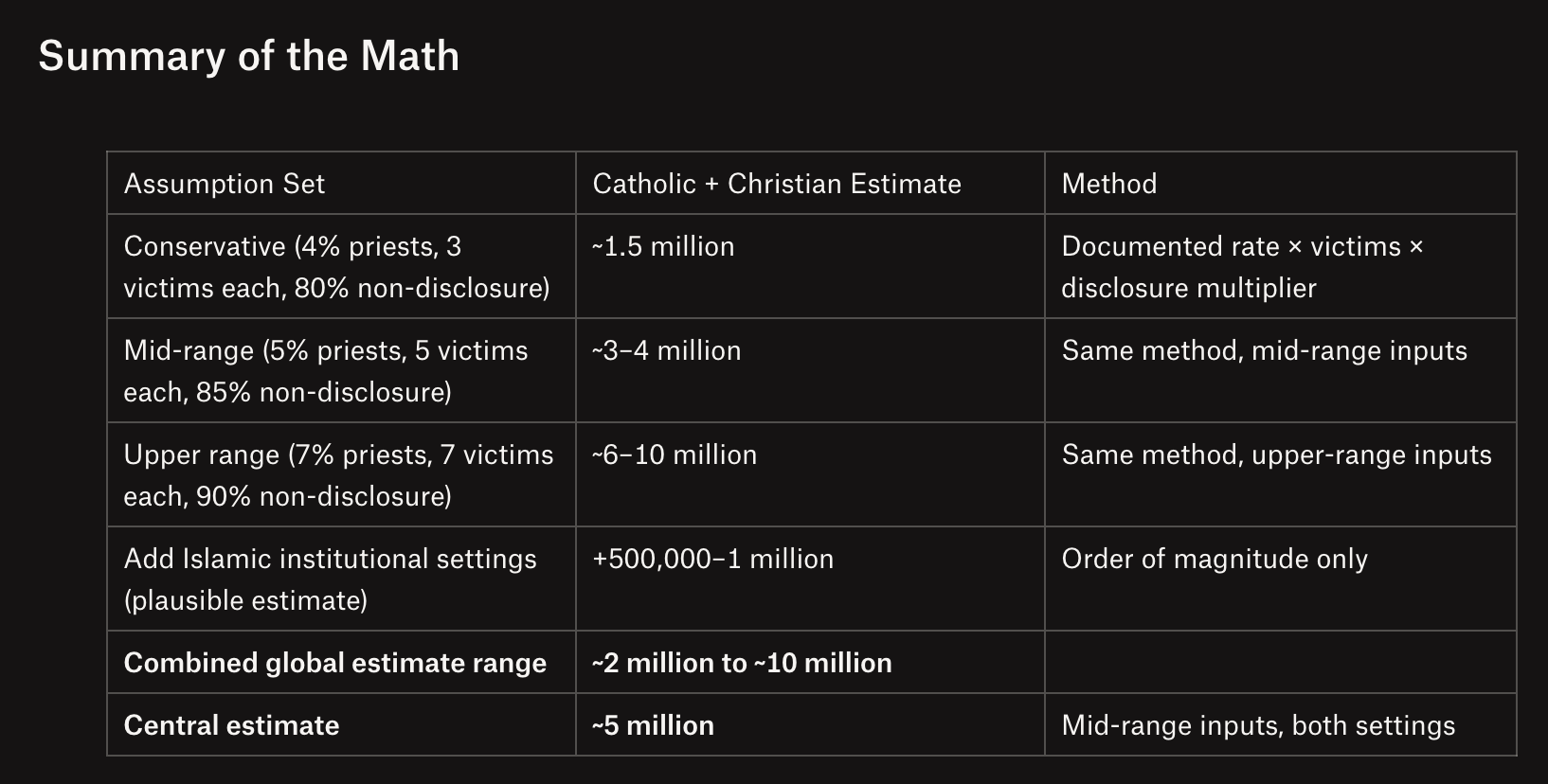
Assumption Set Catholic + Christian Estimate Method Conservative (4% priests, 3 victims each, 80% non-disclosure) ~1.5 million Documented rate × victims × disclosure multiplier Mid-range (5% priests, 5 victims each, 85% non-disclosure) ~3–4 million Same method, mid-range inputs Upper range (7% priests, 7 victims each, 90% non-disclosure) ~6–10 million Same method, upper-range inputs Add Islamic institutional settings (plausible estimate) +500,000–1 million Order of magnitude only Combined global estimate range ~2 million to ~10 million Central estimate ~5 million Mid-range inputs, both settings
What This Math Cannot Tell Us
This calculation cannot tell us exactly how many children were abused. No calculation can. The absence of documentation is itself part of the harm.
What the calculation can do is show that the five-to-ten million range is not fabricated or exaggerated. It is the product of applying documented, peer-reviewed multipliers to documented national inquiry totals. The inputs are publicly available. The method is transparent. The assumptions are stated.
If someone wants to argue the number is lower, they need to argue one of three things:
That the documented national accusation rates (4%–7% of priests) are too high — even though they come from independent national commissions in four different countries.
That the victim-per-abusive-priest count is lower than documented — even though the John Jay average is already considered conservative.
That the non-disclosure rate is lower than 80% — even though peer-reviewed research consistently finds that 70%–90% of child sexual abuse is never reported, and that male victims in religious settings disclose at even lower rates.
Each of those arguments is possible to make. None of them is easy to make honestly.
The documented victims are not the whole story. They are the floor. And the floor, by itself, is already catastrophic enough.
Key Sources for This Appendix
John Jay College Research Team, The Nature and Scope of Sexual Abuse of Minors by Catholic Priests and Deacons in the United States, 1950–2002 (2004)
CIASE (Independent Commission on Sexual Abuse in the Church, France), Report (2021)
MHG Study (German Bishops' Conference), Sexual Abuse of Minors by Catholic Priests, Deacons and Male Religious in Germany (2018)
Australian Royal Commission into Institutional Responses to Child Sexual Abuse, Final Report (2017)
Williams, L.M., "Recall of childhood trauma: A prospective study of women's memories of child sexual abuse," Journal of Consulting and Clinical Psychology 62 (1994)
London, K. et al., "Disclosure of Child Sexual Abuse: What Does the Research Tell Us About the Ways That Children Tell?" Psychology, Public Policy, and Law 11:1 (2005)
Abel et al., "Self-reported sex crimes of nonincarcerated paraphiliacs," Journal of Interpersonal Violence 2:1 (1987)
Psychology Today, "Understanding Delayed Disclosure of Child Sexual Abuse" (June 2023) — citing meta-analysis of 217 studies finding self-reported CSA rates 30× official report rates
Safe Kids Thrive / ICMEC, reporting estimates that 70–90% of child sexual abuse is never reported
Vatican Central Office of Church Statistics, Annuarium Statisticum Ecclesiae (2020, 2022)
Office of Justice Programs / NCJRS, "Controversy Over Repressed Memories"
This appendix accompanies "The Cost of Denial" by Victoria Siegel, published by Rational Body Publishing. The full essay and book are available at rationalBody.com.
A Note of Honesty On the Numbers: A Note of Honesty
I have seen extrapolations suggesting that the total number of boys abused in Catholic and Christian institutional settings over the twentieth century could reach five to ten million worldwide, and that abuse in Islamic religious settings may involve an additional one million or more. I believe these figures are plausible given what we know about underreporting, barriers to disclosure, and the gap between official counts and real-world prevalence.
I cannot prove them from published sources, and I will not pretend I can. No one can prove them — that is precisely the point. These are the cases that were not reported, not documented, not counted. The absence of proof is structural, not accidental.
What I can say, and what every serious inquiry confirms, is this: the documented victims are not the whole story. They are the floor. And the floor is already catastrophic.
If the institutions that committed and concealed this abuse want to argue that the real number is lower than the extrapolations suggest, they are welcome to open every file, every archive, every personnel record, every settlement document, every secret file that was supposed to be destroyed.
Until then, we should err on the side of believing the children.
How Many Priests?
As a cautious public-facing statement, you can say:
In the best-studied Catholic systems, official records show roughly 1 in 25 priests accused of abusing minors; after accounting for underreporting and missing records, a plausible real range is closer to 1 in 20 to 1 in 10 in some places and periods.
Was it worse in the past?
Yes — especially in the mid-20th century through the 1980s, before the scandal fully broke open. In the U.S., the John Jay work found that the major wave of reported abuse was concentrated before 2002, with large numbers tied to clergy ordained before 1970, and later public exposure accelerating after the Boston Globe reporting and the 2002 Dallas Charter. The U.S. official accused-clergy number is about 4%, or about 1 in 25, from 1950–2002. (USCCB)
So the timeline is:
Worst documented period: roughly 1950s–1980s, with many reports clustering in the 1960s, 1970s, and early 1980s.
Worst cover-up period: roughly 1950s–2002, before public scandal forced reforms.
Post-2002: reported new cases appear much lower in the U.S., but that does not erase historical abuse, and it does not prove every setting is now safe.
Germany’s MHG study found 4.4% of clerics accused overall and 5.1% of diocesan priests, while warning the true number was higher because the files were incomplete and controlled by church authorities. Australia’s figure was worse: about 7% of Catholic priests accused from 1950–2010. France’s inquiry estimated a lower perpetrator percentage, roughly 2.5%–2.8% minimum, but also estimated 216,000 clergy-abused children and 330,000 Catholic-linked victims since 1950. (Reuters)
The clean number to use
Officially, about 1 in 25 Catholic priests in the United States were accused of abusing minors. In Germany the figure was similar, about 1 in 23 overall and 1 in 20 diocesan priests. In Australia it was closer to 1 in 14. Because these numbers depend on victims reporting and church files surviving, the real historical prevalence in some Catholic systems was plausibly closer to 1 in 20 to 1 in 10.
How the Church hid it
The pattern repeated across countries and dioceses:
They moved accused priests instead of removing them.
A priest would be accused, sent for “treatment,” then reassigned to another parish, school, retreat center, or youth-facing role. New communities often were not warned. The Pennsylvania grand jury described more than 300 accused priests and more than 1,000 child victims across six dioceses, with bishops and church officials failing to report abuse to police or permanently remove accused priests from ministry. (PBS)
They treated crimes as internal personnel or spiritual problems.
Abuse was often handled as sin, scandal, weakness, misconduct, or a medical problem — not as rape, assault, or criminal child abuse. That allowed dioceses to use internal files, canonical procedures, quiet therapy placements, and private bishop-to-bishop decisions instead of police reports.
They kept secret files.
Many dioceses maintained confidential personnel records or “secret archives” containing allegations. In practice, these files often protected the institution more than children: they preserved internal knowledge while keeping parents, parishioners, police, and future victims uninformed.
They used therapy and treatment centers as laundering mechanisms.
Some accused priests were sent to church-linked treatment facilities, received evaluations, and were then returned to ministry. The effect was not just “care” for the accused; it created paperwork that could justify reassignment while hiding the original allegations from the next parish.
They used settlements and confidentiality.
Victims often received private settlements, sometimes with confidentiality provisions or pressure not to speak publicly. Some dioceses also paid for counseling or therapy in ways that could be tied to private resolution of claims. This does not mean every therapy payment was sinister — some survivors genuinely needed support — but the pattern was that money, pastoral language, and confidentiality could be used to keep cases out of court and out of the news.
They fought statutes of limitation reform.
Because many survivors disclose decades later, statutes of limitation protected institutions from accountability. When states opened “lookback windows,” lawsuits surged — showing how many claims had been legally blocked, not necessarily untrue. The 2024 Los Angeles settlement happened after California opened a window for older claims. (Reuters)
They used bankruptcy and insurance structures.
Many dioceses filed for bankruptcy to manage mass abuse claims. This could create a compensation pool for victims, but it also limited litigation, froze discovery, and reduced the risk of public trials exposing internal documents.
How much did it cost?
The money is staggering, and still incomplete.
In the U.S., BishopAccountability’s master list of major Catholic abuse settlements and awards says those major civil-suit payouts total more than $3 billion, but that list does not capture every cost. (Bishop Accountability)
A later aggregation of U.S. Catholic diocesan reports found $5.025 billion spent from 2004–2023 on abuse allegations. About three-fourths went to victims, 17% to attorneys’ fees, 6% to support for alleged abusers, and 2% to other costs. (National Catholic Reporter)
And that was before or alongside some huge recent settlements. The Archdiocese of Los Angeles agreed in 2024 to pay $880 million to 1,353 victims, bringing its cumulative abuse payouts to more than $1.5 billion. (AP News) Reuters also reported that the Diocese of Rockville Centre settlement was approved at more than $320 million for about 600 survivors, and in 2026 the Archdiocese of New York agreed to an $800 million settlement with about 1,300 survivors. (Reuters)
So the safest line is:
“In the United States alone, Catholic abuse-related costs are now well over $5 billion, and likely above $6 billion when major recent settlements are included. Los Angeles alone has paid more than $1.5 billion.”
In the best-studied Catholic systems, the official number is not one bad priest here or there. In the United States, about 4% of Catholic priests and deacons serving from 1950 to 2002 were accused of abusing minors — roughly 1 in 25. Germany’s figure was similar, about 4.4% overall and 5.1% of diocesan priests. Australia was worse, about 7%, or roughly 1 in 14. Because these numbers depend on victims reporting, files surviving, and church authorities recording allegations honestly, they should be treated as floors. A cautious real-world range is closer to 1 in 20 to 1 in 10 in some countries and periods, especially before the scandals broke open publicly. The abuse appears worst in the mid-20th century through the 1980s, while the cover-up stretched for decades after: priests transferred, allegations hidden in confidential files, therapy used as a way to recycle offenders, settlements handled privately, confidentiality clauses used to keep victims quiet, and legal defenses used to wait out statutes of limitation. In America alone, the financial cost has passed $5 billion and likely exceeds $6 billion with recent settlements, but the human cost is far larger: children sacrificed to protect the reputation, assets, and authority of the institution.