
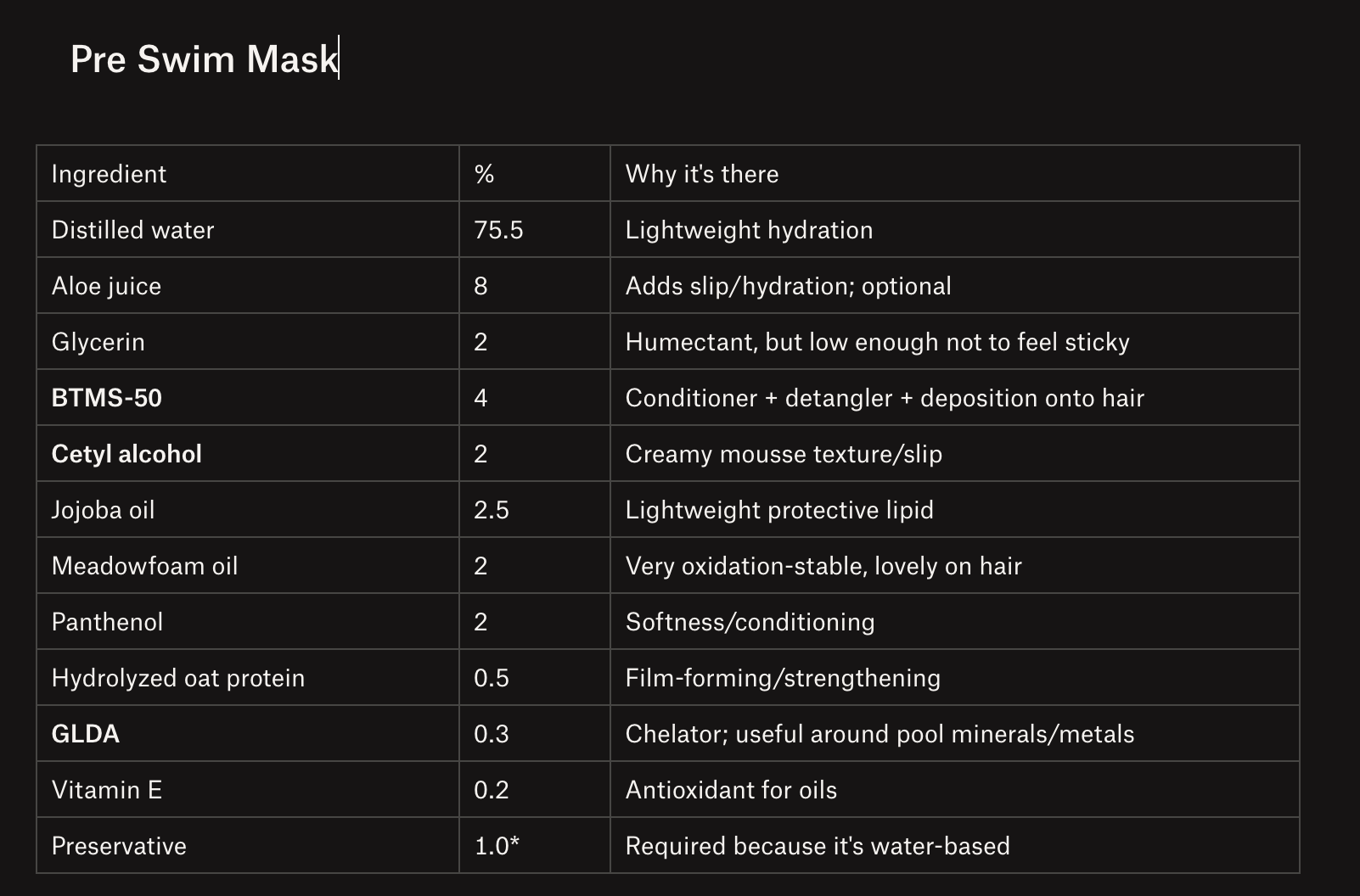
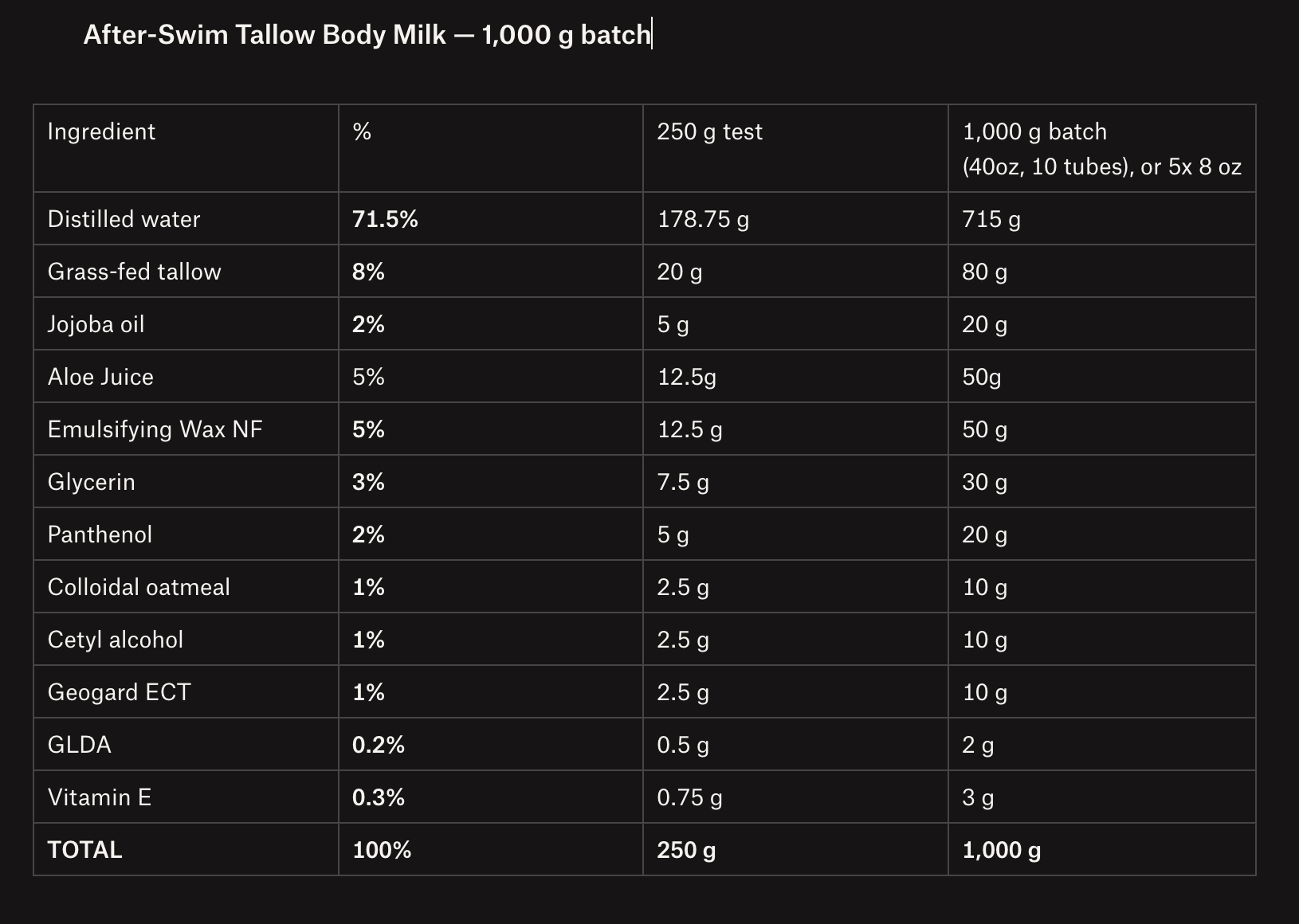
Exact hydrating lotion recipe
This is the kind of product I meant when I said “a lotion/cream with water + glycerin/panthenol gives hydration.”
Simple Post-Swim Hydrating Lotion
200g batch
Water phase
Distilled water — 134.6g
Aloe vera juice — 20g
Glycerin — 8g
Sodium citrate — 0.6g
Colloidal oatmeal — 2g
Oil phase
Apricot kernel oil — 15g
Emulsifying Wax NF — 10g
Cetyl alcohol — 4g
Cool-down
Panthenol — 4g
Geogard ECT — 1.8g
Total: 200g
Why this works
water + aloe = actual hydration
glycerin = humectant, helps hold water at the skin
panthenol = soothing, conditioning
apricot oil = softens and seals
emulsifying wax = turns it into a true lotion instead of oil sitting on top
cetyl alcohol = creaminess and skin feel
sodium citrate = slight hard-water support
oatmeal = comfort/soothing
Why not just tallow or apricot oil first?
Because after swimming, your skin is usually not just dry — it is dehydrated.
That means it needs:
water
humectants
then oil/occlusion
Oils and balms do this well:
soften
reduce water loss
protect
But they do not do this well on their own:
put water back into the skin
So if you apply only:
apricot oil
or tallow balm
to very dry post-swim skin, they can help seal and soften, but they don’t hydrate as effectively as a lotion first.
Best order if you feel very dry:
damp skin → lotion → then apricot oil or tallow balm if needed
So it’s not that tallow or apricot are “wrong.”
It’s that they are often better as the second layer, not the first.
The Simple Swim-Day Skin + Hair Routine
How to protect hair and skin before and after the pool
Pool days are wonderful for kids, but chlorine, sun, sunscreen, and hard water can leave hair and skin feeling dry, tight, tangled, or irritated. The goal is not to scrub harder. The goal is to use the right order.
A good swim routine has four simple jobs:
Saturate hair and skin before swimming
Reduce chlorine contact after swimming
Cleanse gently without stripping
Rehydrate and seal moisture back in
This routine is designed for kids, swimmers, sensitive skin, and hard water homes.
Before Swimming: Saturate + Protect
Step 1: Rinse hair and skin with plain water
Before getting into the pool, wet hair and skin thoroughly with clean water.
Hair and skin are porous. When they are already wet with clean water, they absorb less chlorinated pool water.
This is the easiest, cheapest, and most important pre-swim step.
Step 2: Optional pre-swim hair spray
For hair, especially longer hair, curly hair, highlighted hair, or hair that gets dry after swimming, apply a light pre-swim spray or leave-in conditioner.
The goal is not to coat the hair heavily. The goal is to add a little slip and reduce direct pool-water contact.
Use lightly:
wet hair first
mist or apply leave-in conditioner
comb through gently
braid, bun, or swim cap if desired
For kids, keep this away from eyes and avoid making the hair greasy. A little is enough.
Should vitamin C spray be used before swimming?
Vitamin C is most useful after swimming because it helps neutralize chlorine residue. It can be used before swimming, but I prefer to keep it as a post-swim step.
Before swimming, plain water + a light leave-in conditioner is usually enough.
After Swimming: Rinse + Neutralize
Step 1: Rinse immediately with plain water
After swimming, rinse hair and body with plain water first.
This removes a lot of pool water before any cleanser touches the skin. It also helps reduce the amount of cleanser needed.
Step 2: Fresh Vitamin C Post-Swim Rinse
This is the chlorine-neutralizing step.
Use a fresh-mixed vitamin C rinse after swimming, especially when skin smells like pool, hair feels rough, or swimming is frequent.
Fresh-Mix Vitamin C Rinse
Use:
8 oz / 1 cup water
1 smidgen spoon sodium ascorbate powder
A smidgen spoon is 1/32 teaspoon. This is a tiny amount — not a teaspoon, not a tablespoon.
How to use:
Fill an 8 oz bottle with water.
Add 1 level smidgen spoon of sodium ascorbate.
Shake until dissolved.
Spray or pour over hair and body, avoiding eyes.
Let sit for about 30 seconds.
Rinse off, then cleanse if needed.
For stronger pool smell, use up to 2 smidgen spoons per 8 oz water, but start with 1.
Sodium ascorbate is preferred over ascorbic acid for kids because it is less acidic and usually gentler on skin.
Should the vitamin C rinse be left on?
No. I do not recommend leaving it on all day.
Use it as a quick rinse step:
apply → wait 30 seconds → rinse or wash
Leaving it on can feel sticky, drying, or irritating for some skin, especially with repeated use.
Cleanse Gently
After the vitamin C rinse, use a gentle body wash.
For kids, the cleanser should not be harsh, heavily fragranced, or overly bubbly. Post-swim skin is already under stress from chlorine, sun, and hard water, so this is not the time for aggressive cleansing.
Use a gentle body wash on:
neck
chest
back
underarms
swimsuit areas
legs and feet
For hair, use a dedicated swimmer shampoo only when needed. If hair is short and not dry, the gentle body wash may be enough occasionally. If hair feels sticky, rough, waxy, or tangled, use a swimmer shampoo or swimmer shampoo bar.
After Shower: Rehydrate + Seal
This is the step that makes the biggest difference if skin feels dry after swimming.
After the shower, do not towel-dry completely. Pat skin until it is still slightly damp.
Step 1: Apply a simple hydrating lotion
A lotion or cream is the hydration step because it contains water plus humectants like glycerin and panthenol.
This helps put comfort back into the skin after pool exposure and cleansing.
Apply to damp skin:
arms
legs
belly
back
any areas that feel tight or itchy
Step 2: Seal with apricot oil or tallow balm if needed
If skin still feels dry, apply a thin layer of apricot oil or tallow balm on top.
Apricot oil is lighter and great for everyday use.
Tallow balm is richer and better for very dry patches, legs, elbows, hands, or irritated areas.
The best order is:
damp skin → lotion → apricot oil or tallow balm
Oil or balm alone can soften skin, but it does not hydrate as well as lotion first. Lotion brings water to the skin. Oil or balm helps seal it in.
Simple Swim-Day Routine
Before pool
Rinse hair and skin with plain water.
Apply light leave-in conditioner or pre-swim hair spray if needed.
Put hair up or use a swim cap if desired.
After pool
Rinse hair and body with plain water.
Apply fresh vitamin C rinse.
Wait 30 seconds.
Rinse again or cleanse.
Wash body with gentle body wash.
Use swimmer shampoo only if hair needs it.
Apply lotion to damp skin.
Seal dry areas with apricot oil or tallow balm.
Fresh Vitamin C Rinse Kit
This can be packaged simply as a fresh-mix swim kit.
Include:
8 oz / 1 cup spray or squeeze bottle
sodium ascorbate powder
1 smidgen spoon, which equals 1/32 teaspoon
instruction card
Directions:
Fill bottle with water to the 8 oz line. Add 1 level smidgen spoon sodium ascorbate. Shake. Spray or pour over hair and body after swimming. Wait 30 seconds. Rinse or cleanse. Use fresh. Do not store mixed rinse for more than the day.
A squeeze bottle is often easier for hair and full-body use. A spray bottle feels more elegant, but it takes longer to cover the whole body.
Important Notes
Avoid eyes.
Do not call the vitamin C rinse or body wash “tear-free” unless it has been properly tested.
Do not leave vitamin C rinse on the skin all day.
Make the vitamin C rinse fresh each swim day.
Moisturize while skin is still damp.
Use swimmer shampoo only when hair actually needs stronger cleansing.
The goal is not more products. The goal is the right sequence: rinse, neutralize, cleanse gently, hydrate, seal.