
Dish soap is one of those things where DIY can be better than store-bought, especially for grease + sensitive hands.
Here are two solid options that behave very differently:
A tallow-based dish soap BAR (powerful, zero-waste, classic)
A gentle liquid dish soap (closer to 7th Generation feel, but more complex)
OPTION 1 (RECOMMENDED): Tallow Dish Soap Bar 🍽️🧼
Extremely effective, simple, low-toxicity, eco-friendly
This is what people used for 100+ years to cut grease — and it still slaps.
Why this works so well
High saturated fat (tallow) → excellent grease removal
Hard bar = no plastic
No preservatives
No surfactants beyond soap itself
Cheap, durable, compost-safe
You’ll use it with:
a scrub brush
a dish cloth
or a Swedish dishcloth
Yes — a scrub brush is ideal, especially with kids’ dishes and grease.
🧪 Tallow Dish Soap Bar Formula (by oil weight)
Oil blend (100%)
70% beef tallow
30% coconut oil
Why coconut?
Boosts lather
Improves grease cutting
Keeps bar from feeling “waxy”
Lye & water
Superfat: 0–2% (lower than bath soap!)
Water: 30–33% of oil weight
Low superfat = less residue on dishes.
Optional (but helpful)
1 tbsp sodium citrate per 1 lb oils
(reduces soap scum, great for hard water)
Add sodium citrate to the water before lye.
🧤 Skin safety
Fresh soap is alkaline — gloves are smart
After cure (4–6 weeks), it’s much gentler
Using a brush = minimal skin contact
Many people with sensitive hands tolerate this better than liquid detergents
How to use
Wet brush
Swipe on bar
Wash dishes
Rinse
✨ Zero residue, zero fragrance, zero nonsense.
Tallow Dish Soap Bar (Hard-Water Optimized)
Batch size
1000 g total oils
Yields ~10–12 solid bars (depending on mold)
🧈 Oils (1000 g total)
Beef tallow 70% 700 g
Coconut oil (76°) 30% 300 g
⚗️ Lye & Water
Sodium hydroxide (NaOH)
152 g NaOH
This equals ~1% superfat
Low residue, safe but effective for dishes
Distilled water
300 g water
30% water = firm bar, faster cure
🧂 Hard-Water Booster (Highly Recommended)
Sodium citrate
20 g (2% of oil weight)
How to add:
Dissolve fully in the 300 g water, then slowly add NaOH to that solution.
Why it matters:
Reduces soap scum
Improves rinsing
Makes soap work better in mineral-heavy water
🧑🔬 Recipe Notes (Important)
Mix oils and lye solution at 30–40°C
Stick blend to light trace
Pour, insulate lightly
Unmold after 24–48 hours
Cure minimum 4 weeks, best at 6–8 weeks
Use
Wet dish brush
Swipe bar
Wash dishes
Rinse
👉 Minimal hand contact = much gentler for sensitive skin
OPTION 2: Liquid Dish Soap (Closer to 7th Generation)
This is doable, but more finicky.
You have two routes:
2A. Liquid CASTILE-style soap (tallow + KOH)
Pros
Liquid
Natural
No synthetic surfactants
Cons
Slimy feel
Less sudsy
Can leave residue
Harder to stabilize
Honestly? Most people who try this go back to bars for dishes.
2B. Liquid dish soap using mild surfactants (best liquid option)
If you want something that behaves like 7th Generation:
Base surfactants
Decyl glucoside
Coco glucoside
(Optionally) sodium coco sulfate (adds suds, still mild)
This is not soap + lye, but it’s:
pH balanced
Much gentler on hands
More consistent
Better for guests
If you want this route, I can design a kid-safe, sensitive-skin liquid dish soap next.
What I’d recommend for your household
Given that:
You’re comfortable with lye
You care about environment
You have sensitive hands
You already use gloves sometimes
👉 Tallow dish soap bar + scrub brush is the winner.
Many people find:
less dryness than liquid detergents
fewer ingredients
dramatically better grease removal
You can always keep a small bottle of liquid soap for guests.
Pros/cons:
Tallow is better (5 star) at grease cutting than liquid dish soap.
Both 4 star for skin friendliness.
Tallow is much easier to make
Tallow is easier to sell ;) AND NO PLASTIC!
Just need to find a brush in larger quantities and packaging
Tallow Dish Soap Bar (Exact Lye Amounts)
This is a true dish detergent bar (low superfat, high grease-cutting).
🔢 Batch size: 1000 g total oils (about 10–12 bars)
Oil formula = hard bar + excellent grease removal.
700 g beef tallow (70%)
300 g coconut oil (30%)
⚗️ Lye calculation (NaOH)
Lye needed at 0% superfat (ideal for dishes)
For 1% superfat for safety without residue:
👉 NaOH = 152 g
💧 Water amount
For dish soap, you want it firm and fast-curing.
Water = 30% of oil weight
1000 g oils → 300 g distilled water
(You can go as low as 28% if experienced.)
🧂 Hard-water tweak (HIGHLY recommended)
Add sodium citrate
2% of oil weight
20 g sodium citrate
How to add it
Dissolve sodium citrate fully in the water
THEN add NaOH to that water
This:
Reduces soap scum
Improves rinsing
Makes the bar perform much better in hard water
🧤 Safety notes
Gloves & eye protection: yes
Mask: optional
Ventilation: normal kitchen is fine
🧼 Cure time
Minimum: 4 weeks
Best performance: 6–8 weeks
Dish soap gets better with age.
👉 Use a dish brush or sponge, not bare hands, since soap is alkaline
Brushes minimize skin contact
But it is still much gentler for sensitive hands than liquid detergents!
This is why many people with eczema tolerate soap bars better.
Liquid Dish Detergent (Guest-Friendly Option)
Why have this too? a mild surfactant blend that behaves like 7th Generation.
Familiar for guests
Easier for quick hand-washing
Less alkaline
Still low-tox
🧪 Liquid Dish Detergent — Ingredient List
Surfactants (clean + mild)
Decyl glucoside
Coco glucoside
(Optional for extra suds) Sodium coco sulfate or sodium lauryl sulfoacetate (SLSa)
Builders / boosters
Sodium citrate
Sodium phytate
Conditioning
Glycerin
Preservative
Sodium benzoate + potassium sorbate
Water
Distilled
(No lye, no saponification.)
🫧 Liquid Dish Detergent (Guest-Friendly)
This behaves like 7th Generation–style dish soap:
Pourable
Mild
Sudsy
Neutral pH
No lye
Perfect to keep by the sink for guests or quick washes.
Batch size
1000 g (1 liter)
🎯 Target pH
7.0 – 7.5
Lower pH → gentler on hands
Still excellent grease removal
Adjust with:
Citric acid solution (10%) → to lower pH
Tiny pinch sodium citrate → to raise gently
🧑🔬 Mixing Notes (Liquid Soap)
Heat ~500 g water to ~40°C
Dissolve:
sodium citrate
sodium phytate
sodium benzoate
potassium sorbate
Add glycerin
Slowly stir in decyl glucoside, then coco glucoside
Check & adjust pH
Add remaining water to reach 1000 g
Let sit 12–24 hours before bottling (foam settles)
🫱 Hands, Kids & Environment
Tallow bar
Very alkaline → use with brush
Extremely low waste
Long shelf life
Best grease removal
Liquid detergent
Near-neutral pH
Easier for guests
Gentler for frequent hand contact
Still very low toxicity
Having both is honestly the ideal setup.
🧠 Optional tweaks (later, only if you want)
Increase coconut oil to 35% for harder grease (slightly harsher)
Add 0.5% sodium gluconate instead of citrate if you want max hard-water performance
Add very light EO scent to the liquid only (I can help with safe grams)
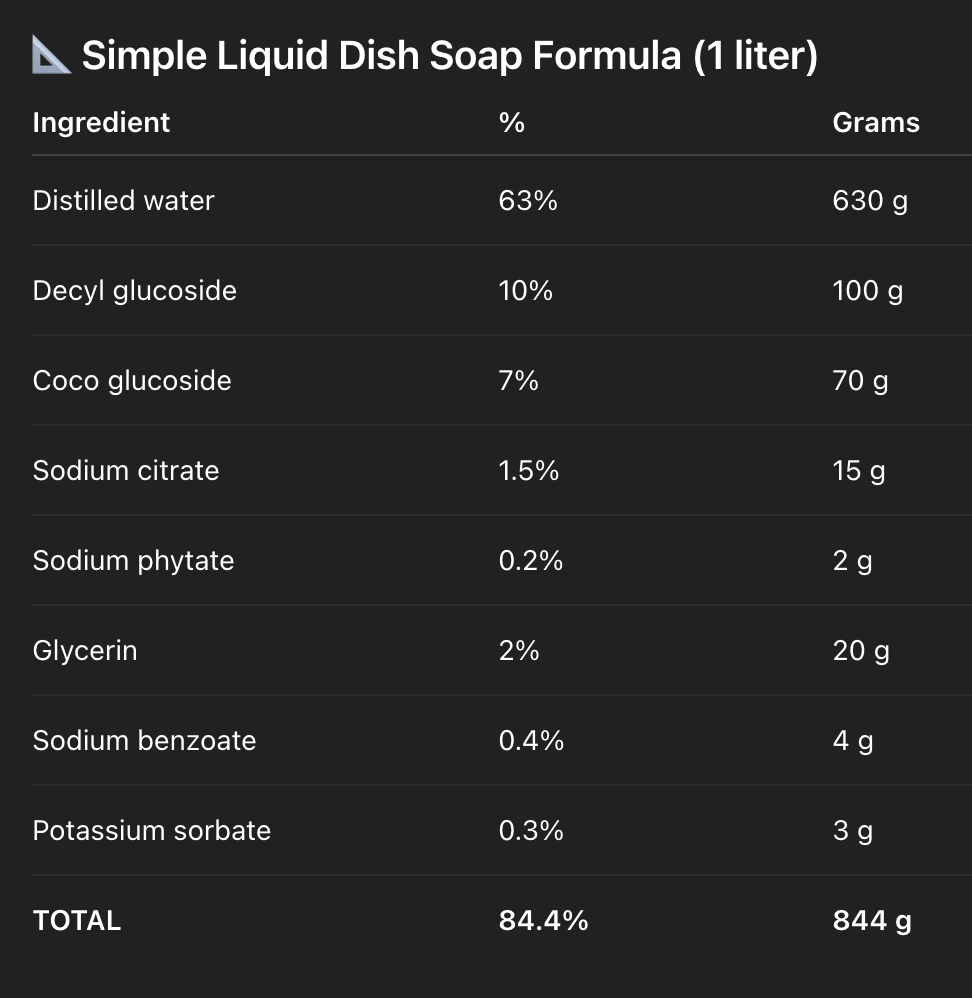
Ingredients
Distilled water 63% 630 g
Decyl glucoside 10% 100 g
Coco glucoside 7% 70 g
Sodium citrate 1.5% 15 g
Sodium phytate 0.2% 2 g
Glycerin 2% 20 g
Sodium benzoate 0.4% 4 g
Potassium sorbate 0.3% 3 g
TOTAL 84.4% 844 g
Top up with distilled water to 1000 g after pH adjustment.
Target pH
👉 7.0–7.5 (much gentler than soap)
Adjust with:
Citric acid (to lower)
Sodium citrate (to raise gently)
🫧 Performance notes
Cuts grease very well
Rinses clean
Less drying than soap
Kid-safe when used normally
🧠 Which should you actually use day-to-day?
You: tallow dish soap bar + brush
Guests / quick use: liquid dish detergent
That combo gives you:
Best performance
Lowest waste
Happiest hands