EWG Study: Umbilical Cord Toxins
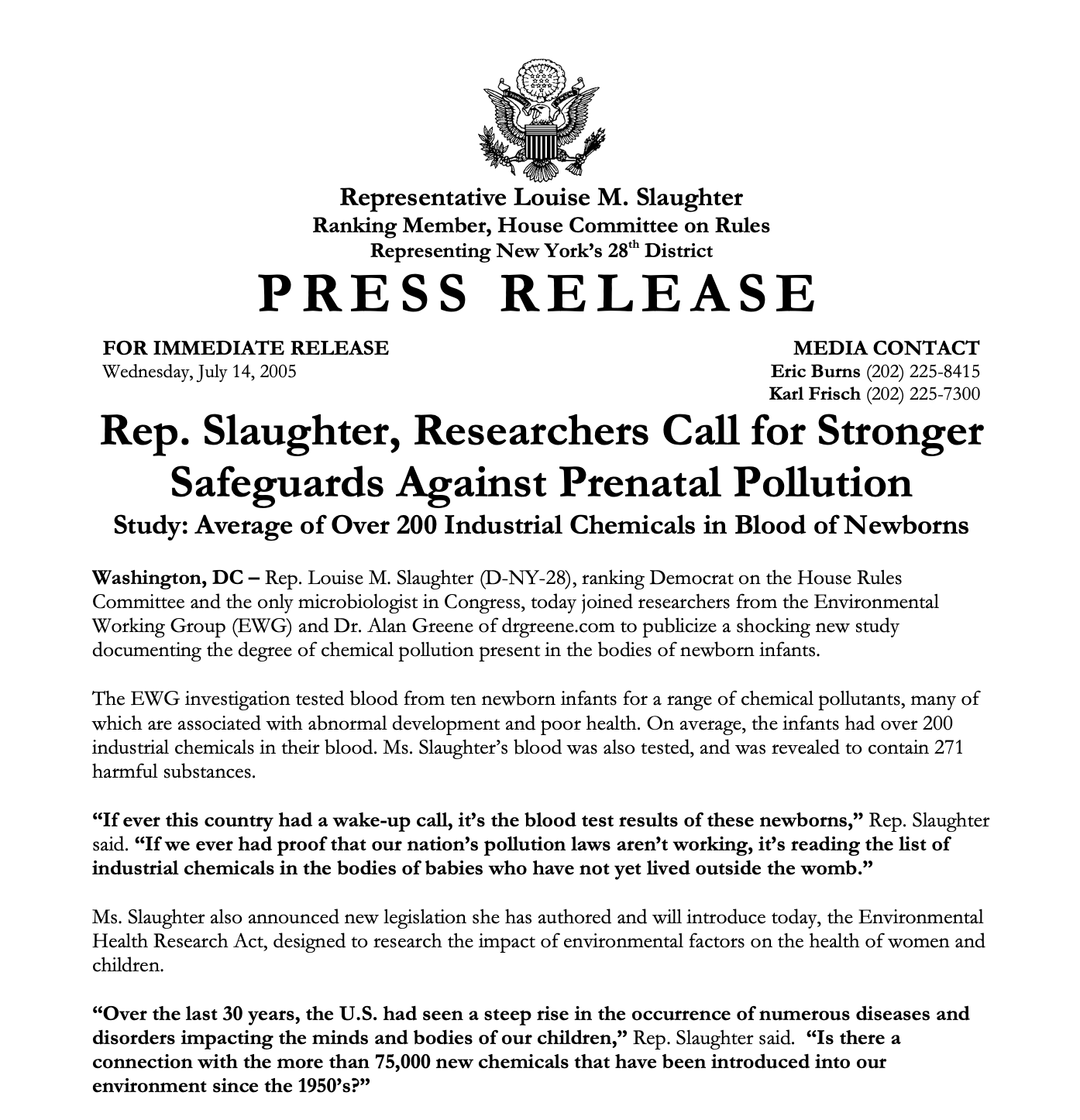
Researchers Call for Stronger Safeguards Against Prenatal Pollution
Researchers Call for Stronger Safeguards Against Prenatal Pollution
Study Finds Average of Over 200 Industrial Chemicals in Blood of Newborns
Washington, DC — Representative Louise M. Slaughter (D-NY-28), ranking Democrat on the House Rules Committee and the only microbiologist in Congress at the time, joined researchers from the Environmental Working Group (EWG) and Dr. Alan Greene of DrGreene.com to publicize a startling new study documenting the extent of chemical pollution in the bodies of newborn infants.
The Environmental Working Group investigation tested blood samples from ten newborn infants for a wide range of chemical pollutants — many of which are associated with abnormal development and poor health. On average, the infants had more than 200 industrial chemicals in their blood at birth. Representative Slaughter also underwent testing, which revealed that her own blood contained 271 harmful substances.
“If ever this country had a wake-up call, it’s the blood test results of these newborns,” Rep. Slaughter said. “If we ever had proof that our nation’s pollution laws aren’t working, it’s reading the list of industrial chemicals in the bodies of babies who have not yet lived outside the womb.”
She also announced legislation she authored — the Environmental Health Research Act — designed to expand research into the impact of environmental factors on the health of women and children.
“Over the last 30 years, the U.S. has seen a steep rise in numerous diseases and disorders impacting the minds and bodies of our children,” Slaughter said. “Is there a connection with the more than 75,000 new chemicals that have been introduced into our environment since the 1950s?”
“We need to research the impact of these chemical pollutants now,” she added. “Only then will we have the information we need both to detoxify and to prevent developmental disabilities and other environmentally related diseases in future generations. Let’s not permit our babies of the future to be polluted before they are even born.”
Background: Pollution Begins Before Birth
Until recently, scientists believed that babies in the womb were largely protected from most toxic chemicals. However, the EWG study confirms that chemical exposure begins before birth.
Tests were conducted on ten American Red Cross umbilical cord blood samples for what researchers described as the most extensive array of industrial chemicals, pesticides, and other pollutants ever studied in newborns. The infants averaged 200 contaminants in their blood, including:
Mercury
Fire retardants
Pesticides
The Teflon chemical PFOA
Rep. Slaughter discussed the findings alongside Jane Houlihan, EWG’s Vice President for Research, and pediatrician Dr. Alan Greene, founder of DrGreene.com and Clinical Assistant Professor at the Stanford University School of Medicine.
Summary of the Environmental Health Research Act
The proposed legislation includes two major components:
1. Women’s Environmental Health Research Centers
The bill authorizes the National Institute of Environmental Health Sciences (NIEHS) to establish six multidisciplinary research centers focused on environmental factors affecting women’s health and disease prevention.
The Director of NIEHS, in consultation with the Director of the Office of Research on Women’s Health, would award grants to public or nonprofit institutions to:
Conduct basic and clinical research
Develop training protocols and programs
Offer continuing education for health professionals
Disseminate information to health professionals and the public
Focus on prevention of environmentally related conditions
Provide stipends for health professionals in training programs
Collaborate with community organizations
Work directly with women affected by environmentally linked disorders
2. Hormone Disruption Research Program
The legislation also directs NIEHS to coordinate a comprehensive research program studying the impact of hormone-disrupting chemicals on maternal and child health.
Working in cooperation with the U.S. Geological Survey and other domestic and international agencies, the program would:
Collect and disseminate scientifically valid data on human health effects
Study low-dose exposures during critical developmental stages
Evaluate prenatal exposure impacts on children
Assess exposure levels in residential and occupational settings
Investigate how hormone-disrupting substances interact with biological systems
Develop in vitro and in vivo screening and testing methods
Examine environmental levels and long-term fate of these chemicals
The Secretary of Health and Human Services would establish a Hormone Disruption Research Interagency Commission and a Hormone Disruption Research Panel to guide scientific direction and interagency coordination.
Rep. Slaughter’s Personal Test Results
Rep. Slaughter described her own participation in the study in striking terms:
“During my life I’ve been called a lot of things — a microbiologist, a mother of three, a Member of Congress. But today I seem to have earned a new title — I am now a walking chemical plant.”
Her results revealed hundreds of chemicals in her body, including:
PCBs (banned decades ago)
Chemicals used in Teflon (currently under federal investigation at the time)
Substances used in insecticides
Chemicals found in electrical cables and fluorescent lamps
Automobile engine oil compounds
Auto exhaust fumes
Flame retardants
In total, 271 harmful substances were identified in her bloodstream.
“That’s hardly the picture of health I had hoped for,” she said. “But I’ve been living in an industrial society for over 70 years.”
She contrasted her experience with that of the newborns in the study.
“These ten newborn babies were born polluted. On average each one had some 200 chemicals in their blood — before they ever touched a blanket, a bassinet, a car seat, or even took their first breath.”
Rising Health Concerns
Rep. Slaughter pointed to increases over the past three decades in:
Childhood cancers
Testicular cancer
Juvenile diabetes
Attention deficit disorder
Learning disabilities
Thyroid disorders
Cognitive impairment
Autoimmune disorders
Autism diagnoses alone rose 210% between 1987 and 1998.
“We ask ourselves, why? What’s happening?” she said. “Is there a connection with the more than 75,000 new chemicals introduced into our environment since the 1950s?”
She emphasized that significant gaps remain in understanding long-term, low-dose exposure effects on women, fetuses, and children at critical stages of development.
A Call for Preventative Action
“Banning chemicals after they have entered the environment is not enough,” Slaughter argued. “We must test chemicals before they go onto the market, not after they get into our bloodstreams.”
For five years, she had urged Congress to pass legislation allowing the National Institutes of Health to study chemical impacts on women and children. With the introduction of the Environmental Health Research Act, she renewed that call.
“Let’s pass this legislation. Let’s clean up our environment. Let’s clean up our bodies. But most importantly, let’s not permit our babies of the future to be polluted before they are even born.”
What has happened in the 20+ years since this came out?
🧪 More Research Confirming Prenatal Chemical Exposures
PFAS “Forever Chemicals”
✔ New studies continue to show that per- and polyfluoroalkyl substances (PFAS) — a class of chemicals widely used in nonstick coatings, firefighting foams, and consumer products — cross the placenta and are found in umbilical cord blood at birth. Researchers using advanced detection methods have identified far more distinct PFAS in cord blood than older tests could capture, showing broader and more complex prenatal exposure than previously understood.
✔ PFAS exposures have been linked in recent studies to low birth weight, preterm birth, altered immune responses, and metabolic changes in children — outcomes that reinforce concerns about early-life effects on health and development.
Other Chemical Classes
✔ Phthalates — plasticizers found in many consumer products — continue to be widely detected in pregnant women and fetuses and have been associated in research with slowed development, endocrine disruption, and adverse birth outcomes.
✔ Studies on urban and diverse populations have documented continued prenatal exposure to a wide range of industrial chemicals, including replacements for banned compounds, pesticides, plastics-associated chemicals, and metals.
✔ Biomonitoring has broadened beyond small pilot studies to larger cohorts measuring dozens to over 100 chemicals in pregnant women and newborns, though not all chemicals of concern are routinely monitored.
🧬 Health Effects and Epidemiology
✔ Chemicals that cross the placenta are now linked in epidemiological studies to neurodevelopmental delays, lower birth weights, preterm births, immune system changes, metabolic differences, and other outcomes in children, suggesting measurable effects connected to prenatal exposures.
✔ Large research programs (such as NIH’s ECHO initiative) have documented associations between prenatal exposures and risks such as preterm birth, lower birthweight, and conditions later in childhood.
✔ Increased focus on mixtures of chemical exposures rather than single agents has become a frontier in research, as real-world exposures involve multiple overlapping chemicals.
📜 Regulatory and Policy Changes
Chemical Regulation in the United States
✔ There have been incremental regulatory actions on some specific chemicals (e.g., bans on certain phthalates in children’s toys), and FDA actions such as banning BPA in baby bottles.
✔ However, broader regulation of industrial chemicals remains fragmented and slow, especially in light of the sheer number of chemicals in commerce and limitations in historic U.S. law such as the Toxic Substances Control Act.
✔ Many advocates and scientists have called for “class-based regulation” of PFAS and similar groups of chemicals instead of addressing them one by one, because exposure and health impacts involve multiple related compounds.
🌍 Ongoing Scientific and Public Health Focus
Broader Awareness
✔ Prenatal exposures are now widely recognized by public health researchers as a significant concern, triggering expanded biomonitoring studies (CDC, NIH ECHO) and deeper investigations into how chemical exposures affect children’s long-term health.
✔ Scientists use higher-resolution methods (like nontargeted chemical analysis) to detect more chemicals in cord blood and human tissues than was possible in the early 2000s.
Environmental Justice Dimensions
✔ Studies have also shown that chemical exposures can vary widely by socioeconomic and racial/ethnic groups, adding environmental justice considerations to discussions about prenatal pollution. (For example, earlier minority cord blood studies detected many hazardous chemicals; ongoing research continues to explore disparities.)
🧠 Bottom Line After 20 Years
Exposure to industrial and consumer-product chemicals before birth is still widespread — across PFAS, phthalates, pesticides, and flame retardants — and modern research has only expanded our understanding of how many chemicals reach fetuses and how they may affect health. Regulation has been modest and incremental, typically chemical by chemical, rather than broadly preventative across chemical classes. This has left scientists and public health advocates calling for stronger safeguards, more comprehensive testing before chemicals enter the market, and better protection of pregnant women and children.