Bringing School Wellness to Life
Bringing School Wellness to Life: Real Programs, Free Lessons, and a Farmers' Market Idea Worth Sharing
What schools in Pennsylvania, California, and Mississippi have already accomplished, and how parents could create similar opportunities in their own communities.
Summary
I've spent quite a bit of time researching school wellness policies, and one of the most encouraging discoveries has been how much useful material already exists. Schools have developed nutrition lessons that take only 15 minutes, established wellness committees that involve parents, created school gardens, organized healthier fundraisers, and partnered with local farms and markets to help children understand where food comes from.
Many of these examples were documented in a 2014 CDC report called Putting Local School Wellness Policies into Action. I wanted to know whether any of the original teaching materials, assessment systems, and programs were still available.
I found some wonderful resources, including an ongoing districtwide wellness program in Pennsylvania, publicly accessible classroom nutrition activities from Oakland, California, and a Mississippi school that incorporated nutrition lessons into its weekly curriculum.
I also discovered that the Pacific Coast Farmers' Market Association, which operates numerous markets in the San Francisco Bay Area, has experience creating educational field-trip opportunities for students.
That gave me an idea I'd love to explore locally: a farmers' market discovery day where children meet growers, learn about seasonal produce, and participate in simple educational activities.
I think there is an opportunity here for schools, farmers, parents, and local businesses to collaborate in ways that support both children's education and the communities that grow their food.
Downingtown, Pennsylvania, shows what long-term school wellness can look like.
One of the schools featured in the CDC's original report was Downingtown Area School District in Pennsylvania.
At the time, its superintendent, Dr. Larry Mussoline, credited regular communication, responsiveness to families and staff, and leadership from principals with helping overcome resistance to changes in school wellness practices.
I wanted to understand what that actually looked like.
The district had established a wellness advisory committee that included administrators, teachers, parents, school board members, community partners, and representatives from different district departments. Individual schools developed wellness plans and reported their progress through school health councils.
They used the CDC's School Health Index to identify areas needing improvement and developed annual plans with specific goals and activities.
What I find particularly impressive is that the system is still active today.
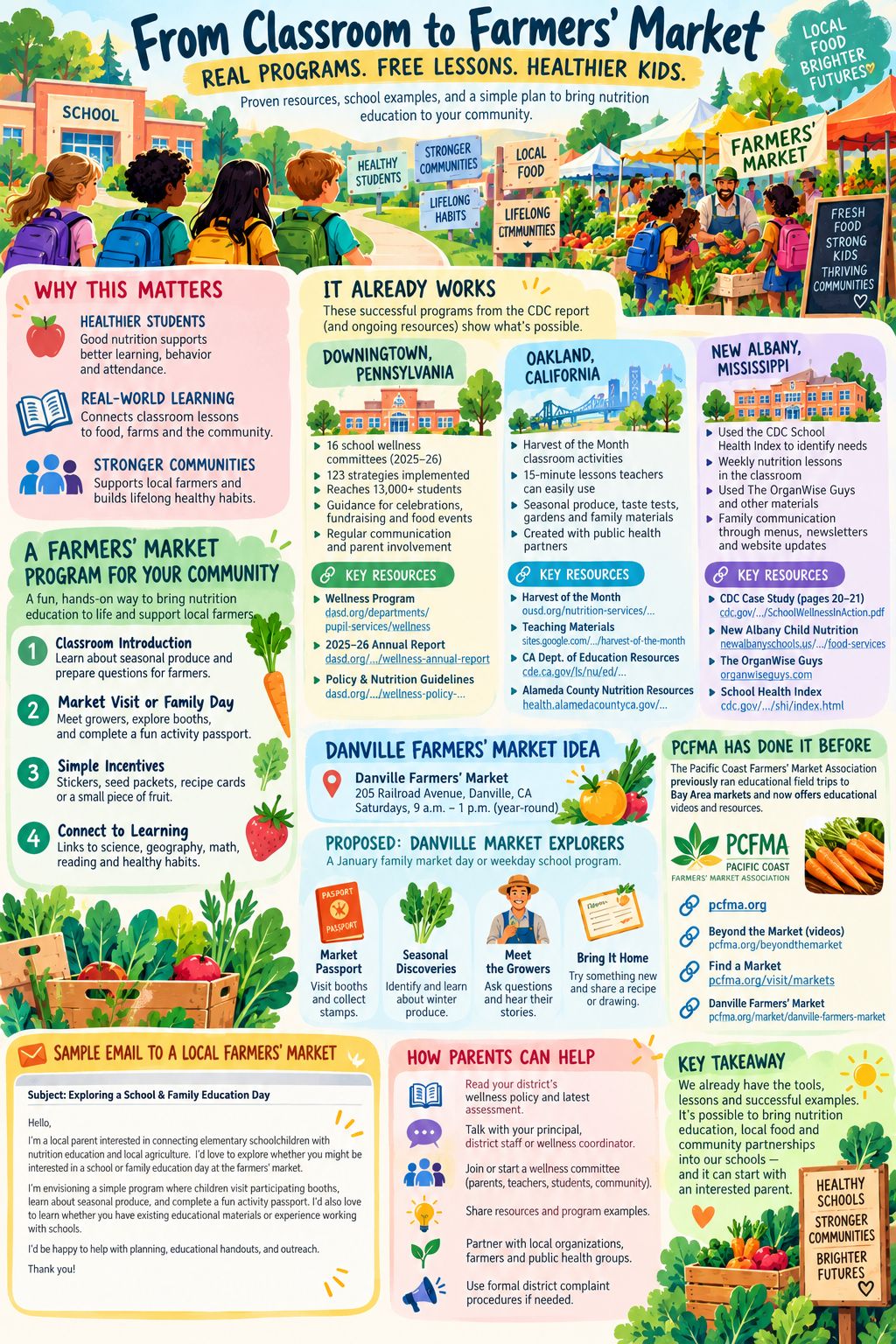
Downingtown's publicly available 2025–26 Annual Wellness Report describes 16 school-level wellness committees, 123 implemented strategies, and wellness initiatives reaching more than 13,000 students.
Individual schools continue to develop wellness plans, and the district publishes information about its goals, activities, and progress.
The program has expanded to address nutrition, physical activity, mental health, school climate, and broader student well-being.
One aspect that especially interests me is that the district's wellness committee reviews activities such as classroom celebrations, fundraising, and school food events to help align them with its wellness goals.
This provides a practical structure for questions that might otherwise be left to individual teachers or volunteers.
The district also publishes guidance on alternatives to food-based celebrations and rewards, recognizing that food rewards can create complications for children with allergies, medical needs, and different dietary restrictions.
I think this is a particularly useful example for districts trying to establish a consistent approach.
Schools already make countless decisions throughout the year about fundraising, celebrations, classroom rewards, and student activities. Having a committee that can provide guidance and help coordinate those decisions seems much easier than expecting each school to interpret its wellness policy independently.
Downingtown also demonstrates why communication matters. The district provides public annual reports, maintains wellness resources on its website, and has designated contacts who can help answer questions.
Its work offers a model for creating accountability while still allowing individual schools to develop programs suited to their students.
Downingtown resources
District Wellness Program:
https://www.dasd.org/departments/pupil-services/wellness
2025–26 Annual Wellness Report:
https://www.dasd.org/departments/pupil-services/wellness/wellness-annual-report
Wellness Policy and Nutrition Guidance:
https://www.dasd.org/departments/pupil-services/wellness/wellness-policy-and-nutrition-guidelines
For anyone interested in introducing a similar model, I would consider contacting the district to ask whether it could share its school health improvement plan templates, wellness committee agendas, or examples of annual assessments.
Those materials could help another district build a practical structure using work that has already been done.
Oakland, California, offers classroom nutrition education that teachers can actually use.
Another CDC example that caught my attention came from Oakland Unified School District.
In the original report, Oakland partnered with the Alameda County Public Health Department to provide nutrition education connected to the foods students encountered in school.
The district developed short classroom activities, colorful posters, student handouts, and information for families. Some of the recommended activities were designed to take approximately 15 minutes, making them easier to incorporate into an existing classroom schedule.
I love that approach because I recognize how many demands are already placed on teachers. A nutrition lesson should be easy to use, interesting for children, and connected to what they're already learning.
Oakland's Harvest of the Month program is particularly useful.
The program introduces children to seasonal fruits and vegetables through classroom lessons, gardening activities, cafeteria experiences, and educational materials.
The district's current resource collection includes newsletters, activity pages, slide presentations, videos, and other teaching materials.
A teacher might introduce a seasonal vegetable, show students how it grows, explain where it comes from, and give children an opportunity to observe or taste it.
That could easily connect to science, geography, reading, or math.
Students could compare different varieties of produce, learn which parts of plants we eat, count seeds, measure vegetables, or explore how food travels from farms to grocery stores and farmers' markets.
These activities also create opportunities for families to continue the learning at home.
The California Department of Education maintains a separate Harvest of the Month resource directory that includes teaching materials from several organizations.
Its collection references taste-testing activities, recipes, gardening lessons, field-trip ideas, videos featuring growers, and family newsletters.
I think these resources would be useful for schools that want to introduce nutrition education without requiring teachers to develop a curriculum from scratch.
Oakland and California teaching resources
Oakland Unified — Harvest of the Month:
https://www.ousd.org/nutrition-services/resources-forms/teachers-corner/harvest-of-the-month
Oakland — Harvest of the Month Teaching Materials:
https://sites.google.com/ousd.org/thecenteredprogramming/harvest-of-the-month
California Department of Education — Harvest of the Month Curriculum Resources:
https://www.cde.ca.gov/ls/nu/ed/harvestofmonthcurr.asp
Alameda County Public Health — Nutrition Resources:
https://health.alamedacountyca.gov/food-and-nutrition-services-resources/
The original 2012–13 Oakland Eats Garden Fresh worksheets were not all available through the current public resources I found. However, the newer materials provide many similar opportunities for classroom education.
I would love to see more schools introduce one seasonal fruit or vegetable each month and connect it to the lessons children are already learning.
New Albany, Mississippi, made nutrition education a weekly activity.
The CDC report also described New Albany Elementary School in Mississippi, which incorporated nutrition education into its regular weekly schedule.
School leaders used the CDC's School Health Index to evaluate their existing programs and identify areas where additional health education was needed.
The school's health services coordinator, administrators, and health education teacher then worked together to develop a curriculum.
Teachers provided at least one nutrition education lesson each week.
Some lessons explored the importance of eating breakfast and the relationship between nutrition, energy, attention, and learning.
The school used educational videos and worksheets, including materials from The OrganWise Guys, and sent information home so families could continue the conversation.
Nutrition education was also reinforced through cafeteria announcements, school newspaper articles, and monthly website updates.
I appreciate that the school established a regular place for nutrition education within its curriculum.
Children learn through repetition and experience, and it makes sense to introduce these topics in age-appropriate ways throughout the year.
A kindergarten class might learn about different fruits and vegetables, while older students could explore nutrition labels, food groups, agriculture, or how food choices affect the body.
Schools could also connect these lessons to seasonal celebrations, gardening projects, or trips to local farms and markets.
The complete original collection of New Albany's weekly lesson plans does not appear to be publicly available. Parents or educators interested in the program could contact the district to ask whether archived curriculum materials, sample schedules, or teacher handouts could be shared.
New Albany resources
CDC — Original New Albany Case Study (see pages 20–21):
https://www.cdc.gov/assessing-improving-school-health/media/pdfs/SchoolWellnessInAction.pdf
New Albany Schools — Child Nutrition:
https://www.newalbanyschools.us/services/food-services/
CDC — School Health Index:
https://www.cdc.gov/assessing-improving-school-health/shi/index.html
The OrganWise Guys:
https://organwiseguys.com/
The School Health Index is particularly useful because it gives schools a way to evaluate their existing practices and develop an improvement plan based on their needs.
What if schools partnered with their local farmers' market?
Reading about these programs made me think about the farmers' market in my own community.
Farmers' markets offer opportunities for children to experience many of the subjects schools already teach. They can learn about agriculture, seasons, geography, nutrition, small businesses, and the relationships between farmers and the communities they serve.
Children can meet the people growing their food, ask questions, see unfamiliar produce, and learn what grows locally at different times of year.
A visit could be connected to a classroom lesson about seasonal produce, plant growth, healthy eating, or the environmental and economic aspects of food production.
I would love to see schools and market operators collaborate on a simple educational experience that encourages children to visit their local farmers' market with their families.
An existing example from the Bay Area
The Pacific Coast Farmers' Market Association, or PCFMA, operates certified farmers' markets throughout the San Francisco Bay Area.
PCFMA previously received grant funding supporting educational field trips to farmers' markets. When the COVID-19 pandemic interrupted in-person visits, the organization expanded its educational work through videos and virtual farm experiences.
Its Beyond the Market video collection continues to feature local growers, farms, food products, and recipes.
This seems like an excellent starting point for developing new educational opportunities.
Pacific Coast Farmers' Market Association:
https://www.pcfma.org/
PCFMA — Beyond the Market Videos:
https://www.pcfma.org/beyondthemarket
PCFMA — Find a Farmers' Market:
https://www.pcfma.org/visit/markets
Danville Farmers' Market:
https://www.pcfma.org/market/danville-farmers-market
The Danville Farmers' Market operates on Saturdays throughout the year, which makes it particularly suitable for a family participation day.
Other communities could adapt the same idea to markets operating on weekdays or coordinate visits from farmers to individual schools.
A farmers' market discovery day for children
I imagine a simple program that could begin with one school or a small group of families and expand if there is interest.
Before the event, participating teachers could introduce students to seasonal produce through a short classroom activity.
Children might learn which fruits and vegetables are currently in season, how food is grown, and what questions they could ask a farmer.
At the market, participating children could receive a small printed passport with activities designed for their age group.
They could visit selected farmers, identify seasonal produce, learn where it was grown, and ask a question about farming.
A farmer might explain how an apple grows, why citrus is harvested during certain months, how long a vegetable takes to mature, or how the weather affects crops.
Children could receive a stamp or sticker at participating booths and complete a few simple activities while exploring the market with their families.
I would also love to arrange opportunities for children to taste unfamiliar fruits or vegetables where practical, with proper food handling, allergy information, and parental supervision.
A small completion reward could encourage participation. It might be a sticker, seed packet, recipe card, certificate, or voucher toward produce from a participating farmer.
The activities could be designed to remain free or very inexpensive for families, with optional sponsors helping cover materials or incentives.
I think the most important part would be making the experience accessible and enjoyable.
A family that doesn't normally visit the farmers' market might discover something new, and children could develop positive associations with fresh food and the people who grow it.
Starting with a January pilot
For a year-round market, January could be an interesting time to try a family education program.
After the holidays, families are returning to their routines, and a market activity could provide something enjoyable to do together.
A winter produce theme could introduce children to citrus, leafy greens, root vegetables, and other seasonal crops, depending on what participating growers have available.
I would be interested in working with market organizers to identify a few farmers willing to participate, develop simple educational questions, and coordinate a small incentive for students who complete their passports.
The program could be promoted through school newsletters, family groups, teachers, local libraries, and community organizations.
A Saturday family event would be relatively easy to organize around an existing market schedule, while a weekday school activity could involve farmers visiting classrooms.
If the first event is successful, it could become seasonal, perhaps with different activities in winter, spring, summer, and fall.
I also think local farmers' market associations might find this valuable because it introduces younger families to their markets, supports farmers, and gives the public another reason to visit.
For market operators who already have experience with school field trips or community education, this could be an opportunity to build on their existing programs.
How parents can help get something started
Parents interested in a similar project could begin by contacting their local farmers' market manager or market association.
It would be useful to ask whether the market already has educational materials, community partnerships, or previous experience hosting school groups.
A small pilot could involve just a few participating farms and one elementary school or community group.
The market organizer could help coordinate vendors, while volunteers could develop the passports, classroom handouts, or simple activities.
Teachers could review the materials and determine whether they fit existing educational goals.
Schools could share information with families, and market organizers could help promote the event through their usual channels.
Any organized school field trip would require the appropriate approvals, supervision, accessibility planning, and safety arrangements. An optional family market day may be easier to start because parents could supervise their own children.
I think the best programs would be developed collaboratively, with farmers helping determine what is practical for their booths and educators helping ensure that activities are age-appropriate.
We have far more resources than I realized.
These examples show how much has already been accomplished by schools that wanted to make wellness education part of everyday learning.
Downingtown established a long-running system of school wellness committees and public reporting.
Oakland developed teaching materials and partnerships that helped educators introduce seasonal foods in the classroom.
New Albany incorporated nutrition education into weekly lessons.
And farmers' market organizations have already explored ways to connect children with growers and local agriculture.
There are opportunities for other schools to learn from this work and adapt the ideas to their own communities.
I hope more parents discover these resources and consider whether they could help introduce something similar.
Some parents may enjoy organizing educational activities, while others may have connections to farmers, nutrition professionals, teachers, local businesses, or community organizations.
A relatively small project could create opportunities for children to learn about food, become more comfortable trying new things, and develop relationships with the people who produce what we eat.
I would love to see farmers' market education become something families can participate in regularly, with schools helping connect classroom learning to experiences in the community.
It seems like a wonderful way to support children, local agriculture, and the broader community at the same time.
Original Reports and Additional Resources
CDC — Putting Local School Wellness Policies into Action (2014)
https://www.cdc.gov/assessing-improving-school-health/media/pdfs/SchoolWellnessInAction.pdf
CDC — School Health Index
https://www.cdc.gov/assessing-improving-school-health/shi/index.html
Downingtown — District Wellness Program
https://www.dasd.org/departments/pupil-services/wellness
Downingtown — 2025–26 Annual Wellness Report
https://www.dasd.org/departments/pupil-services/wellness/wellness-annual-report
Downingtown — Wellness Policy and Nutrition Guidelines
https://www.dasd.org/departments/pupil-services/wellness/wellness-policy-and-nutrition-guidelines
Oakland Unified — Harvest of the Month
https://www.ousd.org/nutrition-services/resources-forms/teachers-corner/harvest-of-the-month
Oakland — Harvest of the Month Classroom Resources
https://sites.google.com/ousd.org/thecenteredprogramming/harvest-of-the-month
California Department of Education — Harvest of the Month Teaching Resources
https://www.cde.ca.gov/ls/nu/ed/harvestofmonthcurr.asp
Alameda County Public Health — Food and Nutrition Resources
https://health.alamedacountyca.gov/food-and-nutrition-services-resources/
New Albany Schools — Child Nutrition
https://www.newalbanyschools.us/services/food-services/
The OrganWise Guys
https://organwiseguys.com/
Pacific Coast Farmers' Market Association
https://www.pcfma.org/
PCFMA — Beyond the Market Educational Videos
https://www.pcfma.org/beyondthemarket
PCFMA — Farmers' Market Directory
https://www.pcfma.org/visit/markets
Danville Farmers' Market
https://www.pcfma.org/market/danville-farmers-market
Example to a local farmer’s market lead:
This is written so parents elsewhere can adapt it by changing the market name and community. I've included the classroom connection and asked about existing educational programs before proposing anything complicated.
Subject: Exploring a Farmers' Market Education Day for Local Schoolchildren
Hello,
I'm a local parent interested in finding ways to connect elementary schoolchildren with nutrition education, local agriculture, and the people who grow our food.
I've been researching successful school wellness programs across the country and recently came across several wonderful examples of schools using gardens, seasonal produce, and farmers' markets to introduce children to healthy foods.
I also learned that some farmers' market associations have previously offered educational field trips, and I would love to explore whether something similar might be possible in our community.
I'm envisioning a simple family market day where children could visit a few participating farm booths, learn about seasonal produce, ask farmers questions, and complete a small educational passport with stamps or stickers. We could potentially include a classroom activity beforehand so children arrive with some background knowledge and questions.
I was thinking January could be an interesting time to try a pilot, particularly if attendance tends to be slower after the holidays, although I'd be happy to work around whatever timing makes sense for the market and participating growers.
I'd also love to learn whether you have existing educational materials, previous experience working with schools, or interest in arranging classroom visits from farmers.
I'm happy to help with the planning, educational handouts, and outreach to interested families or schools. I think this could be a wonderful opportunity to introduce children to local agriculture while encouraging more families to visit and support their farmers' market.
Would this be something your organization might be interested in discussing?
Thank you!