
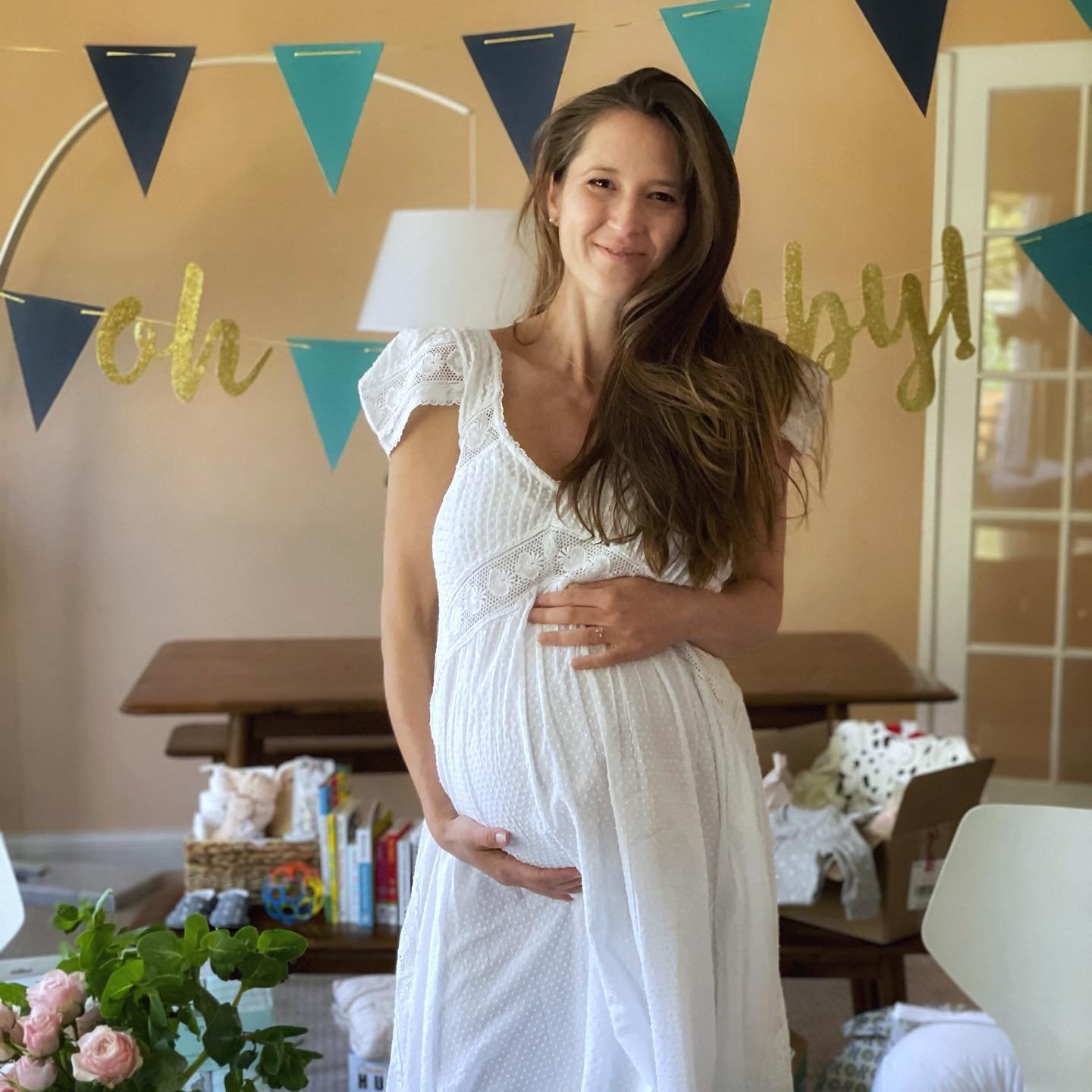
Why I Chose Natural Birth
Why I Chose a Natural Birth
By Victoria Siegel | Community Herbalist & Founder of Rational Body
This is the first piece in a series on natural childbirth, pregnancy preparation, and the fourth trimester. The full birth story — including what actually happened in that delivery room — is in the next article.
Years before I had my first son, I said out loud, to anyone who would listen: when I give birth, I want them to give me every legal drug available.
I thought of it exactly like having a tooth pulled. Why would anyone in their right mind refuse the numbing agent? The idea of going unmedicated seemed like either masochism or an ideology — something people with a point to prove do. I could not imagine a version of myself making that choice.
Then I read one book. And then another. And I couldn't stop.
I remember coming across a passing mention of Miranda Kerr, the Victoria's Secret model, who had an unmedicated birth. The article treated it like a quirky personal preference — a vague curiosity, mentioned without a single word about why she might have made that decision, or what the physiological reasons for it were. I filed it under "not for me" and moved on.
But the reading kept pulling me back. And what I found, consistently, was that the most evidence-based information available about childbirth is not what most hospitals default to. That the biggest thing standing between a woman and a better birth experience is usually just information she was never given.
This is an attempt to give you some of it.
Birth Is Not Like Pulling a Tooth
The comparison I used to make — tooth extraction, why would you refuse the anesthetic — is one of the most common ways people think about labor pain, and it's completely wrong in ways that matter enormously.
Pulling a tooth is a medical procedure. An external intervention on your body. Pain during a dental extraction has no function — it signals nothing useful, helps nothing along, serves no purpose. Of course you remove it.
Labor is not a procedure. Labor is physiology. It is your body doing something it was specifically and elaborately designed to do, with its own pain management system, its own hormonal intelligence, its own feedback loops that guide timing, positioning, and progression.
The pain of labor is purposeful. It tells you where to move, how to position yourself, when to bear down and when to wait. It triggers your body to release endorphins — natural opioids that rise in parallel with oxytocin, the primary hormone of labor. It signals the hormonal cascade that initiates bonding, milk production, and the transition out of pregnancy. It is information your body is using in real time to birth your baby.
When you remove that sensation entirely — when you numb from the waist down, stop the endorphin response, lie still because you can no longer feel where to move — you do not simply remove pain. You interrupt a system.
That interruption has consequences. And most women are not told what they are.
What Undisturbed Labor Actually Looks Like
When labor is left to progress without synthetic intervention, here is what your body is doing:
Oxytocin rises gradually, triggering contractions that intensify in a natural feedback loop. As oxytocin rises, endorphins rise with it — your body's own pain management, calibrated to the intensity of the contractions. You move, instinctively, into positions that help your baby descend. Your pelvis — not a fixed structure but a movable system of joints and ligaments — shifts and opens. Your baby rotates, tucks, navigates. The two of you are doing this together.
Stress hormones interrupt this process. When you feel afraid, threatened, watched, or out of control — when cortisol and adrenaline spike — those hormones suppress oxytocin and endorphin production. The uterus, which is the only muscle in the human body capable of simultaneously pushing out and pulling in, receives conflicting signals. It tries to do both. That is where the most intense pain lives — not in the contractions themselves, but in the conflict.
This is why staying calm is not just a mindset preference during labor. It is one of the most mechanically effective things you can do to reduce pain and help labor progress. Your main active job, biologically, is to feel safe enough for your body to work.
Pitocin, the synthetic hormone used routinely in hospitals to speed or induce labor, does something far cruder. Natural oxytocin acts in both the bloodstream and the brain — triggering contractions, yes, but also triggering the endorphin response that accompanies them. Pitocin is a synthetic compound that only acts in the bloodstream. It knows how to push one button: make contractions happen, harder and faster than your body would produce naturally. It does not know how to trigger the endorphins. So contractions become more intense, more frequent, and more painful — while the natural pain relief that should accompany them is absent. Your body then sees the Pitocin flood and, reading it as sufficient oxytocin, stops producing its own. The endorphin pathway closes further.
This is why Pitocin so reliably leads to epidurals. Not because labor is unmanageable — but because synthetic hormones have removed the tools your body uses to manage it.
And once you say yes to an epidural, you are tethered. An IV line, a continuous fetal monitor, likely a urinary catheter. Up to eight wires keeping you still — at the exact moment when mobility is one of the most powerful tools your body has for helping your baby descend and position correctly. Labor slows by an average of two additional hours with an epidural. The baby, no longer guided by your instinctive movement, may stay in a suboptimal position. The likelihood of further interventions — forceps, vacuum, cesarean — increases with each one that preceded it.
This is called the cascade of interventions. Each step makes the next more likely. Once the wheel is turning, it is very hard to slow.
Hard Now, Easy Later
I want to be honest with you about what this comparison actually looks like.
The pain of unmedicated labor is intense. It is the hardest thing I have ever done. I ran track and cross country, and the best analogy I have found is this: labor is a full marathon, paced over hours, drawing on everything your body has built. And then, when you think you are completely spent, pushing begins — each push is a full 400-meter sprint at maximum effort. I pushed seven times for Lucas. Seven full sprints after a marathon.
The pain ended the moment I held him.
Not gradually. Not over the following hours. It was gone. My body replaced it immediately with something else entirely.
Compare that with what I watched some of my friends go through. One pushed so hard under epidural — unable to feel her body's signals about how far to go — that she gave herself hemorrhoids she dealt with for months and was told, cheerfully, that she had been an "efficient pusher." Another developed a spinal headache from an epidural complication that lasted months. One had a doctor add an extra stitch during her repair — without full discussion — that left her in pain during sex for more than a year.
None of them reported their complications. When I asked why, I got some version of the same answer: they didn't want the doctor to look bad. They liked their doctor. They felt grateful. They didn't want to cause trouble.
And so that data — those real, lived experiences — never made it back to the system. The next woman makes her decisions based on statistics missing those stories entirely.
Hard now, easy later. That is the honest accounting. Hours of purposeful, intense sensation for most women — versus days, weeks, or months of surgical or procedural recovery for many.
That trade-off exists. Most women are never shown it.
The System We're Working Inside
I want to say something clearly before going further: I am not anti-medicine. I gave birth in a hospital both times, and I am glad I did. Modern obstetrics saves lives. When something goes wrong in labor — and sometimes it does — the people in that room are exactly who you want.
The problem is not emergency medicine. The problem is that a system built for emergencies is now the default environment for an event that, for about 70 to 90 percent of healthy women, is not an emergency at all. And the difference between those two things — physiological birth and obstetric emergency management — is significant. Treating every birth like a pending emergency until proven otherwise changes outcomes, and not always for the better.
Here is a data point that should be more widely discussed: the United States spends more money per birth than any other country in the world. And by nearly every measure of maternal and infant outcomes — maternal mortality, severe maternal morbidity, preterm birth rates, postpartum complication rates — we rank among the worst of all wealthy nations.
The OECD tracks this. Norway's maternal mortality rate is about 1.7 deaths per 100,000 live births. The United States sits at approximately 23.2. That is roughly eight to fourteen times higher. Finland and Japan have infant mortality rates around 1.6 to 1.7 per thousand births. The United States sits at about 5.4. We lose roughly 20,500 infants per year. If our rates matched the best-performing peer nations, we would save approximately 14,000 babies and 700 mothers annually.
These countries spend two to three times less per birth. They have five to ten times fewer maternal deaths. They are not achieving this with less technology. They are achieving it with a different philosophy — one that treats birth as a physiological process to be supported rather than a medical event to be managed from the start.
Hospital birth classes in the United States teach you to be a good patient. They walk you through the hospital's protocols and the hospital's preferences. They do not teach you what Pitocin does to your endorphins. They do not teach you the research on mobility during labor. They do not discuss what your rights are in that room, or what evidence-based care looks like versus what standard care looks like. They teach compliance.
There is a history behind this. In the early 1900s, the Flexner Report — commissioned by the Carnegie Foundation — reshaped American medical education and licensing in ways that effectively pushed women out of healthcare entirely. Midwives who had safely attended births in communities for generations were dismissed as primitive and dangerous. The role of doulas, traditional birth workers, and women's lived knowledge of birth was eliminated from legitimized practice. Not because their outcomes were worse. Because they did not generate revenue for the emerging medical industry.
That history shapes every room you walk into when you give birth today. Many of the practices you will encounter in a modern labor and delivery unit are historical artifacts — institutional habits and residue from decisions made generations ago for reasons that had nothing to do with your wellbeing. Research to practice takes an average of seventeen years in medicine. Some things take longer. Some things, like the custom of laboring on your back — which fights gravity, immobilizes the pelvis, and increases tailbone pressure — trace back to the preferences of a seventeenth-century French king who wanted to watch births more easily. It is still the default position in most American hospitals.
The Looks
When I was about seven months pregnant, I took a restorative yoga class. It was me and about five retired women doing a very slow flow. Afterwards, one of the women was talking about my obvious belly and said she had spent her entire career as a prenatal nurse. I told her a little about my preparation for a natural birth.
She gave me a look that was almost pitying. “Aw, honey,” she said. “That's nice. Good luck — but don't expect that to happen.”
She meant it kindly. She had spent decades watching women arrive at hospitals saying they wanted a natural birth, with no preparation, no guidance, no one in their corner — and then struggling badly. She wasn't wrong about that pattern. But she had also spent decades in a system that treats that pattern as proof that natural birth doesn't work, rather than proof that women aren't being adequately supported to do it.
I didn't argue with her. But I thought about her often in the months that followed.
People close to me were doing versions of the same thing — telling me about cords wrapped around necks, about things that can go wrong, offering horror stories with the best of intentions. Women who loved me were doubting me. I started keeping my plans quieter. Not because I was wavering, but because I didn't want to spend the energy defending a decision I had already made to people who had already decided it couldn't happen.
What I knew, and what the retired nurse didn't know about my situation, was that I was not walking in unprepared. I had done the research. I had taken evidence-based classes. SO much of life is mental. Birth is one of the most physiological meets mental moments you can imagine. I had hired a doula who knew what I wanted, had been briefed on my birth plan, and would be paying attention when I couldn't — because birth is serious. There are real life-and-death scenarios. I wanted a healthy baby first and foremost, and I wanted the full burden of navigating that not to fall on my husband in the most intense moments of our lives. I wanted someone in that room who had done this hundreds of times, who could read a situation clearly, and who was working entirely for us — not for the hospital, not for a checklist, not for the clock.
I was prepared, but it was not my job to be ON, in this moment. It was hers. I was paying her to take full control and speak for me, for our family in its most tender moments, if needed.
Mama Bear, Not Meek
Many women go into the hospital wanting to be a good patient. Cooperative. Grateful. Graceful. Not causing trouble. That instinct comes from a good place, though, I feel, out of place.
I went in differently. Not aggressive, not confrontational — but completely clear about whose interests I was there to serve. My baby's. My body's. Not the institution's schedule, not the protocol written in 1987, not anyone's feelings about my choices. Mama bear, not meek.
The head of obstetrics who delivered Lucas walked in announcing — loudly, to the room — that she would never have had a natural birth herself. She arrived with a cart stacked with scissors, instruments, suction devices, and medications. She is on my son's birth certificate.
And she accidentally became one of the most effective motivational forces in that room. Because I was not going to let her reach for that cart. Seven full pushes, every one of them with everything I had, because the alternative was her intervention. The goalpost kept moving. I kept sprinting.
By the time Jaden was born, I knew what to expect. We heard the Star-Spangled Banner playing as we left for the hospital. He was born before the final kickoff. That is how fast the second birth went — and still our doula was there, still essential, pushing back on a nurse who moved automatically to cut the cord while Marcus and I were too absorbed in our newborn to notice. One-third of a baby's blood volume is in that cord at birth. People pay tens of thousands of dollars to bank that stem-cell-rich blood. Your baby deserves to have it in their own body first. My husband said our doula was worth every penny to help us push back on the nurse who wanted to cut it so badly, for literally no reason. I asked why, and she essentially shrugged, backing away with scissors in hand, “It is protocol”, she said. They must do it for a reason, even if she could not remember why.
What Changed Everything
If having a doula were a pharmaceutical drug, it would be negligent not to prescribe her.
I do not say that lightly. Studies consistently show that continuous labor support from a trained doula — not just a partner, not a nurse managing three patients, but someone whose singular job is you — is associated with shorter labors, lower rates of cesarean delivery, lower rates of epidural use, higher rates of breastfeeding initiation, and better maternal satisfaction. If those were the outcomes of a new drug, it would be headline news. Instead, most women have never heard of a doula.
The difference between a doula and a hospital nurse is structural. The nurse is managing a caseload and documenting in a system and following protocols written for the institution. The doctor is trained to intervene when something goes wrong — which means their orientation is always toward what could go wrong, what they might need to do, what the liability framework requires. Both of those things matter. Neither of them is watching you.
A doula is watching you. The whole time. She is reading your face through a contraction. She is anticipating what you need before you can articulate it. She is not distracted by a monitor or a computer screen or another patient down the hall. She works for you — not for the hospital, not for any protocol, not for the insurance company. She sees a human being, not a number on a screen. In a system that struggles to offer that, it is worth every penny.
Natural Birth Is an Option. Not a Badge.
I want to be clear about what I am not saying.
I am not saying that epidurals are wrong. Sometimes they are genuinely the right choice — when a mother is not coping, when labor has stalled in ways that require support, when the clinical picture calls for it. Interventions save lives. The question is not whether they are valuable. It is whether they are being used at the right moment.
I am not saying that every woman should go unmedicated. I am saying that every woman should know it remains a genuine option, available to the majority of healthy women, supported by both ancient wisdom and current research, and with documented benefits for mother and baby that most women are never told about.
I am not saying cesarean sections are bad. I am saying the current U.S. cesarean rate of about 32 percent is roughly double the rate reflecting genuine medical necessity. Babies born by cesarean miss the vaginal microbiome that seeds their gut bacteria — a foundational component of lifelong immune health. Mothers recovering from cesareans face major abdominal surgery at the exact moment when bonding, breastfeeding, and newborn care demand everything they have. These are real costs. They should be in the conversation.
What I am saying is this: natural birth is not a curiosity. It is not a personality type. It is a scientifically supported, biologically intelligent option — and it requires a different kind of preparation than most hospitals will help you with. You have to seek that preparation out yourself.
But you can. And the rest of this series is about how.
Where I Suggest Starting
Read. The books that shaped our thinking most were Ina May's Guide to Childbirth, The Birth Partner by Penny Simkin, and Expecting Better by Emily Oster. I would add Rebecca Decker's work at Evidence Based Birth for anyone who wants to go deeper into the research. Start with any of them. Just start.
Take an evidence-based childbirth class — not a hospital birth class, which teaches you institutional compliance, but one that explains the biology and gives you real options. Hypnobirthing and the Bradley Method are both well-researched. Spinning Babies is essential for understanding fetal positioning — something hospitals almost never discuss — and I would consider it required reading for anyone who wants to minimize pain during birth.
Hire a doula. Do it early. Talk to several. Find someone whose presence makes you feel calm rather than managed.
Know your rights in that room. You have the right to decline any intervention. You have the right to ask what it is, why it is being recommended, what the alternatives are, and what happens if you wait. You do not have to decide anything immediately. The phrase "I'd like some time to think about that" is legal and appropriate in a delivery room.
Know that giving birth in a hospital and going unmedicated are not a contradiction. That is what I did, twice. It is genuinely hard to navigate. But it is possible, and it is worth knowing that the option exists.
Every human has to be born. The way they arrive matters. And the more we talk about it — clearly, honestly, without ideology or shame in either direction — the better it gets for all of us.
The full birth story — what actually happened in that delivery room, what I wished I had known, and what the second birth taught me that the first one couldn't — is in the next piece.
Victoria Siegel is a certified community herbalist (California School of Herbal Studies), mechanical engineer, and founder of Rational Body Natural Skincare. She lives in Danville, California with her husband Marcus and their two sons, both born unmedicated in hospital settings. She is currently writing a book on nutrition, birth, and the fourth trimester.
rationalbody.com