
Nutrition in Schools
When Your Child’s School Ignores Its Own Wellness Policy
Beyond the cafeteria
When my children were little, we lived in San Francisco and went to parent-child classes where food, development, outdoor time, movement, sleep, and emotional health were naturally part of the same conversation. Food was treated as part of how children grow. What went into a child's body belonged in a conversation about that child's development.
Then we moved about thirty minutes away to the suburbs, and sometimes it felt as though we had gone back fifteen years in health advice. There was plenty of conversation about movement, mental health, exercise, sports, drugs, and emotional wellness. All of those things matter. What seemed strangely absent was any serious conversation about what children were actually eating and what those foods were providing their growing bodies.
That stood out to me because nutrition had completely changed my own life.
For most of my younger life, I thought about food mainly when I wanted to change how I looked. If I wanted to fit into a certain outfit, I might go on a diet for a while. Otherwise I ate what was easy and convenient, exercised, and assumed that people who somehow ate beautiful fresh meals every day must have private chefs and personal trainers like movie stars. I had no idea how much of what I wanted was already within reach. I would still happily take the chef and trainer, of course, but I eventually learned that I did not need either one to completely change the way I ate.
I started reading, and I read abundantly. Then I changed the food. I did not count calories or weigh portions. I ate lots and lots of vegetables, meat from good sources, eggs, fruit, nuts, herbs, and recognizable food. I stopped making refined sugar an everyday food and tried to get closer to the ground.
Very quickly, I discovered that real food is delicious. Within those basic choices, I found what felt like an infinite number of things I could eat, and I could eat until I was satisfied. My whole relationship with food changed because I stopped looking primarily at what I was denying myself and started seeing everything good that I could eat.
It was almost as though my body developed eyes. Before that, I mostly evaluated food by the few seconds it spent in my mouth. Once I understood more about nutrition, I started seeing what the rest of my body was receiving too. I could think about how I would feel afterward, whether I was actually feeding myself, and whether the food left me satisfied enough to move on with my day.
At first, my environment mattered enormously. If certain foods were sitting directly in front of me, I had very little control around them, so I stopped keeping them in my house regularly. That worked much better than surrounding myself with food I was trying not to eat and repeatedly expecting myself to resist it. Eventually my preferences changed too. I could say no because I genuinely did not want something anymore, and the temporary pleasure in my mouth stopped seeming worth how I felt afterward.
Then something else happened. I had more energy, I felt better, and my body changed physically in ways that years of exercising harder never had. For a country so obsessed with appearance, I was honestly amazed by that part. I had spent years assuming that changing my body meant exercising harder, while now exercise is something I do because I enjoy feeling strong, like the adrenaline and blood flow, and need the mental break. I no longer think of a workout primarily as something that erases dinner.
At one point, I also had a health scare involving abnormal cells that were one step away from cancer. The doctors, naturopath, and books I turned to kept bringing nutrition into the conversation. That was when I began to understand how much bigger food was than weight. Nutrition kept appearing in discussions of cardiovascular disease, blood sugar, digestive health, allergies, skin conditions, cancer risk, growth, repair, hormones, and the basic materials our bodies use to function.
I was incredibly grateful that I learned that before I had children, before I was physically growing another body inside my own and then establishing the habits that would feel normal to them. That was the perspective I carried into public school.
I expected school lunch to be the problem
I expected the official lunch program to be my first fight and was pleasantly surprised to discover that the formal school-meal system was one of the strongest parts. School meals already operate under detailed nutrition standards, and our district's Child Nutrition program had clearly put thought and work into food quality. The fight I thought I was going to have had already been taken seriously by people whose job was nutrition.
Then I looked beyond the lunchroom, and that was where things became strange.
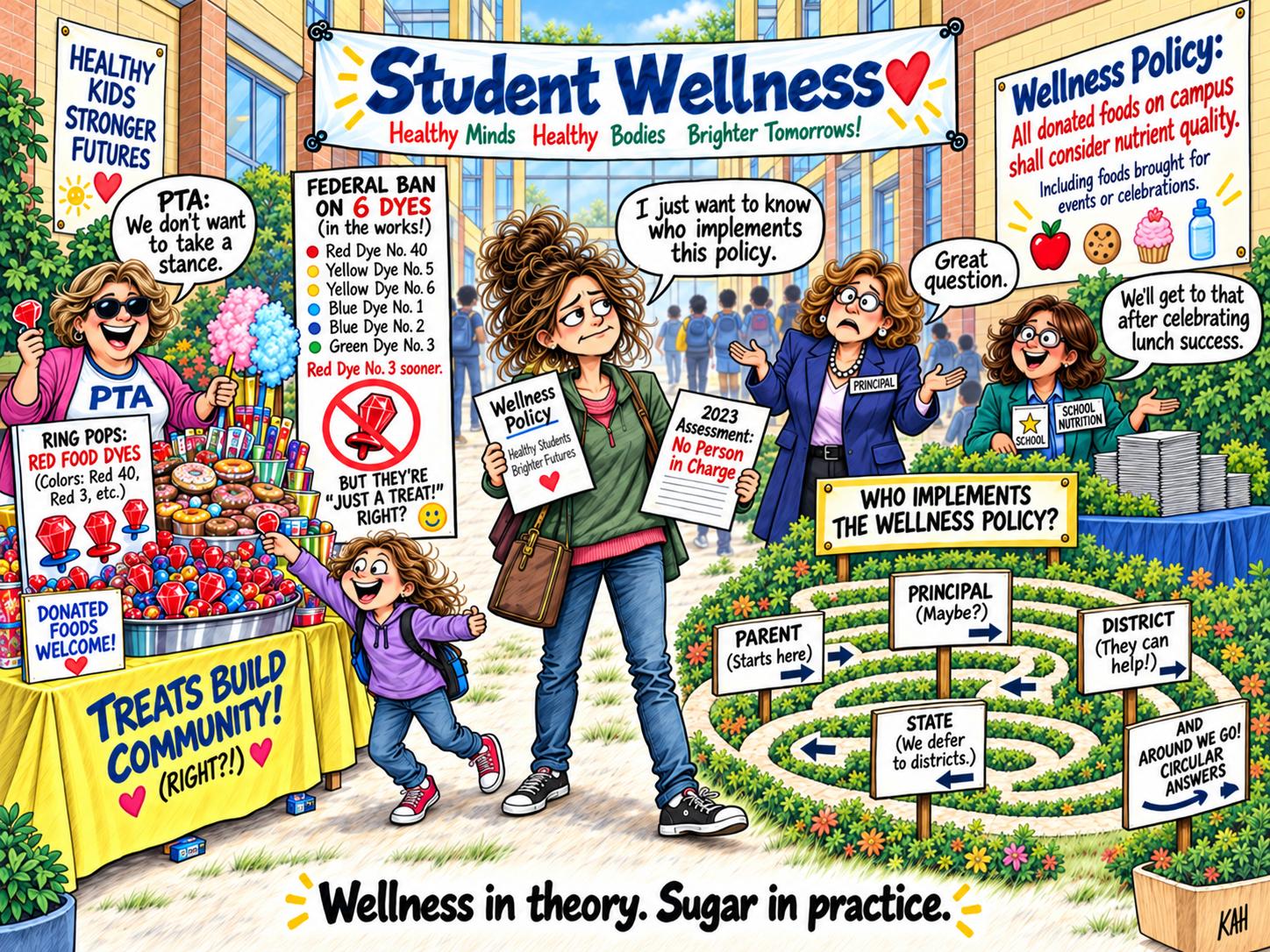
My child could walk onto campus at eight in the morning and be offered a donut. Our school has its own cotton-candy machine. Parents have been asked to provide large quantities of brightly colored candy for events. There are food rewards, birthday treats, celebrations, bakery field trips, and tables full of sweets at school functions. This was not a cupcake twice a year. In practice, some version of it was happening at least weekly.
Any individual event can sound trivial. Together, they create a food culture.
One morning a little girl ran away from the donut table smiling and yelling, “Free energy!” The almost ridiculous part is that a nutritionally regulated breakfast is already available nearby, yet we add the donut anyway.
We make sugar incredibly safe and innocent in our culture. We wrap it in love, generosity, childhood, reward, celebration, and fun. The adult handing it out gets the immediate smile, while the parent trying to maintain a boundary often gets the meltdown.
I became very good at dodging the donut table at drop-off like a ninja so my son would not see it. One morning I successfully got him into his classroom without noticing the donuts, only for another parent to come inside calling to the children who had missed them that it was their “last chance.” My son heard, the meltdown was immediate, and suddenly I was the bad guy.
Eventually I realized that I was trying to police an entire food environment one snack at a time.
Then I learned what was actually in some of the candy
Some of the brightly colored candies being handed out contained synthetic dyes that California had already decided to remove from covered public-school foods. AB 2316 passed its final Senate vote 36-0 and the Assembly's concurrence vote 70-0 in 2024. Beginning December 31, 2027, Blue 1, Blue 2, Green 3, Red 40, Yellow 5, and Yellow 6 will be prohibited in reimbursable California public-school meals and in competitive foods sold at public noncharter schools. Red Dye 3 is on an earlier statewide schedule, along with brominated vegetable oil, potassium bromate, and propylparaben, beginning January 1, 2027. (LegiScan)
The reason this caught my attention was not simply that California had passed another ingredient rule. California's Office of Environmental Health Hazard Assessment had already completed an extensive assessment of synthetic food dyes and concluded that they can produce hyperactivity and other adverse neurobehavioral effects in some children, with children differing in sensitivity. (OEHHA)
I had no idea. In a strange way, I am grateful that I had to go looking, because otherwise nobody was telling me about it.
Parents were being asked to buy and donate brightly colored candy while the state had already spent years studying those dyes and had voted to remove six of them from covered school foods. Nobody around me was talking about that change, and nobody had pointed parents to it. It became another example of something I kept finding throughout this process: the information already existed, but it was not reaching the people actually buying and handing the food to children.
I started asking questions before I knew a policy existed
In February, I started raising nutrition concerns with the PTA. At that point, I had never seen the district Wellness Policy. I was simply a parent trying to make the case that nutrition education belonged in the larger conversation about children's health.
Even participating was difficult because PTA meetings were during the workday, so attending meant taking time off. I kept asking for space to discuss nutrition while the school year continued and so did the food. Every party, event, reward, fundraiser, and celebration seemed to bring another version of the same issue. Each one could be dismissed individually, but by the end of the year I no longer saw isolated treats. I saw an environment.
That was when I reached out to the district. The conversations sent me back through local channels: talk to the school, talk to teachers, work through the PTA. Nobody pointed me to the district's own Wellness Policy.
Then, separately, I found it myself.
That discovery changed the entire question.
Until then, I had been trying to persuade people that nutrition education belonged in school wellness and that the food environment outside the cafeteria mattered. Once I read the Local School Wellness Policy requirements, I realized I did not need to prove either point from scratch. Districts participating in the National School Lunch or School Breakfast Programs are already required to maintain a written Wellness Policy with goals for nutrition promotion and education, standards for foods sold to students, standards for foods provided but not sold, public participation, implementation, assessment, and identification of the officials responsible for oversight. Foods provided but not sold specifically include classroom parties, school celebrations, rewards, and incentives. (California Department of Education)
The policy was intentionally bigger than the lunchroom.
That was what made finding it so freeing. A policy does not require one parent to convince every PTA member, teacher, volunteer, and administrator individually before anything can change. It continues when leadership changes, when a parent group has different priorities, and when the subject is uncomfortable.
I no longer needed to convince the PTA to take a stance on nutrition. The district already had.
My question changed from, “How do I persuade everyone that this matters?” to, “How is the policy we already have supposed to work at this school?”
The policy was much more specific than I expected
Once I read what SRVUSD had actually adopted, I was surprised by how closely it matched the conversation I had been trying to start.
The district's own policy says staff should encourage parents and volunteers to consider nutritional quality when selecting snacks donated for occasional class parties and that class parties or celebrations should be held after lunch when possible. It encourages school organizations to use healthy foods or non-food items for fundraising and encourages staff to avoid non-nutritious food as a reward for academic performance, accomplishments, or classroom behavior. (Diligent Community)
The policy also addresses marketing. SRVUSD's language prohibits marketing and advertising of non-nutritious foods and beverages through a range of school-based channels, while federal and California wellness rules require that food marketed on campus during the school day meet applicable competitive-food standards. (Diligent Community)
This was almost exactly what I had spent months trying to talk about. The missing piece was no longer a policy saying food mattered. The missing piece was getting the policy from paper to practice.
The actual school-food numbers were eye-opening
Reading California's competitive-food standards gave me something else I had been missing: concrete numbers.
For qualifying snacks, California generally limits competitive foods to 200 calories, 200 milligrams of sodium, no more than 35 percent sugar by weight, no more than 35 percent of calories from total fat, less than 10 percent from saturated fat, and less than half a gram of trans fat, subject to specified exemptions for foods such as fruit, vegetables, nuts, seeds, and certain other items. (California Department of Education)
The sugar-by-weight limit gave me an especially useful sense of scale. If a small snack weighs about one ounce, or 28 grams, 35 percent by weight is just under 10 grams of sugar in that one snack.
The American Heart Association recommends that children and adolescents ages 2 through 18 stay at or below 25 grams, or about six teaspoons, of added sugar for the entire day. The two measures are not identical: the school standard is total sugar as a percentage of a particular food's weight, while the AHA recommendation is a daily amount of added sugar. I still find the comparison useful because it shows how quickly a child's day can add up. (professional.heart.org)
A donut sounds small. A birthday treat sounds small. A piece of candy sounds small. A sports snack sounds small. A dessert after dinner sounds small. The pattern is what matters.
The rules around sales also helped me separate two questions that people kept blending together. California's competitive-food rules apply when food is sold to students on campus during the defined school-day window. Whether money changes hands and when the transaction happens therefore matters when deciding whether a particular competitive-food rule applies. (California Department of Education)
Whether the food matters nutritionally is a different question.
A donut does not become biologically different because it is free. Candy does not become nutritionally irrelevant because a parent donated it. That is exactly why the broader Wellness Policy separately requires districts to address foods provided but not sold during the school day. (California Department of Education)
Another school in our district had already made this simple
Then I found Sycamore Valley Elementary, another school in the same district, and saw what local implementation could look like without making it complicated.
Its school wellness page says staff should limit non-nutritious food or beverages at class parties, schedule celebrations after lunch when possible, avoid using non-nutritious foods as rewards, encourage non-food birthday items, and limit classroom parties to three per year. (Sycamore Valley Elementary School)
You can understand the whole thing in about a minute.
A teacher can use it. A parent can use it. A room parent planning a party does not need to become an expert in federal nutrition regulations. The school has translated a broad policy into practical expectations people can actually follow.
That is much closer to what I had been asking for all along.
I also learned how much the source of the information matters. A parent asking for less candy can easily become one parent with an opinion. When the same idea comes with official district guidance, the people trying to organize a classroom or event no longer have to referee a nutrition debate themselves. The principal does not have to reinvent the policy. The PTA does not have to choose a personal stance. Someone can simply say, “This is our guidance.”
Then I asked who that person was
Once I understood the policy, the next question seemed obvious: who at our school was responsible for helping put it into practice?
That answer was surprisingly difficult to find. When I later asked our new principal who our school's Wellness Policy contact was, she had questions about the policy herself. She was new to the role and had already made positive changes at the school. I did not want her to be expected to decipher all of this alone. I wanted the district to provide the structure the policy already contemplated.
California's current guidance is clear that oversight, development, implementation, and monitoring of the Local School Wellness Policy are district functions. It requires identification of the district or school position responsible for implementation and oversight so that each participating school complies. It also requires triennial assessment of actual implementation and annual public notice that the policy exists. (California Department of Education)
Then I found SRVUSD's own December 2023 policy assessment.
Under “Identification of Person in Charge,” the district's comparison was marked “Not Compliant.” SRVUSD's policy itself said the superintendent “shall designate” one or more district or school employees to ensure each site complies, but the assessment found that the responsible person or people were not actually identified. Its stated next step was to obtain the list of site-level staff and appoint replacements where necessary. (Diligent Community)
The same assessment used language that felt extremely familiar to me as an engineer. It repeatedly recommended identifying areas of noncompliance, taking corrective action, creating corrective action plans, setting follow-up evaluation dates, and working with site designees to review what was actually happening. (Diligent Community)
That assessment was dated December 21, 2023. Almost three years later, I was still trying to find the person.
At that point, this stopped looking like a disagreement about donuts and started looking like an implementation gap. The policy existed. The connection between the policy and the school did not.
Food is hard, which is exactly why defaults matter
I understand why people resist changing food. Food is emotional. We crave things from our childhoods and connect them with holidays, grandparents, birthday parties, rewards, love, and being the fun parent.
I am sure five-year-old me would have happily taken every cup of Dippin' Dots anyone was willing to give me. I am also grateful that my mother restricted some things. Soda was not a normal drink in our house. When I got to college and started drinking more of it, I remember noticing how much more I wanted it the more regularly I drank it.
That makes much more sense to me now. Children's food preferences are built through a combination of biology, familiarity, repeated exposure, what adults make available, what other people eat, and the social meaning attached to food. Repeated exposure can increase children's acceptance of foods, and both caregivers and peers influence eating behavior. (PubMed)
That is why I do not see creating a better food environment as deprivation. I see it as making the eventual choice easier.
Parents have a limited number of years in which we get to establish the defaults. We can make water normal. We can make vegetables normal. We can cook food that tastes wonderful. We can let dessert be genuinely fun without turning sugar into the centerpiece of every happy experience.
It does take work, but food can also be incredible. Make the broccoli delicious. Let children help cook. Find the meals everyone actually loves. Put the good food where people can reach it. Make it ordinary enough that nobody has to announce that tonight is a “healthy dinner.”
I can think of plenty of times I wanted the ice cream while it was sitting in front of me. I can think of very few mornings when I woke up wishing I had eaten more of it the night before. What I do appreciate the next morning is a body that feels good.
Our children will eventually be completely responsible for their own food. Until then, we have an opportunity to make their defaults easier than ours may have been.
School is part of that environment too.
Children still need adults to choose the environment
There is a large space between shaming a child for eating a cookie and deliberately placing hundreds of candies in front of elementary-school children. Structure is not shame, and guidance is not dieting.
My children genuinely love vegetables. They will happily eat my garlicky baked broccoli. If broccoli is normal, delicious food, they eat it. If I put a plain carrot beside a giant frosted donut and call the choice neutral, I have changed the comparison. One food has become the exciting event and the other has become the dutiful healthy option.
I do not want vegetables to become the boring thing beside the prize.
The old Clara Davis self-selection experiments are interesting here because they are often remembered as proof that children can simply choose what their bodies need. The important detail is that adults chose the universe of foods first. The young children were given considerable freedom over what and how much they ate, but the available foods were a varied collection of relatively simple, nutrient-rich foods. Davis herself recognized that this was the “trick” in the experiment: adults still controlled what was available. (PubMed Central (PMC))
That is almost exactly what worked for me as an adult. I did not change my habits by keeping everything I found hardest to resist constantly in front of me and proving that I had superior discipline. I changed my environment first, and eventually my preferences followed.
I have also watched parents try the gentlest possible approach around sweets and assume a young child will simply stop when satiated, only to watch the child eat until his stomach hurts or even until he gets sick and then want the same brightly colored frosting when it appears again later. A five-year-old does not necessarily connect delayed discomfort with the thing every smiling adult around him presented as the prize. We are helping children learn those associations, whether we intend to or not.
Expecting elementary-school children to solve a food environment adults created makes very little sense to me.
What I hope happens next
After everything I have read and everything I have tried over the past year, what I want is actually quite simple. I want our school to have clear guidance, a known Wellness Policy contact, and an easy way for staff, PTA leaders, volunteers, and parents to understand what the district already expects.
I also want us to approach this through continuous improvement rather than treating wellness as a demand for instant perfection. Maybe there are fewer donuts. Maybe the broccoli gets better. Maybe one event changes this year and another changes next year. A single dessert will not ruin an otherwise nourishing diet, just as a stick of celery cannot repair an otherwise poor one. The pattern matters.
The goal is not to win an argument or protect an adult's ego. The goal is happy tummies, healthy kids, and children who feel good enough to grow, think, play, and learn.
We already have the Wellness Policy. I would simply like our school to know about it, have guidance for using it, and keep getting better.
For anyone who wants the science: why food quality and environment matter
The story above is really about policy and implementation. Discovering the Wellness Policy meant I no longer needed every person at school to agree with my entire philosophy of food before we could follow expectations the district had already adopted.
For anyone wondering why I care about nutrition so much in the first place, however, the science is fascinating.
Calories in does not equal calories out
One of the biggest ideas I had to unlearn was the calorie-reduction mindset I grew up with. It assumes a remarkably simple model of the body: food goes in as a number, exercise takes that number back out, and if the arithmetic does not seem to work, the answer must be more restriction or more exercise.
Our bodies are incredibly complex.
A food Calorie is a kilocalorie, a unit of energy historically described through heat: approximately the amount required to raise the temperature of one kilogram of water, a little more than four cups, by one degree.
That tells us something about energy quantity. It is not a description of human digestion.
The body does not put lunch in a sealed chamber, burn it underneath four cups of water, and then hand us the result. Food has to be chewed, digested, absorbed, transported, metabolized, incorporated into tissue, stored, used for cellular work, presented to trillions of gut microorganisms, or excreted. Protein, fat, and carbohydrate are handled differently, the physical structure of a food affects access to its nutrients, and hormones and metabolic state help determine what happens next.
That is why I no longer think of a calorie entering through my mouth and a calorie flashing on a treadmill as two biologically equivalent transactions moving in opposite directions.
More importantly, the calorie number tells me almost nothing about quality, which is usually the question I actually care about.
Broccoli contains carbohydrates. So does soda. The word “carbohydrate” does not make them interchangeable. An avocado contains fat. Repeatedly heated frying oil contains fat. The word “fat” does not make those interchangeable either.
Even the FDA's Nutrition Facts label evolved in this direction. “Calories from Fat” was removed because the type of fat matters more than simply the amount, while “Added Sugars” became a required line on the label because the old label was missing information people needed to evaluate diet quality. (U.S. Food and Drug Administration)
Added sugar is now one of the first things I look at on a packaged food. It tells me something the calorie number does not.
Food can affect the same body very differently
The idea that all food can be reduced to energy also leaves out signaling.
Oral glucose, for example, measurably changes growth-hormone secretion. In one study of healthy children, GH was suppressed below the study threshold for 135 minutes after an oral glucose load and then rose again. Growth hormone normally operates in pulses, and actual childhood growth involves a much larger network including GH, IGF-1, insulin, thyroid hormones, sex hormones, sleep, body composition, genetics, and nutrient availability. (PubMed)
What interests me is the larger lesson. Food is not passive fuel. It changes the metabolic and hormonal environment in which a child's body is doing the work of growing.
Growth is happening every day. Cells are dividing, bones are remodeling, neural connections are being built, and tissue is constantly being made and repaired. A repeated dietary pattern therefore matters in a way that looking at one dessert in isolation cannot capture.
The same principle is why one dessert in an otherwise nourishing diet does not define a child any more than one celery stick fixes an otherwise poor diet. It is the repeated environment that matters.
Development has timing
Nutrition matters throughout life, but pregnancy and childhood have another dimension because development happens on a schedule.
The body is not simply waiting indefinitely for every missing input. Brain development includes sensitive and critical periods when particular nutrients are needed for biological processes that are underway at that time. Research on early-life nutrition specifically describes both critical periods for certain nutrients and nutrient-driven epigenetic changes. Iron is one of the clearest examples because it is involved in processes such as myelination, neurotransmitter development, and hippocampal function during particular developmental windows. (PubMed)
This was one of the things that made epigenetics so fascinating to me. DNA is not operating in isolation from the environment around it. Nutrition can influence mechanisms involved in regulating gene expression without changing the underlying DNA sequence, and early development is a particularly sensitive period for those interactions. (PubMed)
Some nutritional problems can improve remarkably quickly once the missing input is restored. Other developmental effects are much harder to fully make up later because the biological window itself has moved on.
That is why “we can worry about food later” has never made much sense to me with growing children. Their bodies are building now.
We also feed an ecosystem
When we eat, we are not feeding only our own cells. We are feeding an enormous microbial ecosystem in the gut.
Different fibers give microbes different material to ferment, and those microbes produce metabolites such as short-chain fatty acids that can interact with our metabolism and other physiological systems. Human randomized trials show that increasing particular dietary fibers changes microbial populations and microbial metabolism, including increases in organisms such as Bifidobacterium and changes in butyrate production. (PubMed)
This is another reason “a carb is a carb” makes so little sense to me. The carbohydrate in a vegetable can arrive inside an intact plant structure along with fiber, vitamins, minerals, water, and plant compounds. A refined sugar can arrive almost completely separated from those things.
The microbiome adapts to what we repeatedly feed it, while the brain's familiarity and reward systems also adapt to repeated exposure. That helped me understand my own experience in college with soda and later with changing my diet. The more normal certain foods became, the more I wanted them. Once I changed my baseline environment, those cravings eventually became much quieter.
Heating and processing can change food too
The word “fat” is another place where the nutrition categories I learned were far too crude.
Repeatedly heating oils changes them chemically. In animal studies, diets containing repeatedly heated canola and sunflower oils have increased oxidative stress and inflammatory signaling, including changes in NRF2- and NF-kB-related pathways in the brain. Other rat studies of repeatedly heated canola oil have found reduced antioxidant defenses and worse cognitive measures compared with the corresponding unheated oils. (PubMed)
That is very different from saying that all dietary fat is bad or that eating fat simply becomes body fat. It means the source, processing, composition, and condition of the fat matter.
The high-fat, high-sucrose combination common in Western-style processed food has also produced striking results in brain-injury research. In an animal model of traumatic brain injury, rats fed a high-fat, high-sucrose diet before injury had worse learning outcomes and lower hippocampal BDNF, a protein involved in neural plasticity. (PubMed)
Those were the kinds of findings I encountered in books such as Deep Nutrition that completely changed what I thought the word “food” meant. Food was no longer something I could understand adequately by looking at one number on a menu. It was part of the environment affecting signaling, oxidation, inflammation, repair, recovery, hormones, and the material available to build tissue.
Our genes were not rewritten when supermarkets were.
Human physiology developed over an enormously longer period than the last century of industrial food production. Technology has made food safer, more portable, more abundant, and easier to store, which are real accomplishments. Progress, however, does not always mean making food technologically more complicated.
Sometimes learning more about biology brings us back to something remarkably simple: vegetables, fruit, eggs, beans, nuts, herbs, good meat, and recognizable food prepared so that it tastes wonderful.
Self-control was not the thing that finally worked for me
We put enormous responsibility on individuals to make healthy choices while surrounding them with cues to make different ones.
Research supports what feels obvious once you notice it: children's food behavior is influenced by availability, repeated exposure, caregivers, peers, and the larger environment. School food policies themselves can change what children eat; a systematic review and meta-analysis of 91 interventions found measurable improvements from policies involving healthier food provision, competitive-food standards, and school-meal standards. (PubMed)
Education matters, but the environment has to support the education.
What sits in the kitchen matters. What a spouse eats matters. What friends order matters. What everyone at a party is eating matters. For a five-year-old, what adults on a school campus enthusiastically hand to every other child matters.
I had spent years thinking I needed more self-control. What finally helped most was changing the current I was swimming in. Once I stopped putting the foods I found hardest to resist directly in front of myself every day, everything became easier, and eventually I genuinely wanted many of them less.
That is why I struggle with the idea that the answer for elementary-school children is simply to give them every possible option and trust them to figure it out. Adults are still choosing the environment.
The food business and the human body have different goals
The modern food system has accomplished incredible things, but it also operates inside a marketplace. A company succeeds when people purchase its food and come back to purchase more.
A human body has a different endpoint. Ideally, food tastes wonderful, gives the body what it needs, satisfies hunger, and lets the person move on with the rest of life.
Those goals can overlap, but they are not automatically identical.
“Betcha can't eat just one” worked as advertising because everyone understood the joke.
For me, one of the most freeing things about real food is that it can be delicious without requiring a fight with myself. It can feed me, satisfy me, and then be finished.
That is what I want to make normal for my kids while I still have some influence over what normal means.
We solved scarcity better than we solved nutrition
The history of school lunch makes all of this especially interesting.
In 1941, at the National Nutrition Conference for Defense, federal officials were already describing widespread nutritional problems as an issue of national health and military readiness. The conference proceedings emphasized that simply having enough food was not sufficient; people needed the right kinds of food. (GovInfo)
That concern formed part of the historical backdrop to making school lunch a permanent federal program in 1946. The purpose was nourishment.
Over the decades that followed, we became extraordinarily good at making calories cheap, abundant, portable, shelf-stable, convenient, and profitable. We did not automatically become equally good at nourishing people.
The World Health Organization now defines malnutrition broadly enough to include deficiencies, excesses, and imbalances. Undernutrition and overnutrition are both forms of malnutrition. (World Health Organization)
The military picture today is strikingly different. CDC says just over one in three Americans ages 17 through 24 is too heavy to meet military weight standards. That modern statistic cannot be directly compared with historical military rejection figures because the populations and denominators are different, but the change in the problem is still remarkable. (CDC)
We became extremely good at producing enough calories.
The challenge now is creating environments that actually help bodies thrive.
Food is hard, but food is also incredible. It can be colorful, delicious, social, comforting, fun, and deeply nourishing at the same time. We do not have to make childhood less joyful in order to make the food better.
We can make the good food joyful too.
If you find the same gap at your school
One thing I learned through this process is that I do not think parents should be frightened by the word complaint.
I am an engineer, and in my professional world I am much more accustomed to thinking in terms of a corrective action program, or CAP. When something does not meet a requirement, the useful response is to identify the requirement, document what is actually happening, understand the reason for the gap, assign responsibility, correct it, and then come back later to make sure the correction worked.
That is not failure. That is how a functioning system learns.
In engineering, some of the most useful corrective actions come from somebody noticing a deficiency and finding a creative way to prevent it from happening again. A good CAP can be something people are proud of because it leaves the system stronger than it was before.
SRVUSD's own 2023 Wellness Policy assessment uses almost exactly this language. It recommends corrective action where requirements are not being met, calls for corrective action plans in some areas, and calls for follow-up evaluation. (Diligent Community)
I think parents can approach school wellness the same way. Start locally and assume good faith. Ask for the policy. Ask who the designated Wellness Policy person is. Ask what staff, PTA leaders, volunteers, and parents are supposed to use as guidance. If nobody can answer, that is useful information about the system.
If conversations resolve the problem, wonderful. If they do not, there are formal complaint processes for a reason. SRVUSD publishes its Uniform Complaint Procedures and identifies a district compliance officer; whether a particular Wellness Policy issue falls within UCP depends on the specific requirement involved, so a parent can also contact the California Department of Education's Local School Wellness Policy team directly for guidance about the correct route. CDE currently lists LSWP@cde.ca.gov for Wellness Policy questions. (San Ramon Valley Unified School District)
A formal complaint does not have to mean declaring war on a school. It can mean putting a known deficiency into a system where somebody has responsibility for evaluating and correcting it.
Public schools and school districts are public institutions. The district works for the public, not the other way around. That does not mean individual teachers, principals, or staff members are personal employees of parents, and it certainly does not mean treating them disrespectfully. It means parents are not asking for a personal favor when they ask how a publicly adopted policy is being implemented.
In fact, the Wellness Policy expects us to participate. Federal and California guidance require districts to provide parents, students, staff, administrators, school boards, and members of the public opportunities to participate in development, implementation, review, and updates. (California Department of Education)
The point is not to catch somebody doing something wrong.
The point is to find the gap, fix it, learn from it, and keep improving.
Resources
SRVUSD Wellness Resources and Wellness Policy: the district's central wellness page includes its Wellness Policy and triennial assessment. SRVUSD Wellness Resources
SRVUSD 2023 Wellness Policy comparison: this is the assessment that marked “Identification of Person in Charge” as “Not Compliant” and repeatedly recommended follow-up and corrective action. (Diligent Community)
California Local School Wellness Policy guidance: this explains nutrition education, foods provided but not sold, responsible officials, public participation, triennial assessments, implementation, and annual notification. It also lists LSWP@cde.ca.gov for questions. California Local School Wellness Policy guidance
California Competitive Foods guidance: this explains Smart Snacks/California requirements, including the 35-percent-sugar-by-weight standard and the rules governing sales at school. California Competitive Foods reference
California school-food additive and dye guidance: this explains the upcoming restrictions on Red Dye 3 and on Blue 1, Blue 2, Green 3, Red 40, Yellow 5, and Yellow 6 in covered school foods. California school nutrition standards update
Sycamore Valley Elementary's wellness page: this is a useful example within SRVUSD of translating the policy into simple rules parents and staff can actually use. Sycamore Valley Wellness Policy
SRVUSD Uniform Complaint Procedures: this explains the district's formal complaint system, its compliance contact, and the UCP complaint form. SRVUSD Uniform Complaints
California School Nutrition Administrative Review: CDE specifically reviews whether Wellness Policies include required components and are actually implemented, publicly communicated, and monitored. CDE School Nutrition Administrative Review
American Heart Association added-sugar guidance: children and adolescents ages 2–18 are advised to stay at or below 25 grams, or about six teaspoons, of added sugar per day. AHA added-sugar guidance for children